Skip to content
  • STNI
  • Statistics
    • Ops and Passengers
      • King County International Airport (Boeing Field) Annual Operations
    • Financials
    • Aviation fuel uplift in the State of Washington 2018 – 2025
      • Aviation Fuel Tax Revenue in the State of Washington 1983-2025
      • Aviation Fuel Uplift at Sea-Tac Airport
    • Air Quality Monitoring
    • Flight Tracking
      • Flow and Flight Tracks
      • Five Year Comparison
      • Busiest Hours and Days
    • SEL Noise Reports & Graphs
      • About The Permanent Noise Monitors
      • Minutes of Quiet by Noise Monitor
      • Noise Events mapped
      • Noise Events (SEL)
    • Runways
    • Employees
    • Real Estate
      • Port Properties and Trees mapped
    • Parking
  • Events
  • Protest
    • Regular Events
    • Legislation 2026
    • Complain about a particular flight
    • Advocacy Organizations
    • Media Outlets
    • People
    • The Port of Seattle
      • Commission Meetings
      • Public Records Requests
      • StART
      • Highline Forum
    • Contact Your Electeds
  • Resources
    • FAQs
      • FAA Occurrences/Accidents/Indents
    • The SAMP
      • SAMP Public Comment Template
        • Two versions of Appendix K: NEPA/SEPA 2018 vs 2023
      • SAMP NTP: 31 projects by the numbers
      • SEPA Draft EIS (2026)
      • SAMP Record of Decision/FONSI (2025)
      • SAMP Draft EA (October 2024)
      • 2018 Scoping
    • Port Packages
      • Port Package Property Costs
      • Port Packages mapped
      • The Port Package Explainer
      • So you want a (first-time) Port Package? Start here
      • Port Package Looker Upper
      • How do I determine if I have a Port Package or Avigation Easement?
      • Progress on Port Package Update legislation
      • Having a Port Package Problem?
      • Port Package Site Visit Follow-Up
    • Document Library
    • Explainers
      • The Airport Law Cheat Sheet
      • The Grant Explainer
    • External Articles
    • History
      • Timeline
      • The Sea-Tac Communities Plan
        • Sea-Tac Communities Plan – Planning Maps
      • PSRC Third Runway Decision Process
    • Studies
    • Videos
  • Stories
  • Mission
  • Subscribe
  • Contact
Scroll down to content

Get InformedStay Informedx

I understand that you will never share my information with anyone, you will only use it to keep me updated on relevant events and that I may unsubscribe at any time.

STNI

STNISea-Tac Noise.Info

  • Solve for Sea-Tac. Solve for every airport.
  • Since 2016, working to obtain justice for everyone living under the flight path.
  • Less Noise. Cleaner Air. Better Public Health. Compensation.
  • Everything you think you know about the airport is wrong.

TagFAA(684)

Advanced Search Options

  • Dates
  • Media
    • External Articles
    • Images
    • PDFs
    • Video
    • Audio
  • Order By
  • 2024-07-02

    Appendix E: Coastal Resources — FAA CZMP Negative Determination and Washington State Department of Ecology Response for Sea-Tac Airport Near-Term Projects

    The FAA issued a Negative Determination in July 2024, concluding that planned Near-Term Projects at Seattle-Tacoma International Airport (SEA) are not likely to cause coastal effects under the Coastal Zone Management Act. The projects include taxiway extensions, blast pad expansions, and relocation of navigational equipment across four airfield areas, with construction set to begin in 2026 over a six-year period. Because all FAA actions are confined to upland areas within the airport property, no significant impacts to Washington State's coastal zone resources were identified.
    TagsEcology, environmental assessment, FAA, NEPA, SAMP, Sea-Tac Airport, Sustainable Airport Master PlanFolderAppendices
  • 2024-07-02

    FAA CZMP Negative Determination Letter: Seattle-Tacoma International Airport Near-Term Projects

    The FAA issued a Negative Determination in July 2024, concluding that planned near-term construction and equipment-relocation projects at Seattle-Tacoma International Airport are not likely to cause effects on Washington State's coastal zone. The 31 Near-Term Projects—drawn from the airport's Sustainable Airport Master Plan—include taxiway extensions, blast pad expansions, and high-speed runway exits, with FAA involvement limited to relocating navigational aids and adjusting flight procedures on airport property. The Washington State Department of Ecology was asked to concur with this finding under the Coastal Zone Management Act.
    TagsEcology, FAA, NEPA, SAMP, Sea-Tac Airport, Sustainable Airport Master PlanFolderAppendices
  • 2024-07-02

    Appendix E: Coastal Resources – FAA CZMP Negative Determination Letter

    The Federal Aviation Administration (FAA) issued a Negative Determination in July 2024, concluding that planned near-term construction and equipment relocation projects at Seattle-Tacoma International Airport (SEA) are not reasonably likely to cause effects on Washington State's coastal zone. The 31 Near-Term Projects, which include taxiway extensions, blast pad expansions, and relocation of navigational aids, are part of the airport's Sustainable Airport Master Plan and are scheduled to begin construction in 2026. The FAA requested written concurrence from the Washington State Department of Ecology, while the Port of Seattle remains responsible for separate consistency certification for any projects requiring Clean Water Act permits.
    TagsEcology, Environmental Impact Statement, FAA, SAMP, Sea-Tac Airport, SEPA, Sustainable Airport Master PlanFolderAppendices
  • 2024-06-13

    Record of Approval: FAA Part 150 Noise Compatibility Program, King County International Airport/Boeing Field

    This document is the FAA's official Record of Approval for King County International Airport/Boeing Field's (Boeing Field/BFI) Noise Compatibility Program under Federal Aviation Regulation Part 150. It outlines six key recommendations to reduce aircraft noise impacts on nearby residents, including developing combined noise contours with Seattle-Tacoma International Airport, implementing quieter flight approach and departure procedures, and upgrading noise monitoring systems. The FAA reviewed and issued determinations on each recommendation, approving most measures on a voluntary basis while noting that approvals do not constitute commitments to implement the actions.
    TagsBoeing Field, FAA, KCIA, Noise Abatement Procedures, Part 150FolderKCIA (Boeing Field)
  • 2024-06-01

    Environmental Justice Protocol: Seattle-Tacoma International Airport

    This document is an Environmental Justice Protocol prepared by Landrum & Brown, Incorporated for the Federal Aviation Administration and the Port of Seattle in June 2024. It addresses socioeconomics, environmental justice, and children's health considerations related to Seattle-Tacoma International Airport. The protocol provides a framework for evaluating how airport-related impacts may affect minority, low-income, and other vulnerable populations in surrounding communities.
    TagsEnvironmental Justice, FAA, Landrum & Brown, NEPA, Port Of Seattle, SAMP, Sustainable Airport Master PlanFolderAppendices
  • 2024-05-22

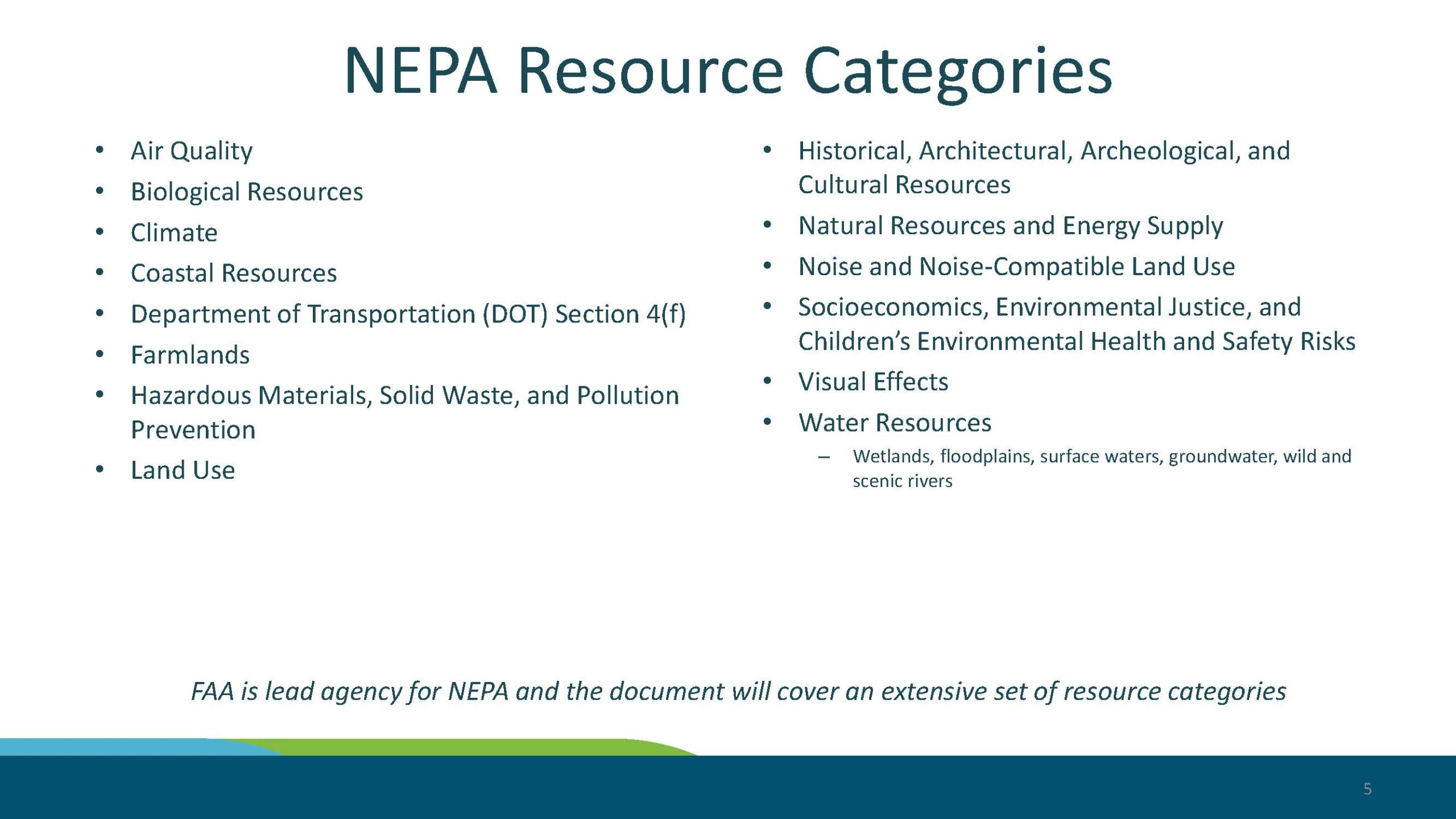
    Highline Forum SAMP NTP Environmental Review Overview — Slide 5 (May 22, 2024)

    This presentation slide lists the NEPA resource categories that will be covered in an environmental review document, including Air Quality, Biological Resources, Climate, Coastal Resources, DOT Section 4(f), Farmlands, Hazardous Materials, Land Use, Historical/Cultural Resources, Noise and Noise-Compatible Land Use, Socioeconomics/Environmental Justice, Visual Effects, and Water Resources. A footer note states that the FAA is the lead agency for NEPA and that the document will cover an extensive set of resource categories; this is slide 5 of the presentation.
    TagsEnvironmental Review, FAA, Highline Forum, NEPA, SAMPFolderHighline Forum 2024
  • 2024-05-14

    FAA still short about 3,000 air traffic controllers, new federal numbers show

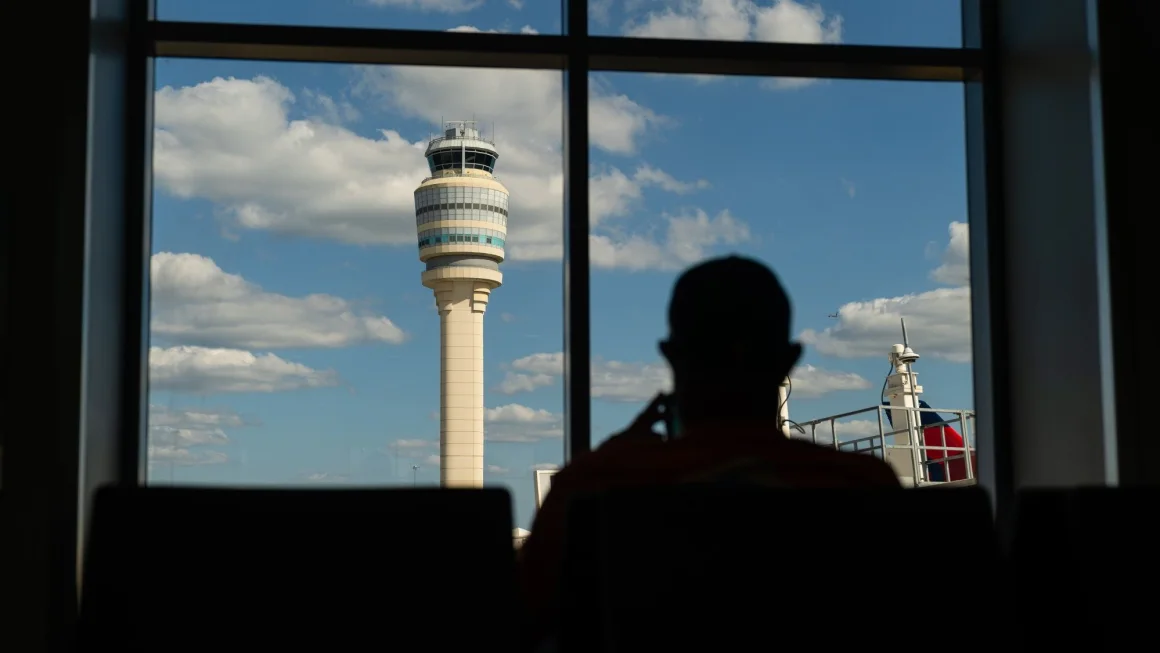
    The air traffic control tower at Hartsfield-Jackson Atlanta International Airport (ATL) in Atlanta, Georgia, US, on Monday, Oct. 2, 2023. Elijah Nouvelage/Bloomberg/Getty Images Gregory Wallace, CNN Updated 3:38 PM EDT, Tue May 14, 2024 Despite a surge in hiring last year, air traffic control stations nationwide are still about 3,000 controllers short, according to new
    CategoriesFrom The Web TagsAir Traffic Control, CNN, FAA
  • 2024-05-13

    Integrated Noise Model (INM)

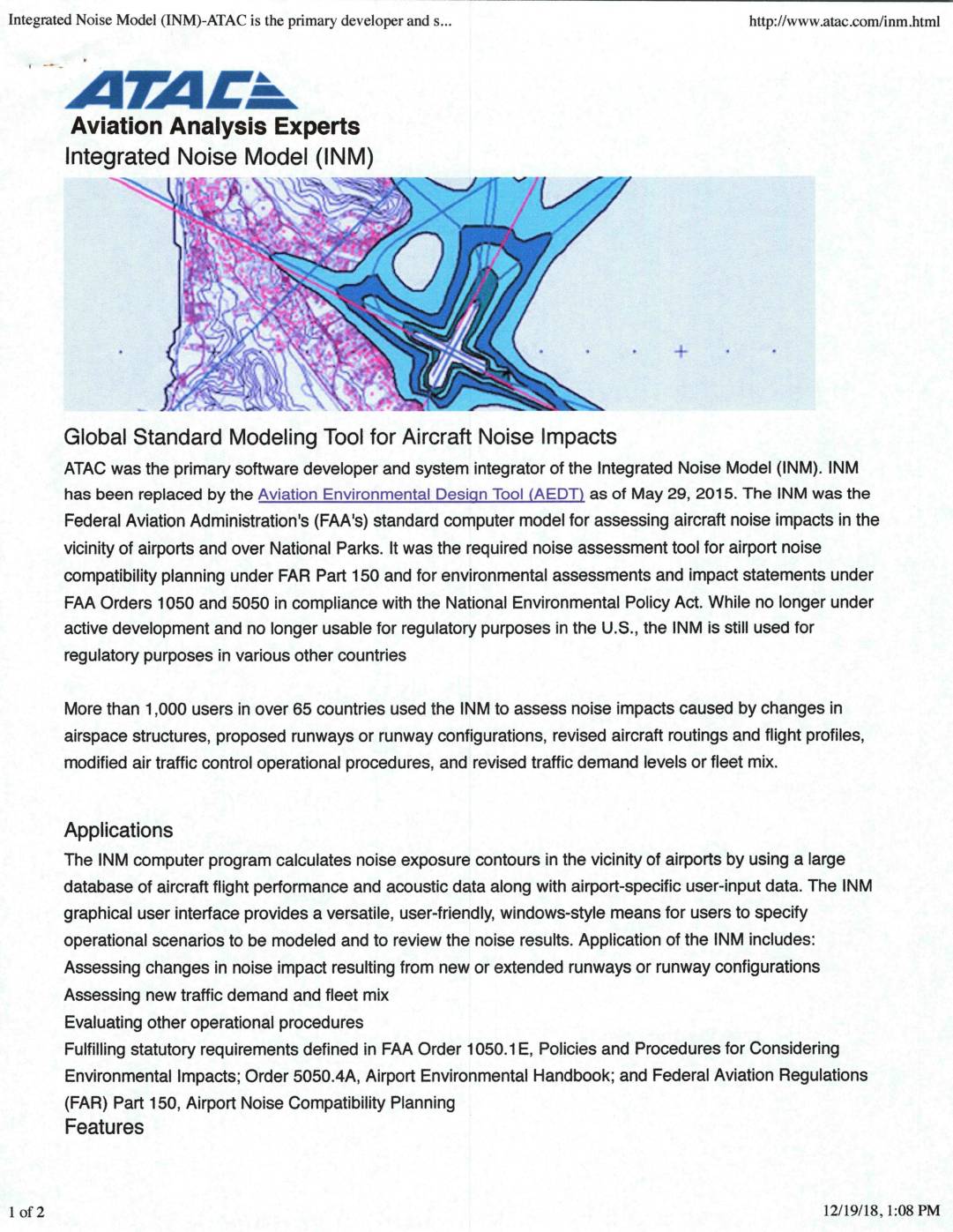
    The Integrated Noise Model (INM), developed by ATAC Corporation for the FAA, was the standard computer tool used to assess aircraft noise impacts near airports like Sea-Tac, calculating noise exposure contours and predicted sound levels at sensitive locations such as schools and hospitals. It was required for airport noise compatibility planning under FAR Part 150 and environmental reviews under the National Environmental Policy Act until it was replaced by the Aviation Environmental Design Tool (AEDT) in May 2015. Though no longer valid for regulatory use in the U.S., the INM was used by over 1,000 users in 65 countries to evaluate the noise effects of runway changes, flight routing, air traffic procedures, and shifts in aircraft fleet mix.
    TagsAEDT, FAA, INM, Part 150FolderSP #2
  • 2024-05-13

    Record of approval: Federal Aviation Regulation Part 150 noise compatibility program, Seattle-Tacoma International Airport, Seattle, Washington

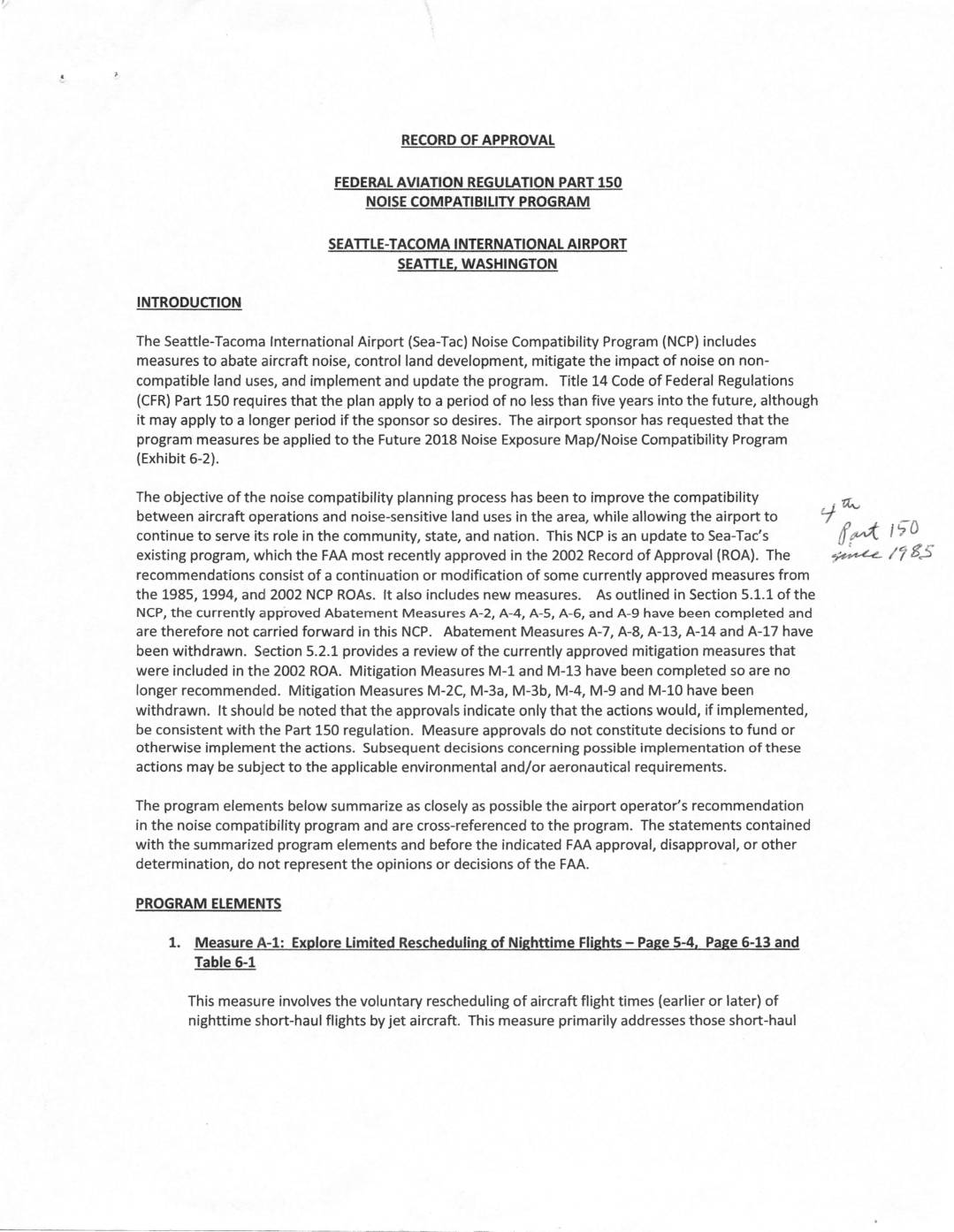
    This document is the FAA's Record of Approval for Seattle-Tacoma International Airport's Noise Compatibility Program, which outlines measures to reduce aircraft noise and manage land use around the airport. It covers both new and updated measures, including voluntary rescheduling of nighttime flights, preferential runway use during nighttime hours, and a Fly Quiet Program to encourage airlines to follow noise abatement procedures. The FAA approved most measures as continuations of previously approved programs dating back to 1985, while disapproving the engine maintenance run-up regulations.
    TagsFAA, Fly Quiet, Noise Abatement Procedures, Part 150, Sea-Tac AirportFolderSP #2
  • 2024-05-13

    Airport/community noise roundtables and FAA support

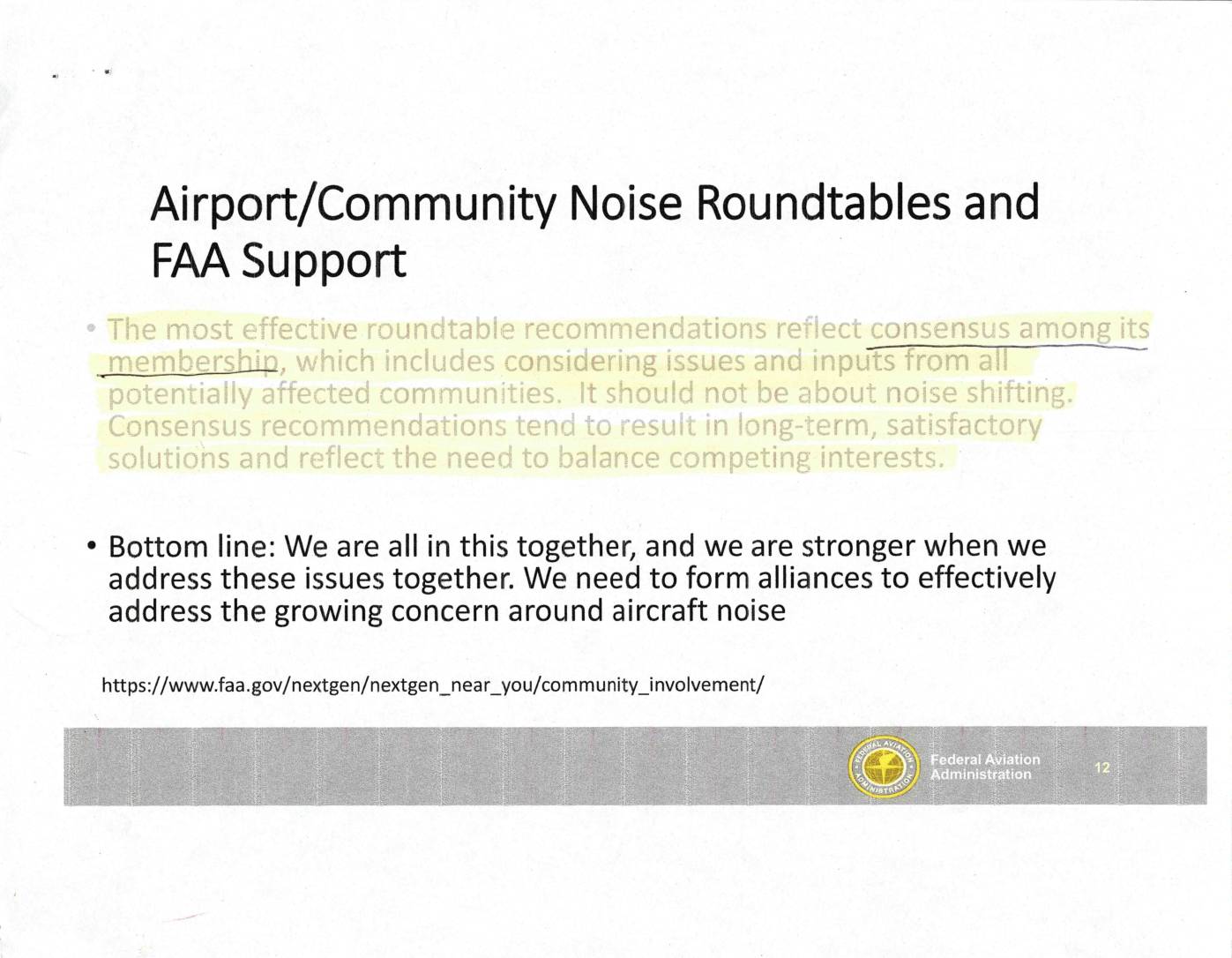
    This FAA presentation covers Airport/Community Noise Roundtables and FAA support for addressing aircraft noise concerns near airports like Sea-Tac. It explains that effective roundtables build consensus among all affected communities, while the FAA's Air Traffic Organization (ATO) works through a large backlog of noise-reduction recommendations, each requiring months of technical feasibility review and environmental assessment. The FAA encourages communities to focus on the most actionable recommendations and to form alliances, emphasizing that collaborative, balanced solutions produce the best long-term outcomes.
    Tagscommunity engagement, FAA, NextGen, RoundtableFolderSP #2

Posts pagination

Page 1 … Page 18 Page 19 Page 20 Page 21 Page 22 … Page 69
Sidebar On/Off

Upcoming Events

  • Stay Grounded Event: Night trains, not night planes!
    Add to CalendarMSunday Sep 13: 12:00am
    Ntnnp social media3

    For the past two years, more than 220 initiatives from 15 countries have declared September 13th as the International day for the ban of night flights at airports. In parallel, activists across Europe have been gathering for pyjama parties for night trains – coordinated in 2024 and 2025 by Back on Track and Stay Grounded.

    [...]
  • Burien Airport Committee Meeting September 15, 2026
    Add to CalendarMTuesday Sep 15: 6:00pm
    400 SW 152nd St, Burien, WA 98166
    Burien airport committee 15 sep 2026 agenda pdf pdf

    a) Part 150 Noise Study (Emily Inlow-Hood) — 15 minutes
    b) SAMP Update and Next Steps (Brian Davis and Sarah Moore) — 15 minutes
    c) Legislative Updates — 10 minutes
       • SCA (Sarah Moore)
       • Work with Sen. Orwall (Brian Davis)
    d) StART Reorganization (Jeff Harbaugh and Karen Veloria) — 10 minutes

    [...]

[See all...]


Help study childhood asthma. Get free HEPA filter!

read more...

Issues

Sea-Tac Airport is currently undergoing the largest and longest expansion in its history, collectively known as the Sustainable Airport Master Plan (SAMP). Some of it you can already hear, but you’re probably not aware of what it all means. Here’s what you need to know.
read more...

Read This!

As the source for federal transportation grants, the Puget Sound Regional Council was charged with developing a system to meet the growing need for commercial aviation. When the search for a second airport failed, they authorized the Port of Seattle to build the Third Runway, with a mandate to develop a noise abatement and mitigation program. In their effort to stop the Third Runway, the ACC argued over every detail of the Port's efforts--including property buyouts and sound insulation. The dispute was meant to be settled by a three member Expert Arbitration Panel. This is their final report. It finds 2-1, that the Port's program was insufficient in several respects. Despite that, funding for the Third Runway was approved by the PSRC, and the 'Port Package' program, proceeded largely unchanged. Expert Arbitration Panel's final decision finding that the Port of Seattle had not shown sufficient reduction in real on-the-ground noise impacts to satisfy noise reduction conditions required for approval of a third runway at Sea-Tac International Airport. The majority decision concluded the Port's noise abatement programs were insufficient despite being impressive in scope.
continue...

The Podcast!

Subscribe to the only podcast devoted to policies, politics, history, impacts for people living under the flight path everywhere. It’s definitely not just about noise!
  • Sea-Tac Noise.Info
  • Connect with STNI

    • Subscribe
    • Port Package Problem?
    • Donate
    • Podcast
    • Socials
      • Facebook
      • X (Twitter)
      • Bluesky
      • Instagram

    "PCHB Doc 01-160: Order Granting ACC’s Motion to Strike Certain Pre-Filed Testimony and Limit Oral Testimony" — , 2002

  • Learn

    • Frequently Asked Questions
    • Explainers
    • Youtube
    • Research Requests
    • Make a complaint
  • Goals

    Fulfill the promises of 1976:
    • Compensation
    • Reduced noise
    • Improved air quality
    • Environmental remediation
Login/Register
©2026•Data Privacy

Message

We use cookies to provide basic functionality. We also provide access to search engines in order to provide site analytics. We do not sell or share your data.
V V