TagFAA(687)
-
 2024-11-20
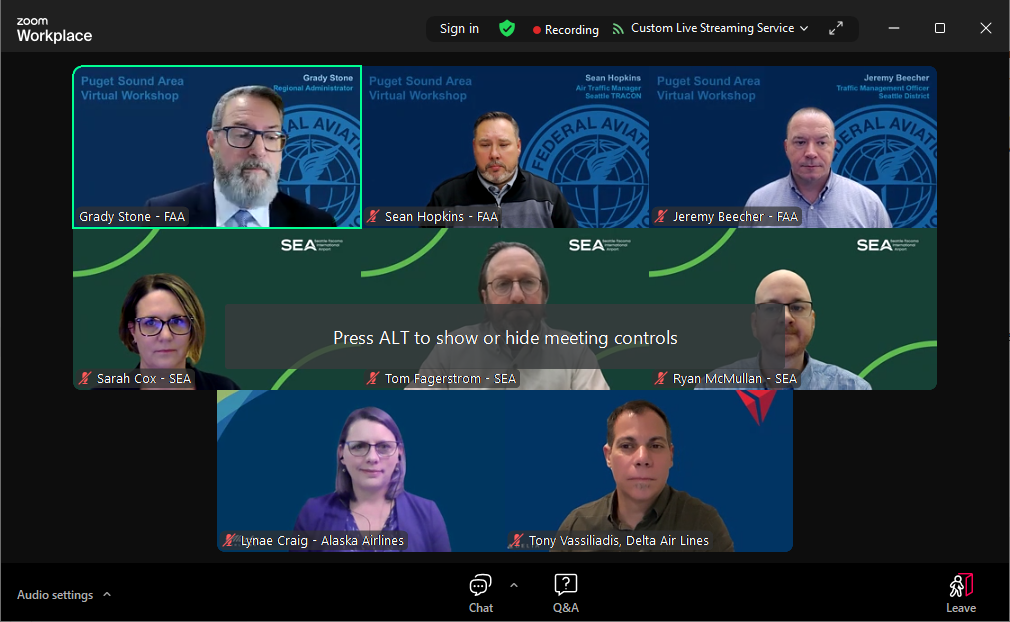
FAA Puget Sound Airspace Webinar
Almost everything you ever wanted to know about flight paths. Can you handle the truth? Overview A two hour seminar hosted by the FAA which answers every common question area residents always. have. We’ve participated in several of these in other cities and although each is customized to describe the local airport and flight paths, -
 2024-11-12
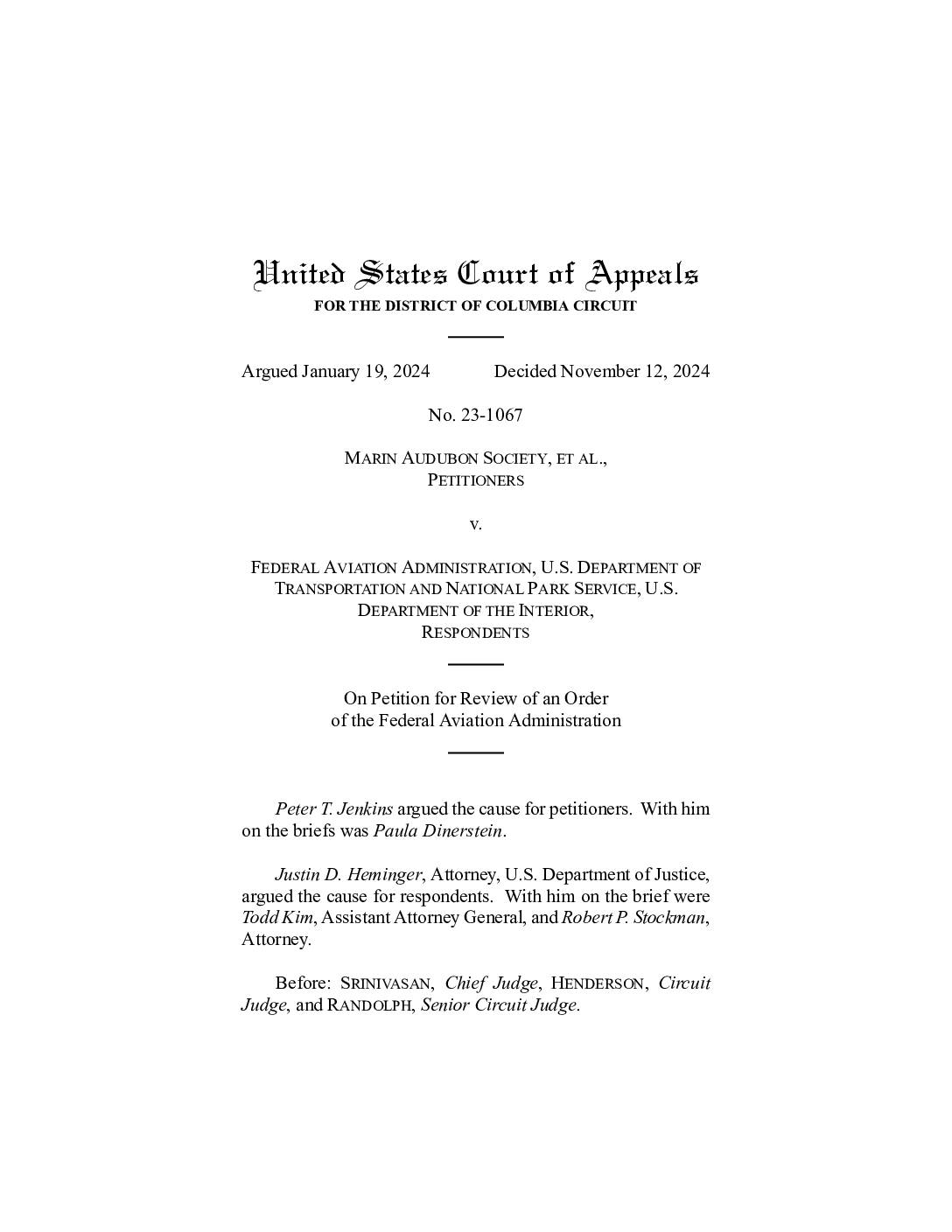
Marin Audubon Society v. Federal Aviation Administration: D.C. Circuit Court of Appeals Opinion No. 23-1067
A federal appeals court reviewed a challenge by conservation groups to an Air Tour Management Plan regulating tourist flights over four national parks near San Francisco, including Golden Gate National Recreation Area and Point Reyes National Seashore. The Federal Aviation Administration and National Park Service had jointly issued the plan under the National Parks Air Tour Management Act of 2000, determining that no full environmental review was required because the plan would cause minimal additional environmental impact. The court considered whether the agencies properly bypassed environmental analysis under the National Environmental Policy Act. -
 2024-10-02
Certain college grads can now be air traffic controllers immediately
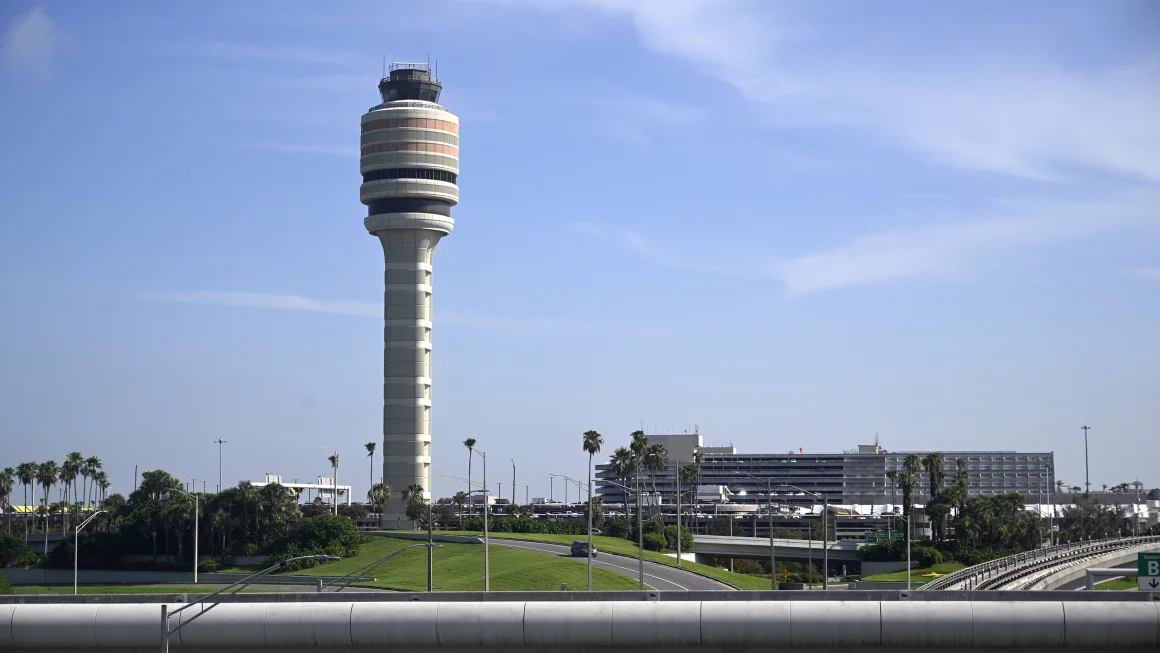
The FAA air traffic control tower at Orlando International Airport. Phelan M. Ebenhack/AP The Federal Aviation Administration says that graduates of two college air traffic control programs can now bypass the agency’s backlogged training academy. The new announcement is the FAA’s latest move to tackle air traffic controller shortages that have plagued the air travel -
 2024-10-01
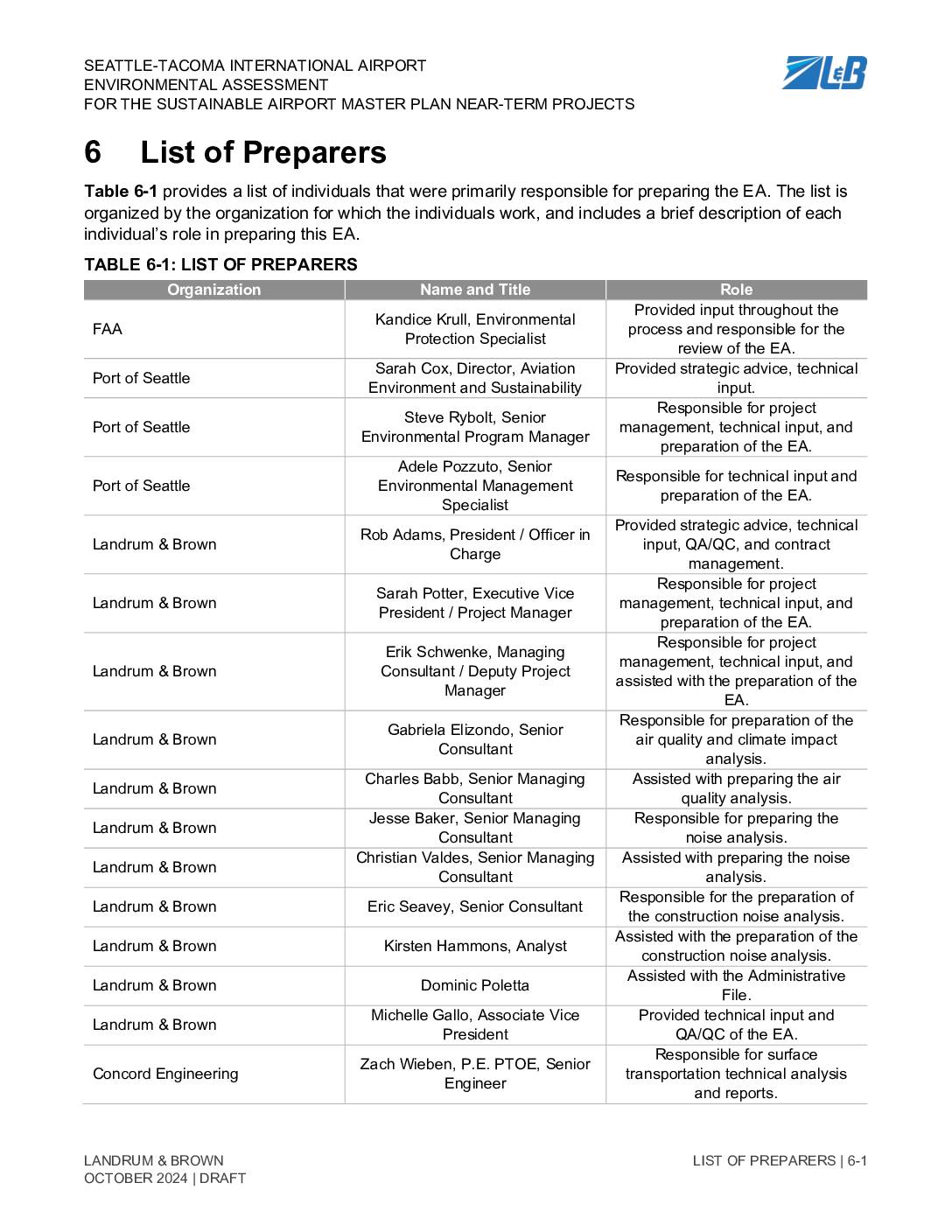
Seattle-Tacoma International Airport Environmental Assessment for the Sustainable Airport Master Plan Near-Term Projects: Chapter 6 — List of Preparers
This section of the Seattle-Tacoma International Airport Environmental Assessment lists the individuals and organizations responsible for preparing the document, including staff from the FAA, Port of Seattle, and several consulting firms. The team covered a wide range of technical areas, with specialists handling noise analysis, air quality, surface transportation, wetlands, cultural resources, and public engagement. The assessment was produced in October 2024 as a draft under the airport's Sustainable Airport Master Plan for near-term projects. -
 2024-10-01
Seattle-Tacoma International Airport Environmental Assessment for the Sustainable Airport Master Plan Near-Term Projects: Chapter 1, Introduction and Purpose & Need
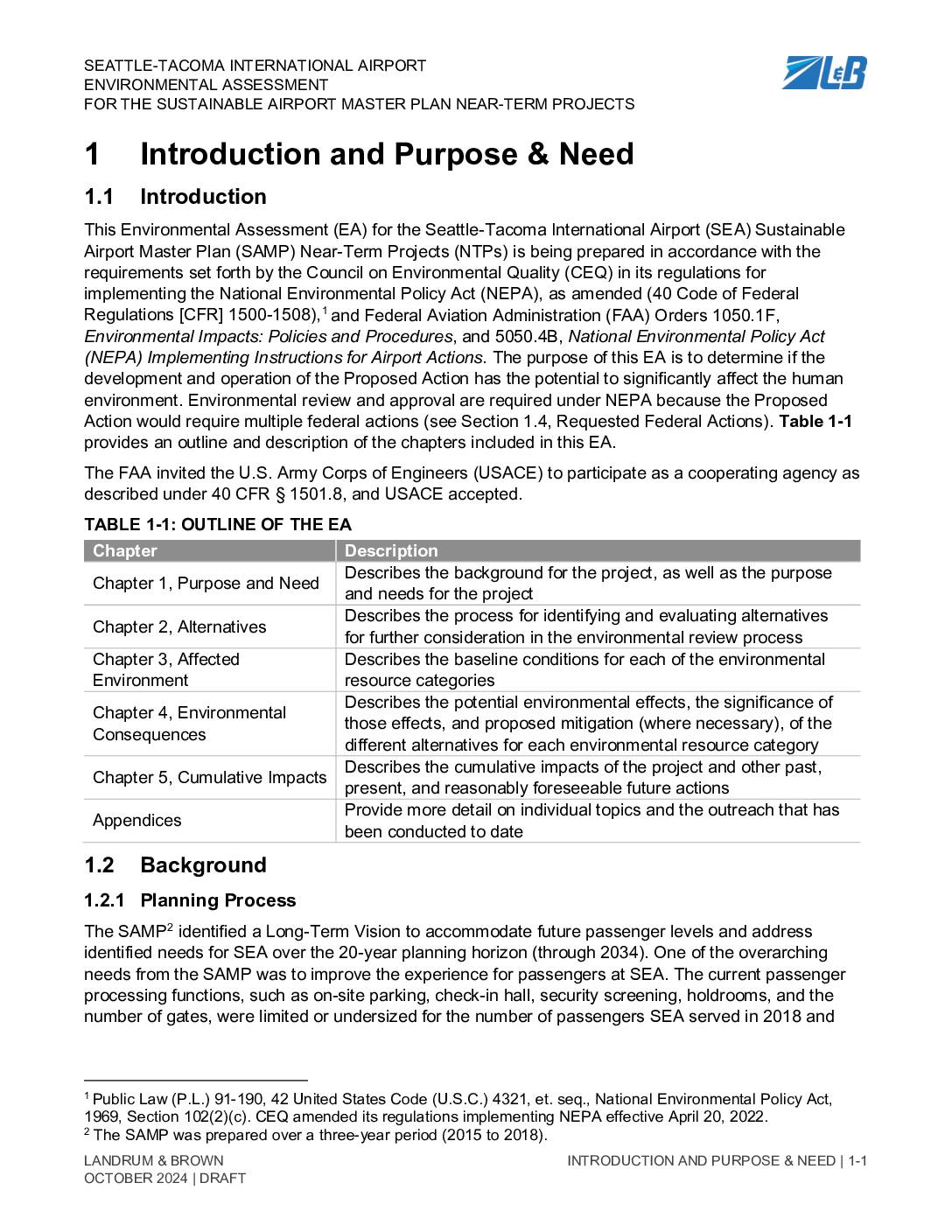
The Port of Seattle is preparing an Environmental Assessment for 31 near-term improvement projects at Seattle-Tacoma International Airport (SEA), covering upgrades to taxiways, runways, terminals, and support facilities. The projects, expected to be operational by 2032, aim to reduce crowding, long lines, and flight delays that have grown as passenger demand has increased. The Federal Aviation Administration (FAA) will review the findings to determine whether the projects will significantly impact the surrounding environment, potentially affecting noise levels for nearby communities. -
 2024-10-01
Draft Environmental Assessment for the Sustainable Airport Master Plan Near-Term Projects: Cover, Table of Contents, and Acronyms
This October 2024 Draft Environmental Assessment, prepared by Landrum & Brown for the Port of Seattle and the FAA, evaluates the environmental impacts of near-term construction projects at Seattle-Tacoma International Airport as part of its Sustainable Airport Master Plan. The assessment covers a wide range of environmental topics—including noise and noise-compatible land use, air quality, water resources, and environmental justice—for proposed improvements to passenger terminals, cargo facilities, airfield design, taxiways, and fuel storage. It is intended to support FAA decision-making under the National Environmental Policy Act (NEPA) and addresses the airport's ability to accommodate a projected 56 million annual passengers. -
 2024-10-01
Airport Improvement Magazine, October 2024: Runway & Ramp Special Edition
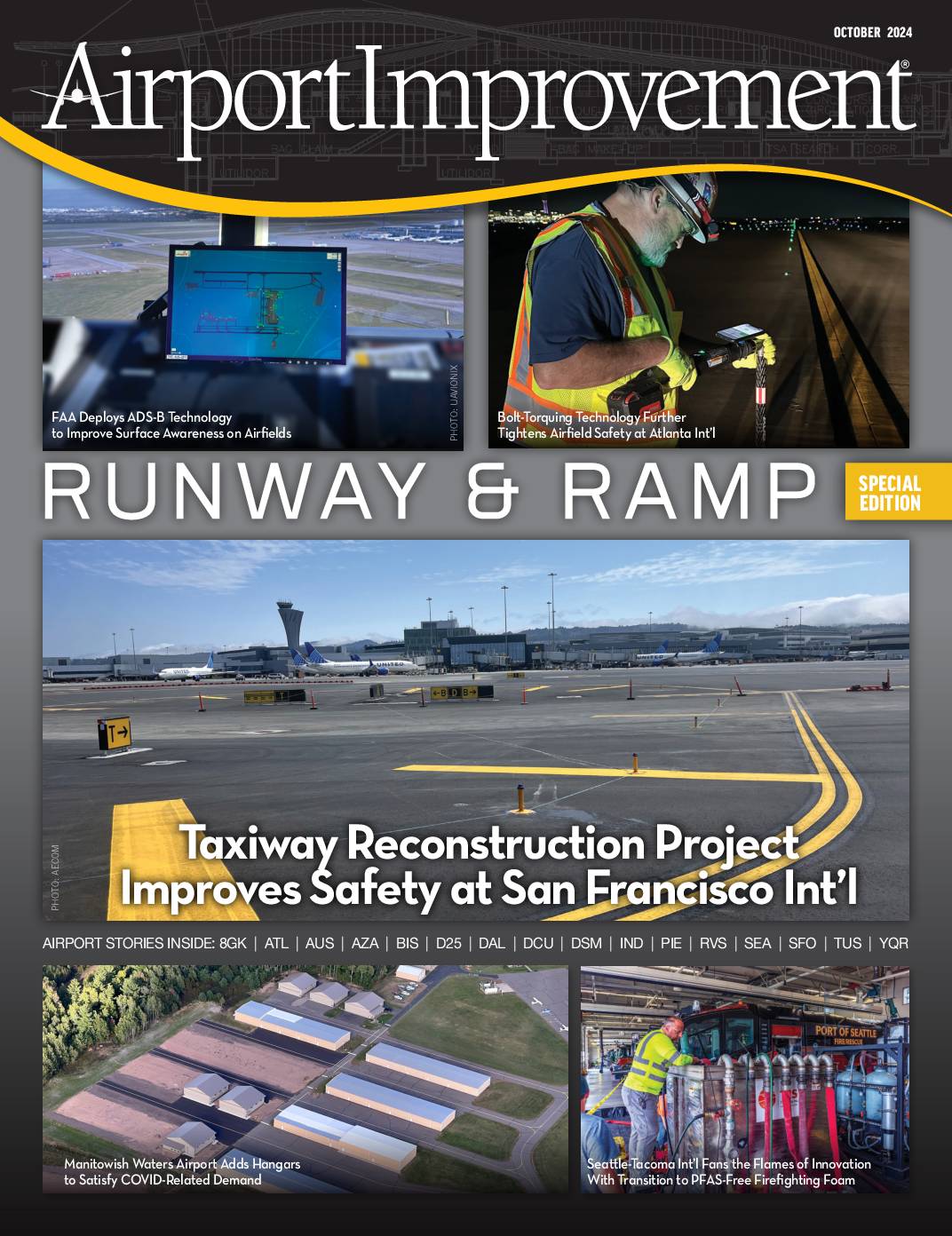
The October 2024 special edition of Airport Improvement magazine covers runway and ramp safety projects at airports across the United States, including Seattle-Tacoma International Airport's transition to PFAS-free firefighting foam. The Seattle-Tacoma article focuses on cleaning PFAS contamination from firefighting vehicles, reflecting broader efforts to eliminate hazardous fluorine-based chemicals from airport operations. Additional stories cover FAA technology deployments, taxiway reconstruction, and airfield safety improvements at airports nationwide. -
 2024-09-24
Appendix D: Biological Resources — Biological Evaluation and Section 7 Consultation Request, SEA SAMP Near-Term Projects
The FAA submitted a Biological Evaluation to support an informal consultation under the Endangered Species Act for near-term construction projects at Seattle-Tacoma International Airport, all expected to be completed by 2032. The projects aim to expand passenger and cargo capacity, upgrade taxiway layouts, and increase fuel storage including sustainable aviation fuel. The evaluation assessed potential impacts on 14 species, determining that several—including Chinook salmon, bull trout, and killer whales—may be affected but not likely adversely, while the remaining species, such as the marbled murrelet and North American wolverine, would face no effect. -
 2024-09-05
HAWKZ Eight Arrival (RNAV) — Transition Routes, Seattle-Tacoma International Airport
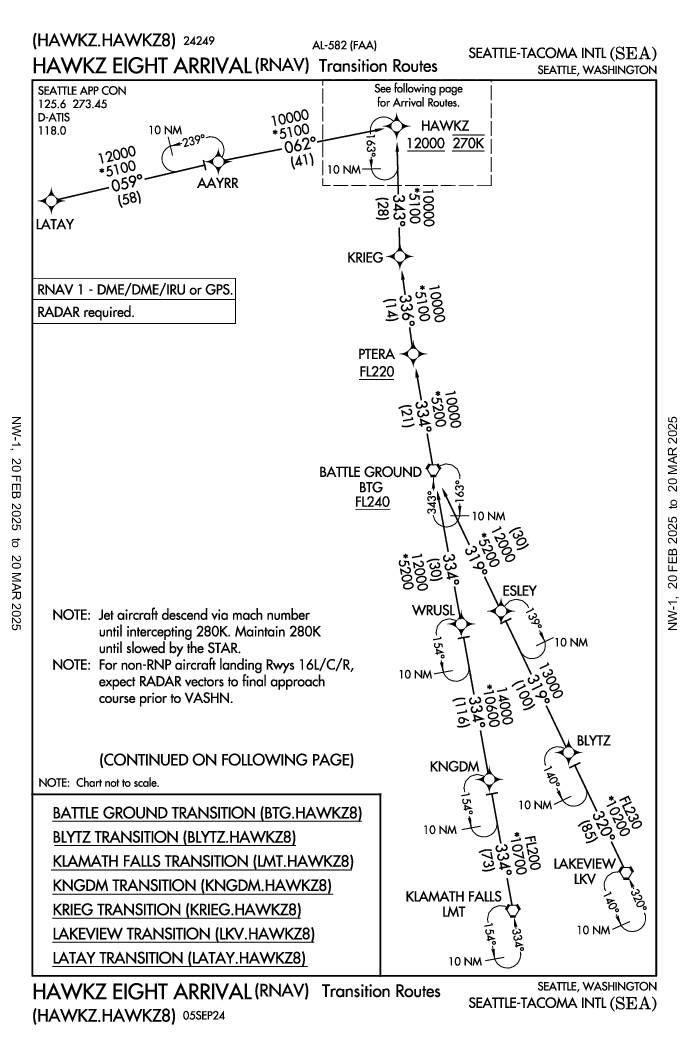
The HAWKZ Eight Arrival (HAWKZ8) is a standard terminal arrival route (STAR) used to guide aircraft into Seattle-Tacoma International Airport (SEA) from multiple directions, including transitions from waypoints such as Battle Ground, Klamath Falls, and Lakeview. The procedure requires RNAV 1 capability (DME/DME/IRU or GPS) and radar, and directs jet aircraft to descend via Mach number until intercepting 280 knots. Aircraft follow a series of waypoints and altitude restrictions, ultimately converging at the HAWKZ fix at 12,000 feet and 270 knots before continuing to the airport. -
 2024-09-01
GAO 24-107001: FAA Actions Are Urgently Needed to Modernize Aging Systems
A September 2024 U.S. Government Accountability Office report found that the FAA's air traffic control systems are critically outdated, with 37% rated unsustainable and 39% potentially unsustainable out of 138 total systems reviewed. The agency has been slow to modernize the most at-risk systems, with some upgrades not planned for completion until 2030–2035, and four critical systems lacking any modernization plans at all. The GAO made seven recommendations to improve FAA oversight and accelerate upgrades to protect the safety and efficiency of the national airspace.