TagEnvironmental Impact Statement(328)
-
2014-08-02
Community roundtables will tackle airplane noise issues – QNS
Posted on August 2, 2014 By Bob Harris After years of pressuring for the formation of community roundtables to discuss airplane noise over residential neighborhoods, Gov. Andrew Cuomo has authorized the formation of such groups. Meetings were recently held in a large hanger at the Vaughn College of Aeronautics adjacent to LaGuardia Airport. The Queens -
 2013-10-23
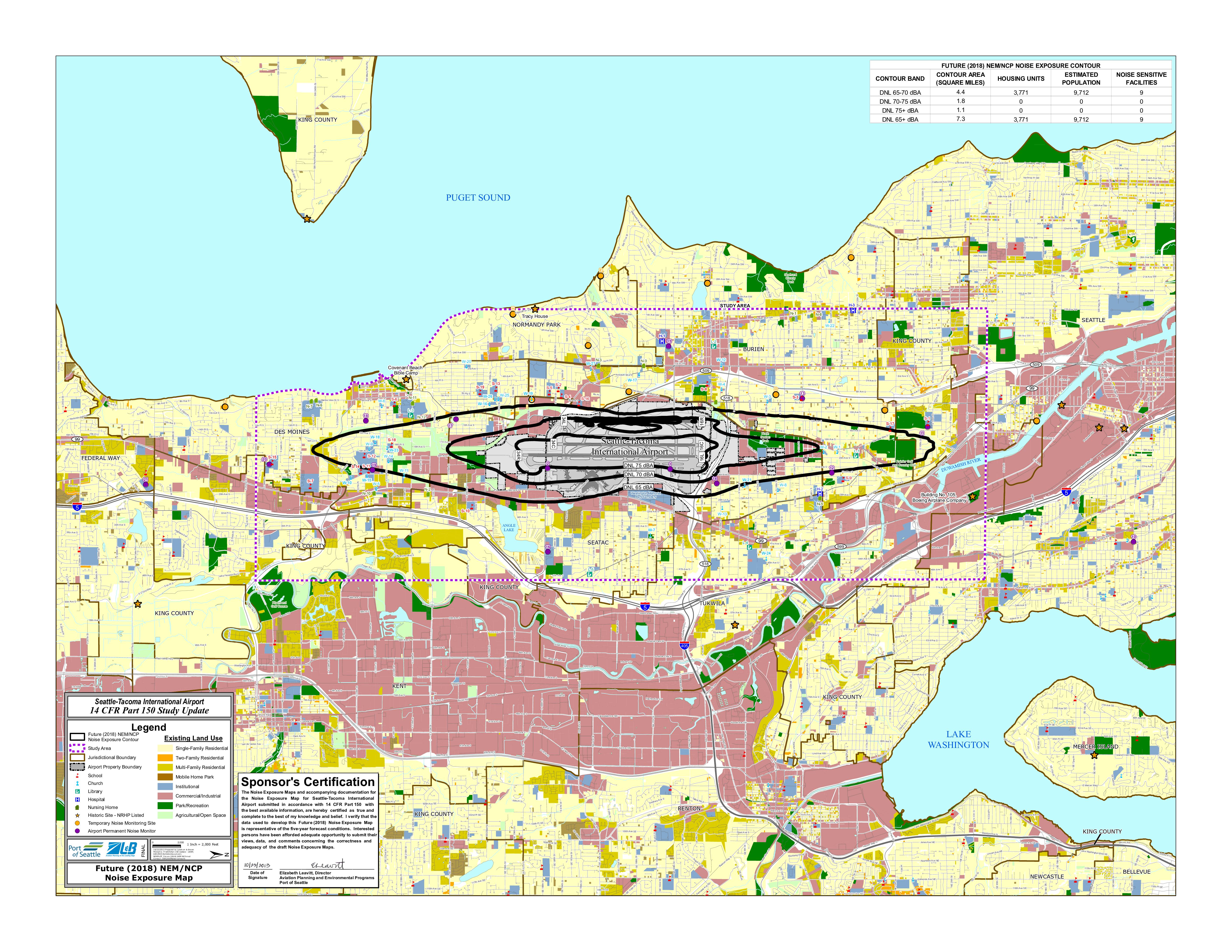
Future (2018) NEM/NCP Noise Exposure Map: Seattle-Tacoma International Airport 14 CFR Part 150 Study Update
This map, prepared by Landrum & Brown for the Port of Seattle's 14 CFR Part 150 Study Update, shows projected aircraft noise exposure around Seattle-Tacoma International Airport for the year 2018. It illustrates three noise contour zones (DNL 65, 70, and 75 dBA), with the total area above DNL 65 dBA covering approximately 7.3 square miles and affecting an estimated 3,771 housing units and 9,712 residents. The map also identifies noise-sensitive land uses such as schools, churches, hospitals, and libraries within the affected area, and was certified by the Port of Seattle's Director of Aviation Planning and Environmental Programs. -
 2009-11-11
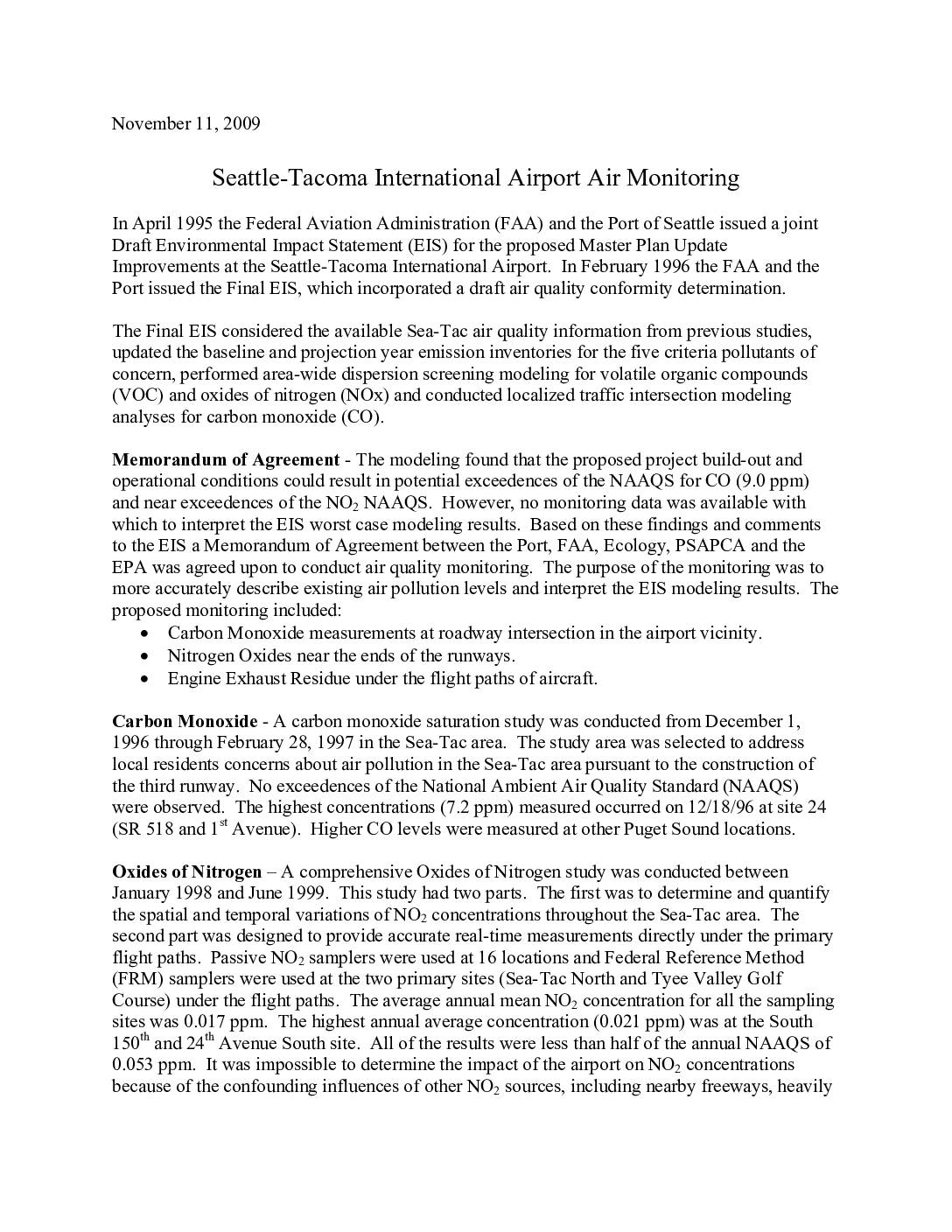
Seattle-Tacoma International Airport Air Monitoring
This 2009 report summarizes air quality monitoring conducted near Seattle-Tacoma International Airport between 1996 and 2002, covering carbon monoxide, nitrogen dioxide, particulate matter, and air toxics. Monitoring found that levels of all measured pollutants remained below federal National Ambient Air Quality Standards (NAAQS), though chromium concentrations at the Sea-Tac North site exceeded EPA's lifetime risk-based threshold. The studies were prompted by a Memorandum of Agreement among the Port of Seattle, FAA, and environmental agencies following an Environmental Impact Statement for proposed airport expansion. -
 2009-10-05
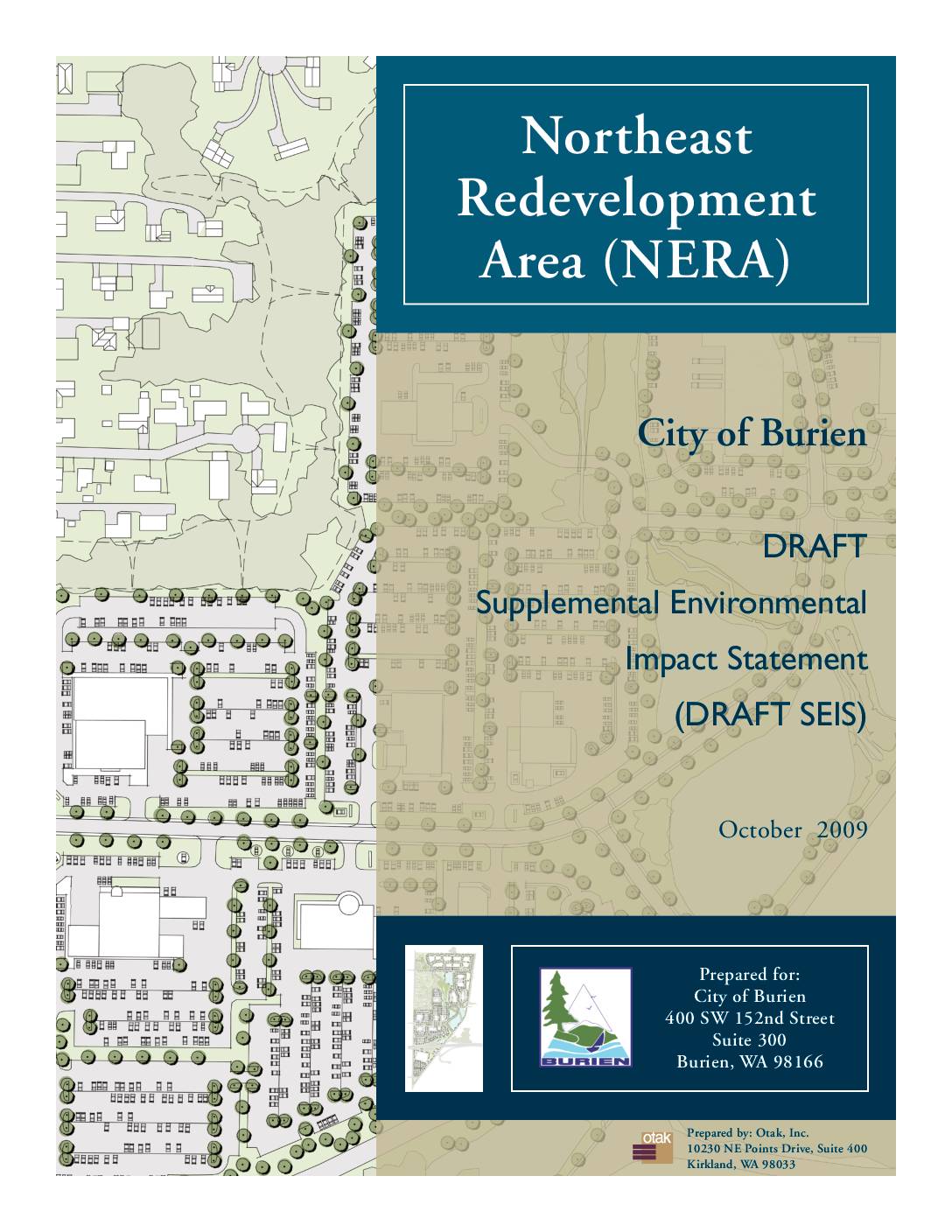
Northeast Redevelopment Area (NERA): City of Burien Draft Supplemental Environmental Impact Statement
The City of Burien's 2009 Draft Supplemental Environmental Impact Statement (SEIS) examines redevelopment options for the Northeast Redevelopment Area (NERA), located near Sea-Tac Airport. Three alternatives are evaluated, including rezoning the area to allow airport-compatible uses such as light industrial, office, and limited retail (Alternative 1), a more restricted version without auto or general retail sales (Alternative 2), or maintaining the existing SPA-4 zoning with no changes (Alternative 3). The document is relevant to Sea-Tac Airport noise policy as all proposed land use changes are explicitly designed to ensure compatibility with airport operations in the surrounding community. -
 2007-07-16
VISION 2040 supplemental draft environmental impact statement
The VISION 2040 Supplemental Draft Environmental Impact Statement, published by the Puget Sound Regional Council in July 2007, identifies a Preferred Growth Alternative for managing forecasted population and development growth in the Puget Sound region through the year 2040. It supplements a May 2006 Draft EIS that examined four conceptual growth alternatives, adding analysis of environmental impacts associated with the preferred option. The document was prepared in accordance with Washington State's Environmental Policy Act and invites public comment on regional growth planning policies. -
 2007-04-02
Massachusetts v. Environmental Protection Agency Supreme Court Decision
In this 2007 U.S. Supreme Court case, Massachusetts and other states sued the Environmental Protection Agency (EPA) for refusing to regulate greenhouse gas emissions from motor vehicles under the Clean Air Act. The Court ruled that the EPA had the authority and responsibility to regulate such emissions, and that states like Massachusetts had legal standing to challenge the EPA's inaction due to real harms caused by rising sea levels and climate change. This case established that carbon dioxide and other greenhouse gases can be regulated as air pollutants under federal law. -
 2004-03-16
Report and decision for shoreline conditional use permit and shoreline substantial development permit
This 2004 King County decision concerns a permit application by Glacier Northwest (Northwest Aggregates) to mine and export sand and gravel from Maury Island and replace an aging barge-loading dock on Puget Sound. The project proposed replacing 228 old creosote timber piles with 62–82 steel piles, extending the dock further into the water to protect nearby eelgrass beds, and enclosing the conveyor in a steel pipe to reduce spillage and noise. Note: this document relates to a Maury Island mining and shoreline development project and does not contain information about Sea-Tac Airport noise policy. -
 2004-02-23
NEPA Environmental Assessment/SEPA Environmental Impact Statement for Proposed Master Plan Improvements at King County International Airport (Boeing Field)
Preliminary Draft NEPA Environmental Assessment (EA) and SEPA Environmental Impact Statement (EIS) prepared by King County for proposed Master Plan improvements at King County International Airport (Boeing Field/BFI), dated February 23, 2004. Covers FAA review process, public comment period with hearing scheduled April 5, 2004, and potential outcomes including Finding of No Significant Impact (FONSI) -
 2004-02-23
NEPA Environmental Assessment/SEPA Environmental Impact Statement for Proposed Master Plan Improvements at King County International Airport (Boeing Field)
Preliminary Draft NEPA Environmental Assessment (EA) and SEPA Environmental Impact Statement (EIS) prepared by King County for proposed Master Plan improvements at King County International Airport (Boeing Field/BFI), dated February 23, 2004. Covers FAA review process, public comment period with hearing scheduled April 5, 2004, and potential outcomes including Finding of No Significant Impact (FONSI) -
 2003-06-24
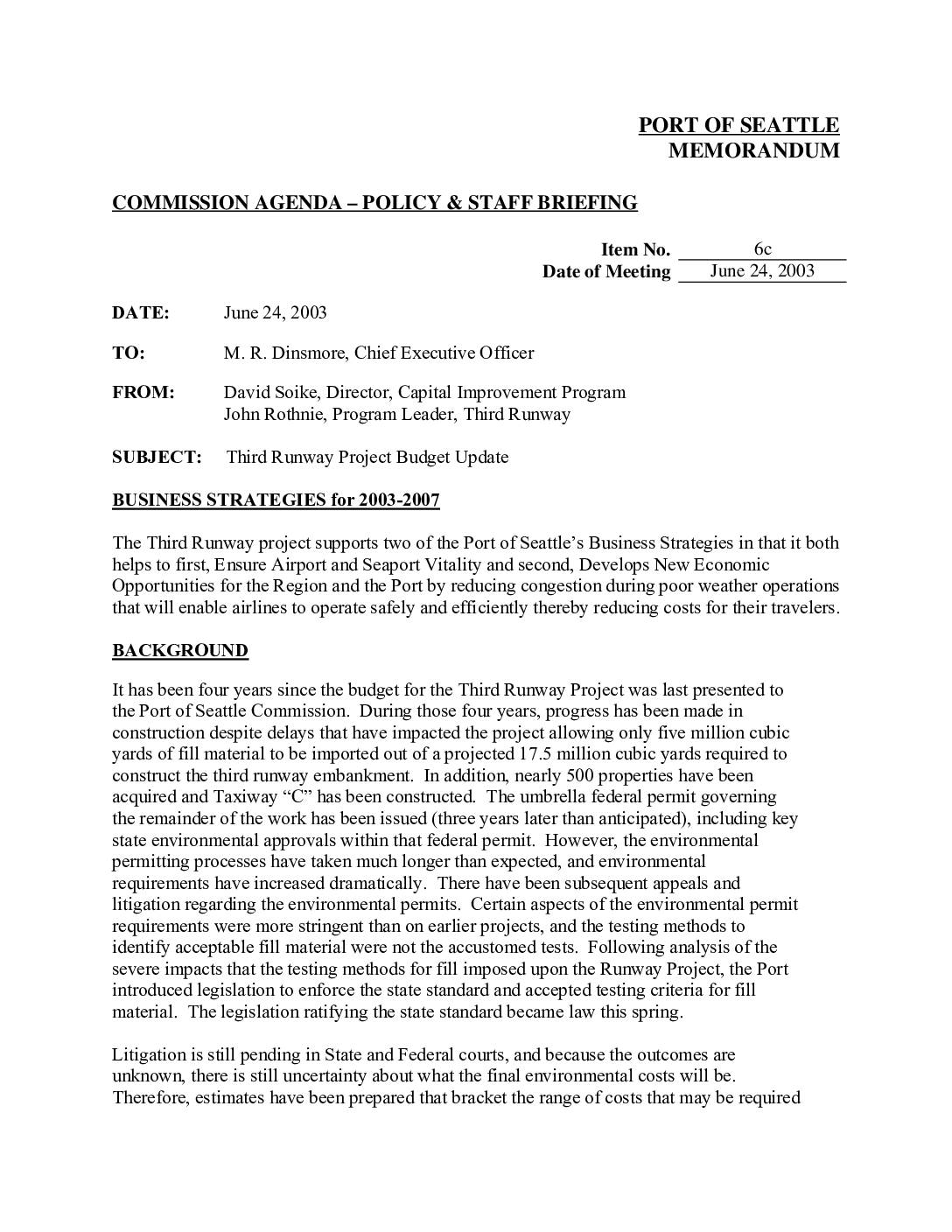
Third Runway project budget update
A 2003 Port of Seattle memo updates the Commission on the ballooning costs of the Sea-Tac Third Runway project, which had grown from an approved budget of $773 million to an estimated $1.1–1.15 billion due to environmental permitting delays, litigation, and stricter regulatory requirements. The project, intended to reduce airport congestion by allowing simultaneous landings on two runways during poor weather, was projected for completion in 2008 if construction contracts were advertised promptly. Key cost drivers included $151 million in additional environmental permit requirements, $55 million in delay costs, and $55 million in project scope additions.