TagAdam Smith(57)
-
 2021-02-22
Letter to FAA Administrator Dickson on FY21 Sound Insulation Program Implementation
Letter dated February 22, 2021 from Representatives Adam Smith (WA-09) and Katherine Clark (MA-05) to FAA Administrator Stephen Dickson urging swift implementation of the FY21 House Appropriations Report provision on the FAA sound insulation program. The letter addresses Airport Improvement Program (AIP) regulations barring airports from applying for federal funds for the same project more -
 2021-01-01
Adam Smith 2021 Washington’s 9th Congressional District Logo
Logo for Washington's 9th Congressional District, featuring a stylized outline of Washington State in blue with a mountain silhouette and a green treeline. The green banner reads 'WASHINGTON'S 9TH DISTRICT.' -
A Letter To Congressman Adam Smith – AQM
The Sea-Tac Annual Air Quality Monitoring Program – a proposal Background Since 1971 there have roughly thirteen ‘studies’ of various air toxins around Sea-Tac Airport. We put the word ‘studies’ in air quotes because almost all of them have been limited either to a single toxin or to a subset of the complete Sea-Tac air -
 2020-10-20
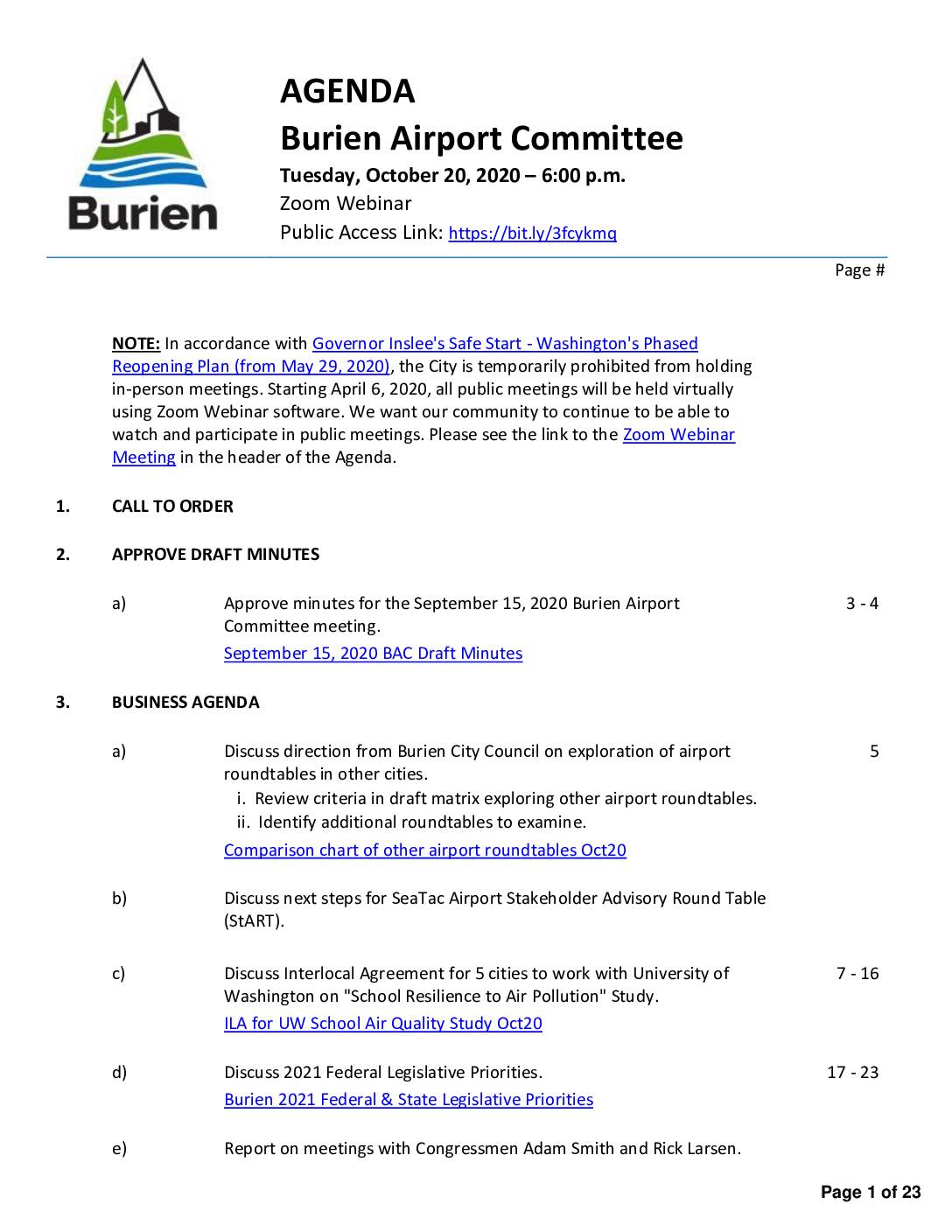
Burien Airport Committee agenda, October 20, 2020
The Burien Airport Committee held a virtual meeting on October 20, 2020, to discuss issues related to Sea-Tac Airport's impact on surrounding communities. Key agenda items included comparing airport roundtables in other cities, reviewing next steps for the SeaTac Airport Stakeholder Advisory Round Table (StART), and examining a proposed University of Washington study on school air quality near the airport. The committee also discussed 2021 federal legislative priorities and received reports on meetings with congressional representatives Adam Smith and Rick Larsen. -
 2020-09-23
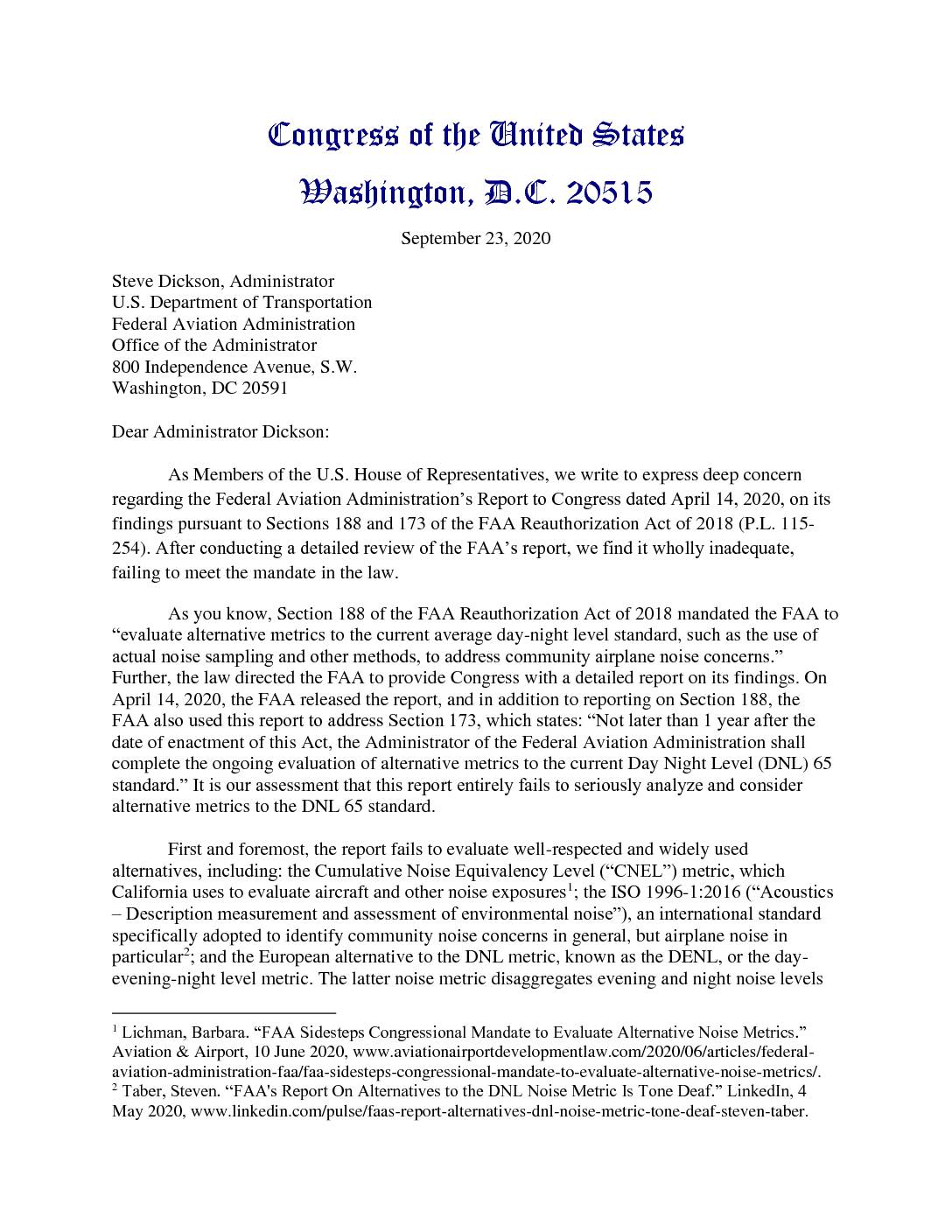
Congressional letter to FAA Administrator Steve Dickson on alternative noise metrics report
Currently, FAA law has extremely complicated rules for establishing a noise boundary around airports. (A noise boundary is a geographic area inside which there is a certain acceptable noise level.) This is referred to as the DNL65. and it has several major flaws. The FAA Reauthorization Act Of 2018 attempted to address these flaws in several ways. This letter, from a caucus of Congressmen engaged on airport community issues complains to the Administrator that the spirit of the law is not being adhered to and demands that he make attempts to put his agency into compliance. The language is fairly technical, however there are a couple of basic points they raise: First, that the noise boundary be determined by actual noise measurements (currently the noise boundaries are 'modeled' and those calculations often do not reflect in any way the lived experience for residents.) Second, that the 'acceptable' noise level of sixty five decibels (hence DNL65) has been determined to be far too high to conform with current understandings of healthy living. -
 2020-09-02
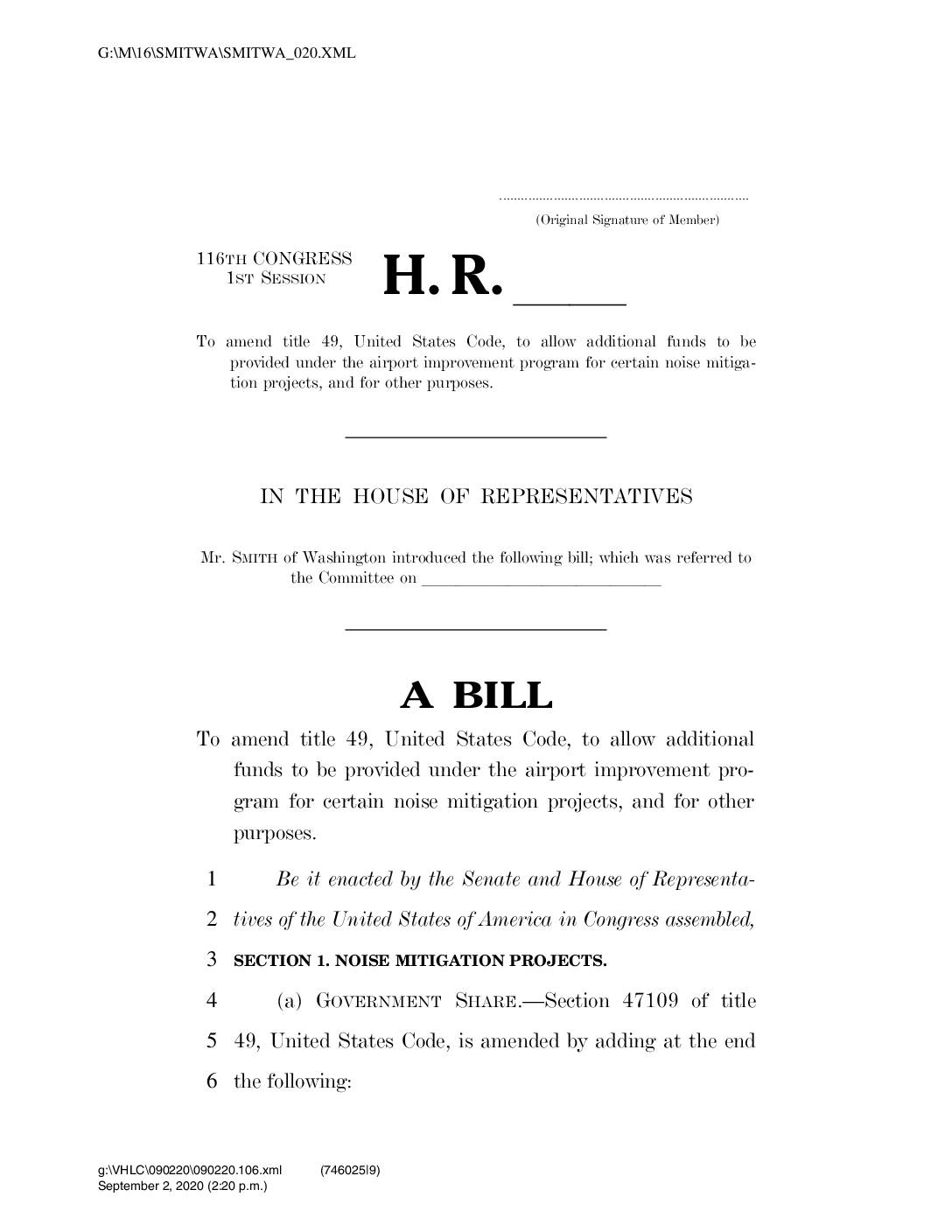
Airport Improvement Program Noise Mitigation Projects Bill
A bill introduced in the 116th Congress by Representative Smith of Washington would allow airports to receive additional federal funding under the Airport Improvement Program for noise mitigation projects on buildings that have already received such assistance. The bill would permit the Secretary of Transportation to waive the usual restriction on repeat federal funding if increased aircraft noise, deteriorating soundproofing, or damage caused by prior mitigation work justifies further action. Eligible buildings must fall within the DNL 65 noise standard and be certified by a state-licensed building inspector, making this legislation particularly relevant to communities near high-traffic airports like Seattle-Tacoma International. -
AICA Gone Local
For the past several years there has been a lot of energy directed at creating Federal legislation to correct the systemic unfairness we all experience living near a large airport like Sea-Tac. On the surface, this makes perfect sense: the FAA has direct authority over all airports. And many, many attempts at obtaining relief by -
Congressman Smith Reintroduces the Aviation Impacted Communities Act
WASHINGTON, D.C. – Congressman Adam Smith (D-WA) reintroduced the Aviation Impacted Communities Act today, which will help communities better address noise and other environmental impacts stemming from nearby airports. Communities across the nation continue to experience an increased and disproportionate share of noise and other environmental impacts stemming from commercial aviation. The Aviation Impacted Communities -
 2020-02-28
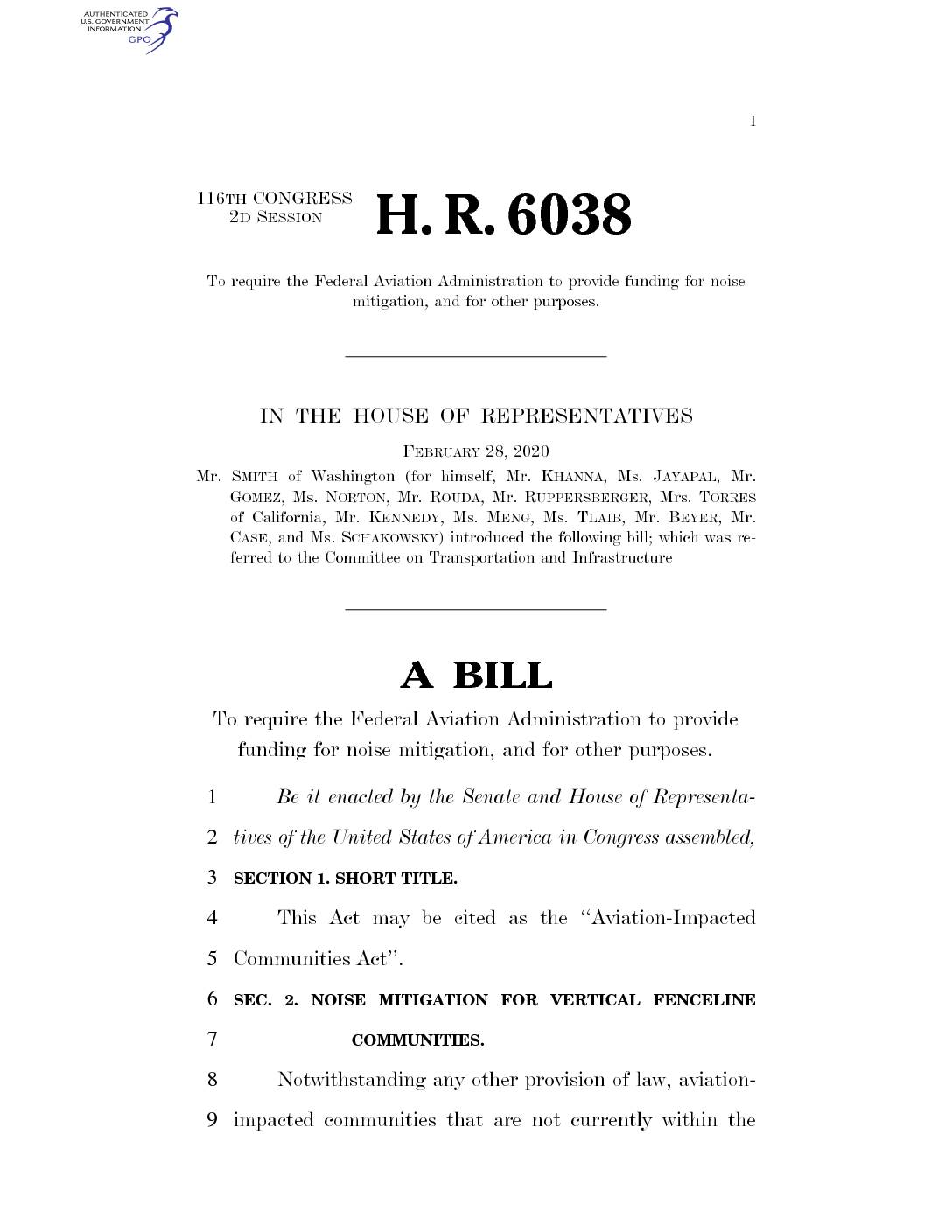
H.R. 6038 – Aviation-Impacted Communities Act
An earlier version of this bill was introduced into the 115th Congress as HR6168