TagAdam Smith(57)
-
 2025-12-12
The Sound Insulation Treatment Repair and Replacement Program Act
The Sound Insulation Treatment Repair and Replacement Program Act, introduced by Rep. Adam Smith (WA-09), would allow the FAA to waive a rule that currently prevents federal Airport Improvement Program (AIP) funds from being used more than once on the same home. The bill addresses problems caused by poor-quality materials and faulty installations from early noise mitigation programs in the 1980s and 1990s, which left some homeowners dealing with mold, structural damage, and non-functioning insulation at their own expense. Airports would not be required to participate, but those that choose to could repair or replace defective sound insulation in homes still within the 65 DNL noise contour, provided an FAA-compliant noise auditor verifies the issues stem from improper installation or faulty materials rather than homeowner neglect. -
 2025-12-07
National Defense Authorization Act for Fiscal Year 2026
This document is the National Defense Authorization Act for Fiscal Year 2026, a proposed federal law organizing defense spending and policy across eight divisions covering the Department of Defense, Military Construction, Department of Energy, and other areas. It outlines procurement authorizations for Army, Navy, and Air Force programs, including rules on aircraft, submarines, and unmanned vessels. This legislation does not address airport noise policy and is unrelated to Sea-Tac Airport or regional aviation noise regulations. -
 2025-08-28
Smith – Pilot Program for Sound Insulation Repair and Replacement
Congressional amendment to Rules Committee Print 119-8 offered by Rep. Adam Smith of Washington, adding a new section to title XVII establishing a pilot program for sound insulation repair and replacement under 49 U.S.C. sections 47109 and 47110. The FAA would establish a pilot program at up to 4 large hub public-use airports providing a -
 2025-08-28
Amendment to Rules Committee Print 119-8 Offered by Mr. Smith of Washington: Pilot Program for Sound Insulation Repair and Replacement
Congressional amendment to Rules Committee Print 119-8 offered by Rep. Adam Smith of Washington, adding a new section to title XVII establishing a pilot program for sound insulation repair and replacement under 49 U.S.C. sections 47109 and 47110. The FAA would establish a pilot program at up to 4 large hub public-use airports providing a -
 2025-02-06
Quiet Skies Puget Sound: Aviation Committee 2.0 Comments
Quiet Skies Puget Sound presented concerns to the Aviation Committee 2.0 about the Sea-Tac Airport Master Plan (SAMP) draft Environmental Assessment, warning that 87,000 additional annual flights would pose serious public health risks to children, the elderly, and environmental justice communities. The group criticized the Port for failing to provide meaningful collaboration or mitigation across 4,600 pages of documentation, and argued that community forums like StART and the Highline Forum have been treated as mere formalities. On a positive note, the group highlighted growing opposition to the SAMP from the EPA, local cities, advocacy groups, and elected officials, as well as a favorable legal and regulatory environment for challenging the airport's expansion plans. -
 2025-01-14
Aviation Noise and Emissions Mitigation Act: Fact Sheet
The Aviation Noise and Emissions Mitigation Act, introduced by Rep. Adam Smith (WA-09), aims to help communities near airports — including those around Sea-Tac — deal with the health risks posed by aviation noise and air pollution. The bill would create two EPA grant programs: one funding research and neighborhood-level monitoring of noise and emissions, and another supporting mitigation efforts such as home soundproofing, public health programs, and healthcare services for affected residents. The legislation responds to studies linking airport emissions to increased risks of cancer, heart disease, and asthma, as well as findings that aircraft noise negatively affects children's learning. -
 2025-01-14
Aviation Impacted Communities Act: Fact Sheet
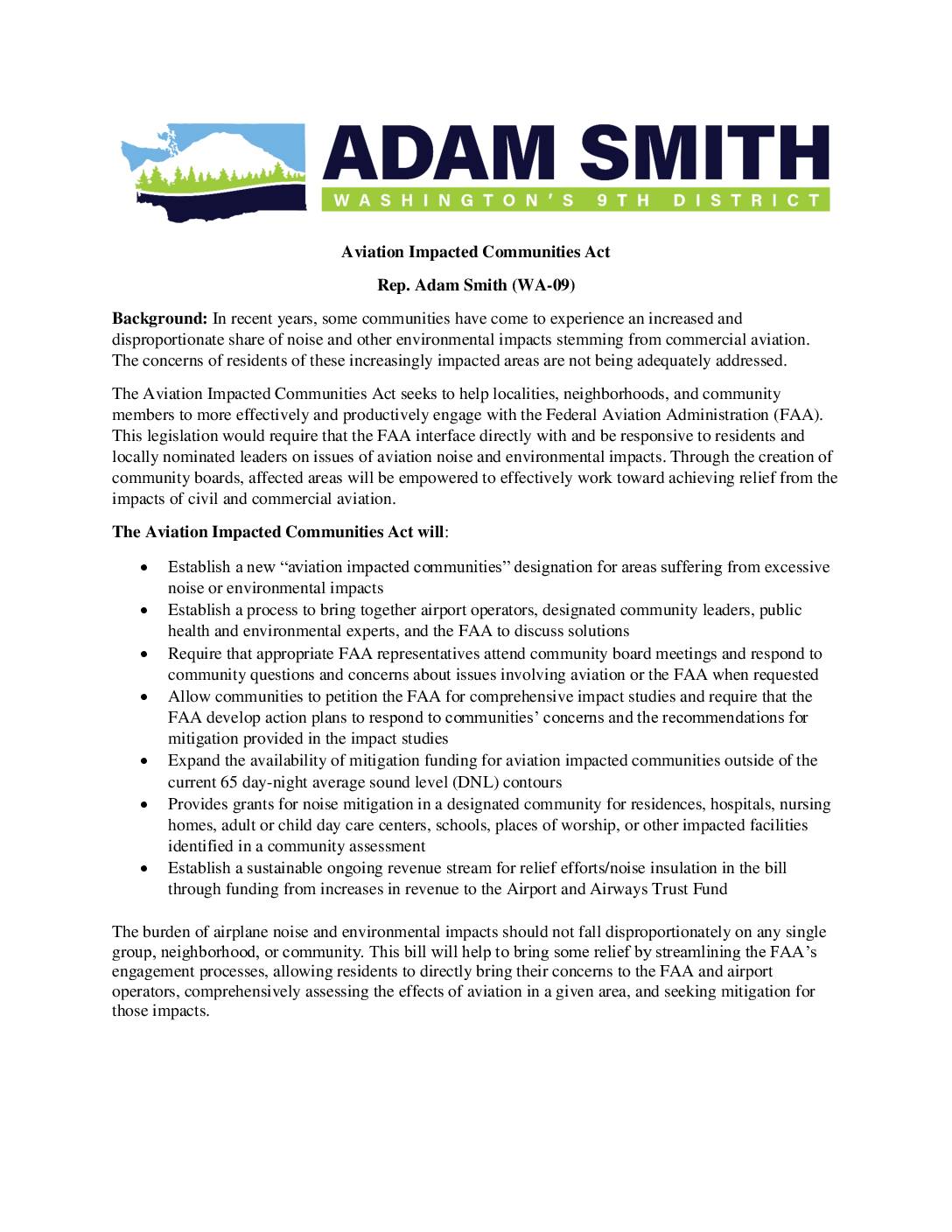
The Aviation Impacted Communities Act, introduced by Rep. Adam Smith (WA-09), aims to give residents and local leaders a stronger voice in addressing excessive airplane noise and environmental impacts by requiring the FAA to engage directly with affected communities through newly established community boards. The bill would create an 'aviation impacted communities' designation, allow communities to petition for comprehensive impact studies, and expand funding for noise mitigation beyond current sound-level boundaries. It also establishes a sustainable revenue stream for ongoing relief efforts through the Airport and Airways Trust Fund. -
 2025-01-07
Aviation Noise and Emissions Mitigation Act (H.R. __, 119th Congress, 1st Session)
The Aviation Noise and Emissions Mitigation Act, introduced in the 119th Congress by Rep. Smith of Washington, would direct the EPA to establish a 3-year pilot grant program to measure aircraft and airport noise and emissions—including greenhouse gases, particulate matter, and ultrafine particles—in communities near airports and flight paths. Grant recipients would use advanced monitoring technology to trace pollution to specific sources, produce neighborhood- and ZIP Code-level data, and work with local agencies and community organizations to develop mitigation strategies. The program is designed to be replicable nationwide, with a focus on identifying and protecting frontline and disproportionately impacted communities. -
 2025-01-07
Aviation-Impacted Communities Act: House Bill Text (119th Congress, 1st Session)
The Aviation-Impacted Communities Act, introduced in the 119th Congress by Rep. Smith of Washington, would require the FAA to provide noise mitigation funding to communities affected by airport noise even if they fall outside the current 65 DNL sound threshold. The bill would make these communities eligible for Airport Improvement Program funds, allow them to establish local boards to address airport noise, and direct the National Academy of Sciences to study aviation impacts at major hub airports — including King County, WA (Sea-Tac) — across the country. -
Adam Smith: Aviation Noise and Emissions
The Ninth District is home to several airports, including Sea-Tac airport. Communities surrounding airports have come to experience an increased and disproportionate share of public health and environmental impacts stemming from increases in air traffic. Studies have demonstrated that communities near airports and airflight pathways are exposed to higher proportions of harmful pollution particles from