TagAdam Smith(57)
-
 2020-02-26
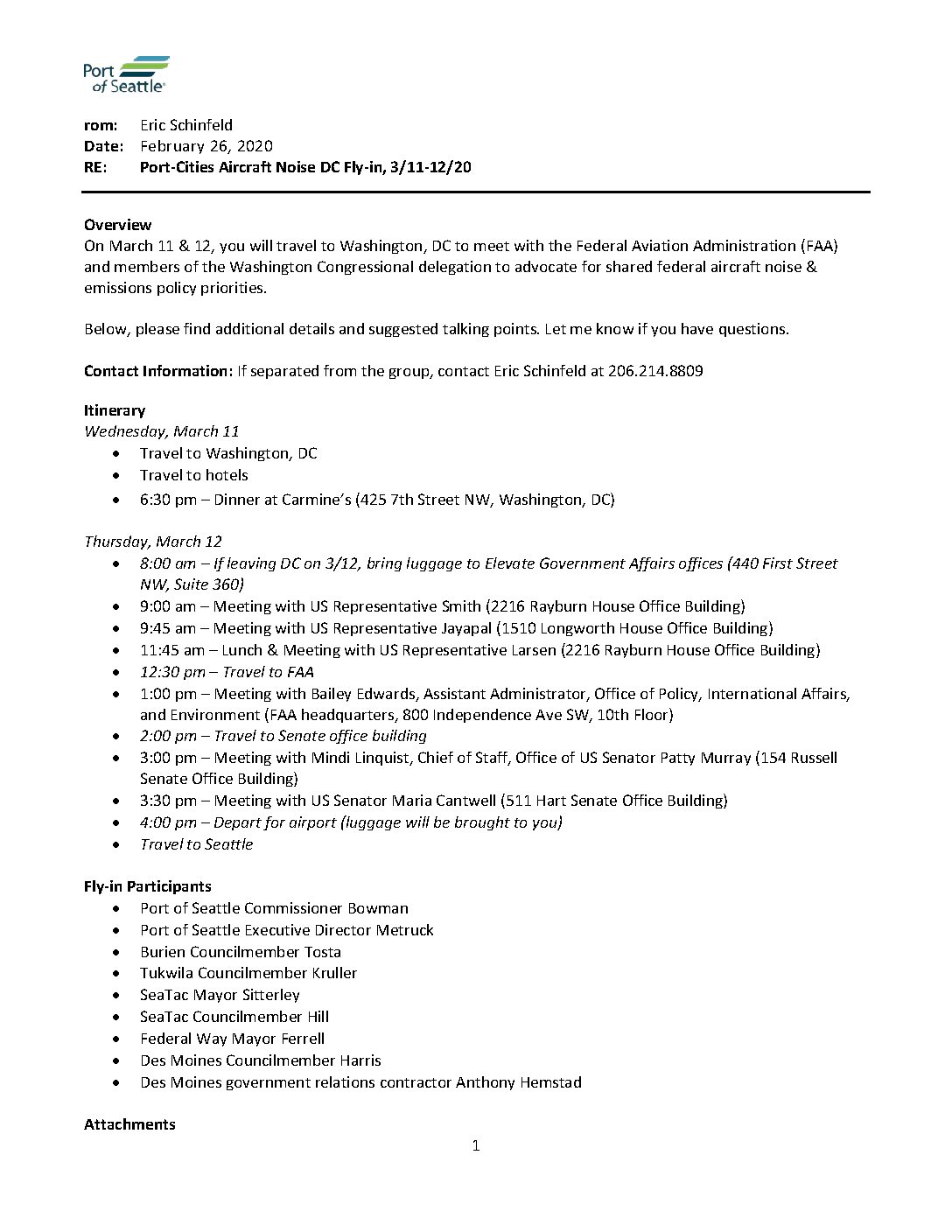
Port-Cities Aircraft Noise DC Fly-in Prep Memo, March 11–12, 2020
In March 2020, Port of Seattle officials and representatives from surrounding cities including Burien, Tukwila, SeaTac, Federal Way, and Des Moines traveled to Washington, D.C. to meet with the FAA and members of Congress about aircraft noise and emissions issues affecting the Puget Sound region. The group advocated for implementation of key provisions from the 2018 FAA Reauthorization Act, including a review of the 65 DNL noise standard, a study on the health impacts of overflight noise, and a new environmental mitigation pilot program. The meetings emphasized that local authorities have limited power to address flight paths, aircraft types, or noise insulation funding, and that federal action is needed to provide new tools and resources for affected communities. -
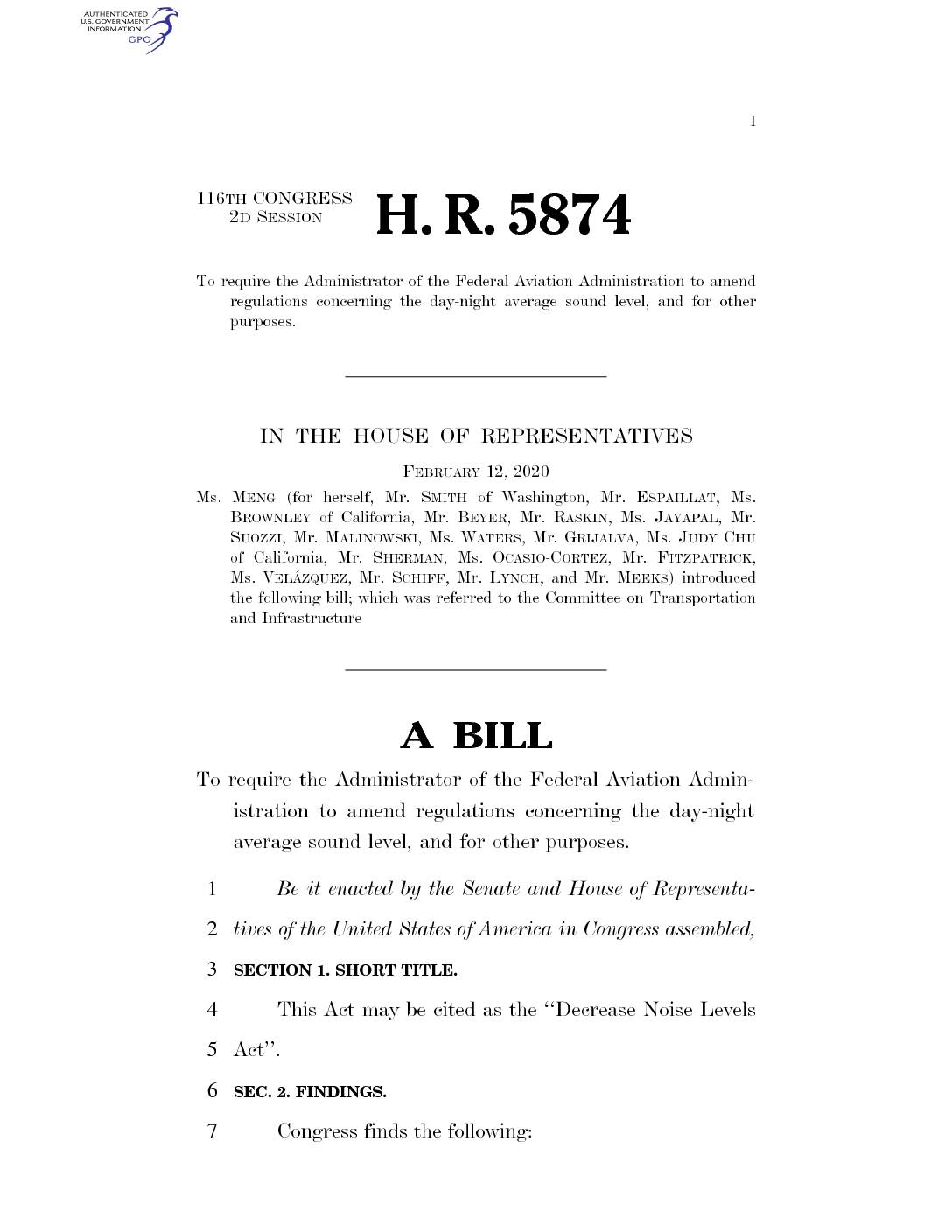
HR 5874 – Decrease Noise Levels Act
116th CONGRESS 2d Session H. R. 5874 To require the Administrator of the Federal Aviation Administration to amend regulations concerning the day-night average sound level, and for other purposes. IN THE HOUSE OF REPRESENTATIVES February 12, 2020 Ms. Meng (for herself, Mr. Smith of Washington, Mr. Espaillat, Ms. Brownley of California, Mr. Beyer, Mr. -
 2020-02-12
H.R. 5874 – Decrease Noise Levels Act
H.R. 5874, the 'Decrease Noise Levels Act,' introduced in February 2020, would require the FAA to lower the threshold for significant aircraft noise from a day-night average sound level of 65 to 60 decibels. The bill also directs the FAA to publish a public report within one year outlining a strategy to further reduce residential noise levels to 55 decibels over the following decade. Additionally, it mandates that community outreach efforts include evaluations of alternative noise measurement metrics beyond the current standard. -
 2019-11-14
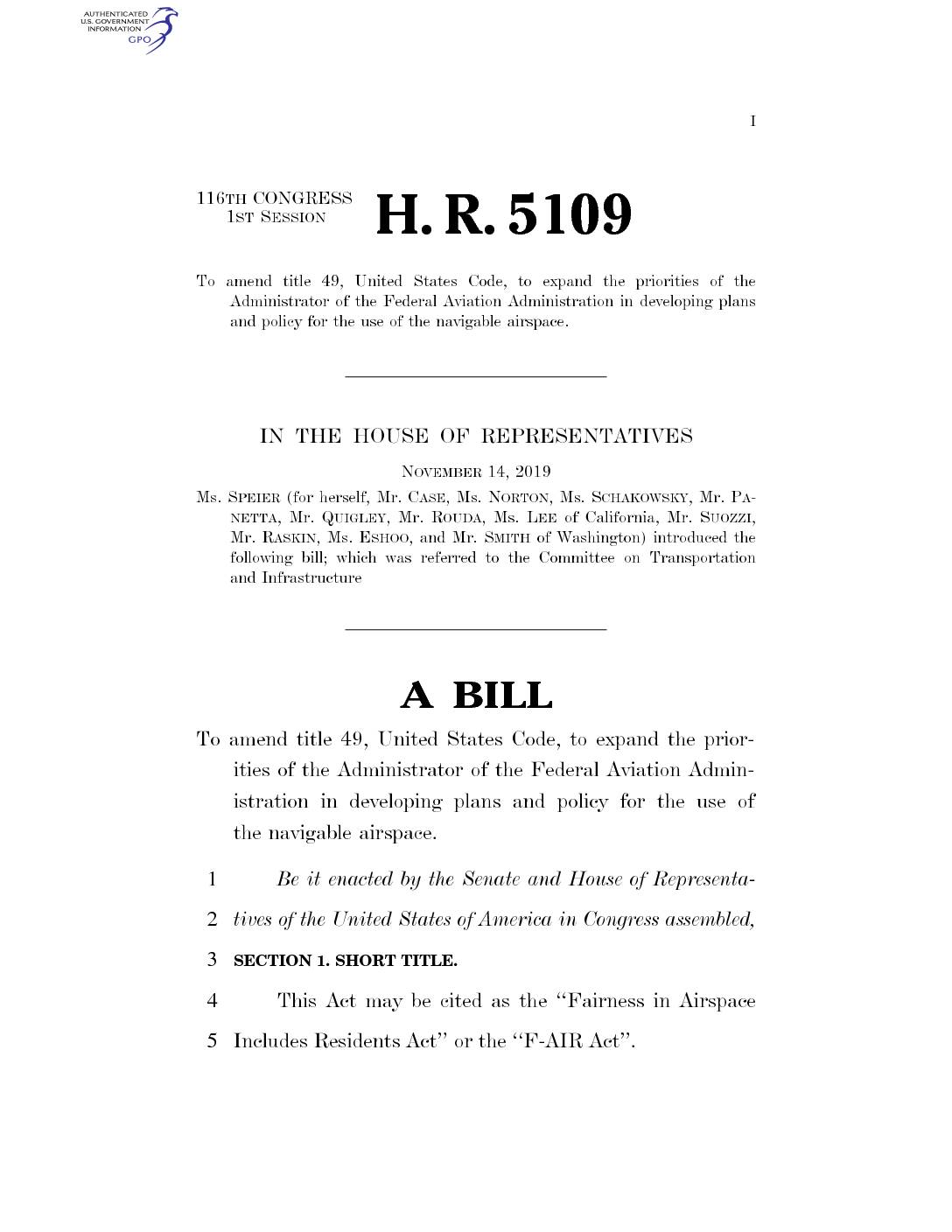
H.R. 5109 – Fairness in Airspace Includes Residents Act (F-AIR Act)
The F-AIR Act (H.R. 5109), introduced in November 2019, proposes to update the FAA's priorities when managing U.S. airspace. While keeping aircraft safety as the top priority, the bill would elevate the reduction of aviation noise, community health impacts, and environmental concerns to co-equal status alongside airspace efficiency. The FAA would be required to review and update its regulations, policies, and mission statement within 12 months of the act's passage to reflect these new priorities. -
 2019-10-31
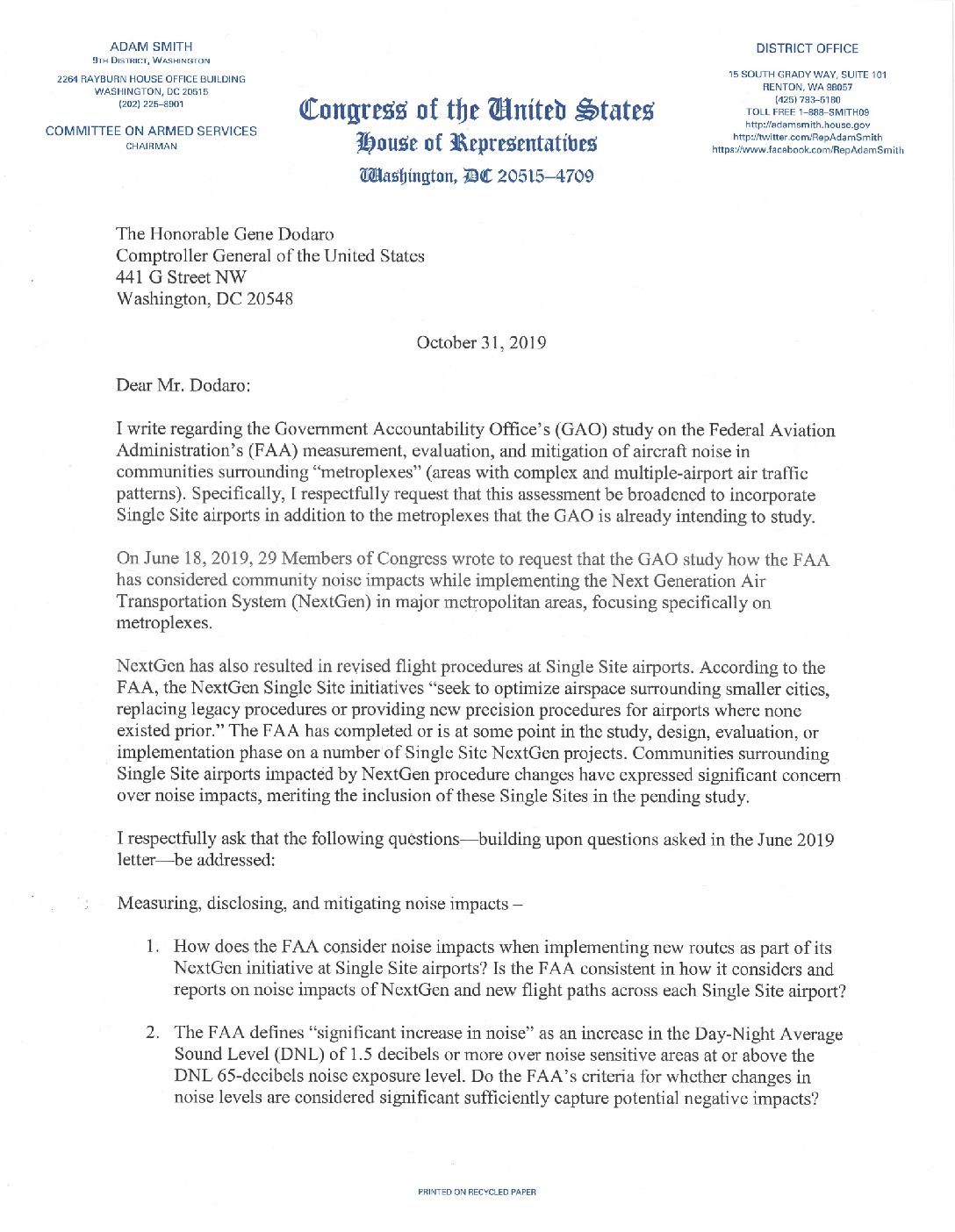
Letter from Adam Smith to Gene Dodaro regarding GAO study on FAA noise impacts at Single Site airports
In October 2019, Congressman Adam Smith (WA-9th District) wrote to the Government Accountability Office requesting that its study on FAA aircraft noise management be expanded beyond major metropolitan 'metroplexes' to also include Single Site airports, such as those affected by NextGen flight procedure changes near smaller cities. The letter asks the GAO to examine how the FAA measures, discloses, and mitigates noise impacts at these airports, whether its current noise standards adequately protect communities, and how effectively it engages the public when implementing new flight routes. The request was driven by significant community concern over increased noise resulting from NextGen-related flight path changes at Single Site airports. -
A Letter To Amanda Wyma-Bradley re. HR 6168
Ms. Wyma-Bradley is a Legislative Assistant for Congressman Adam Smith (D) 9th District, WA. Thank you for your work on this issue.I worry that my comments at the meeting may have veered discussion away from your intended text. But I think I do understand the local situation and my concern in HR 6168 was that -
A Letter To Adam Smith Re. HR 6168
Dear Congressman, As I wrote you on 24 March re. ANCA, I want to thank you for all your help for airport communities. I now have the following comments ahead of your August 27 Meeting with our communities. Representation I am very concerned about the definition and structure of ‘community’ and who will be designated -
 2019-08-20
Overview: The Aviation Impacted Communities Act
The Aviation Impacted Communities Act establishes a structured process to help neighborhoods affected by aircraft noise, starting with the FAA identifying eligible communities and ending with grants for noise mitigation. A community qualifies as 'aviation impacted' if it is located within 1 mile of any point where a commercial or cargo jet route passes at or below 3,000 feet above ground level. Once designated, communities can form boards, conduct studies, and develop action plans to address aviation-related impacts near airports like Sea-Tac. -
 2019-08-20
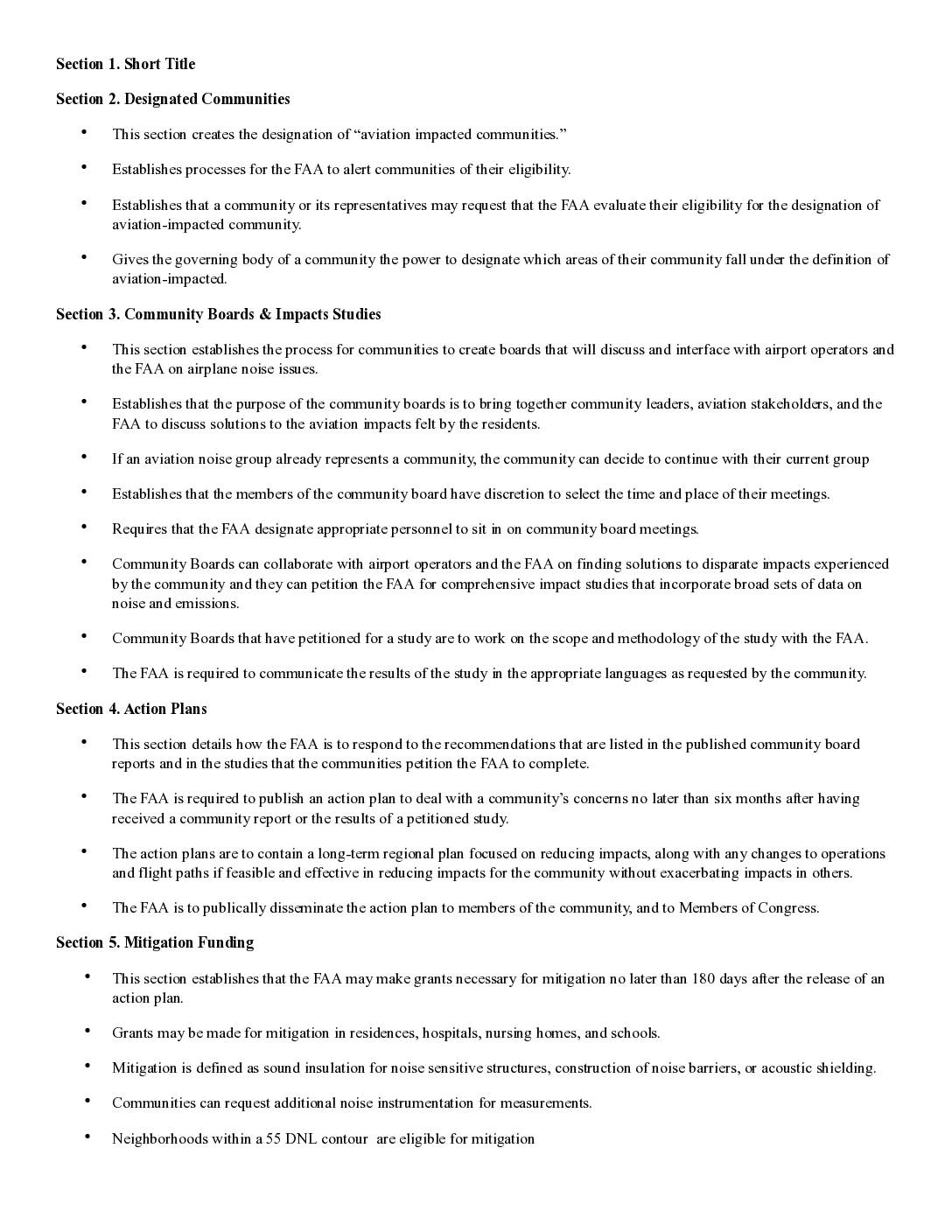
Airport Impacted Communities Act: Section-by-Section Summary
This legislative summary outlines a proposed bill aimed at protecting communities affected by airport noise and aviation emissions. It establishes a formal designation for 'aviation-impacted communities' located within one mile of low-flying commercial or cargo jet routes, creates local community boards to engage with the FAA and airport operators, and requires the FAA to develop action plans and provide mitigation funding — such as sound insulation and noise barriers — for affected residences, schools, hospitals, and nursing homes. -
2019-06-25
Cantwell, Smith secure $9.1 million for Noise Mitigation in Highline Public Schools
U.S. Senator Maria Cantwell (D-WA), ranking member of the Senate Committee on Commerce, Science, and Transportation, and Congressman Adam Smith (WA-09), chairman of the House Armed Services Committee, on Tuesday (June 25) announced that $9.1 million in federal funding was awarded to support noise mitigation projects at schools in Highline Public Schools. These funds will