Skip to content
  • STNI
  • Statistics
    • Ops and Passengers
      • King County International Airport (Boeing Field) Annual Operations
    • Financials
    • Aviation fuel uplift in the State of Washington 2018 – 2025
      • Aviation Fuel Uplift at Sea-Tac Airport
    • Air Quality Monitoring
    • Flight Tracking
      • Flow and Flight Tracks
      • Five Year Comparison
      • Busiest Hours and Days
    • SEL Noise Reports & Graphs
      • About The Permanent Noise Monitors
      • Minutes of Quiet by Noise Monitor
      • Noise Events mapped
      • Noise Events (SEL)
    • Runways
    • Employees
    • Real Estate
      • Port Properties and Trees mapped
    • Parking
  • Events
  • Protest
    • Regular Events
    • Legislation 2026
    • Complain about a particular flight
    • Advocacy Organizations
    • Media Outlets
    • People
    • The Port of Seattle
      • Commission Meetings
      • Public Records Requests
      • StART
      • Highline Forum
    • Contact Your Electeds
  • Resources
    • FAQs
      • FAA Occurrences/Accidents/Indents
    • The unSustainable Airport Master Plan
      • SAMP Public Comment Template
        • Two versions of Appendix K: NEPA/SEPA 2018 vs 2023
      • SAMP NTP: 31 projects by the numbers
      • SEPA Draft EIS (2026)
      • SAMP Record of Decision/FONSI (2025)
      • SAMP Draft EA (October 2024)
      • 2018 Scoping
    • Port Packages
      • Port Package Property Costs
      • Port Packages mapped
      • The Port Package Explainer
      • So you want a (first-time) Port Package? Start here
      • Port Package Looker Upper
      • How do I determine if I have a Port Package or Avigation Easement?
      • Progress on Port Package Update legislation
      • Having a Port Package Problem?
      • Port Package Site Visit Follow-Up
    • Document Library
    • Explainers
      • The Airport Law Cheat Sheet
      • The Grant Explainer
    • External Articles
    • History
      • Timeline
      • The Sea-Tac Communities Plan
        • Sea-Tac Communities Plan – Planning Maps
      • PSRC Third Runway Decision Process
    • Studies
    • Videos
  • Stories
  • Mission
  • Subscribe
  • Contact
Scroll down to content

Get InformedStay Informedx

I understand that you will never share my information with anyone, you will only use it to keep me updated on relevant events and that I may unsubscribe at any time.

STNI

STNISea-Tac Noise.Info

  • Solve for Sea-Tac. Solve for every airport.
  • Since 2016, working to obtain justice for everyone living under the flight path.
  • Less Noise. Cleaner Air. Better Public Health. Compensation.
  • Everything you think you know about the airport is wrong.

TagLegislation(135)

Advanced Search Options

  • Dates
  • Media
    • External Articles
    • Images
    • PDFs
    • Video
    • Audio
  • Order By
  • 2021-05-17

    Engrossed Second Substitute Senate Bill 5141: Environmental Justice—Various Provisions (HEAL Act)

    Washington State's Engrossed Second Substitute Senate Bill 5141, signed into law in May 2021, aims to reduce environmental and health disparities by implementing recommendations from the state's Environmental Justice Task Force. The law requires covered state agencies—including the departments of ecology, health, transportation, and others—to address the disproportionate environmental burdens faced by low-income communities and communities of color. It establishes an Environmental Justice Council and directs state programs to prioritize benefits for communities with the greatest environmental and health burdens.
    TagsEcology, Environmental Justice, Legislation, State of Washington, Washington State Legislature
  • 2021-03-12

    E2SSB 5141: House Bill Analysis — Reducing Environmental and Health Disparities (HEAL Act)

    Washington State Senate Bill 5141 requires several state agencies, including the departments of Ecology, Health, Transportation, and others, to incorporate environmental justice principles into their planning and decision-making processes. The bill mandates that these agencies complete environmental justice assessments for significant actions, create community engagement plans for overburdened communities, and consult with Indian tribes on decisions affecting tribal lands. An environmental justice council would be established to oversee implementation, and the Department of Health would maintain an environmental health disparities map tracking conditions across Washington communities.
    TagsEcology, Environmental Justice, Legislation, Washington State Department Of Health, Washington State Legislature
  • 2021-02-26

    Aircraft noise and emissions legislation in the next Congress: Priorities, perspectives, and predictions

    This presentation by attorney Peter J. Kirsch, delivered at the 2021 Aviation Noise and Emissions Symposium, examines anticipated legislative priorities related to aircraft noise and emissions in the new Congress. It references key noise measurement tools, including the Schultz Curve and a updated National Curve, both of which plot the percentage of people highly annoyed against Day-Night Average Sound Level (DNL) in decibels. The materials suggest growing public sensitivity to aircraft noise even at lower decibel levels, with implications for how policymakers may revisit the longstanding 65 DNL threshold used in federal noise compatibility programs.
    TagsAviation Noise & Emissions Symposium, Kaplan Kirsch Rockwell, Legislation, Peter Kirsch
  • 2021-02-26

    Legislation in the next Congress: priorities, perspectives, and predictions

    This presentation by Sanford Fidell and Vincent Mestre, delivered at the UC Davis Aviation Noise and Emissions Symposium on February 26, 2021, discusses priorities and predictions for U.S. aircraft noise legislation. It is based on their book 'A Guide to U.S. Aircraft Noise Regulatory Policy,' which covers topics ranging from the history of noise regulation and its effects on communities to airport land use planning, noise mitigation, and potential future changes to regulatory policy.
    TagsAviation Noise & Emissions Symposium, Legislation, UC Davis, Vince Mestre
  • 2021-01-19

    Bill analysis: HB 1099 – Improving the state’s climate response through updates to the state’s comprehensive planning framework

    HB 1099 is a Washington State bill focused on improving the state's climate response by updating the Growth Management Act to require counties and cities to include climate change and resiliency planning in their comprehensive land use plans. The bill mandates reductions in greenhouse gas emissions and vehicle miles traveled, and requires the Department of Commerce to publish guidelines for achieving statewide emissions targets. It also addresses coastal resilience by requiring Shoreline Master Programs to account for sea level rise and increased storm severity.
    TagsClimate, Department Of Commerce, Greenhouse gases, Legislation, Washington State Legislature
  • 2021-01-01

    Final Bill Report: E2SSB 5141 — Washington Environmental Justice Act (HEAL Act)

    Washington State's E2SSB 5141, enacted in 2021, requires key state agencies including Transportation and Ecology to incorporate environmental justice principles into their planning and decision-making processes, with a focus on protecting overburdened communities from disproportionate environmental and health harms. Agencies must develop community engagement plans by 2022, environmental justice implementation plans by 2023, and conduct formal environmental justice assessments for significant actions such as new rules, grants, and capital investments. Note: this legislation addresses statewide environmental justice policy broadly and does not specifically address Sea-Tac Airport noise issues.
    TagsEcology, Environmental Justice, Legislation, Puget Sound, Washington State Department Of Health, Washington State Legislature
  • 2021-01-01

    Community perspectives on legislation: Aircraft noise and emissions legislation in the next Congress

    A 2021 presentation by Darlene Yaplee, founding member of the Aviation-Impacted Communities Alliance (AICA), argues that the FAA's current systems for assessing and addressing aircraft noise and health impacts are outdated and in need of legislative reform. The document outlines community perspectives on aircraft noise and emissions legislation, covering problem framing, insights for future laws, noise reduction strategies, and real examples of community input. Residents across impacted communities are calling for meaningful relief from the noise and emissions burdens caused by modern air traffic.
    TagsAICA, Aviation Noise & Emissions Symposium, FAA, Legislation
  • 2020-02-12

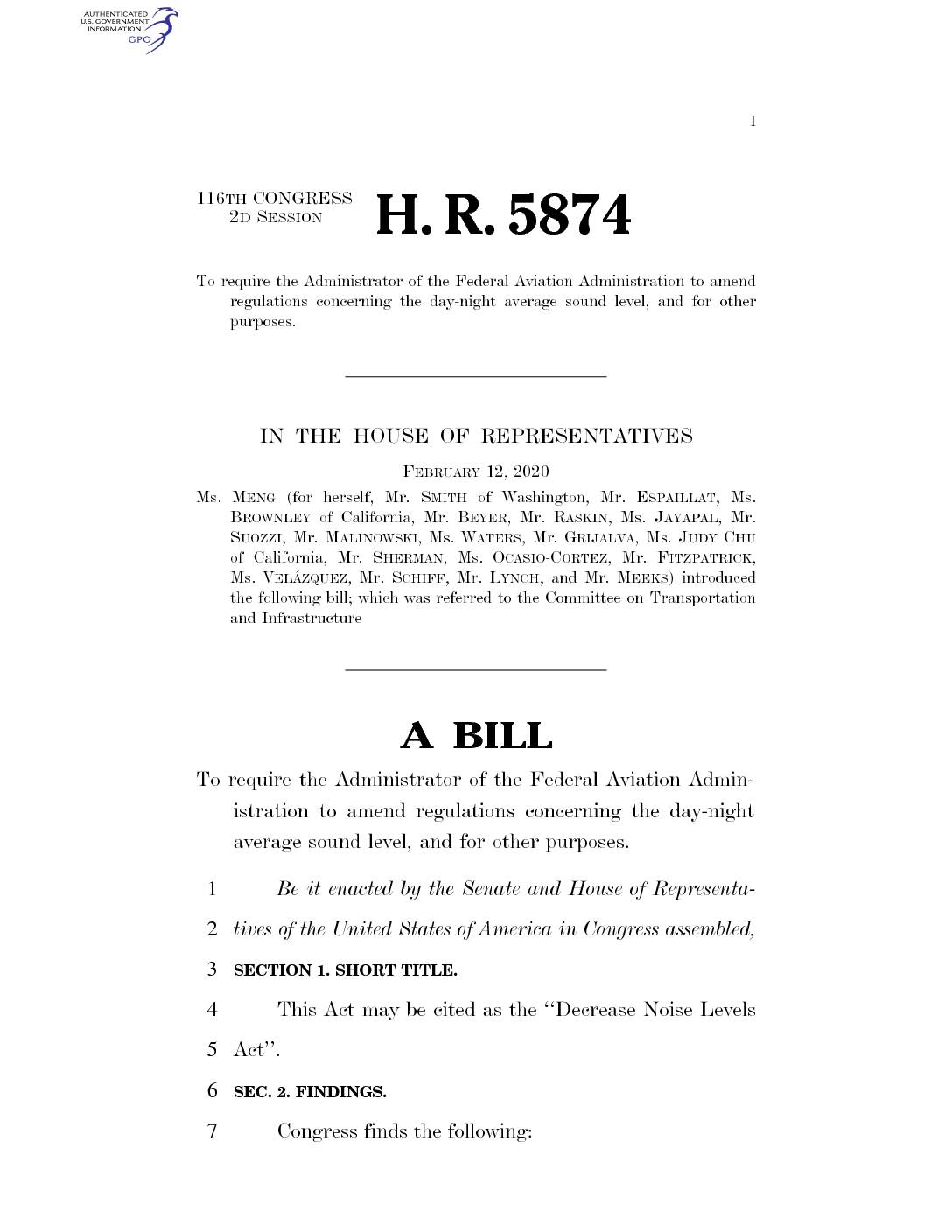
    H.R. 5874 – Decrease Noise Levels Act

    H.R. 5874, the 'Decrease Noise Levels Act,' introduced in February 2020, would require the FAA to lower the threshold for significant aircraft noise from a day-night average sound level of 65 to 60 decibels. The bill also directs the FAA to publish a public report within one year outlining a strategy to further reduce residential noise levels to 55 decibels over the following decade. Additionally, it mandates that community outreach efforts include evaluations of alternative noise measurement metrics beyond the current standard.
    TagsAdam Smith, DNL65, Grace Meng, Legislation, Noise Mitigation
  • 2020-01-17

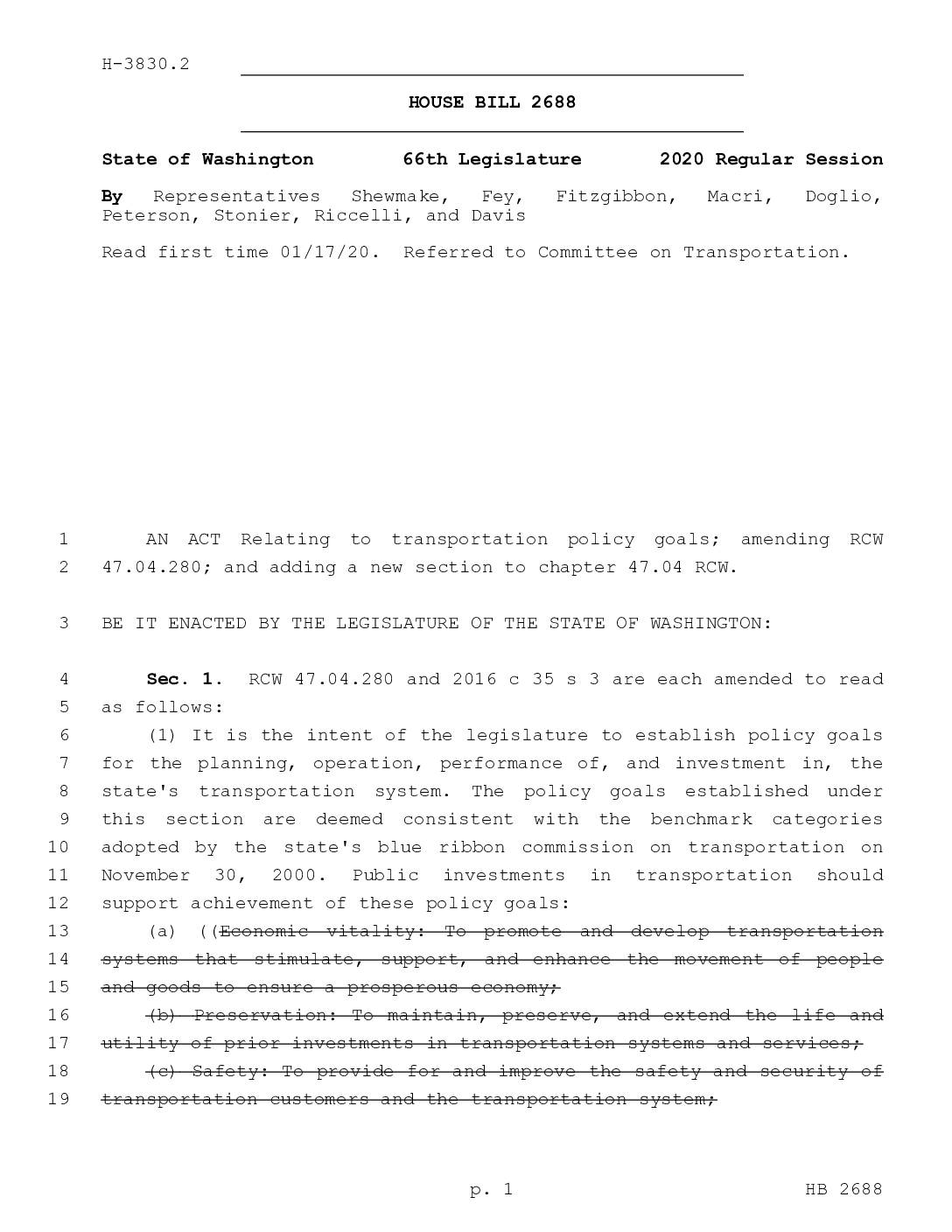
    House Bill 2688: Relating to transportation policy goals

    Washington House Bill 2688, introduced in the 2020 legislative session, proposes updating the state's transportation policy goals to prioritize accessibility, environmental justice, public health, and climate by replacing older goals focused primarily on economic vitality and mobility. The bill would require transportation projects to undergo a multi-agency evaluation—including input from vulnerable and impacted communities—before receiving budget authorization. Projects that do not meet a minimum score based on the new policy goals would generally be excluded from funding.
    TagsEnvironmental Justice, Legislation, non-aviation transportation, State of Washington, Washington State Legislature
  • 2019-12-11

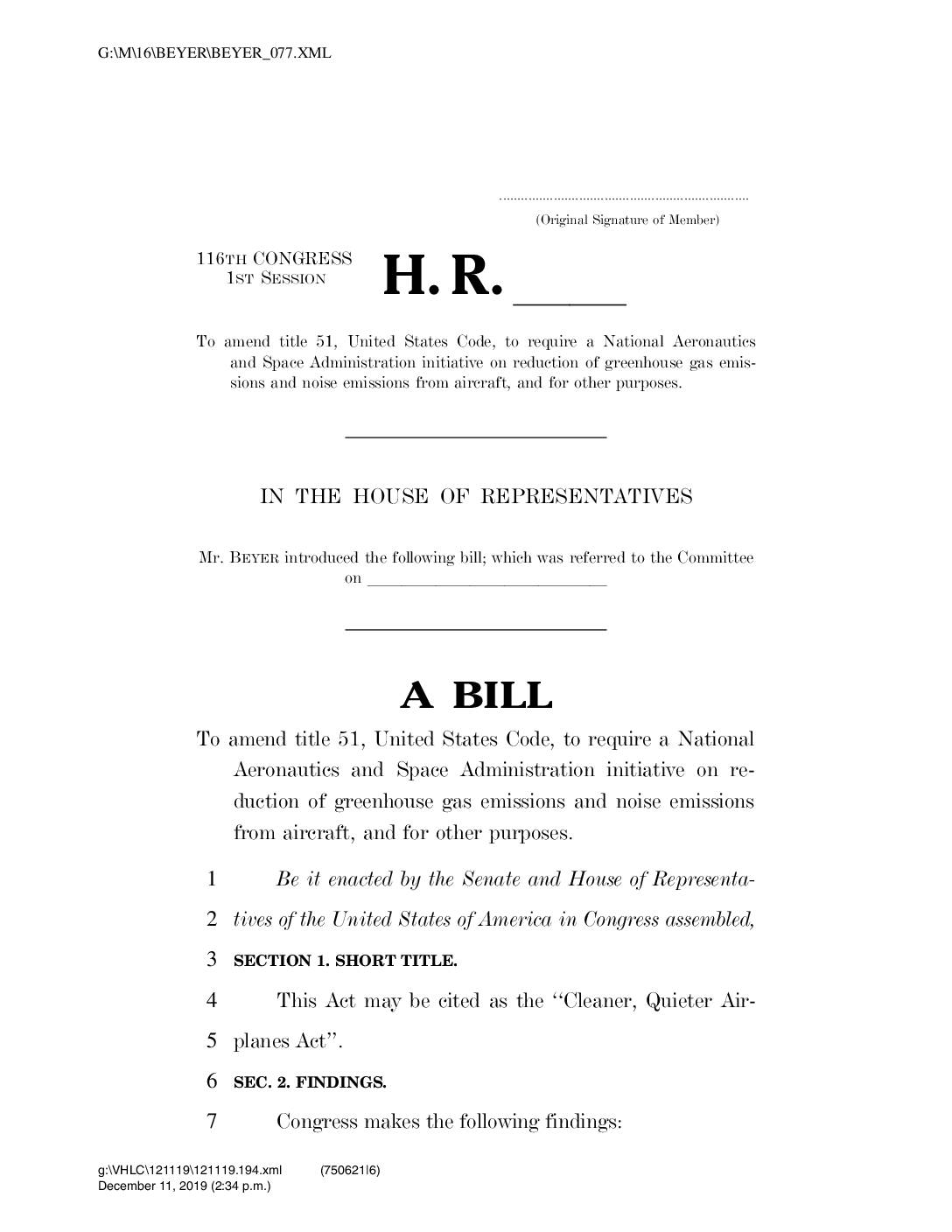
    Cleaner, Quieter Airplanes Act

    The 'Cleaner, Quieter Airplanes Act,' introduced in the 116th Congress by Mr. Beyer, would require NASA to establish an initiative to develop and demonstrate new aircraft technologies capable of reducing both greenhouse gas emissions and noise emissions by at least 50 percent compared to the best-performing aircraft in service as of December 31, 2019. The bill responds to findings that aviation noise pollution is worsening in some communities as air traffic increases and performance-based navigation technology is adopted. It reflects a broader U.S. goal of carbon-neutral aviation growth from 2020 onward.
    TagsAviation Emissions, Greenhouse gases, Legislation, NASA

Posts pagination

Page 1 … Page 9 Page 10 Page 11 Page 12 Page 13 Page 14
Sidebar On/Off

Upcoming Events

  • StART SEA Stakeholder Advisory Round Table
    Add to CalendarMWednesday Aug 26, 5:00pm - 7:00pm
    Zoom (Virtual Meeting)
    START meetingagenda 2026826 final 0 pdf

    Meeting Objectives Introduce the primary feedback themes identified by StART members regarding StART’s Operating Procedures and determine areas that may warrant future discussion. 5:00 PM – Welcome Meeting Management Welcome Lead: Andrés Mantilla, Facilitator, Uncommon Bridges; Wendy Reiter, Airport Managing Director, POS 5:15 PM – Dinner: All participants eat. 5:30 PM – StART Operating Procedures

    [...]
  • Commercial Aviation Work Group
    Add to CalendarMThursday Sep 3, 10:00am - 1:30pm
    Virtual Meeting (Zoom)
    Cawg agenda sep 3 26 virtual pdf

    Meeting Agenda 10:00 a.m. – 10:15 a.m. | Welcome – Evan Nordby, Chair a. Introductions and Agenda Reviewb. Status of appointments and non-voting member invitationsc. Other updates as necessary 10:15 a.m. – 11:00 a.m. | Is it practical and legal to operate the western Washington [Puget Sound] airports as a single airport system? – Consultant

    [...]

[See all...]


Help study childhood asthma. Get free HEPA filter!

read more...

Issues

Sea-Tac Airport is currently undergoing the largest and longest expansion in its history, collectively known as the Sustainable Airport Master Plan (SAMP). Some of it you can already hear, but you’re probably not aware of what it all means. Here’s what you need to know.
read more...

Read This!

As the source for federal transportation grants, the Puget Sound Regional Council was charged with developing a system to meet the growing need for commercial aviation. When the search for a second airport failed, they authorized the Port of Seattle to build the Third Runway, with a mandate to develop a noise abatement and mitigation program. In their effort to stop the Third Runway, the ACC argued over every detail of the Port's efforts--including property buyouts and sound insulation. The dispute was meant to be settled by a three member Expert Arbitration Panel. This is their final report. It finds 2-1, that the Port's program was insufficient in several respects. Despite that, funding for the Third Runway was approved by the PSRC, and the 'Port Package' program, proceeded largely unchanged. Expert Arbitration Panel's final decision finding that the Port of Seattle had not shown sufficient reduction in real on-the-ground noise impacts to satisfy noise reduction conditions required for approval of a third runway at Sea-Tac International Airport. The majority decision concluded the Port's noise abatement programs were insufficient despite being impressive in scope.
continue...

The Podcast!

Subscribe to the only podcast devoted to policies, politics, history, impacts for people living under the flight path everywhere. It’s definitely not just about noise!
  • Sea-Tac Noise.Info
  • Connect with STNI

    • Subscribe
    • Port Package Problem?
    • Donate
    • Podcast
    • Socials
      • Facebook
      • X (Twitter)
      • Bluesky
      • Instagram

    "Washington State Department of Revenue Leasehold Tax Return: Port Of Seattle, Q1 2019" — , 2019

  • Learn

    • Frequently Asked Questions
    • Explainers
    • Youtube
    • Research Requests
    • Make a complaint
  • Goals

    Fulfill the promises of 1976:
    • Compensation
    • Reduced noise
    • Improved air quality
    • Environmental remediation
Login/Register
©2026•Data Privacy

Message

We use cookies to provide basic functionality. We also provide access to search engines in order to provide site analytics. We do not sell or share your data.
V V