TagLegislation(123)
-
Vote View
Voteview allows users to view every congressional roll call vote in American history on a map of the United States and on a liberal-conservative ideological map including information about the ideological positions of voting Senators and Representatives. The original Voteview of DOS was developed by Keith T. Poole and Howard Rosenthal at Carnegie-Mellon University between 1989 and 1992. -
 2022-07-28
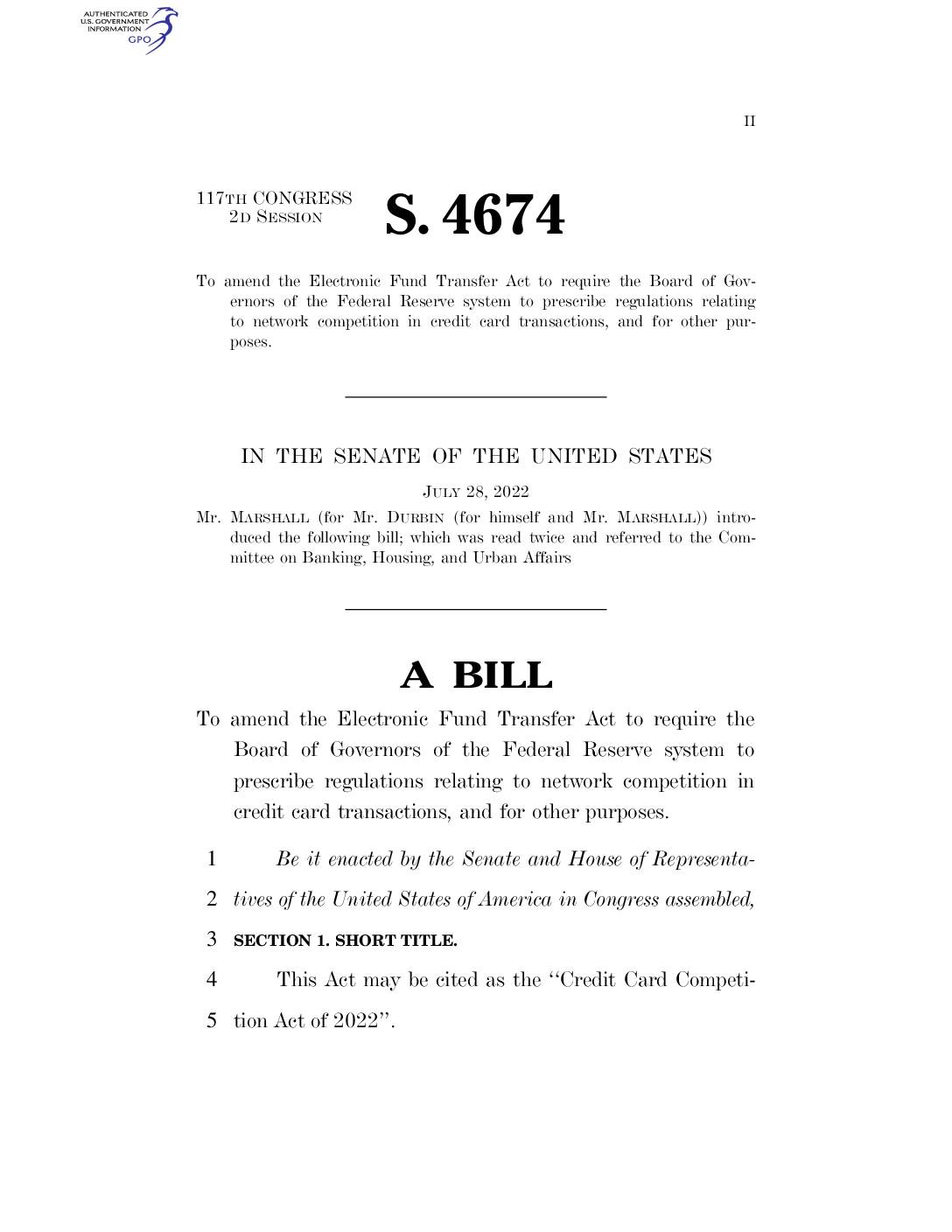
Credit Card Competition Act of 2022
The Credit Card Competition Act of 2022 (S. 4674) is a U.S. Senate bill introduced on July 28, 2022, that would require the Federal Reserve to issue regulations preventing large credit card issuers and payment networks from restricting which networks can process credit card transactions. The bill aims to increase competition by ensuring merchants have access to at least two unaffiliated payment networks for processing electronic credit transactions. The Federal Reserve would be required to implement these rules within one year of enactment and review market conditions every three years. -
 2022-07-01
Overview of the legislative process
This document provides an overview of how Washington State's Legislature turns ideas into laws, walking through each step from a bill's introduction and committee review to floor votes, the Governor's signature, and final enactment. It explains the roles of the Senate and House of Representatives across Washington's 49 legislative districts, the structure of regular and special sessions, and how bills can carry over within a two-year legislative cycle. While focused on general legislative procedure, this resource may provide context for understanding how noise-related policies affecting areas like Sea-Tac Airport are formally proposed, debated, and passed into state law. -
 2021-05-17
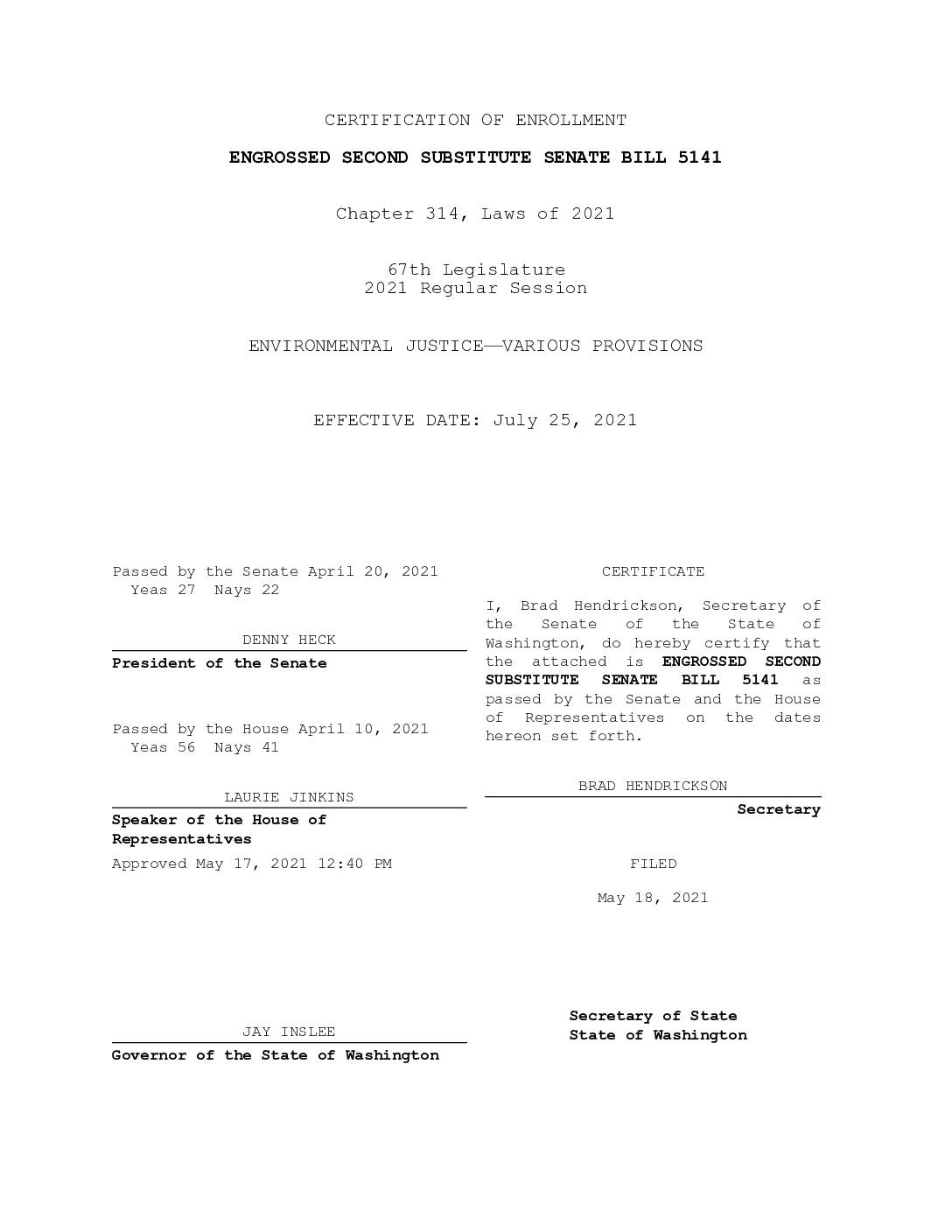
Engrossed Second Substitute Senate Bill 5141: Environmental Justice—Various Provisions (HEAL Act)
Washington State's Engrossed Second Substitute Senate Bill 5141, signed into law in May 2021, aims to reduce environmental and health disparities by implementing recommendations from the state's Environmental Justice Task Force. The law requires covered state agencies—including the departments of ecology, health, transportation, and others—to address the disproportionate environmental burdens faced by low-income communities and communities of color. It establishes an Environmental Justice Council and directs state programs to prioritize benefits for communities with the greatest environmental and health burdens. -
 2021-03-12
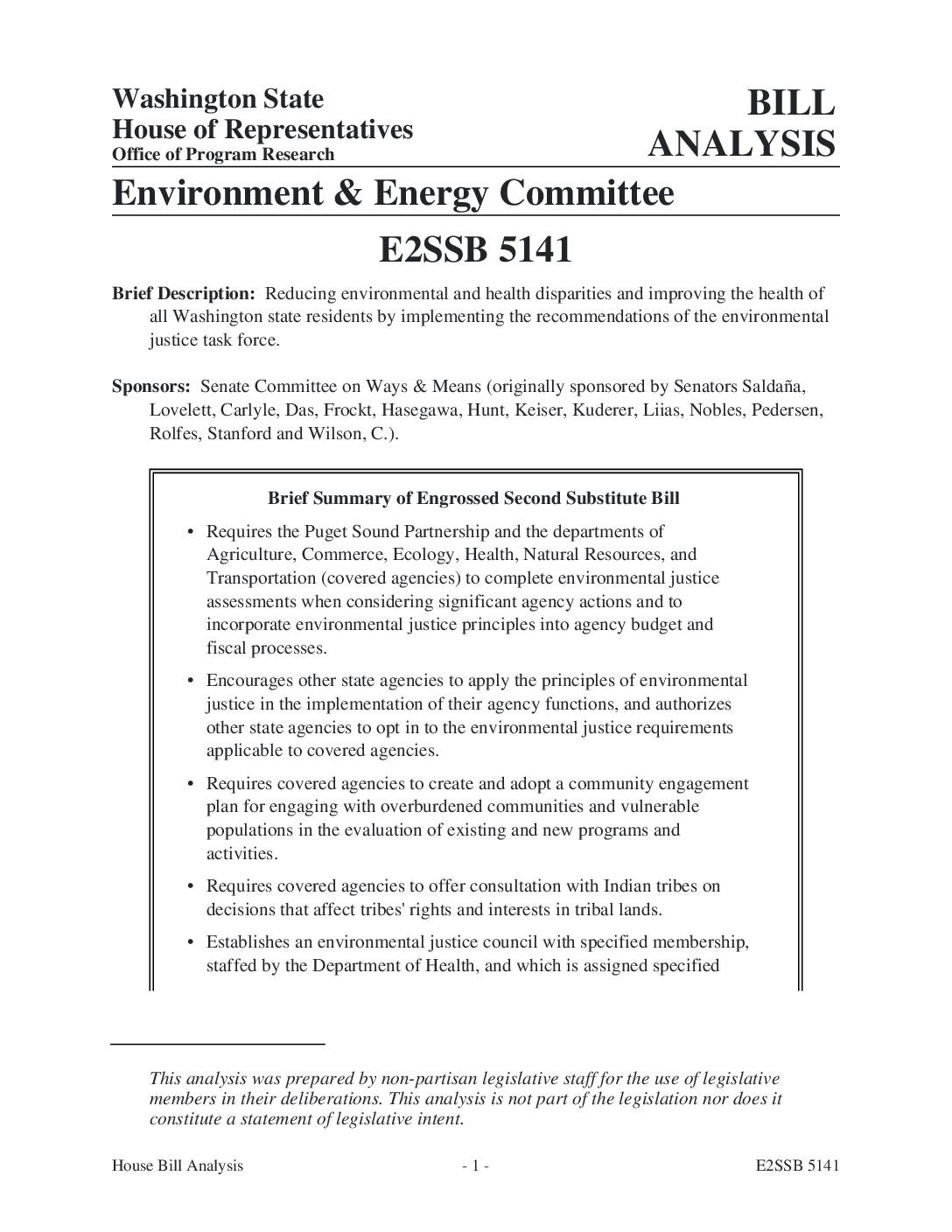
E2SSB 5141: House Bill Analysis — Reducing Environmental and Health Disparities (HEAL Act)
Washington State Senate Bill 5141 requires several state agencies, including the departments of Ecology, Health, Transportation, and others, to incorporate environmental justice principles into their planning and decision-making processes. The bill mandates that these agencies complete environmental justice assessments for significant actions, create community engagement plans for overburdened communities, and consult with Indian tribes on decisions affecting tribal lands. An environmental justice council would be established to oversee implementation, and the Department of Health would maintain an environmental health disparities map tracking conditions across Washington communities. -
 2021-02-26
Aircraft noise and emissions legislation in the next Congress: Priorities, perspectives, and predictions
This presentation by attorney Peter J. Kirsch, delivered at the 2021 Aviation Noise and Emissions Symposium, examines anticipated legislative priorities related to aircraft noise and emissions in the new Congress. It references key noise measurement tools, including the Schultz Curve and a updated National Curve, both of which plot the percentage of people highly annoyed against Day-Night Average Sound Level (DNL) in decibels. The materials suggest growing public sensitivity to aircraft noise even at lower decibel levels, with implications for how policymakers may revisit the longstanding 65 DNL threshold used in federal noise compatibility programs. -
 2021-02-26
Legislation in the next Congress: priorities, perspectives, and predictions
This presentation by Sanford Fidell and Vincent Mestre, delivered at the UC Davis Aviation Noise and Emissions Symposium on February 26, 2021, discusses priorities and predictions for U.S. aircraft noise legislation. It is based on their book 'A Guide to U.S. Aircraft Noise Regulatory Policy,' which covers topics ranging from the history of noise regulation and its effects on communities to airport land use planning, noise mitigation, and potential future changes to regulatory policy. -
 2021-01-19
Bill analysis: HB 1099 – Improving the state’s climate response through updates to the state’s comprehensive planning framework
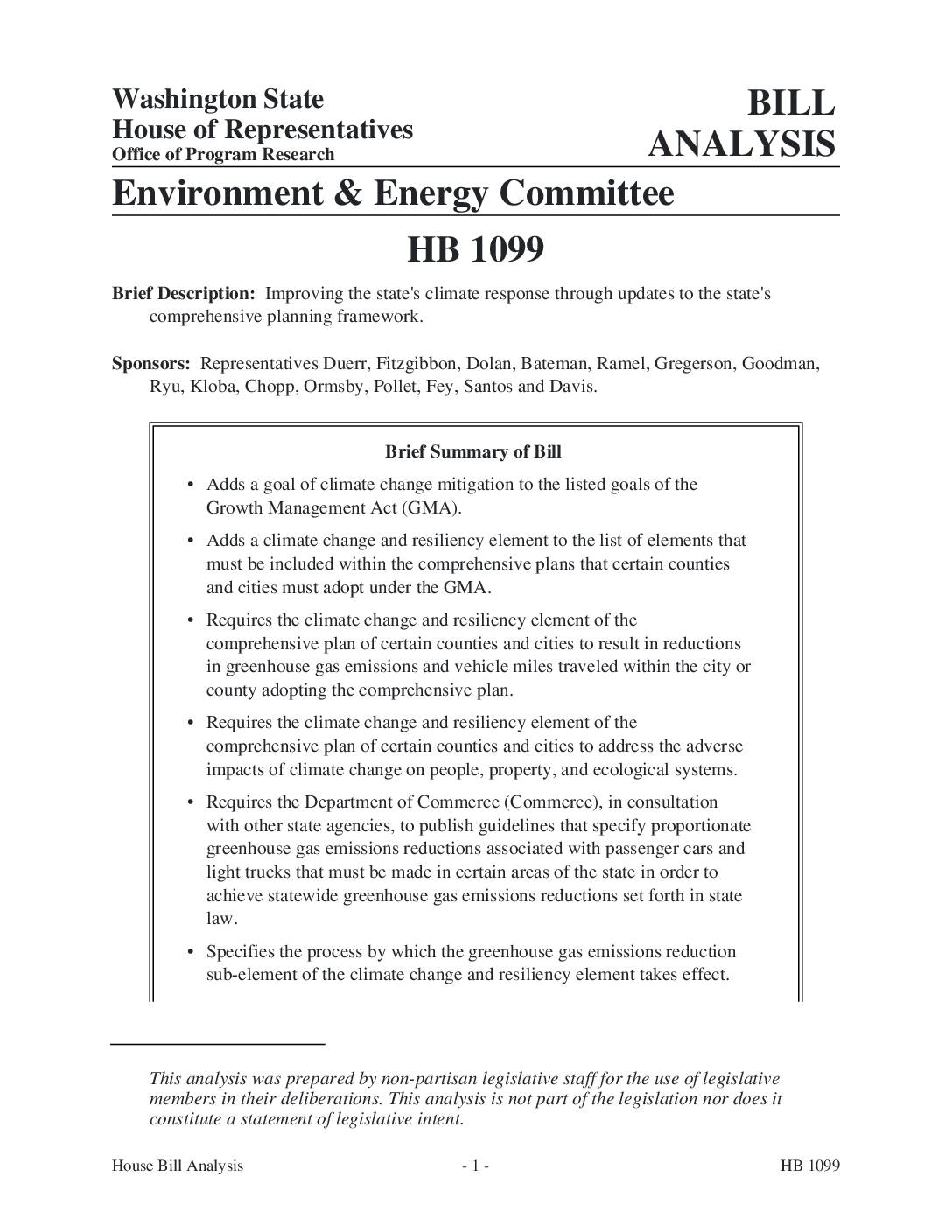
HB 1099 is a Washington State bill focused on improving the state's climate response by updating the Growth Management Act to require counties and cities to include climate change and resiliency planning in their comprehensive land use plans. The bill mandates reductions in greenhouse gas emissions and vehicle miles traveled, and requires the Department of Commerce to publish guidelines for achieving statewide emissions targets. It also addresses coastal resilience by requiring Shoreline Master Programs to account for sea level rise and increased storm severity. -
 2021-01-01
Community perspectives on legislation: Aircraft noise and emissions legislation in the next Congress
A 2021 presentation by Darlene Yaplee, founding member of the Aviation-Impacted Communities Alliance (AICA), argues that the FAA's current systems for assessing and addressing aircraft noise and health impacts are outdated and in need of legislative reform. The document outlines community perspectives on aircraft noise and emissions legislation, covering problem framing, insights for future laws, noise reduction strategies, and real examples of community input. Residents across impacted communities are calling for meaningful relief from the noise and emissions burdens caused by modern air traffic. -
 2021-01-01
Final Bill Report: E2SSB 5141 — Washington Environmental Justice Act (HEAL Act)
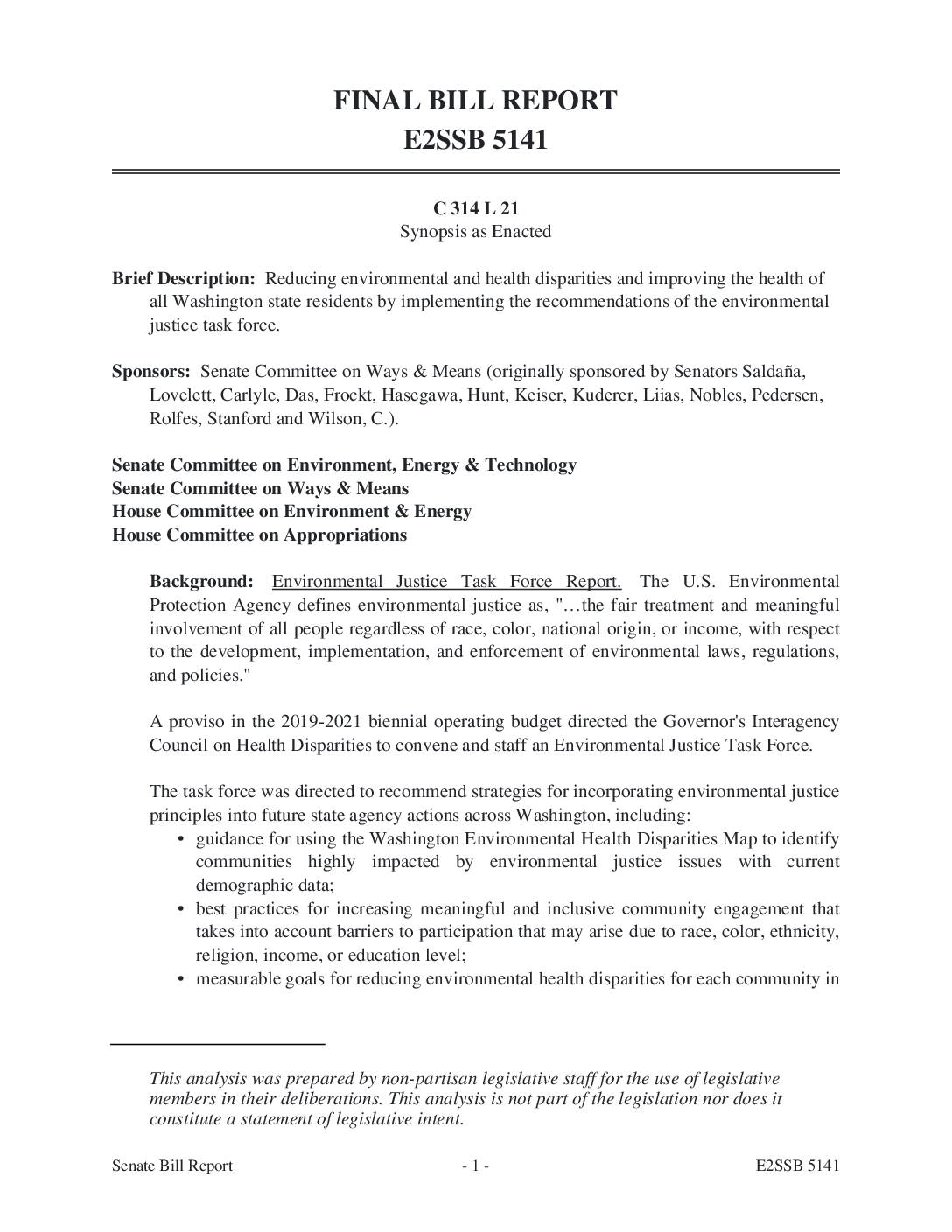
Washington State's E2SSB 5141, enacted in 2021, requires key state agencies including Transportation and Ecology to incorporate environmental justice principles into their planning and decision-making processes, with a focus on protecting overburdened communities from disproportionate environmental and health harms. Agencies must develop community engagement plans by 2022, environmental justice implementation plans by 2023, and conduct formal environmental justice assessments for significant actions such as new rules, grants, and capital investments. Note: this legislation addresses statewide environmental justice policy broadly and does not specifically address Sea-Tac Airport noise issues.