TagLegislation(123)
-
 2024-01-08
Senate Bill 5990: Integrating Environmental Justice Considerations into Certain Project Decisions
Washington Senate Bill 5990, introduced in January 2024, aims to reduce environmental health disparities by requiring assessment of cumulative pollution burdens on overburdened communities before approving new projects. The bill defines key terms such as 'disproportionate impact' and 'environmental justice impact statement,' and establishes a framework to evaluate stressors like air pollution, water quality, and public health risks. Note: this bill addresses broad environmental justice concerns statewide and does not specifically address Sea-Tac Airport noise policy. -
 2024-01-08
HB 2070: Integrating Environmental Justice Considerations into Certain Project Decisions
Washington House Bill 2070 (2024) aims to reduce environmental health disparities by requiring environmental justice impact assessments for projects that may add pollution burdens to already overburdened communities. The bill defines key terms such as 'disproportionate impact' and 'adverse cumulative stressors' to evaluate whether a proposed project would worsen air, water, or other environmental conditions in vulnerable neighborhoods. Note: this bill addresses broad environmental justice considerations statewide and does not specifically concern Sea-Tac Airport noise policy. -
 2024-01-07
Three people posing for photo outside residential building
Image shows three people – two women and one man – standing together and smiling outside what appears to be a residential building with large windows. The setting suggests this may be related to community outreach or organizing activities. -
 2024-01-03
House Bill 2103: Mitigating Harm and Improving Equity in Large Port Districts
Washington House Bill 2103 (2024) requires large port districts operating major airports, such as Seattle-Tacoma International Airport, to dedicate a growing portion of their property tax levy revenue toward programs that reduce noise and air pollution impacts on nearby communities. The bill was prompted by health and equity concerns, as studies show that communities of color living close to Sea-Tac face higher rates of asthma, heart disease, premature births, and other health disparities. Mitigation programs funded under the bill may include repairing failed soundproofing equipment, providing air purifiers, creating urban green spaces, and supporting indoor community facilities in affected neighborhoods. -
 2024-01-01
Senate Bill 5955: Mitigating Harm and Improving Equity in Large Port Districts
Washington Senate Bill 5955 (2024) requires large port districts operating airports, such as the Port of Seattle which runs Sea-Tac International Airport, to dedicate a growing share of their annual property tax levy revenue toward programs that reduce noise and air pollution impacts on nearby communities. Starting in 2024, at least half of any levy revenue increase must fund mitigation efforts, rising to a minimum of 1% of total levy revenue by 2025 and increasing by 1% each year up to a cap of 10%. The bill was introduced in response to documented health disparities—including higher rates of asthma, heart disease, and premature births—affecting Black, Hispanic, Native Hawaiian, and Pacific Islander residents who disproportionately live within 10 miles of Sea-Tac Airport. -
 2024-01-01
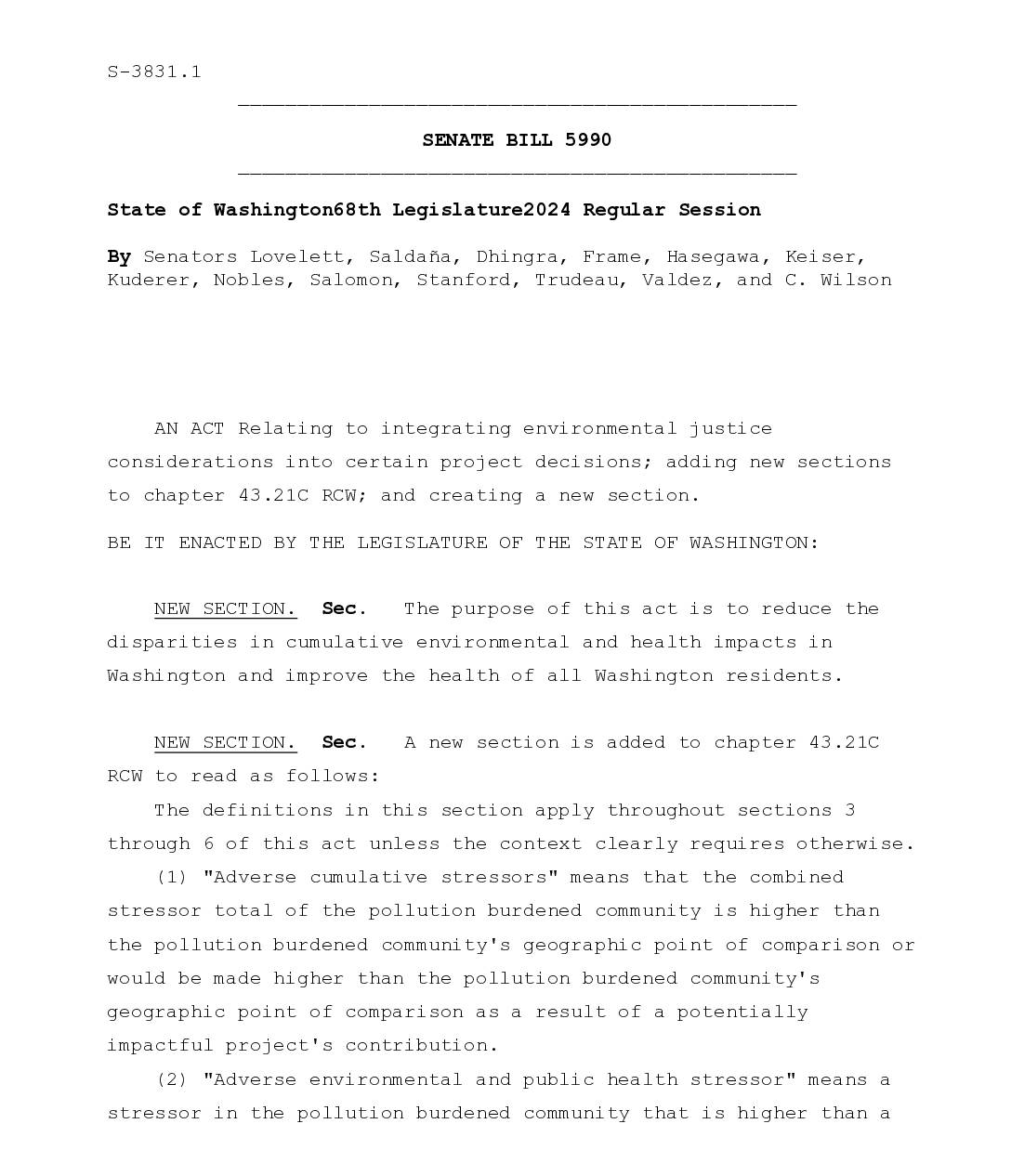
Senate Bill 5990: Integrating Environmental Justice Considerations into Certain Project Decisions
Washington Senate Bill 5990, introduced in the 2024 legislative session, aims to reduce environmental health disparities by requiring detailed impact assessments before approving projects in communities already burdened by pollution. The bill defines key terms such as 'disproportionate impact' and 'environmental justice impact statement,' and establishes a framework for evaluating whether new or expanded projects would worsen cumulative health and environmental stressors in overburdened communities. Note: this bill addresses broad environmental justice policy statewide and does not specifically address Sea-Tac Airport noise or aviation-related impacts. -
 2023-11-07
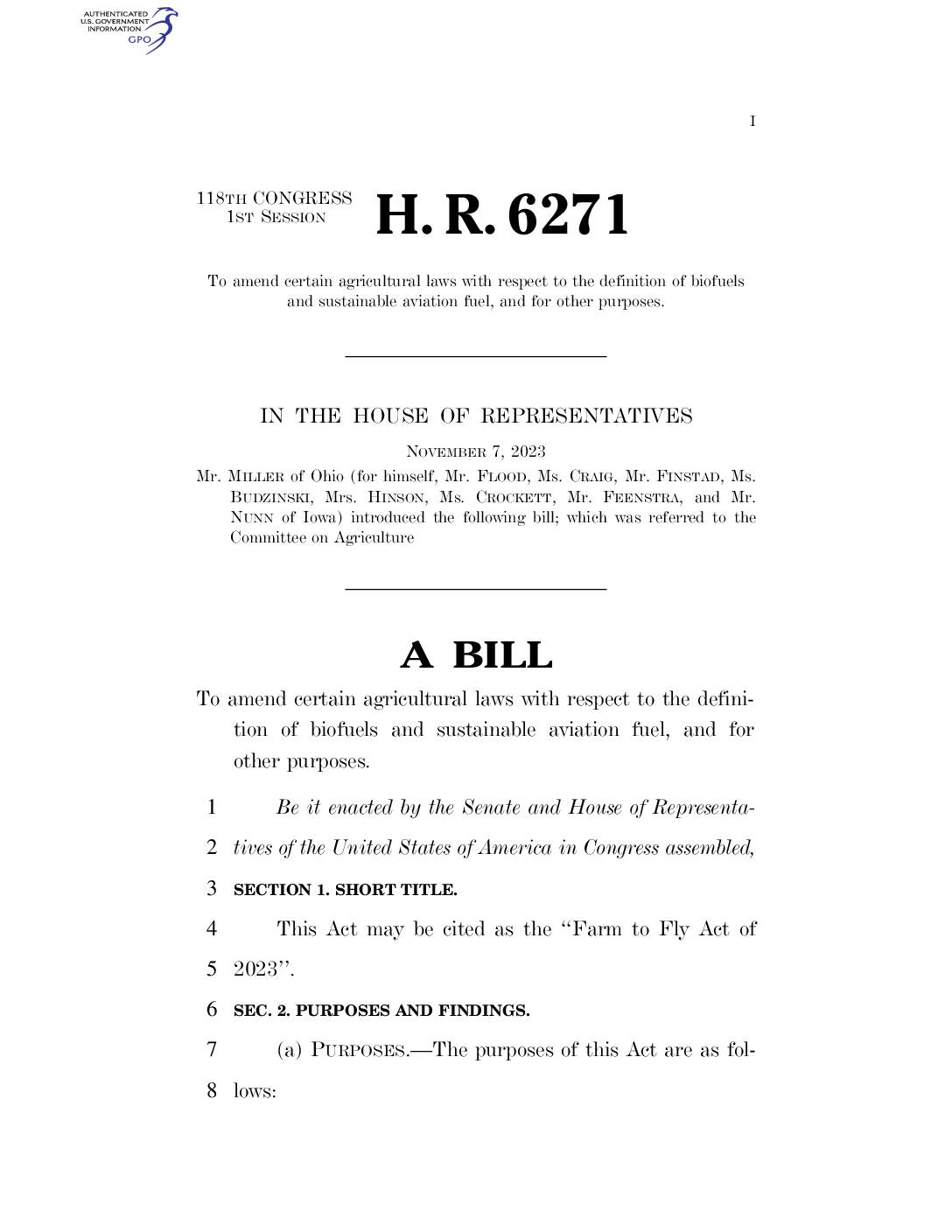
Farm to Fly Act of 2023 (H.R. 6271)
The Farm to Fly Act of 2023 (H.R. 6271) is a U.S. House bill introduced in November 2023 that updates agricultural law definitions to formally include sustainable aviation fuel (SAF) within USDA bioenergy programs. The bill aims to expand the domestic supply of cleaner aviation fuel by supporting American farmers and agricultural feedstocks as key sources for SAF production. It recognizes the partnership between the agricultural and aviation sectors as a means to boost rural economic development and domestic energy security. -
 2023-04-23
Engrossed Substitute Senate Bill 5187
Washington State Engrossed Substitute Senate Bill 5187, passed by both chambers of the legislature on April 23, 2023, is a broad fiscal appropriations act establishing the state budget for the 2023–2025 biennium (July 1, 2023 through June 30, 2025). The bill authorizes funding for salaries, wages, and operating expenses across numerous state agencies and offices, while also amending a wide range of existing state laws related to finance, health, education, and the environment. Note: this document pertains to general Washington State fiscal matters and does not appear to contain specific provisions related to Sea-Tac Airport noise policy. -
 2023-02-14
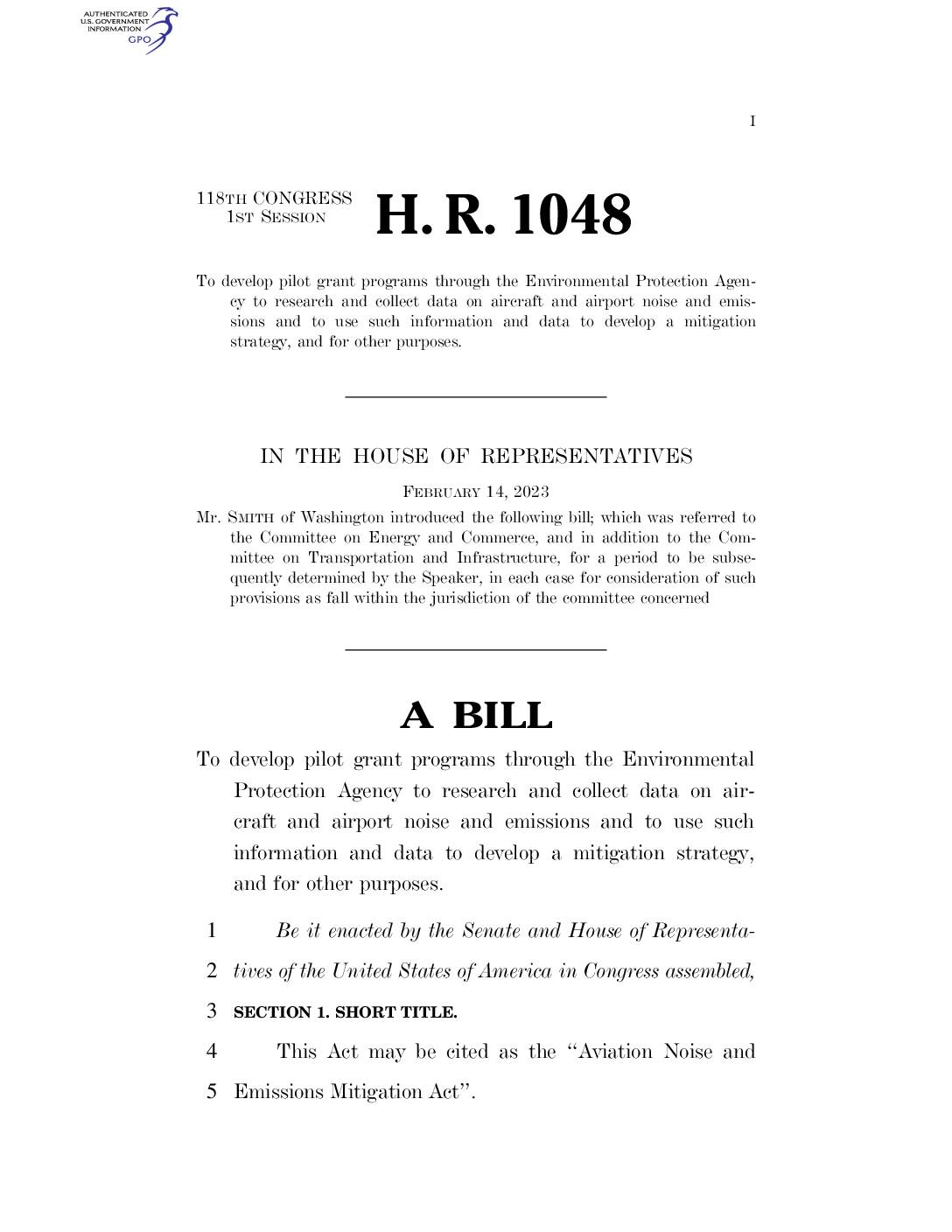
Aviation Noise and Emissions Mitigation Act (H.R. 1048)
H.R. 1048, the Aviation Noise and Emissions Mitigation Act, introduced in February 2023, would direct the EPA to establish a 3-year pilot grant program to measure aircraft and airport noise and emissions—including greenhouse gases, particulate matter, and ultrafine particles—in communities near airports and flight paths. Grant recipients would be required to use technology capable of tracing noise and emissions to specific sources, produce neighborhood- and ZIP Code-level data, and work with local organizations to develop mitigation strategies. The program aims to create a replicable national model for ongoing monitoring and to identify frontline communities disproportionately impacted by aviation-related pollution. -
 2023-01-05
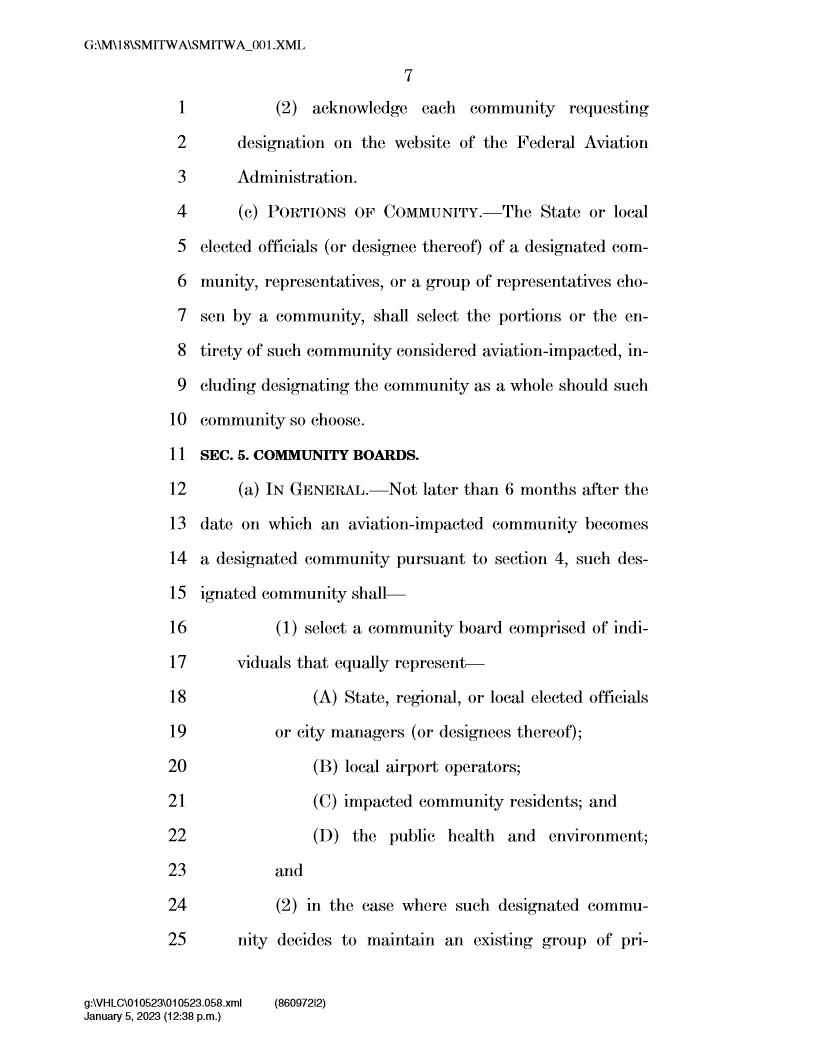
Aviation-Impacted Communities Act Draft — Community Board Structure (Page 7, January 2023)
Page 7 of a U.S. House legislative draft (file g:WHLC1052310523.058.xml, dated January 5, 2023) covering Sections 4–5 of what appears to be the Sen/Rep Smith aviation noise bill (SMITWA). The text establishes that designated aviation-impacted communities must, within 6 months, select a community board equally representing elected officials, local airport operators, impacted residents, and public health and environment interests.