TagPort Of Seattle(2400)
-
 1973-05-01
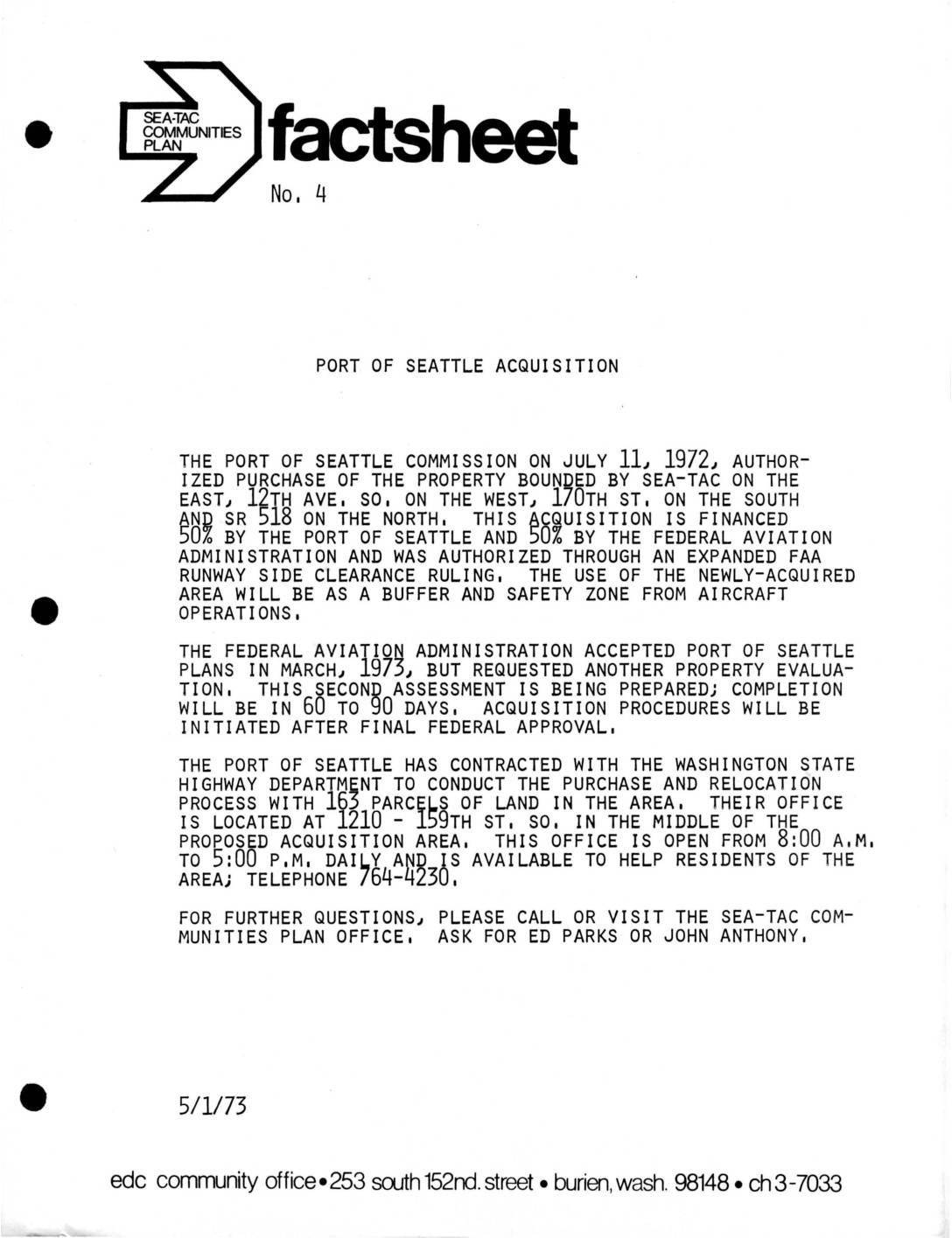
Fact Sheet No. 4: Port Of Seattle Acquisition
In July 1972, the Port of Seattle Commission authorized the purchase of property around Sea-Tac Airport, bounded by 12th Ave. S., 170th St., and SR 518, to serve as a buffer and safety zone from aircraft operations. The acquisition is split equally between the Port of Seattle and the Federal Aviation Administration under an expanded FAA runway side clearance ruling. As of May 1973, a second property evaluation was underway, with acquisition procedures set to begin after final federal approval of the 163 affected parcels. -
 1973-01-01
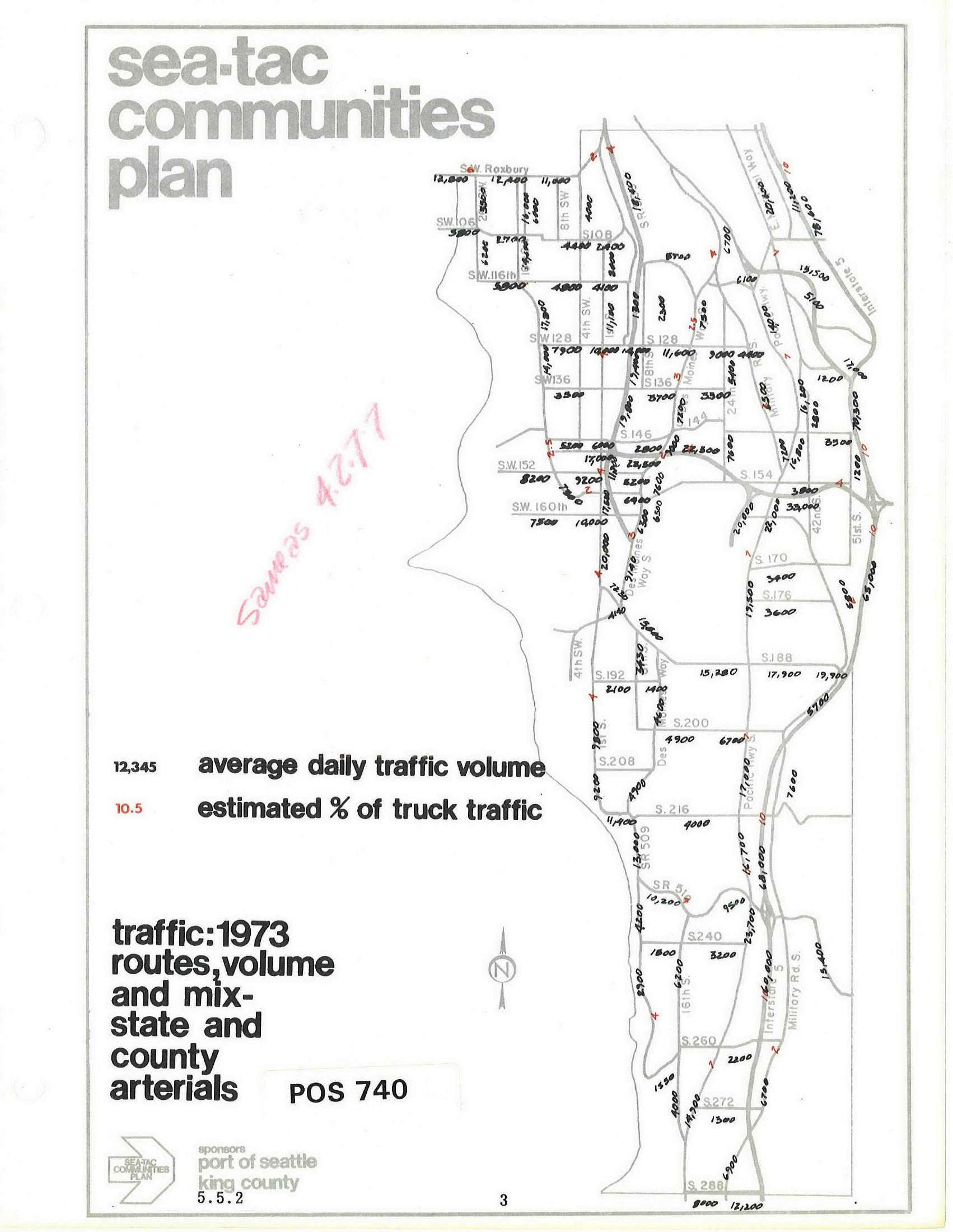
Sea-Tac Communities Plan: 1973 Average Daily Traffic Volumes on State and County Arterials
Map document from the Sea-Tac Communities Plan (document number POS 740, section 5.5.2) showing 1973 average daily traffic volumes and estimated truck traffic percentages on state and county arterials in the Sea-Tac area. Sponsored by the Port of Seattle and King County, the map displays street-level traffic counts across roads including SW 106th through S 288th, with a handwritten notation 'Savings 4,277' in red. -
 1973-01-01
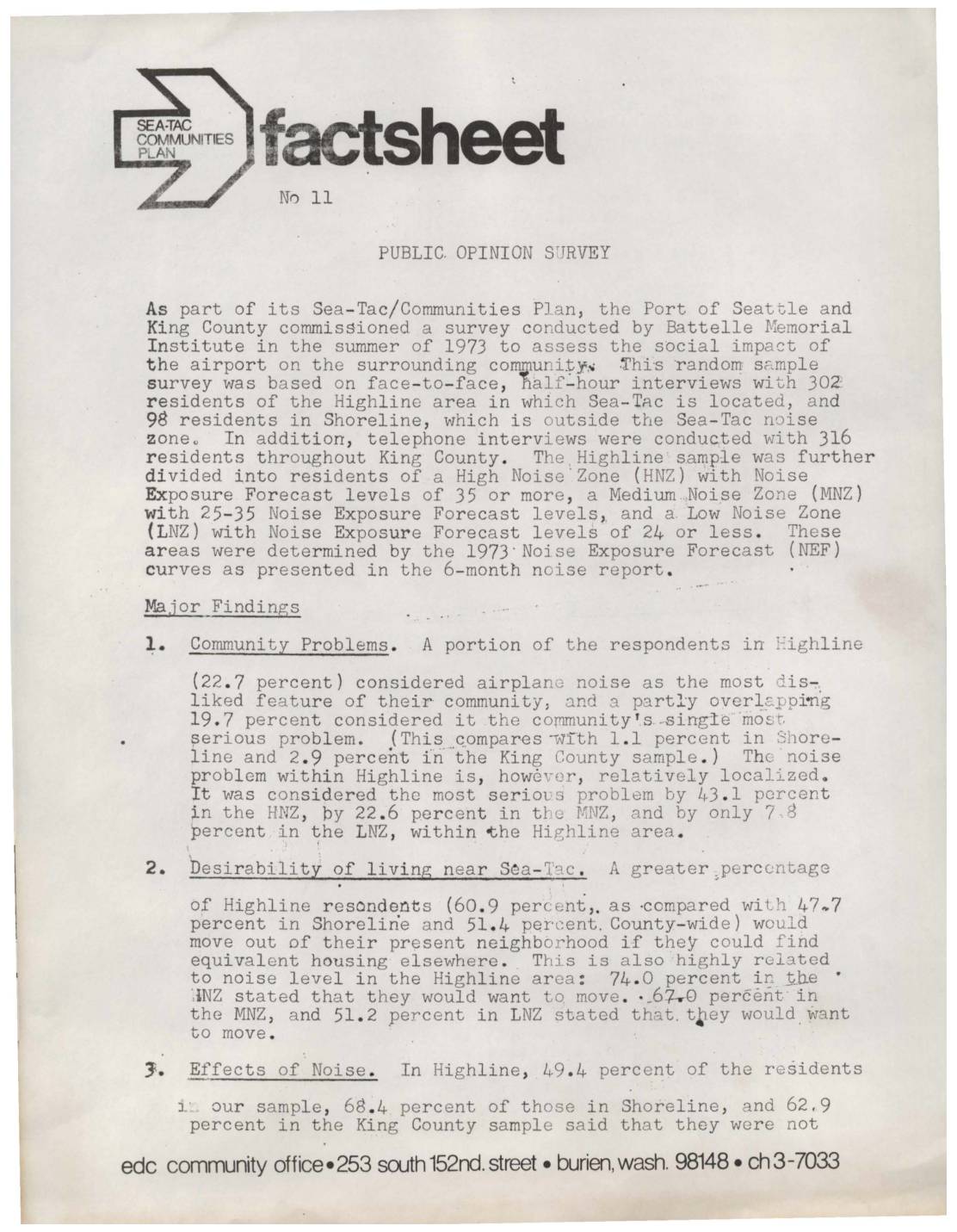
Public Opinion Survey: Sea-Tac Communities Plan Factsheet No. 11
A 1973 public opinion survey commissioned by the Port of Seattle and King County found that nearly one in five Highline-area residents considered airplane noise from Sea-Tac Airport their community's single most serious problem, with concern rising sharply among those living in the highest-noise zones. Highline residents were more likely to want to move than those in quieter comparison areas, though the survey also found that the Port of Seattle was viewed favorably by a strong majority across all groups surveyed. -
 1972-11-27
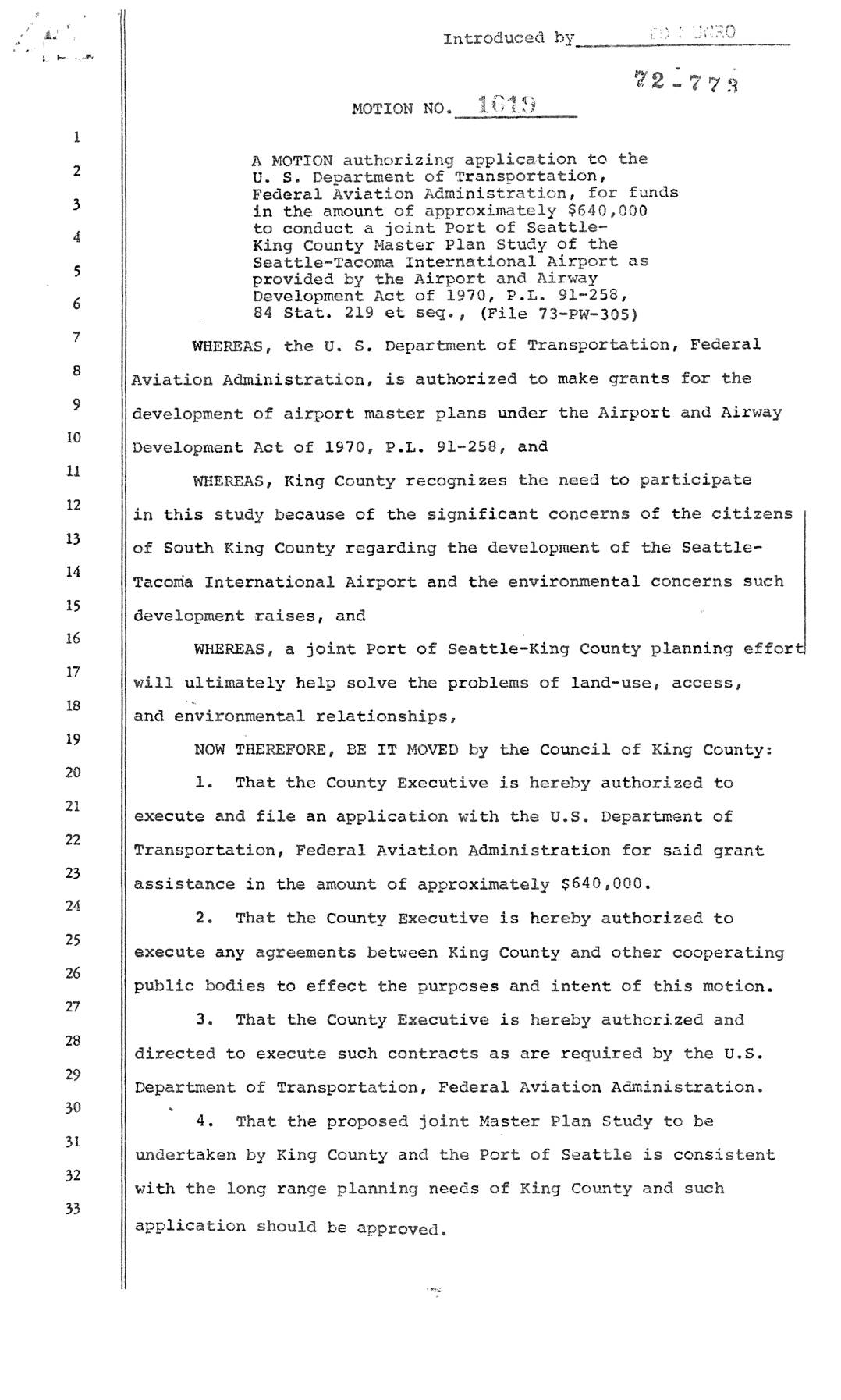
Motion No. 1019: Authorizing Application for Federal Aviation Administration Grant for Joint Port Of Seattle–King County Master Plan Study of Seattle-Tacoma International Airport
In November 1972, the King County Council passed Motion No. 1019, authorizing the County Executive to apply for approximately $640,000 in federal grant funding from the U.S. Department of Transportation's Federal Aviation Administration. The funds were intended to support a joint Port of Seattle–King County Master Plan Study of Seattle-Tacoma International Airport, prompted by citizen concerns in South King County about airport expansion and its environmental impacts. The motion also authorized the County Executive to enter into agreements with other public bodies and execute any contracts required by the FAA to carry out the study. -
 1972-11-06
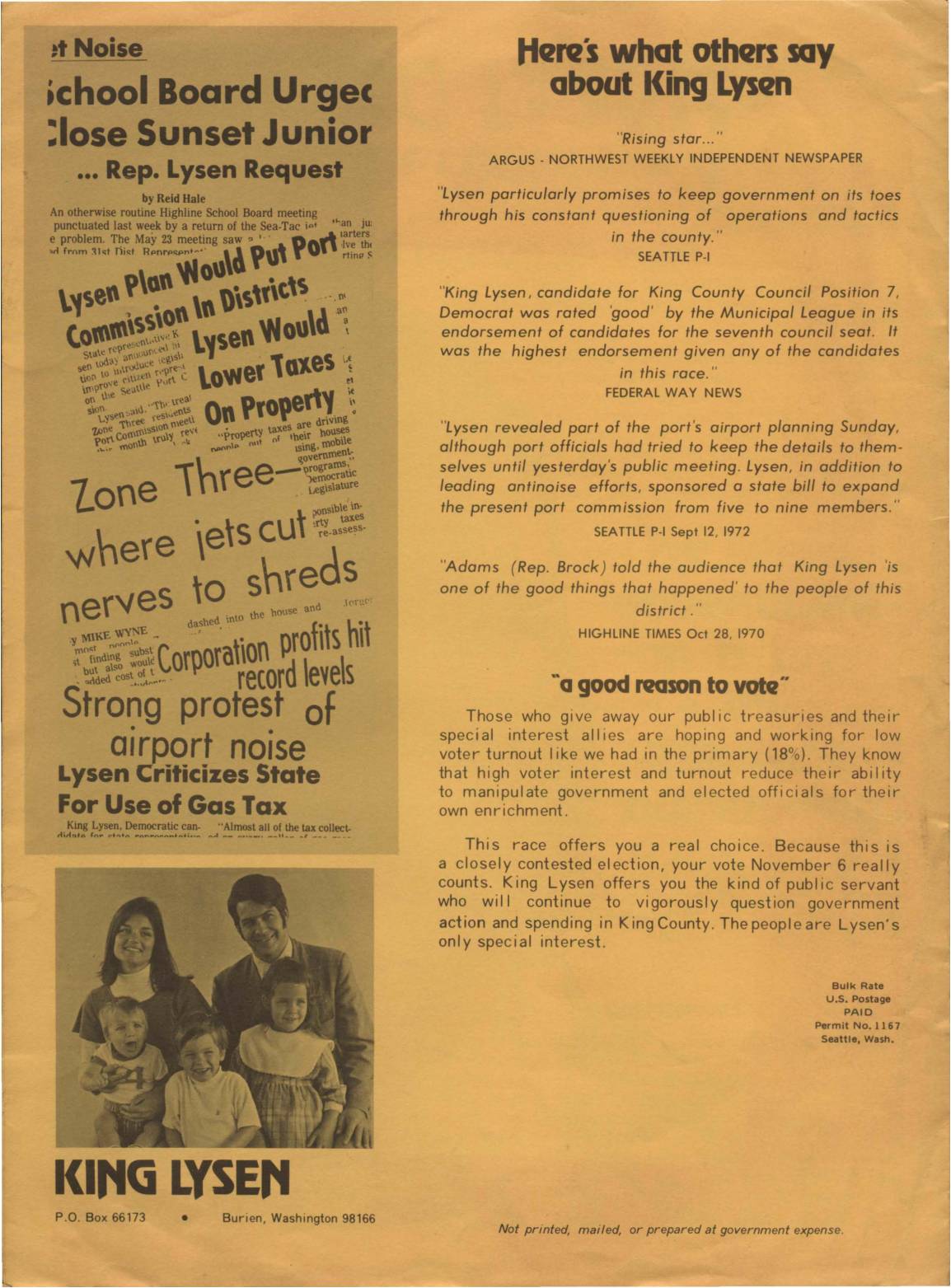
King Lysen for King County Council Position 7 campaign mailer
This is a campaign mailer for King Lysen, a Democratic candidate for King County Council Position 7 in the early 1970s, highlighting his record of challenging government spending and operations in King County, Washington. Lysen was notably active in anti-noise efforts related to Sea-Tac Airport, including revealing port airport planning details to the public and sponsoring a state bill to expand the port commission from five to nine members. The mailer compiles endorsements from outlets such as the Seattle Post-Intelligencer, the Argus, and the Federal Way News, emphasizing his reputation as a government watchdog and advocate for residents affected by airport noise. -
 1970-10-01
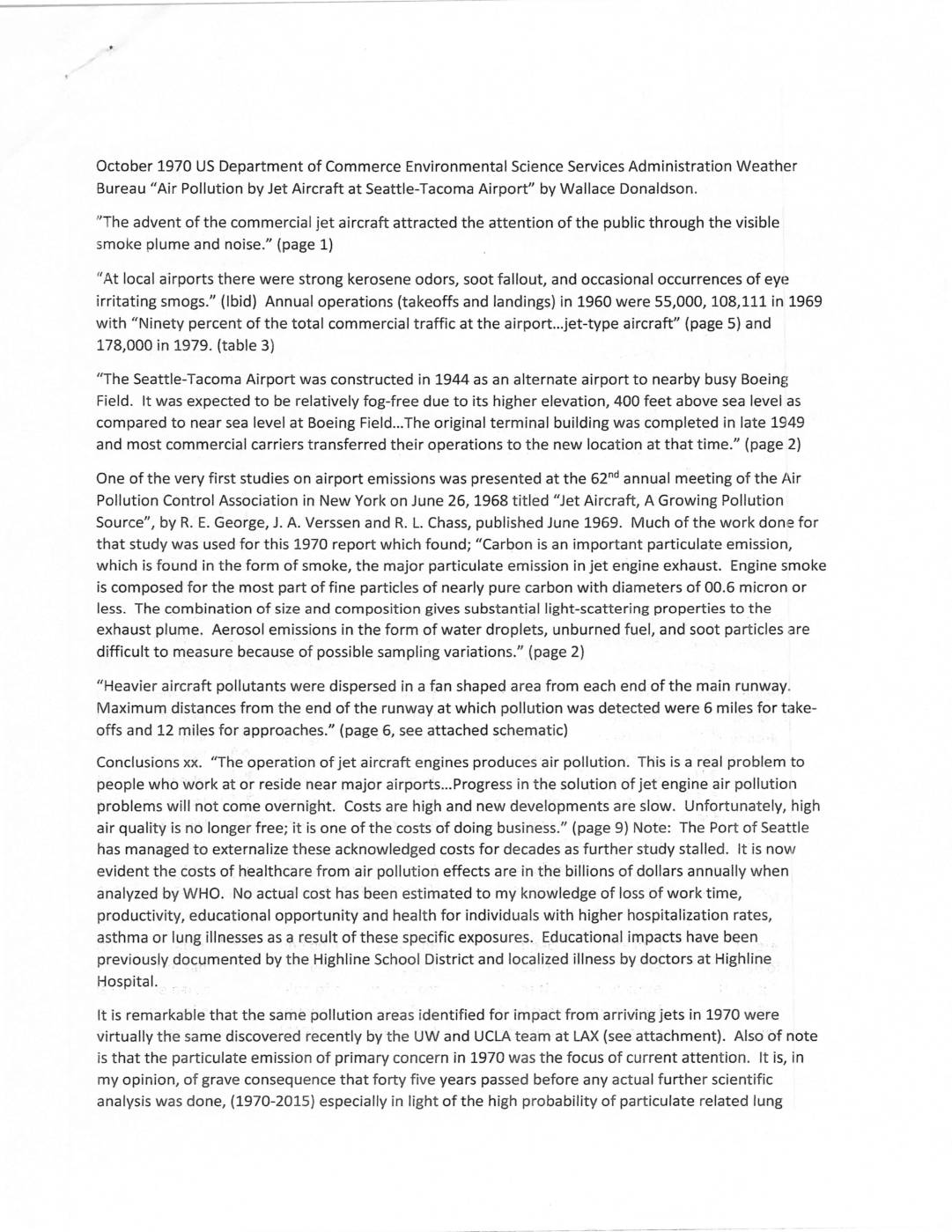
Air pollution by jet aircraft at Seattle-Tacoma Airport: Historical summary and commentary
This document traces decades of air pollution concerns around Seattle-Tacoma International Airport, drawing on studies from 1970 through 1991 that documented harmful emissions including carbon particles, hydrocarbons, and nitrogen oxides affecting residents living near the airport. It highlights how early research identified health risks and pollution spread up to 12 miles from the runways, yet meaningful follow-up scientific study and regulatory action were largely delayed for 45 years. Community groups, lawsuits, and independent monitoring repeatedly confirmed that nearby residents faced noise, kerosene odors, soot, and air quality violations, while the Port of Seattle externalized the associated public health costs. -
 1966-04-17
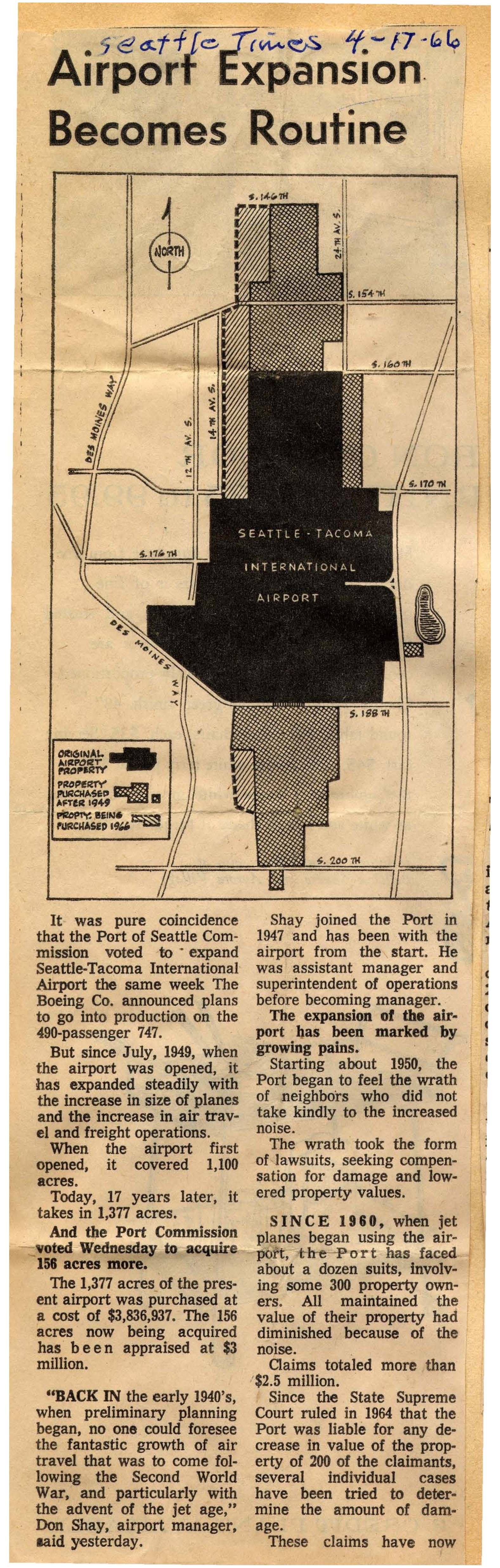
Airport expansion becomes routine
A April 17, 1966 Seattle Times article reports that the Port of Seattle Commission voted to acquire 156 additional acres, expanding Seattle-Tacoma International Airport from its original 1,100 acres at opening in 1949 to over 1,500 acres. The expansion coincided with Boeing's announcement of the 490-passenger 747, reflecting rapid growth in air travel and freight. The article also details mounting legal challenges from roughly 300 neighboring property owners seeking over $2.5 million in compensation for noise-related property value losses, particularly since the introduction of jet aircraft in 1960. -
 1962-01-01
Seattle-Tacoma International Airport and its impact upon the economy of King County
This 1962 report by the Seattle Port Commission examines the history and economic impact of Seattle-Tacoma International Airport on King County. It covers the airport's development milestones, airborne traffic trends including passenger numbers, airmail, air freight, and aircraft operations, as well as forecasts for future growth. The report also analyzes the airport's primary and secondary economic effects on the local economy, making it a foundational document for understanding Sea-Tac's early role as a regional economic driver. -
 1957-07-17
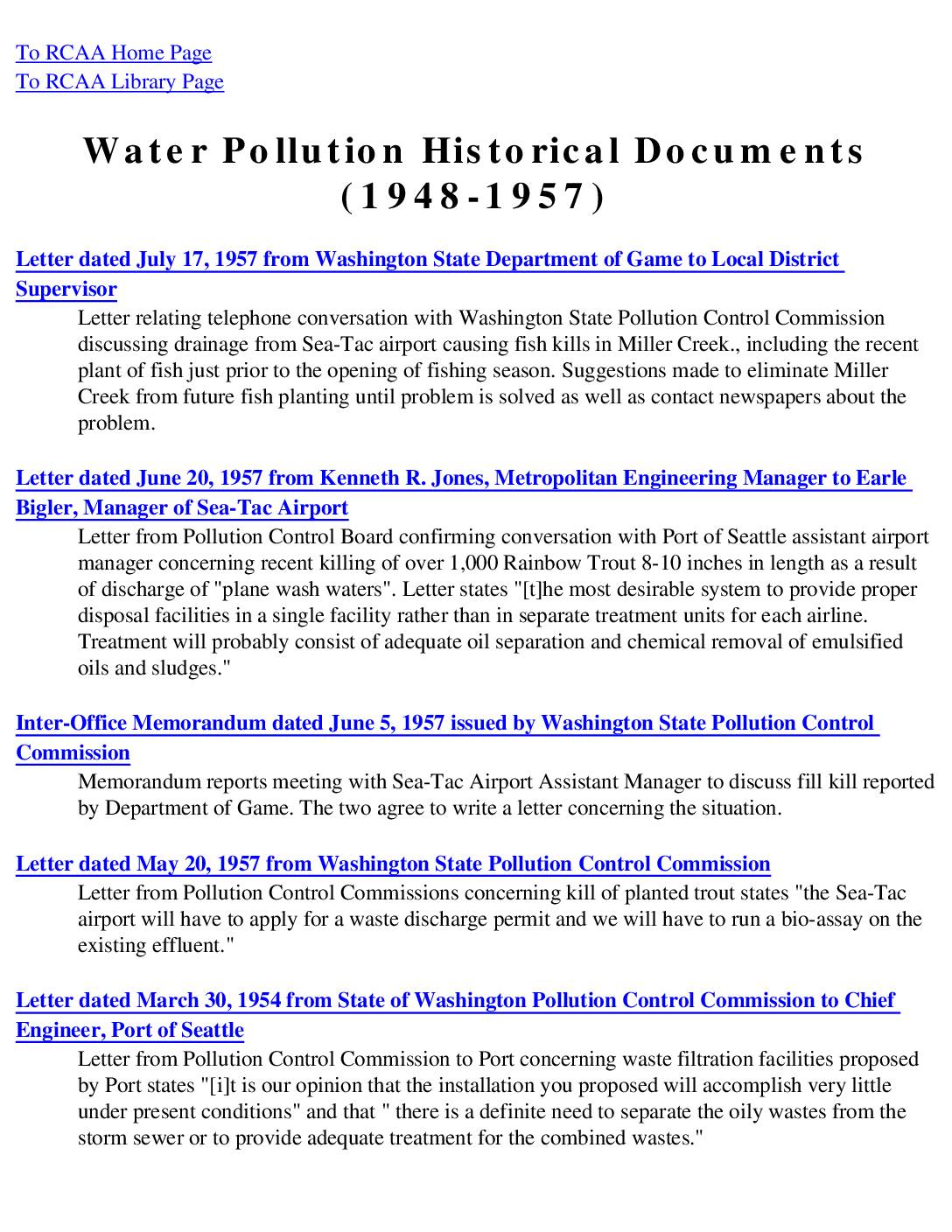
Water pollution historical documents (1948-1957)
This collection of historical documents from 1948 to 1957 chronicles ongoing water pollution problems caused by Sea-Tac Airport's drainage of aircraft wash water, oils, and chemicals into nearby Miller Creek and Des Moines Creek. The records show repeated fish kills, contamination of private property, and years of failed or inadequate treatment solutions, prompting complaints from residents, state legislators, and wildlife agencies. Despite numerous proposals and temporary fixes, the Washington State Pollution Control Commission continued to pressure the Port of Seattle to develop a permanent waste disposal system throughout the period. -
 1956-01-01
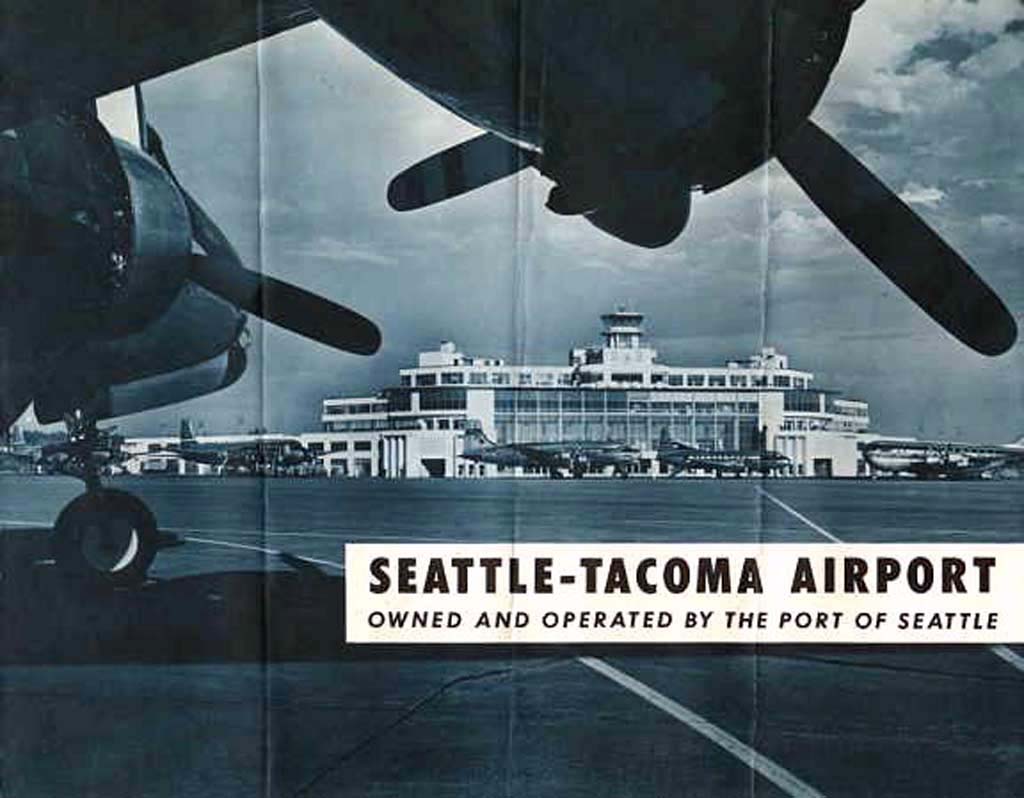
Sea-Tac Airport Terminal Promotional Brochure Cover, 1956
Cover image of a promotional brochure for Seattle-Tacoma Airport, owned and operated by the Port of Seattle. The black-and-white photograph shows the original terminal building viewed from the tarmac, framed by propeller aircraft in the foreground, consistent with mid-20th century airport imagery from the era of SeaTac's early operations.