TagPort Of Seattle(2405)
-
 1996-12-01
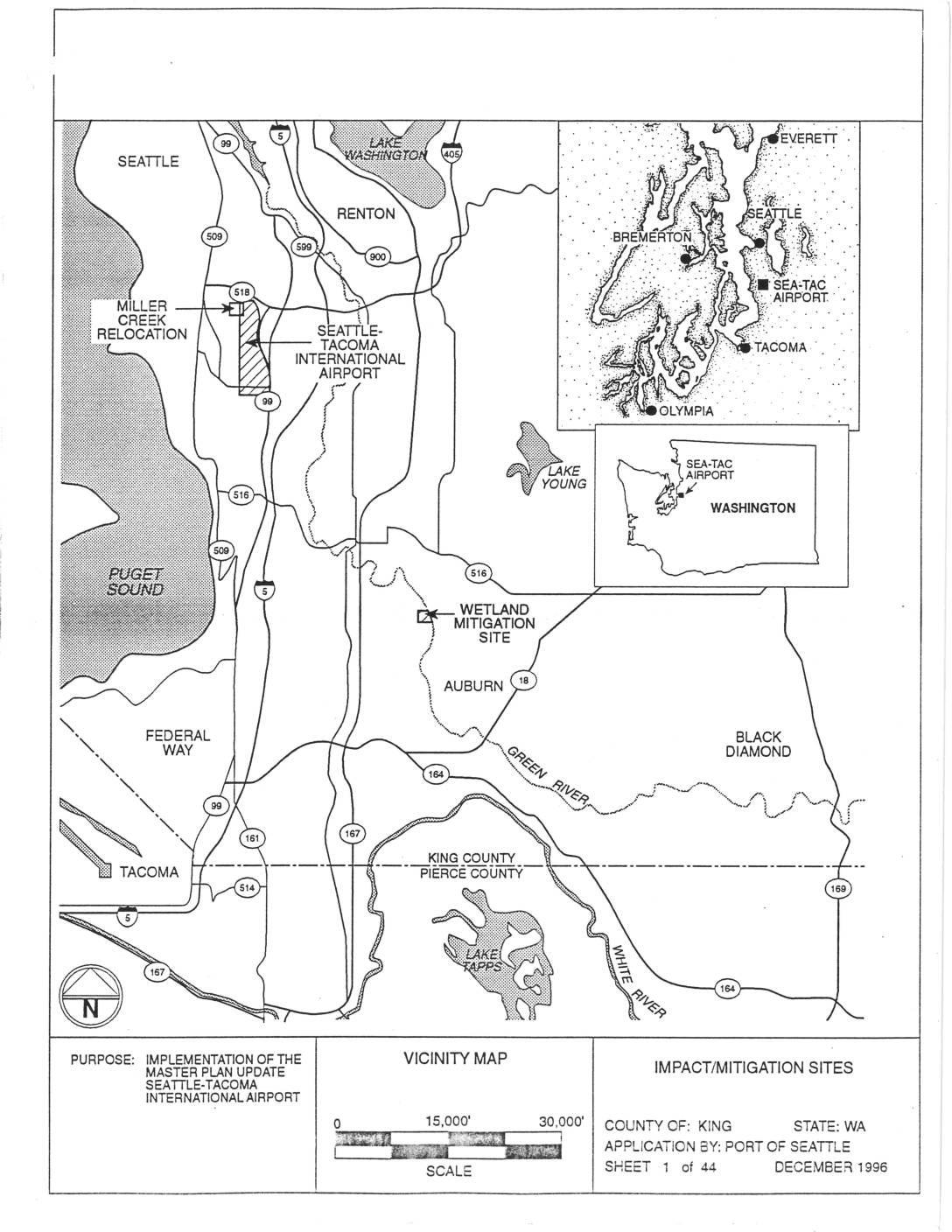
Sea-Tac Master Plan Update 1996: Wetland Impact/Mitigation Sites — Vicinity Map, Wetlands Affected, and Classification/Size/Impact Tables
This 1996 document outlines the Port of Seattle's wetland impact and mitigation plan associated with the Seattle-Tacoma International Airport Master Plan Update. It includes vicinity maps showing the airport's location in King County, Washington, and identifies numerous wetland sites affected by planned airport improvements. Detailed tables classify each impacted wetland by type—forested, shrub-scrub, or emergent—and quantify the acreage disturbed across sections of Townships 22N and 23N, Range 4E. -
 1996-11-18
EXH AR027767: Annual Stormwater Monitoring Report for Seattle-Tacoma International Airport, July 1995–June 1996
Annual Stormwater Monitoring Report for Seattle-Tacoma International Airport (STIA) covering the period July 1, 1995 through June 30, 1996, AR 027767–027769. Prepared by Scott Tobiason, Environmental Management Specialist, Port Of Seattle Environmental Services. Reviewed by Tom Hubbard (Port of Seattle) and Gary Minton (Resource Planning Associates). Document concerns NPDES stormwater monitoring at Sea-Tac Airport. -
 1996-10-01
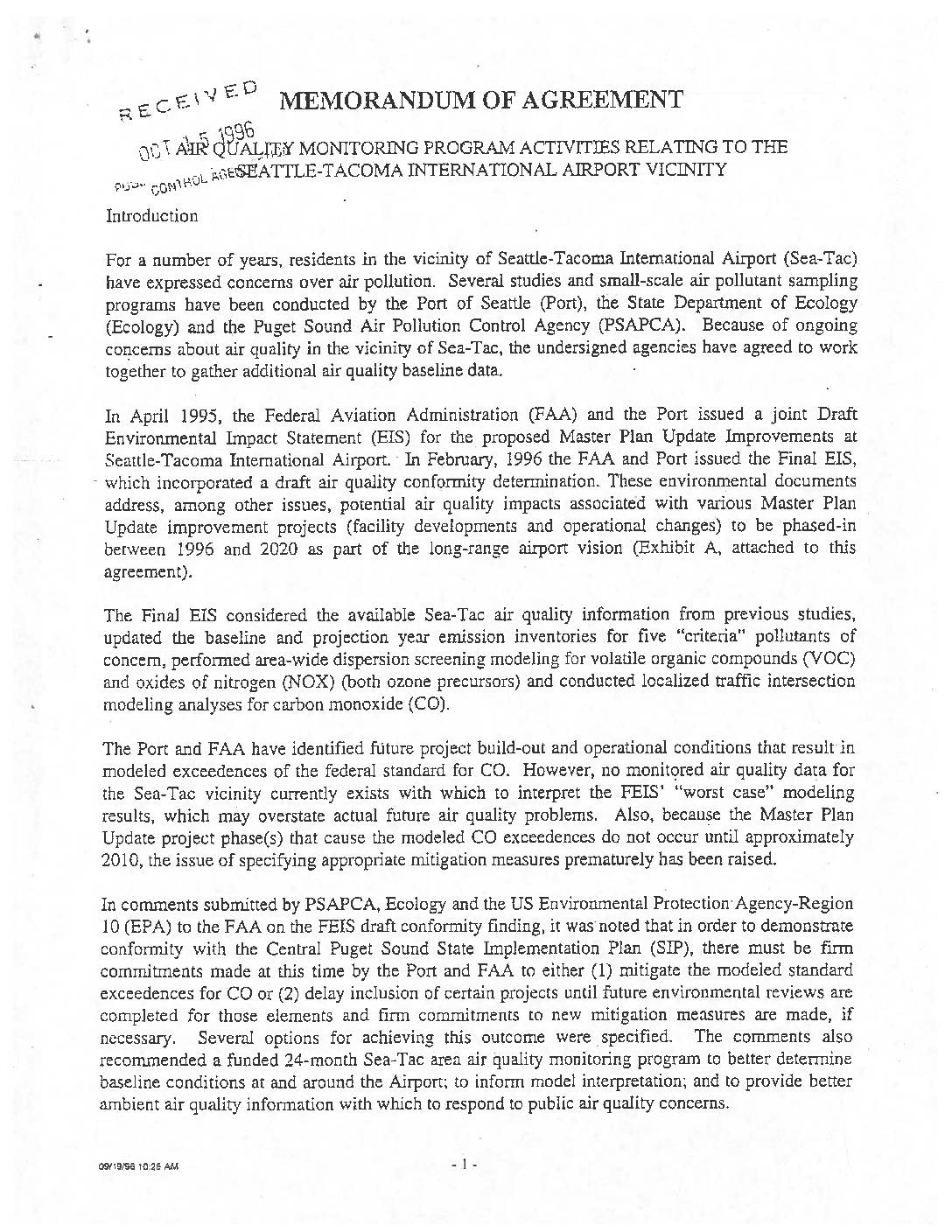
Memorandum of Agreement: Air Quality Monitoring Program Activities Relating to the Seattle-Tacoma International Airport Vicinity
This 1996 Memorandum of Agreement establishes a 24-month air quality monitoring program near Seattle-Tacoma International Airport, involving the Port of Seattle, FAA, EPA, Washington State Department of Ecology, and the Puget Sound Air Pollution Control Agency. The program, funded at $195,000, focuses on measuring carbon monoxide, nitrogen oxides, and aircraft fuel particle residue to establish baseline air quality data and evaluate potential pollution impacts from planned airport expansion projects. The Port agreed not to proceed with expansion elements projected to cause carbon monoxide standard violations until monitoring is complete and, if necessary, mitigation measures are identified. -
 1996-09-19
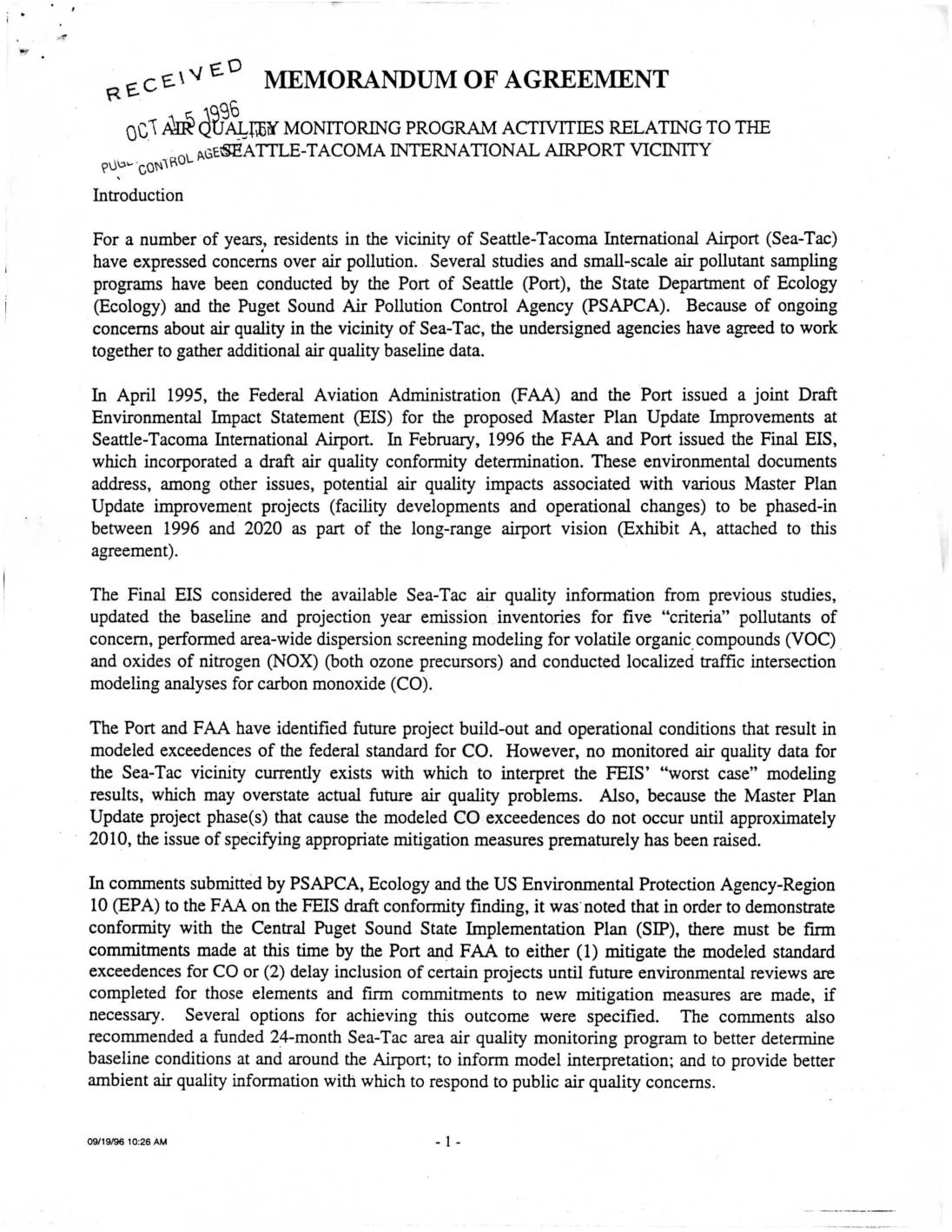
Memorandum of Agreement: Air Quality Monitoring Program Activities Relating to the Seattle-Tacoma International Airport Vicinity
A 1996 Memorandum of Agreement between the Port of Seattle, FAA, EPA, Washington State Department of Ecology, and the Puget Sound Air Pollution Control Agency established a 24-month air quality monitoring program near Seattle-Tacoma International Airport. The $195,000 program was designed to measure carbon monoxide, nitrogen oxides, and aircraft fuel particle residue in order to establish baseline pollution data and assess the accuracy of earlier 'worst case' air quality models from the airport's Final Environmental Impact Statement. The Port agreed not to proceed with Master Plan expansion projects projected to cause CO standard exceedances until monitoring was complete and, if necessary, appropriate mitigation measures were identified. -
 1996-08-22
EXH AR026790: NPDES Permit WA-002465-1 Modification Response to Comments
This 1996 document summarizes public responses to a proposed modification of the water discharge permit (NPDES Permit No. WA-002465-1) for Sea-Tac International Airport, operated by the Port of Seattle. It addresses concerns raised at a June 1996 public hearing in Burien, WA, including questions about self-monitoring of water samples, erosion and water flow in Miller Creek, and the Department of Ecology's enforcement and fining process. The document outlines how Ecology responded to community concerns and describes permit changes, such as a new condition requiring the Port to assess the airport's impact on local creek hydrology. -
 1996-08-01
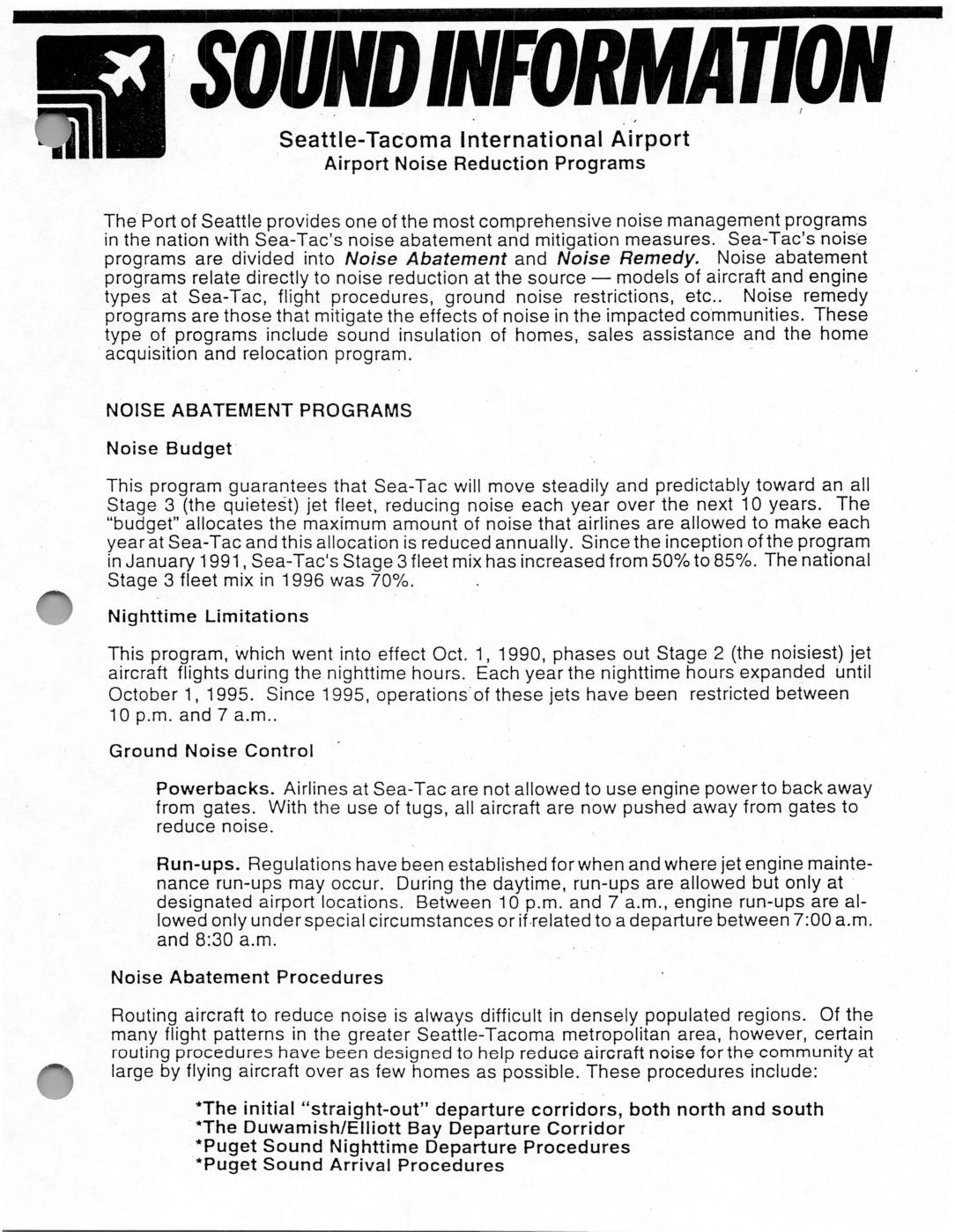
STIA Airport Noise Reduction Programs: Sound Information Fact Sheets
Seattle-Tacoma International Airport operates one of the nation's most comprehensive airport noise management programs, divided into Noise Abatement measures — such as restricting the noisiest Stage 2 jets at night, controlling ground engine use, and routing flight paths over fewer homes — and Noise Remedy programs that help affected residents through home sound insulation, sales assistance, and a completed acquisition program that purchased 1,400 severely impacted homes. The Port of Seattle also monitors noise levels through an 11-station system and tracks flight paths using FAA radar data to ensure compliance. Residents can report concerns or request information 24 hours a day via the Noise Information/Complaint Line at 433-5393 or toll-free at 1-800-826-1147. -
 1996-05-15
Barge in dirt for runway? Idea for filling ravine is built on conveyor, not trucks
In 1996, Lynnwood engineer Hank Hopkins proposed using barges and an electric conveyor belt system to transport the roughly 14 million cubic yards of fill dirt needed to build a third runway at Seattle-Tacoma International Airport, rather than relying on a constant stream of dump trucks. Hopkins argued his patented modular conveyor system would be faster, cheaper, quieter, and less disruptive to surrounding communities than the truck-based approach outlined in the environmental study. The city of Des Moines, which opposed the runway project, was seen as the primary obstacle to approving the conveyor plan, as the system would require city permits that trucking would not. -
 1996-03-27
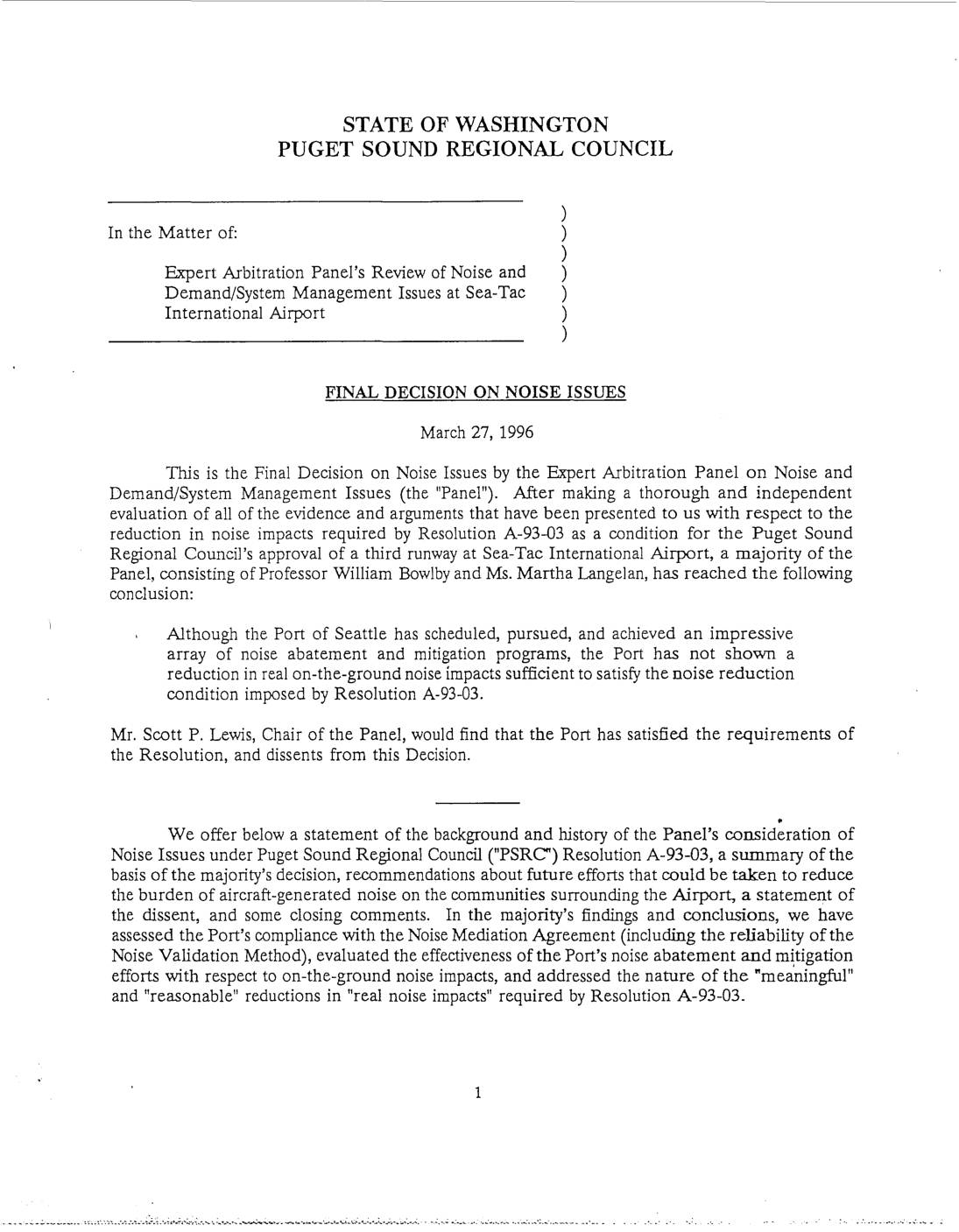
Final Decision on Noise Issues – Expert Arbitration Panel’s Review of Sea-Tac International Airport
★In March 1996, an Expert Arbitration Panel reviewed whether the Port of Seattle had met noise reduction requirements set by the Puget Sound Regional Council as a condition for approving a third runway at Sea-Tac International Airport. A majority of the Panel concluded that, despite the Port's extensive noise abatement programs, it had not demonstrated a sufficient reduction in real, on-the-ground noise impacts to satisfy Resolution A-93-03. This decision left the noise condition as the sole remaining hurdle for authorizing the third runway's construction. -
 1996-03-27
Appendix E: Comments Concerning the Final Environmental Impact Statement — Sea-Tac Airport Master Plan Update
Appendix E contains public comments submitted in response to the Final Environmental Impact Statement (FEIS) for the Seattle-Tacoma International Airport Master Plan Update. Commenters include the Highline Water District, the Washington State Department of Ecology, the U.S. Public Health Service, and the Washington State Department of Natural Resources, raising concerns about groundwater contamination, the handling of aircraft de-icing glycols, storm water runoff, and surface mining permit requirements for borrow sites on Port of Seattle property. The agencies generally called for stronger mitigation measures and clearer answers to environmental questions before approving the proposed airport expansion. -
 1996-03-27
PSRC Expert Arbitration Panel Final decision on noise issues
The Expert Arbitration Panel on Noise and Demand/System Management Issues issued its final decision on noise issues related to Resolution A-93-03, which set noise reduction conditions for PSRC authorization of a third runway at Sea-Tac International Airport. A majority of the Panel found that the Port of Seattle had not demonstrated a sufficient reduction in