Notes
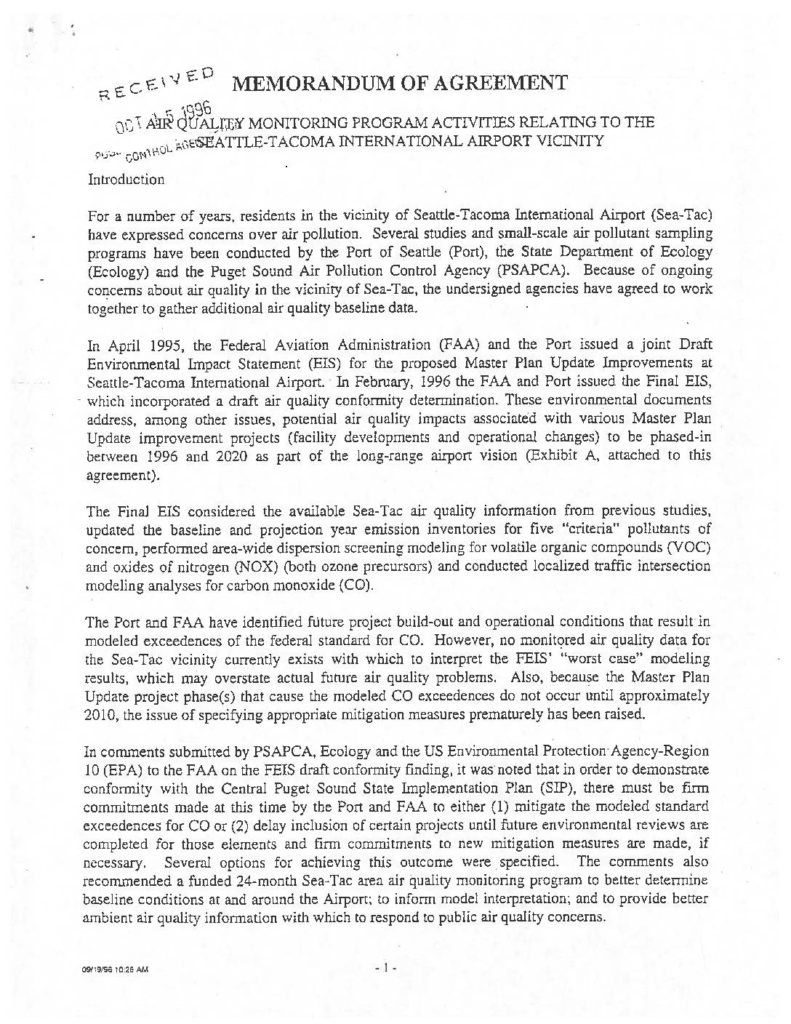
Memorandum of Agreement (MOA) signed October 1996 among the Port of Seattle, Federal Aviation Administration (FAA), Washington State Department of Ecology, Puget Sound Air Pollution Control Agency (PSAPCA), and EPA Region 10 establishing a 24-month air quality monitoring program in the Sea-Tac Airport vicinity. The MOA responds to FEIS comments on the Sea-Tac Master Plan Update EIS (issued February 1996) and addresses modeled exceedences of the National Ambient Air Quality Standard (NAAQS) for carbon monoxide (CO) at roadway intersections, oxides of nitrogen (NOX) from aircraft departure backup queues, ground-level residue from aircraft fuel particle discharges, toxic substances, and fugitive dust particulate matter from construction. Total funding of $195,000 committed: Ecology ($35K), EPA ($30K), Port of Seattle ($130K). Field monitoring scheduled for completion by June 1998. Port agrees not to proceed with Master Plan Update elements projected to cause CO exceedences until monitoring is complete and mitigation identified. Conformity with Central Puget Sound State Implementation Plan (SIP) under Clean Air Act is a central concern.