TagPort Of Seattle(2405)
-
 1997-09-29
EXH 2090 (AR 033510): Annual Stormwater Monitoring RP STIA Jul 1, 1996–May 31, 1997
This 1997 Annual Stormwater Monitoring Report, prepared by Scott Tobiason of Port of Seattle Environmental Services, documents water quality data collected from Seattle-Tacoma International Airport's stormwater discharges between July 1, 1996 and May 31, 1997. The report analyzes discharge samples from stormwater outfalls across the airport's drainage basins, comparing results to regional and national benchmarks, and notes that improvements from newly installed Best Management Practices (BMPs) would be evaluated in the following year's report. It was submitted to the Washington Department of Ecology in fulfillment of Special Condition S.9 of the airport's NPDES permit. -
1997-09-03
Petition Calls For Changing Port Of Seattle’s Name To Port Of King County
Lisa Pemberton-Butler Seattle Times Business Reporter King County voters may be asked later this year if they’d like to change the Port of Seattle’s name to the Port of King County, reflecting that its money comes from taxpayers across the county. A group called King County Citizens for an Accountable Port yesterday turned in a -
 1997-07-03
EXH AR041146: FAA Record of Decision for Sea-Tac Airport Master Plan Update Development Actions
FAA Northwest Mountain Region Record of Decision (ROD) dated July 3, 1997, providing final Federal Aviation Administration approval for Sea-Tac International Airport Master Plan Update development actions adopted by Port of Seattle (POS) Commission Resolution #3212 (August 1, 1996) and amended by Resolution No. 3245 (May 27, 1997). Approves a new 8500-foot dependent air carrier -
 1997-06-30
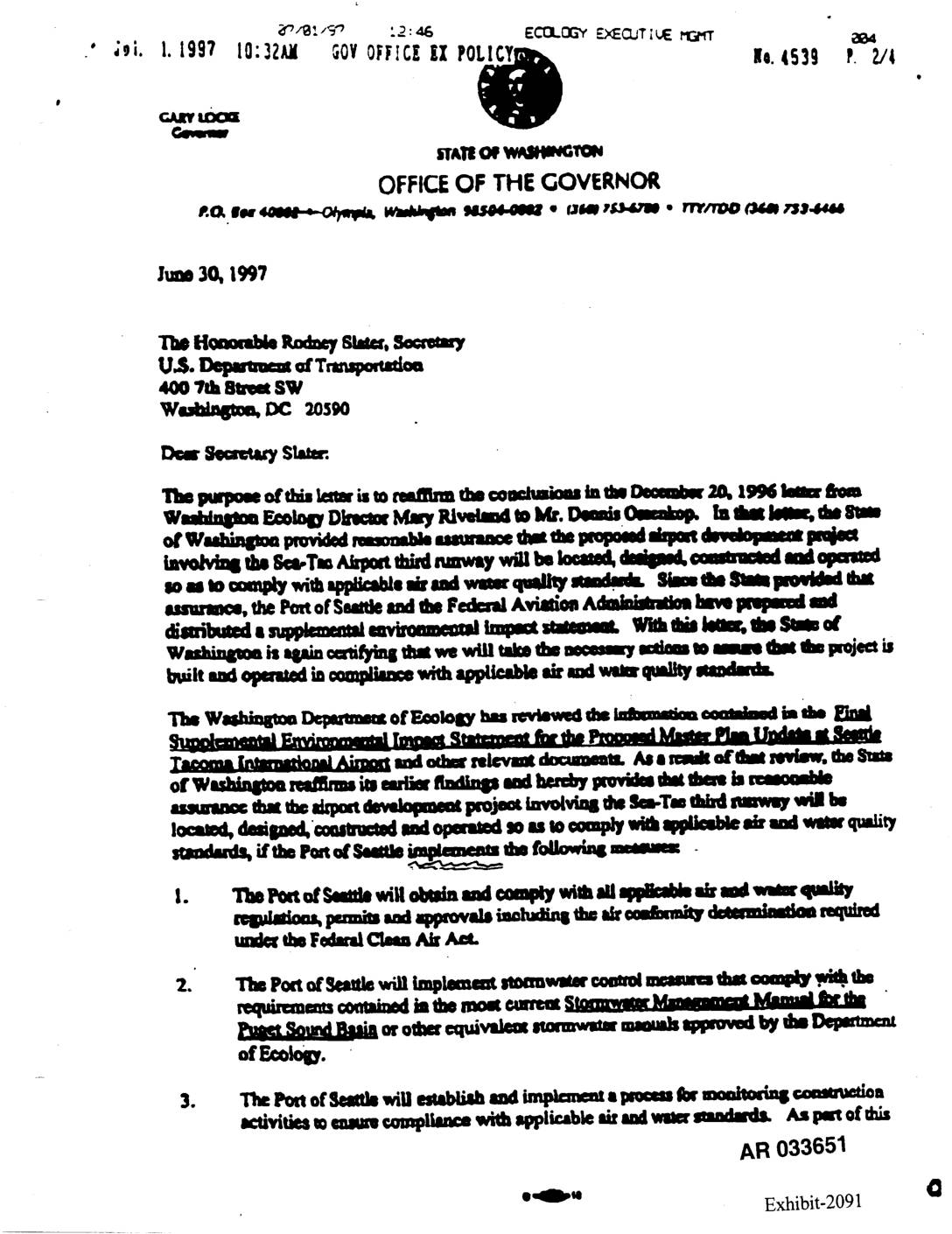
Exhibit 2091: Governor Gary Locke Letter to Secretary Rodney Slater Re: Sea-Tac Airport Third Runway Air and Water Quality Assurance
June 30, 1997 letter from Washington Governor Gary Locke to U.S. Department of Transportation Secretary Rodney Slater reaffirming state certification under 49 U.S.C. 47101 for the Sea-Tac Airport third runway development project. Supersedes December 20, 1996 letter from Ecology Director Mary Riveland to Dennis Ossenkop. Port of Seattle required to: obtain air and water quality -
 1997-06-08
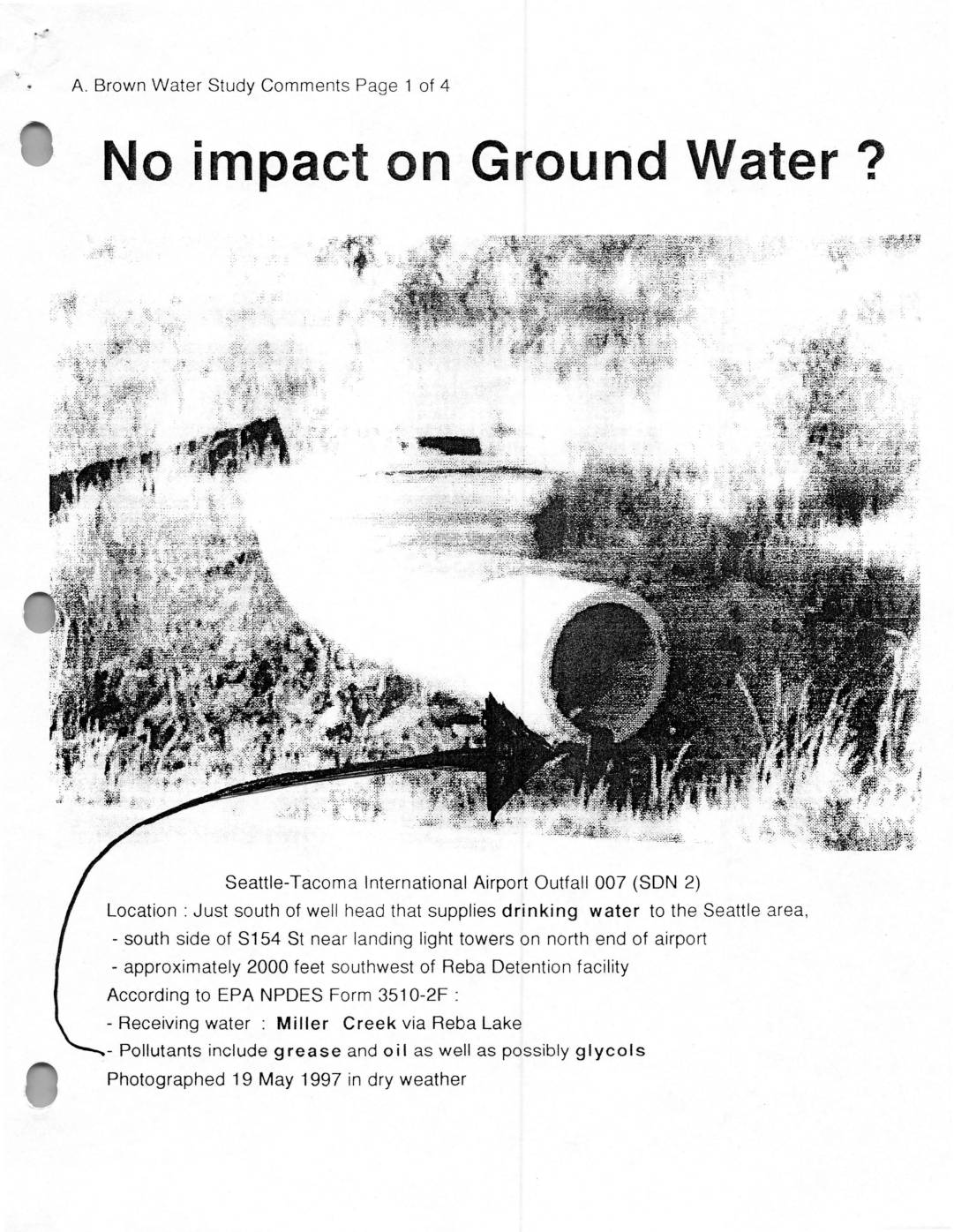
No Impact on Ground Water? Comments on DOE and Port Of Seattle Agreement for Ground Water Study at Sea-Tac Airport
A 1997 public comment letter from a Seattle resident raises concerns that a planned ground water study near Seattle-Tacoma International Airport is too limited in scope to accurately assess pollution risks to local drinking water. The author documents an airport outfall discharging oil, grease, and glycols just south of a drinking water well head, and argues the study must be expanded to include outfalls, fuel depot leaks, abandoned underground tanks, and the effects of massive planned construction. The letter urges regulators to require more rigorous sampling conditions and to openly address the water quality impacts of the airport's proposed Third Runway expansion. -
 1997-06-04
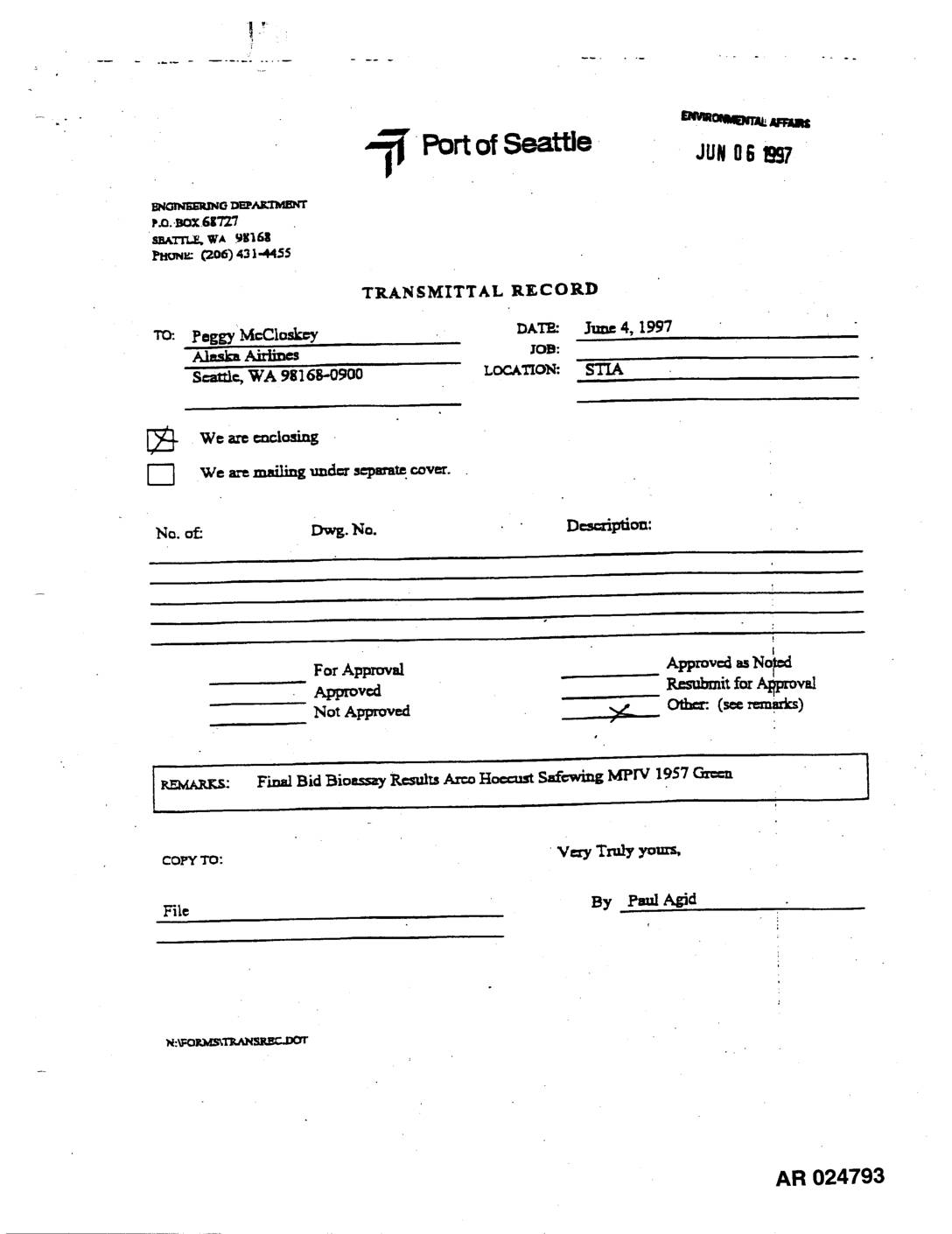
EXH AR024793: Transmittal Record & Lab RP — Acute Oral Rat Toxicity Test, Green Safewing MP IV
A June 1997 transmittal from the Port of Seattle Engineering Department to Alaska Airlines' Peggy McCloskey forwards final bid bioassay results for the Arco Hoecust Safewing MP IV 1957 Green product. The enclosed Laboratory Report from Bio Research Laboratories, Inc. documents an Acute Oral Rat Toxicity Test performed for MultiChem Analytical Services, testing the Green Safewing MP IV substance at a dose of 5000 mg/kg. The report, dated May 21, 1997, was directed by Warren C. Ladiges, DVM, and signed off by President and Scientific Director John J. Majnarich, Ph.D. -
 1997-06-01
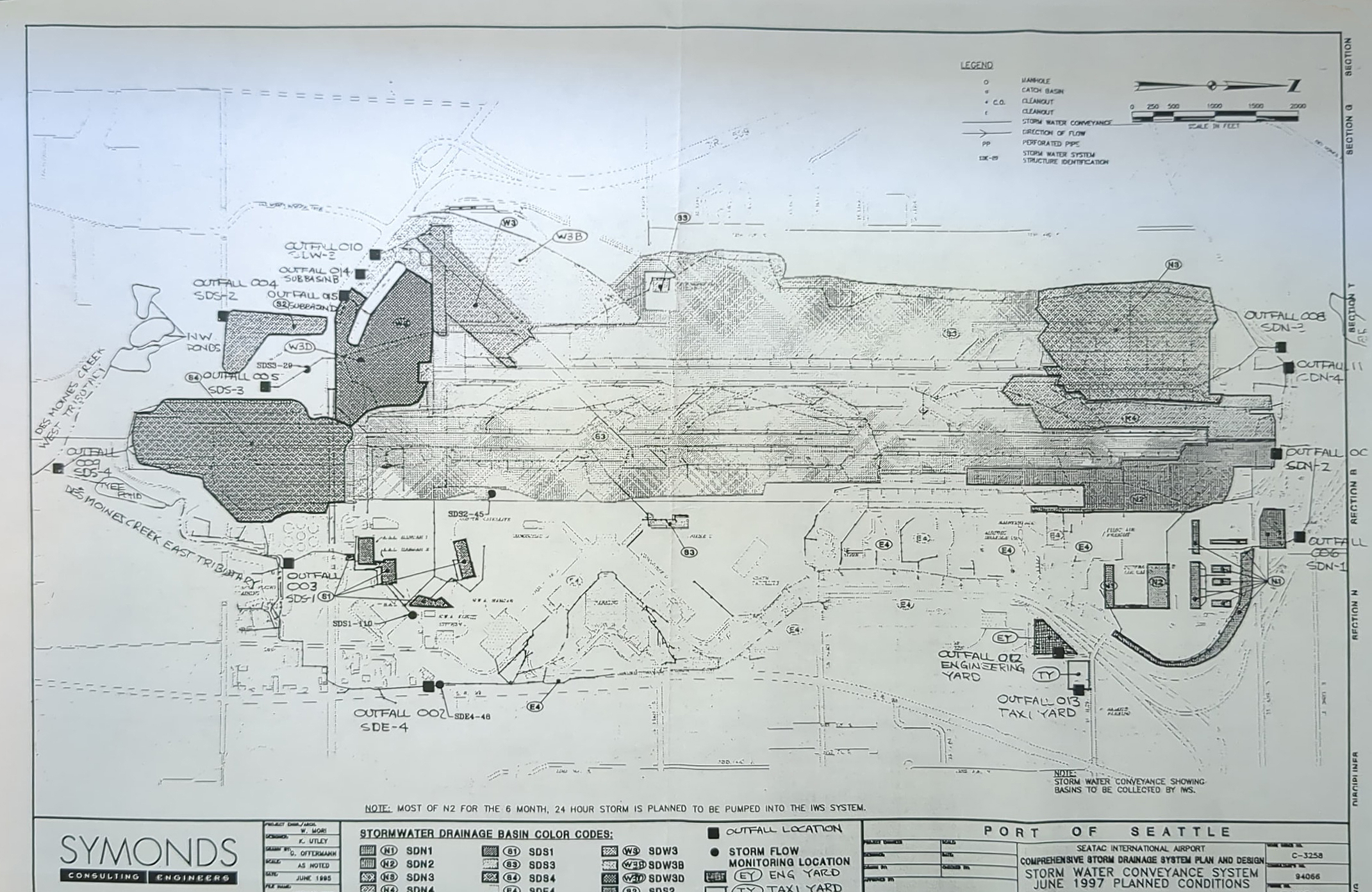
Symonds Stormwater System June 1997
Engineering drawing prepared by Symonds Consulting Engineers for the Port of Seattle, titled 'Comprehensive Storm Drainage System Plan and Design – Storm Water Conveyance System, June 1997 Planned Conditions' (Drawing No. C-3258, Project No. 94066). The plan depicts SeaTac International Airport's stormwater drainage basins, outfall locations (Outfalls 002–016), storm flow monitoring locations, and drainage connections to Des Moines Creek and its east tributary. -
 1997-06-01
Exhibit AR022300: Port Of Seattle Storm Water Receiving Environment Monitoring Report for NPDES Permit No. WA-002465-1
This June 1997 report, prepared by the Port of Seattle for Washington State's Department of Ecology, presents storm water receiving environment monitoring results conducted under NPDES Permit No. WA-002465-1. It covers water quality topics including instream toxicity bioassays, sediment quality, identification of pollution sources, metals speciation, vegetation management, and streambank erosion in Miller Creek and Des Moines Creek watersheds near Sea-Tac Airport. The findings assess the environmental impact of airport storm water runoff on local waterways and identify contributing pollution sources within each creek basin. -
 1997-05-01
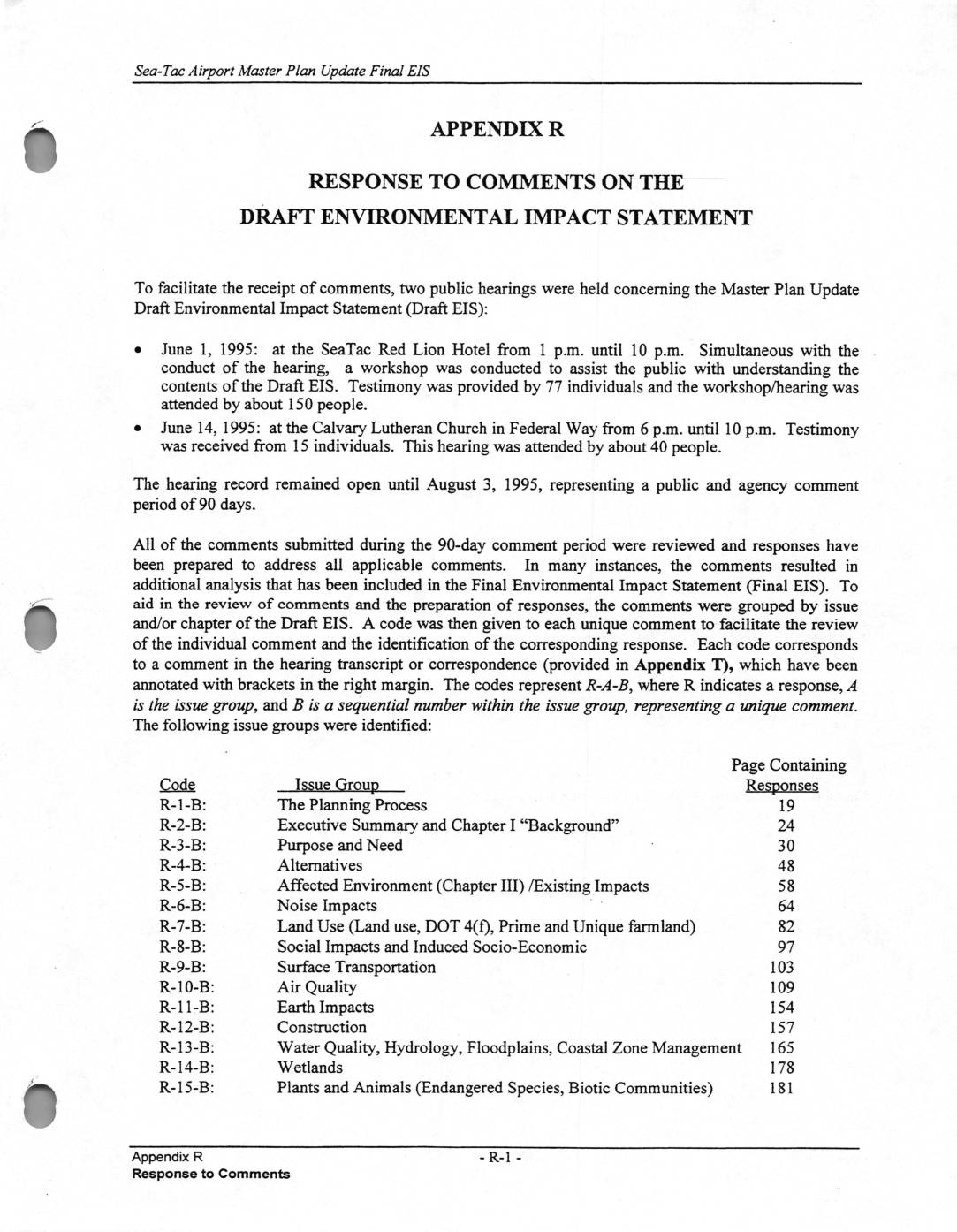
Sea-Tac Airport Master Plan Update Final EIS: Appendix R — Response to Comments on the Draft Environmental Impact Statement
This document is Appendix R of the Sea-Tac Airport Master Plan Update Final Environmental Impact Statement (EIS), containing official responses to public comments received during a 90-day comment period in 1995. Two public hearings gathered testimony on topics including noise impacts, land use, air quality, and surface transportation. A key finding was that airport activity levels were expected to grow regardless of whether improvements were built, driven by regional population and income growth rather than airport capacity alone. -
 1997-05-01
Final Supplemental EIS, Appendix F: DSEIS Response to Comments — Forecasts, Do-Nothing/With Project Capacity, and Forecast Ranges
This document is part of the Final Supplemental Environmental Impact Statement for Seattle-Tacoma International Airport, addressing public comments on aviation demand forecasts and runway capacity planning. It explains how the 'Do-Nothing' and 'With Project' (Third Runway) alternatives were evaluated based on projected passenger and operations data through 2010, noting that the existing airfield has a maximum capacity of 460,000 annual operations. The document also acknowledges the inherent uncertainty in long-range aviation forecasts and clarifies that neither NEPA nor SEPA require the use of worst-case data in environmental reviews.