TagNoise(262)
-
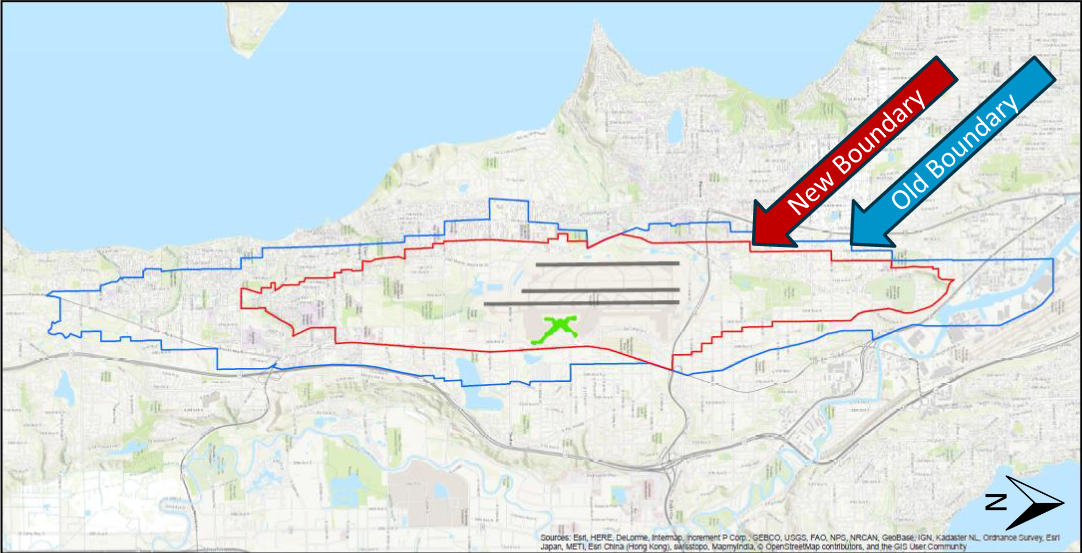
2021 Projected Noise Boundary Map
A GIS map comparing the old noise boundary (blue line) and new noise boundary (red line) around Seattle-Tacoma International Airport, with runway layout and airport symbol visible at center. Map data credited to Esri, HERE, DeLorme, Intermap, GEBCO, USGS, NPS, NRCAN, and other contributors. -
 2021-03-02
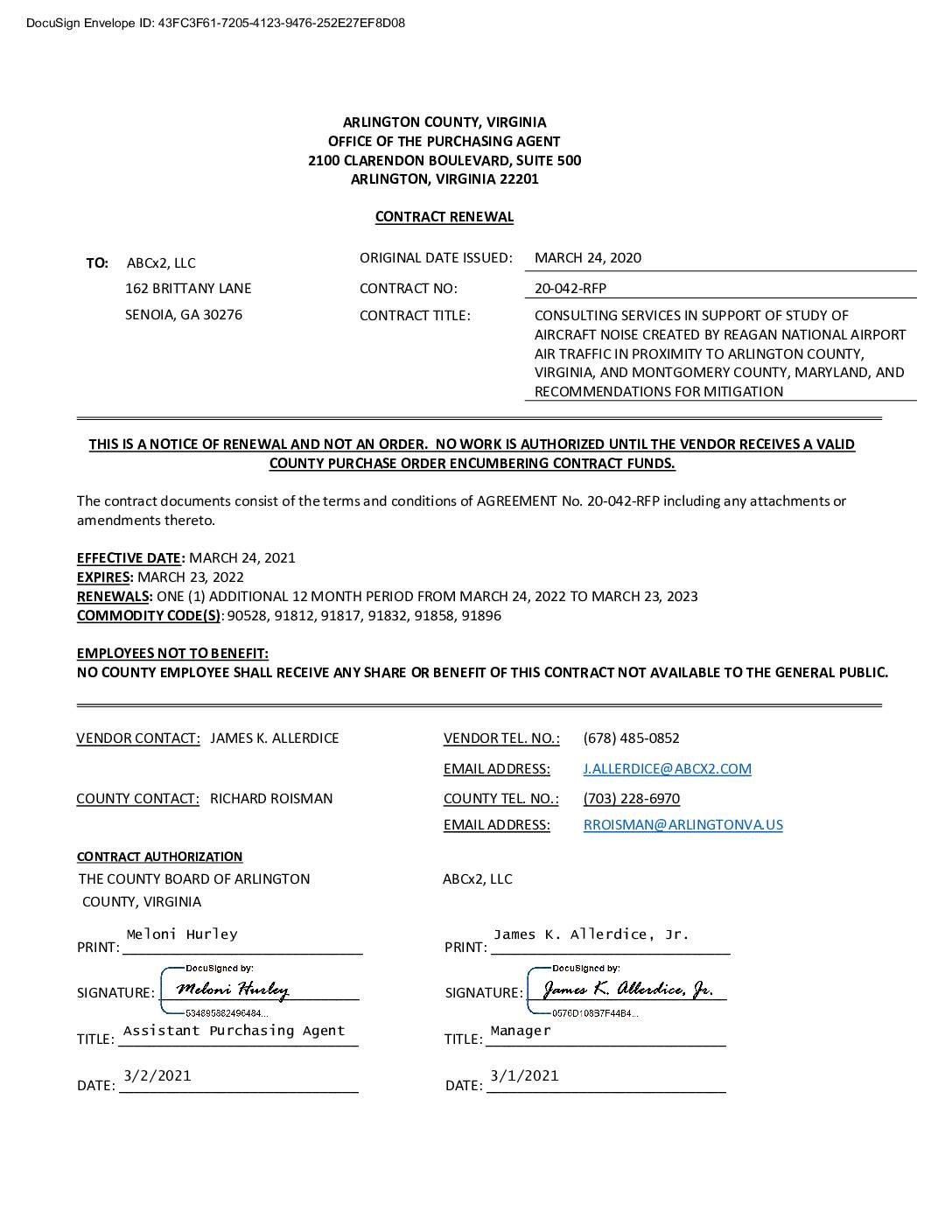
Contract Renewal Notice 20-042-RFP: Consulting Services for Aircraft Noise Study — Reagan National Airport Impact on Arlington County, VA and Montgomery County, MD
Arlington County, Virginia renewed a consulting services contract (No. 20-042-RFP) with ABCx2, LLC to study aircraft noise generated by Reagan National Airport air traffic near Arlington County, VA, and Montgomery County, MD, and to recommend mitigation strategies. The renewal period runs from March 24, 2021 to March 23, 2022, with one additional 12-month renewal option extending through March 23, 2023. The contract was signed by Arlington County's Assistant Purchasing Agent Meloni Hurley and ABCx2, LLC Manager James K. Allerdice, Jr. -
 2021-02-01
Dispersion in the Age of RNAV Jim Allerdice, Jr. ABCx2 ANES
This 2021 presentation by aviation consultant Jim Allerdice examines 'dispersion' — the practice of intentionally varying flight paths so that aircraft noise is spread across a wider area rather than repeatedly concentrated over the same neighborhoods. It explores the tension between the FAA's preference for Performance-Based Navigation (PBN/RNAV), which promotes precise, repeatable flight paths for safety and efficiency, and the concerns of communities living under those concentrated flight corridors. The material is relevant to ongoing debates about how airports like Sea-Tac can balance operational efficiency with equitable distribution of aircraft noise impacts. -
 2021-02-01
Analysis of the Neighborhood Environmental Survey
This 2021 FAA report analyzes the Neighborhood Environmental Survey (NES), a large-scale study examining how aircraft noise affects communities around 20 U.S. commercial airports. Researchers surveyed over 10,000 residents and found that annoyance with aircraft noise increases steadily as noise levels rise, with significantly more people reporting high annoyance than older studies had suggested. The findings provide an updated national curve showing the relationship between measured noise exposure (DNL) and community annoyance, which can inform airport noise policy decisions. -
Navy should use our data on Growler noise, not dismiss it
Jan. 8, 2021 at 12:19 pm Updated Jan. 8, 2021 at 12:19 pm An EA-18G Growler engine’s thrust with afterburner propels its takeoff with a loud roar from Naval Air Station Whidbey Island during an exercise. (Ken Lambert / The Seattle Times) By Lauren Kuehne and Julian Olden Special to The Times We are the scientists -
 2021-01-01
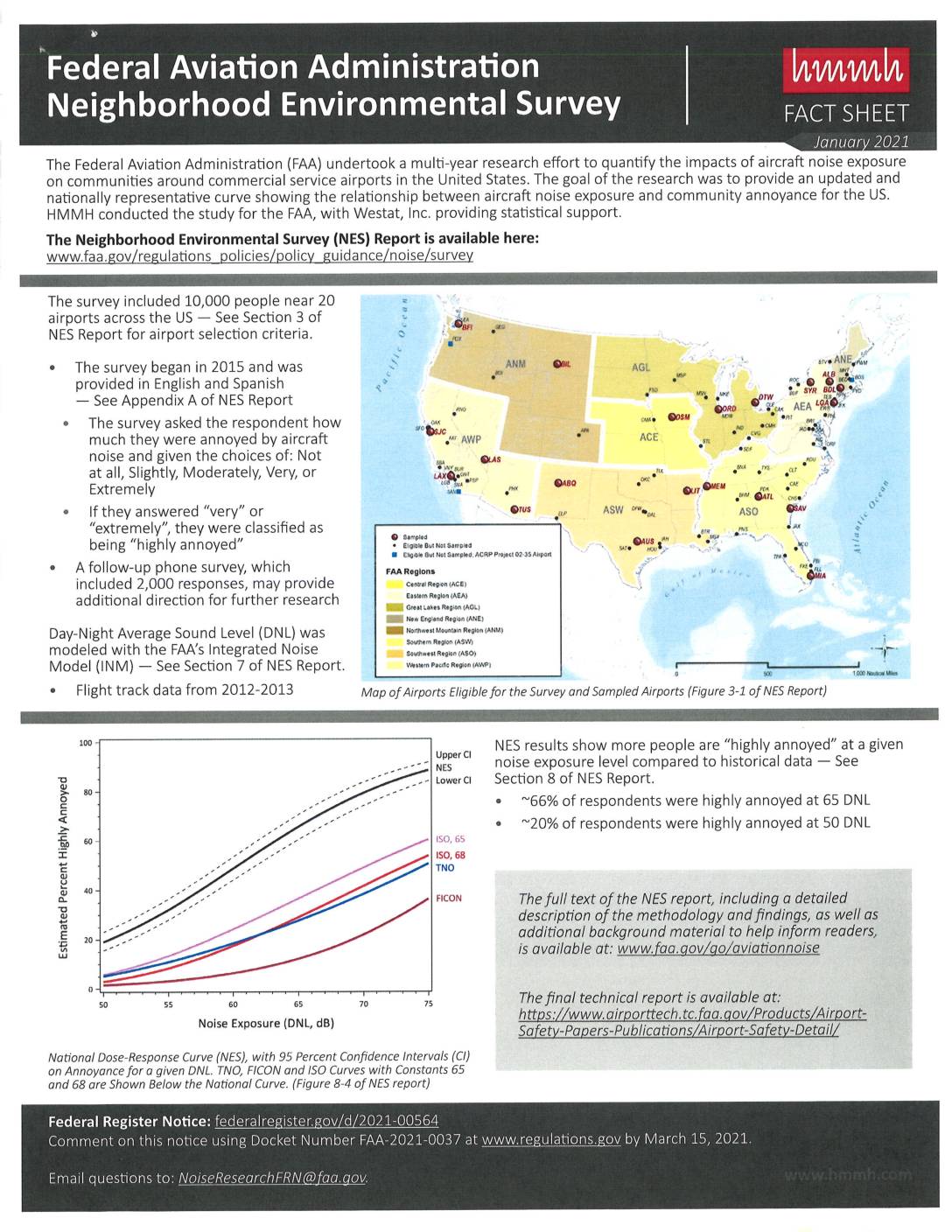
Neighborhood Environmental Survey fact sheet
The FAA conducted a large-scale Neighborhood Environmental Survey (NES) of 10,000 people near 20 U.S. airports to measure how aircraft noise affects community annoyance, finding that significantly more people are bothered by noise than older studies suggested — about 66% of respondents were highly annoyed at 65 decibels (DNL) and 20% at 50 decibels. The agency uses the Day-Night Average Sound Level (DNL) metric to measure noise exposure and is reviewing whether its longstanding 65 DNL threshold for 'significant' noise impact should be updated. The FAA is seeking public comment on these research findings before making any changes to official noise policy. -
The Noise Center
Hear for the Future® The Center for Hearing and Communication is proud to offer the Noise Center as a public service for people seeking information about the dangers of noise exposure and the steps they can take to promote a safer and quieter world. Exposure to noise is the leading cause of hearing loss—not age. -
Common environmental noise levels
★How loud is too loud? Continued exposure to noise above 85 dBA (adjusted decibels) over time will cause hearing loss. The volume (dBA) and the length of exposure to the sound will tell you how harmful the noise is. In general, the louder the noise, the less time required before hearing loss will occur. According -
The impact of noise on childhood cognitive development
Poor classroom acoustics: The invisible reason Johnny can’t read. Poor classroom acoustics create a negative learning environment for many students, especially those with hearing or learning difficulties. According to a report by David Lubman (“America’s Need for Standards and Guidelines to Ensure Satisfactory Classroom Acoustics”) “acoustical conditions in many classrooms are unsuitable for such tasks -
 2020-11-17
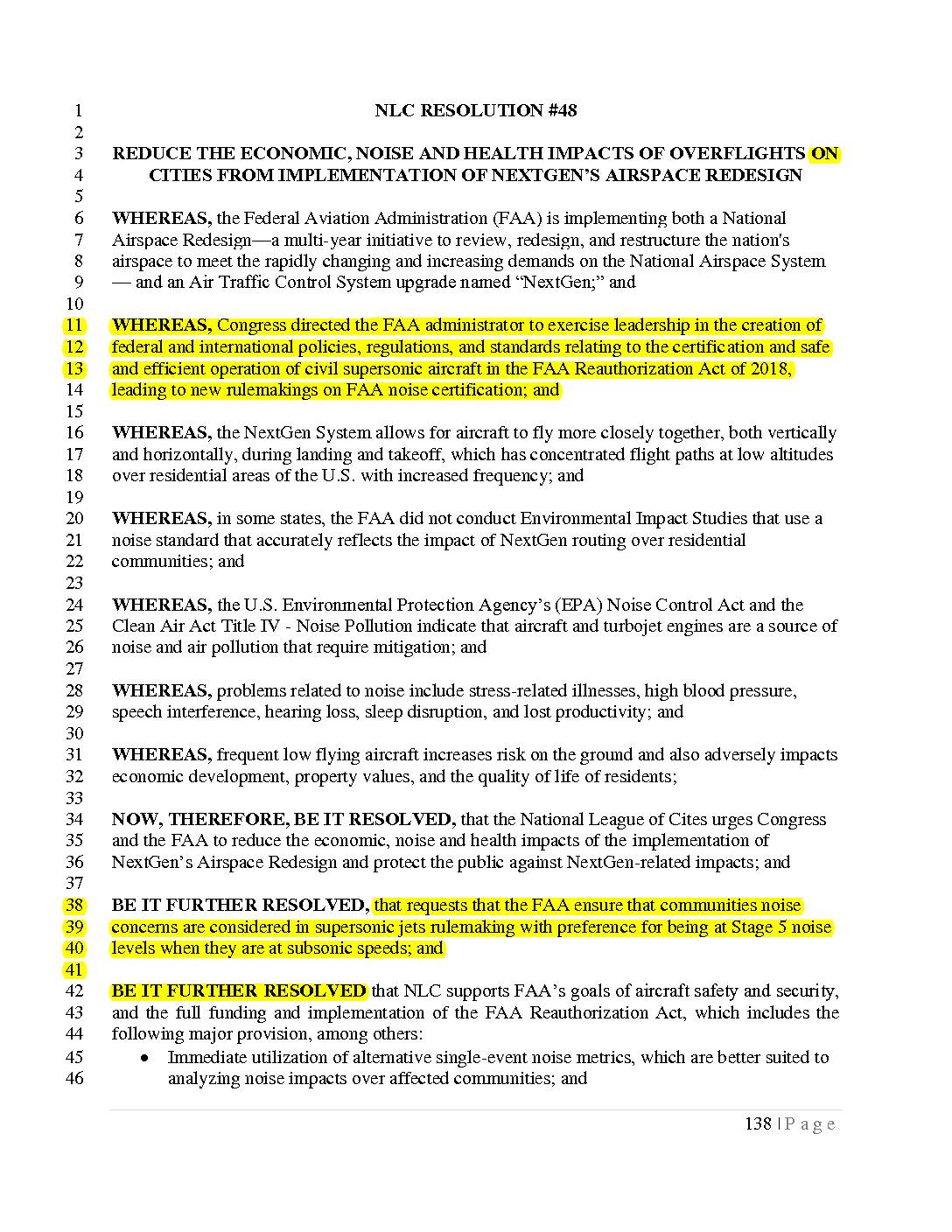
NLC Resolution #48: Reduce the Economic, Noise and Health Impacts of Overflights on Cities from Implementation of NextGen’s Airspace Redesign
NLC Resolution #48 calls on Congress and the FAA to reduce the noise, health, and economic burdens placed on residential communities resulting from the FAA's NextGen air traffic control system, which has concentrated flight paths at low altitudes over neighborhoods. The resolution highlights concerns such as stress-related illness, hearing loss, reduced property values, and inadequate environmental review, and urges the FAA to adopt better noise measurement standards and consider community noise impacts in supersonic jet rulemaking. It also supports increased NASA funding for research into quieter aircraft engines and airframes.