TagNoise(262)
-
 2020-09-24
The Impact of Airport Proximity on Single-Family House Prices—Evidence from Poland
Academic journal article published in MDPI Sustainability (2020, vol. 12, 7928) by Mirosław Bełej, Radosław Cellmer (University of Warmia and Mazury in Olsztyn), and Michał Głuszak (Cracow University of Economics) examining the impact of airport proximity on single-family house prices in Poland, 2013–2017. Analyzes Gdańsk Lech Walesa Airport and Warsaw Chopin Airport limited use areas -
2020-09-24
The Impact of Airport Proximity on Single-Family House Prices—Evidence from Poland
Academic journal article published in MDPI Sustainability (2020, vol. 12, 7928) by Mirosław Bełej, Radosław Cellmer (University of Warmia and Mazury in Olsztyn), and Michał Głuszak (Cracow University of Economics) examining the impact of airport proximity on single-family house prices in Poland, 2013–2017. Analyzes Gdańsk Lech Walesa Airport and Warsaw Chopin Airport limited use areas -
 2020-09-23
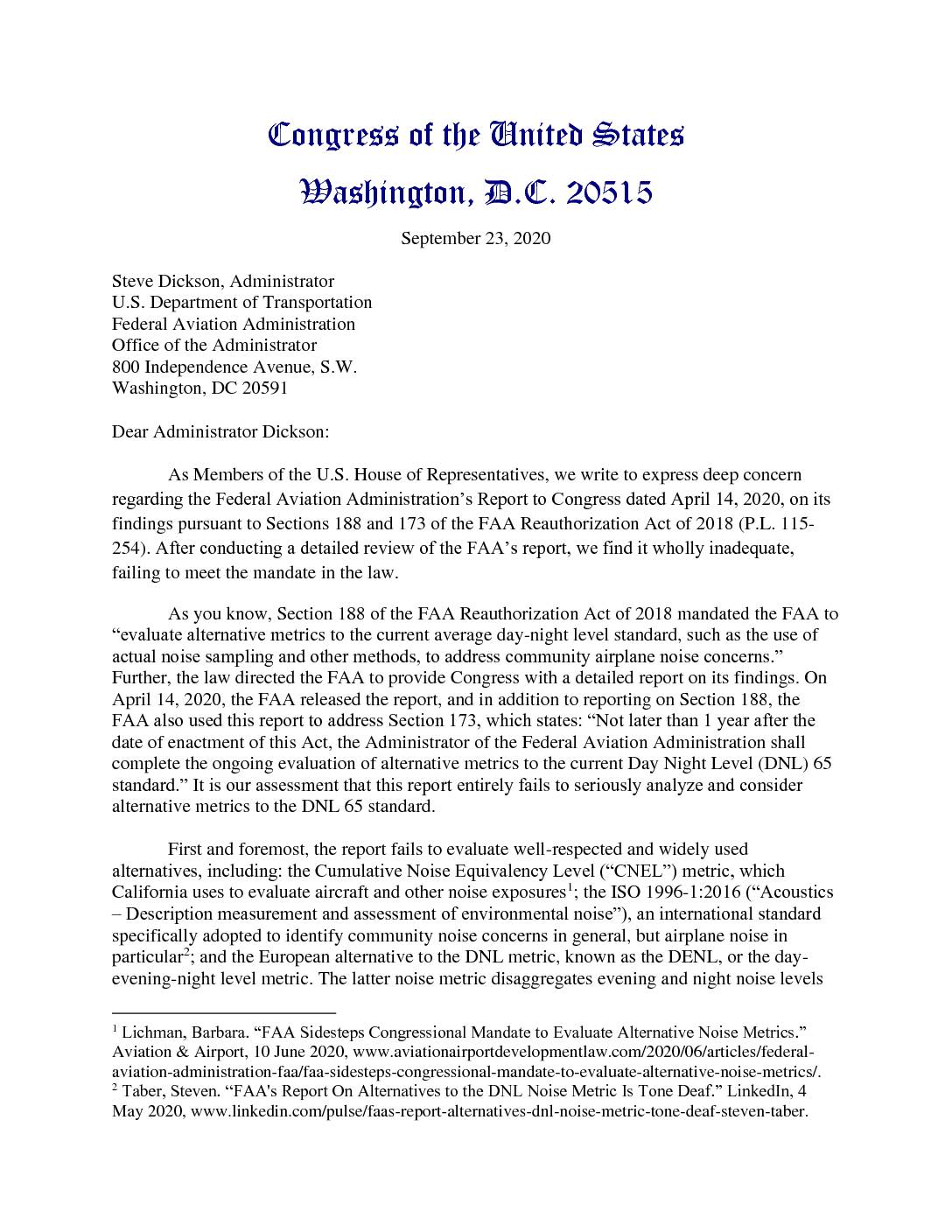
Congressional letter to FAA Administrator Steve Dickson on alternative noise metrics report
Currently, FAA law has extremely complicated rules for establishing a noise boundary around airports. (A noise boundary is a geographic area inside which there is a certain acceptable noise level.) This is referred to as the DNL65. and it has several major flaws. The FAA Reauthorization Act Of 2018 attempted to address these flaws in several ways. This letter, from a caucus of Congressmen engaged on airport community issues complains to the Administrator that the spirit of the law is not being adhered to and demands that he make attempts to put his agency into compliance. The language is fairly technical, however there are a couple of basic points they raise: First, that the noise boundary be determined by actual noise measurements (currently the noise boundaries are 'modeled' and those calculations often do not reflect in any way the lived experience for residents.) Second, that the 'acceptable' noise level of sixty five decibels (hence DNL65) has been determined to be far too high to conform with current understandings of healthy living. -
New aircraft-noise rule would do little to quiet the skies: government report
By Jon Hemmerdinger 24 August 2020 A ban on aircraft that do not meet new noise standards would do little to reduce overall aircraft noise and would impose costly requirements on airlines and aerospace manufacturers. That is according to a 20 August report from the US Government Accountability Office into the likely impact of a -
 2020-06-11
SHB1847 – Aircraft Noise Abatement Various Provisions
Washington State's Substitute House Bill 1847, signed into law on March 25, 2020, expands the aircraft noise abatement programs available to port districts by lowering the threshold for eligibility from airports serving more than 900 scheduled jet flights per day (previously 20). The law also enlarges the geographic 'impacted areas' around runways where noise relief programs—such as soundproofing, property acquisition, and transaction assistance—can be offered, extending coverage from six to ten miles north and up to thirteen miles south of runway ends, and from one to two miles from runway centerlines. -
 2020-05-29
Section 14: Summary — Study of the Current and Ongoing Effects of the Operation of the Seattle-Tacoma International Airport
A 2020 study evaluated the positive, negative, and neutral effects of Seattle-Tacoma International Airport on six nearby cities — Burien, Des Moines, Federal Way, Normandy Park, SeaTac, and Tukwila — using data spanning 1997 to 2019. The study found that noise was the top public concern, followed closely by air quality issues from aircraft operations, along with traffic congestion and distrust of the FAA and Port of Seattle. Researchers attempted to distinguish between impacts directly caused by airport operations and those resulting from the broader regional population growth that roughly doubled over the same period. -
 2020-05-29
Stantec Sea-Tac Airport Communities Impact Study: Appendix A, Section 5 – Noise & Vibration
This 2020 report examines how noise from Seattle-Tacoma International Airport has changed between 1997 and 2019, focusing on the impact of aircraft takeoffs, landings, and overflights on nearby communities. It explains key noise measurement concepts—including decibels, Sound Exposure Level (SEL), and the Day-Night Average Sound Level (DNL)—and notes that while DNL is the federal regulatory standard used by the FAA, individual SEL events are often what residents find most disruptive. The report highlights a growing tension between how federal agencies measure and regulate aircraft noise and the real-world experience of people living under flight paths. -
 2020-05-29
Stantec 2020 Sea-Tac Airport Impact Study: Appendix A, Section 4 – Community Input (pp. 41–43)
A 2020 study gathered input from 48 community stakeholders near Seattle-Tacoma International Airport, finding that while residents valued the economic benefits, jobs, and convenient access the airport provides, noise and air quality were the top concerns—especially for those living to the south and west under flight paths. Stakeholders raised issues including late-night flights, NextGen procedures concentrating aircraft noise, ultrafine particle pollution, and the limitations of existing noise mitigation programs. Traffic congestion and potential public health impacts from aircraft emissions were also frequently cited challenges. -
 2020-04-14
Report to Congress: FAA Reauthorization Act of 2018 (Pub. L. 115-254) Section 188 and Sec 173
This April 2020 FAA Report to Congress evaluates alternative noise metrics to the current Day-Night Level (DNL) 65 decibel standard used to measure community aircraft noise exposure, as required by the FAA Reauthorization Act of 2018. The report reviews the history and definitions of various noise measurement tools, explains why no single metric can address all aviation noise situations, and examines the roles of both noise modeling and actual noise sampling. It was produced in response to congressional direction to assess whether better methods exist for capturing and addressing community concerns about airplane noise.