TagNoise(262)
-
The FAA allows Americans to be exposed to unsafe levels of aircraft noise
Daniel Fink – djfink01@aol.com Twitter: @QuietCoalition Board Chair, The Quiet Coalition 60 Thoreau Street Concord, MA 01742 United States The Quiet Coalition is a program of Quiet Communities, Inc., Lincoln, MA, USA Popular version of 4aNS8-The Federal Aviation Administration (FAA) allows Americans to be exposed to unsafe levels of aviation noise, presented at the 183rd -
 2022-12-02
Guidelines for Considering Noise in Land Use Planning and Control (USDOT/EPA)
This document appears to be a blank or nearly blank page with no readable text content, likely a placeholder or cover page from the Sea-Tac Airport noise policy archive. No substantive policy information, data, or findings could be extracted from this page. -
 2022-11-29
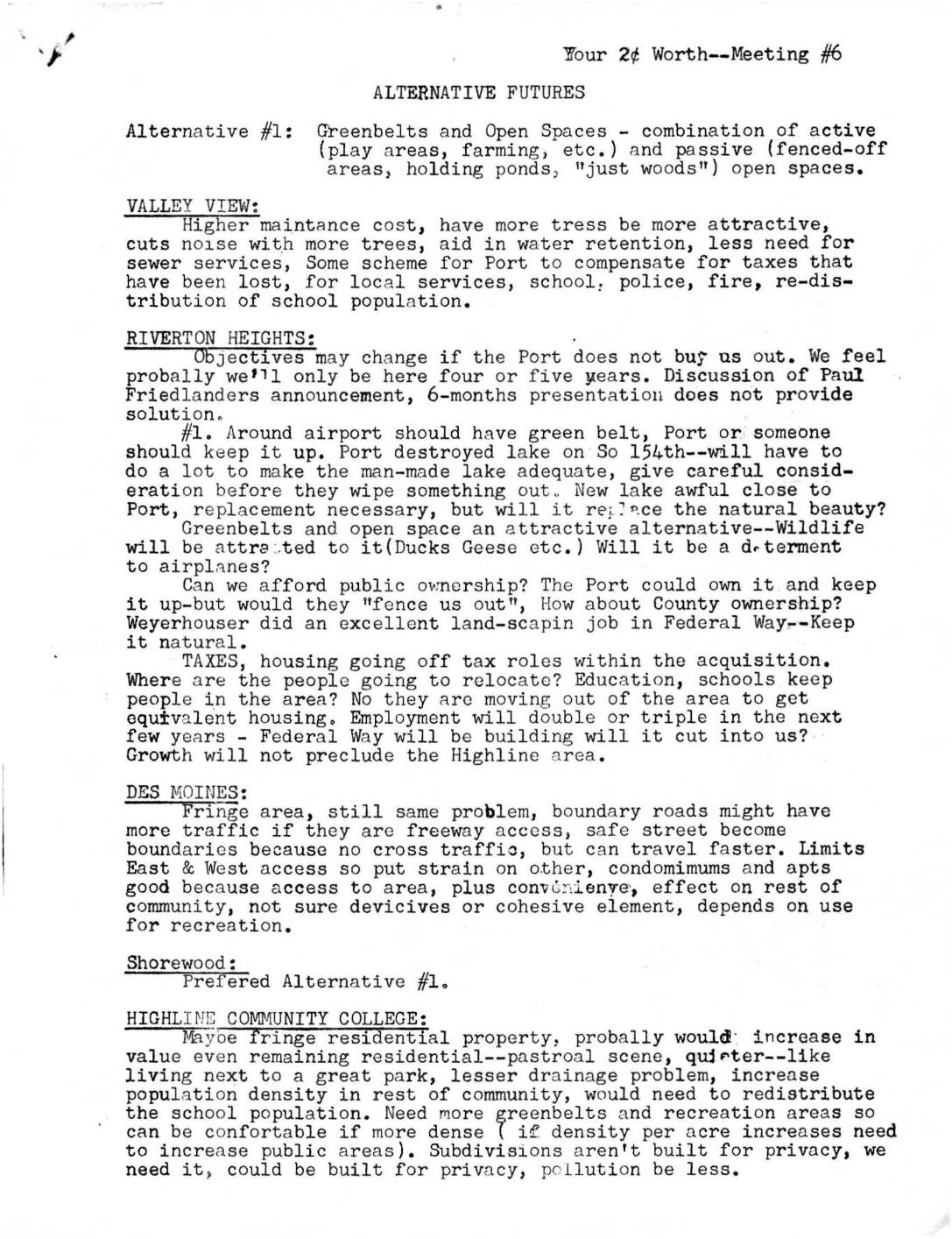
Your 2¢ Worth, Meeting #6: Alternative Futures
This document records community feedback from Meeting #6 of a public engagement series on alternative futures for neighborhoods near Sea-Tac Airport, where residents from Valley View, Riverton Heights, Des Moines, and other areas discussed three options: creating greenbelts and open spaces, pursuing a planned city renewal approach, or allowing an unrestricted free market. Participants raised concerns about airport noise, property taxes, displacement of residents, loss of natural resources, and the Port of Seattle's land acquisition practices. Communities generally favored enforceable planning with citizen input, and many preferred the greenbelt option, while expressing skepticism about government-led redevelopment and unregulated market approaches. -
Calculating DNL65
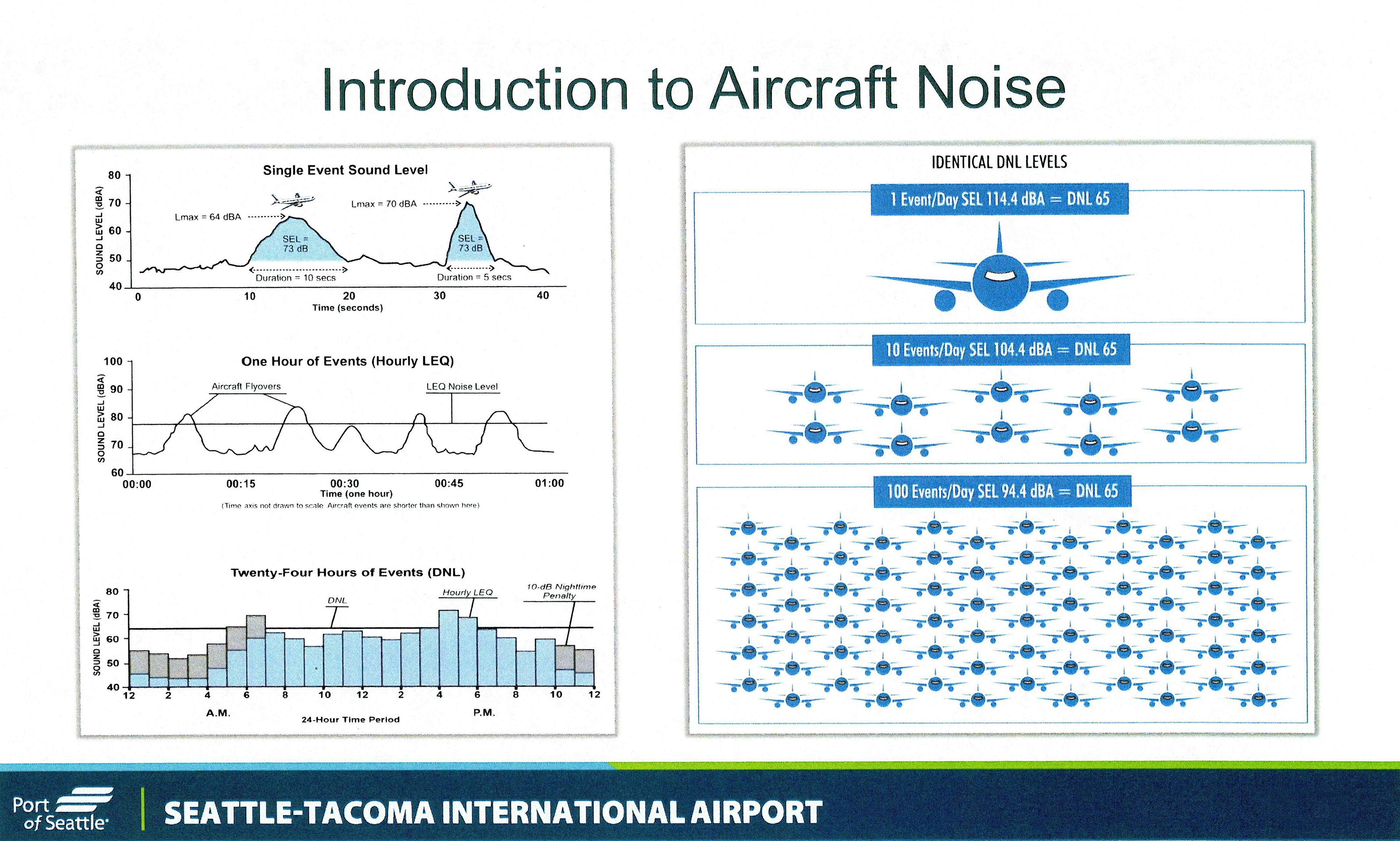
We’ve often made the claim that DNL65 is not really a unit of measure. And when we say that it comes off as both condescending and patronizing. Okeedokee… If you want to understand DNL65, you should probably start by going to the regulations governing Airport Noise Compatibility and Planning aka Part 150. Got it? Great. -
The FAA allows Americans to be exposed to unsafe levels of aircraft noise
Nov 8, 2022 | 183rd Meeting, Lay Language Paper, Noise, Psychological and Physiological Acoustics Daniel Fink – djfink01@aol.com Twitter: @QuietCoalition Board Chair, The Quiet Coalition 60 Thoreau Street Concord, MA 01742 United States The Quiet Coalition is a program of Quiet Communities, Inc., Lincoln, MA, USA Popular version of 4aNS8-The Federal Aviation Administration (FAA) allows Americans to be exposed to -
 2022-09-12
Economy, traffic fuel commercial-service talk
This article from the Snohomish County Business Journal discusses growing interest in establishing scheduled commercial air service at Paine Field in Everett, Washington, as an alternative to the congested Sea-Tac Airport. Supporters argue that commercial flights would boost the local economy and attract new businesses, while noting that modern, quieter aircraft have significantly reduced noise concerns. The county's 20-year airport master plan, approved in December, projected commuter service flights from Paine Field within five years. -
 2022-08-30
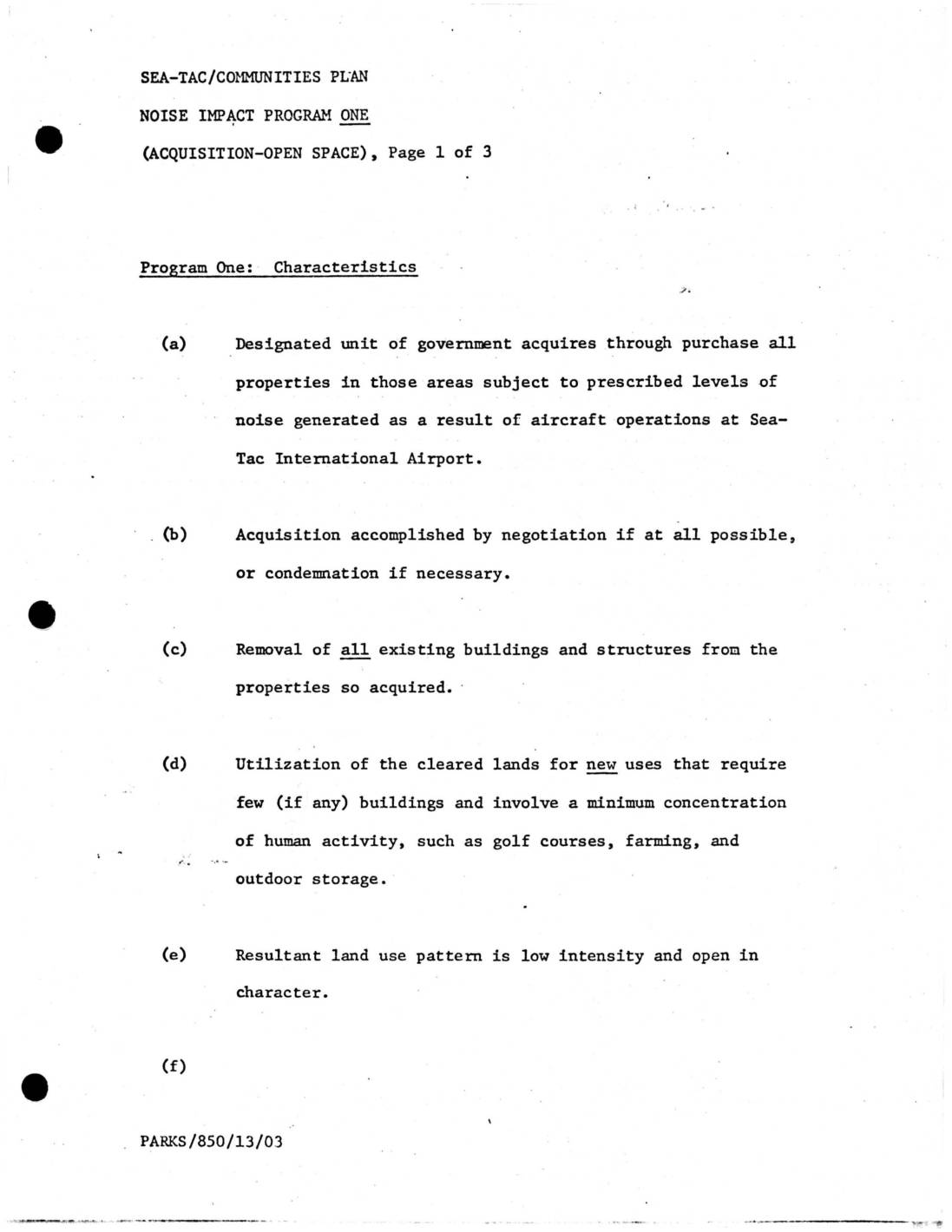
Sea-Tac Communities Plan: Noise Impact Programs One, Two, and Three — Acquisition Characteristics
The Sea-Tac/Communities Plan outlines three noise impact programs for managing properties affected by aircraft noise at Seattle-Tacoma International Airport. All three programs involve a designated government unit purchasing affected properties through negotiation or condemnation. The programs differ in how the land is subsequently used: Program One converts it to low-intensity open space such as golf courses or farmland; Program Two redevelops it for noise-compatible industrial or commercial uses; and Program Three leases the properties back to prior owners for a set period, leaving land use largely unchanged in the short term. -
 2022-08-28
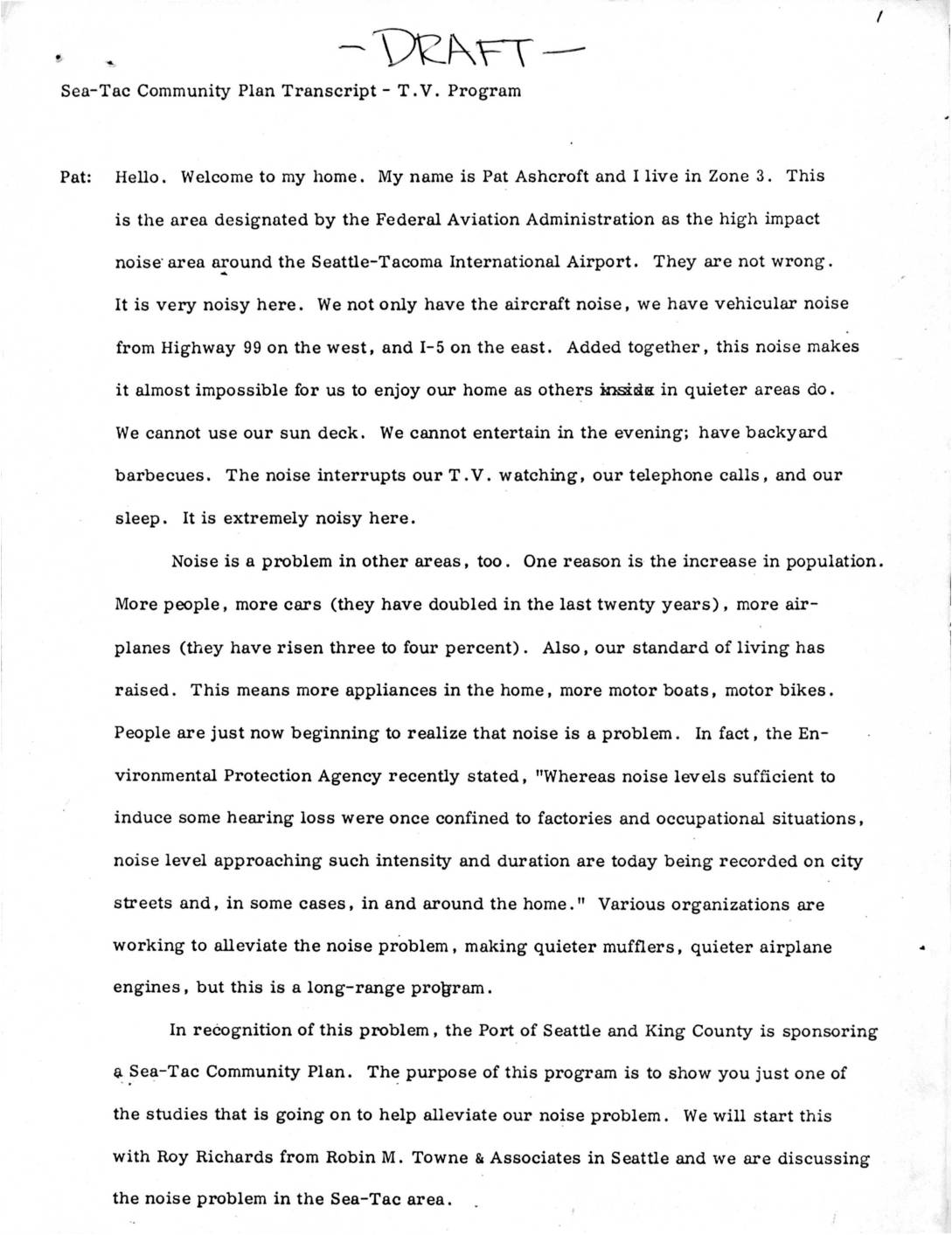
Sea-Tac Communities Plan – T.V. Program Transcript
This is a draft transcript from a Sea-Tac Community Plan television program in which resident Pat Ashcroft and noise researcher Roy Richards of Robin M. Towne & Associates discuss the serious noise impact on communities surrounding Seattle-Tacoma International Airport. Richards explains that the Port of Seattle and King County sponsored a comprehensive noise study covering approximately 50 square miles around the airport, measuring over 4,200 aircraft takeoff and landing events at 66 monitoring locations. The study aimed both to document the extent of noise exposure and to provide a planning tool for future land use and facility design decisions. -
 2022-08-24
City of Burien Seattle-Tacoma Airport Master Plan Update Studies: Environmental issues executive summary
This draft report from the City of Burien analyzes environmental impacts of proposed updates to the Seattle-Tacoma Airport Master Plan, covering noise and vibration, air quality, water resources, and visual aesthetics. The study found that while the airport's Environmental Impact Statement used accepted noise modeling methods, several gaps remain — including the need for better data on aircraft noise levels, surface traffic noise, and vibration effects on nearby residents and buildings. Mitigation measures to address these issues will be developed in a separate follow-up report. -
 2022-08-24
Noise sources and land uses: Are they compatible?
This paper by Edward P. Gorski examines how local governments can achieve noise-compatible land use planning through two main approaches: administrative techniques that officials and planners can use to require or encourage noise compatibility, and physical methods available to architects, designers, and builders to reduce noise impacts. By considering noise at the source, along its path, and at the point of reception, planners can integrate noise control into broader environmental and community planning goals. The paper argues that this integrated approach can improve quality of life in communities affected by noise sources such as airports.