TagFAA(687)
-
 2010-08-19
Appendix N – Forecast approval
This document is Appendix N of the Seattle-Tacoma International Airport Part 150 Noise Compatibility Study Update, compiled by Landrum & Brown in October 2013. It contains the FAA's official approval, dated August 19, 2010, of the aviation activity forecast submitted by Sea-Tac Airport in July 2010. The FAA determined that the forecast provided adequate justification for total aircraft operations and authorized its use in the airport's Noise Compatibility Plan Update. -
 2010-04-01
Northeast Redevelopment Area (NERA): Redevelopment Plan and Implementation Strategy
The Northeast Redevelopment Area (NERA) Redevelopment Plan and Implementation Strategy, prepared in April 2010 by Otak, Inc. for the City of Burien and the Port of Seattle, outlines a framework for redeveloping land in the northeast area near Seattle-Tacoma International Airport. The plan addresses existing conditions—including Federal Aviation Administration requirements and airport noise constraints—alongside community input, infrastructure needs, and market analysis to guide future land use decisions. It identifies preferred development alternatives, zoning amendments, and prioritized implementation steps to support responsible redevelopment of properties affected by airport operations. -
 2010-02-17
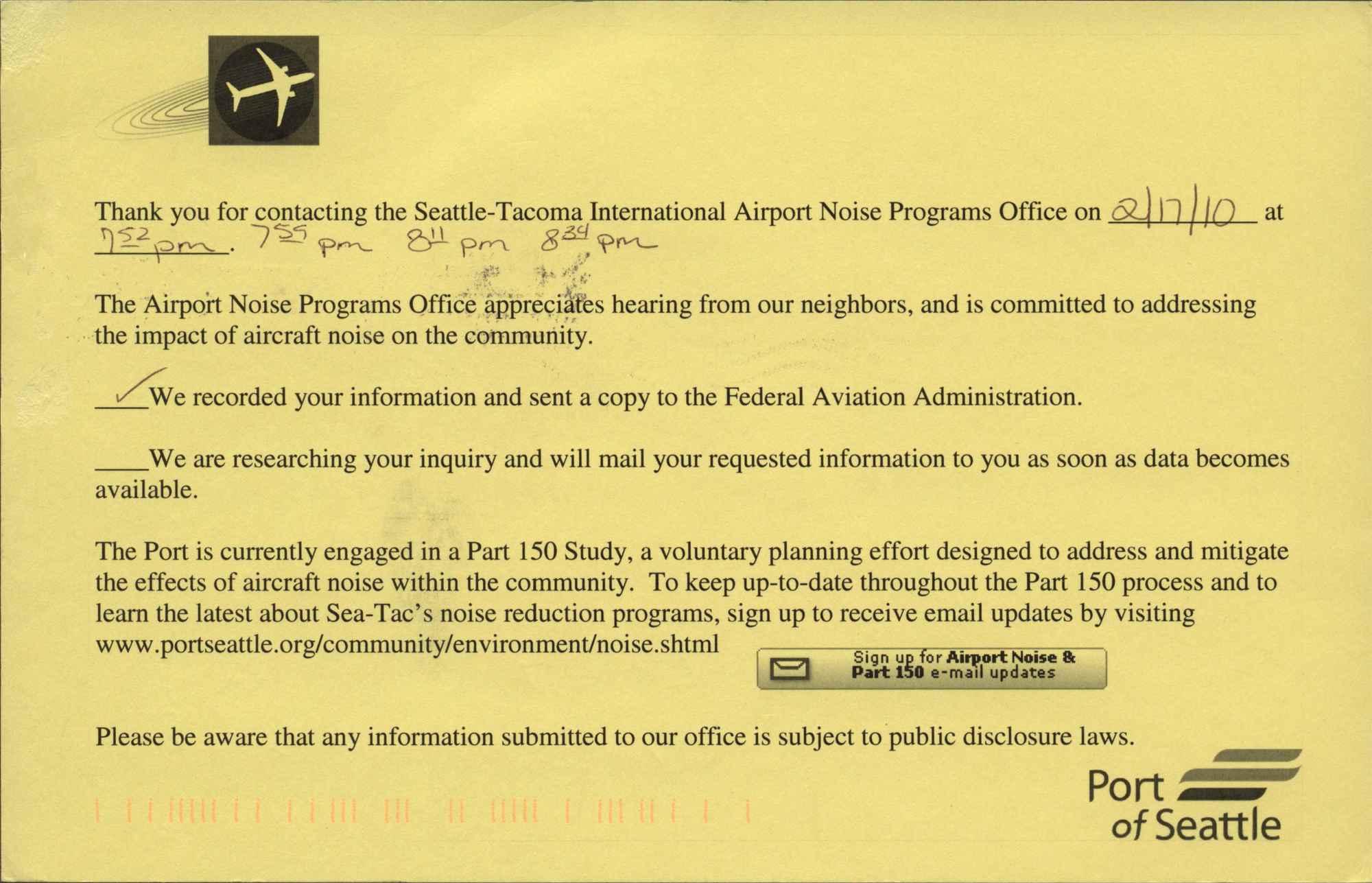
Airport Noise Office Thank You For Contacting Us Postcard
A Port of Seattle acknowledgment postcard sent in response to a noise complaint filed with the Seattle-Tacoma International Airport Noise Programs Office on 2/17/10, logging four aircraft noise events at 7:52 PM, 7:55 PM, 8:11 PM, and 8:34 PM. The card confirms that the caller's information was recorded and forwarded to the Federal Aviation Administration, and references the ongoing Part 150 Study for community noise mitigation. -
 2009-12-10
Aviation noise impact: A historical perspective
This December 2009 presentation by Kenneth J. Plotkin of Wyle Laboratories examines the history of aviation noise impact research, tracing how noise metrics evolved over time and what was learned—or lost—along the way. It outlines the FAA's Aviation Noise Impacts Research Roadmap, whose goals include improving understanding of annoyance and sleep disruption, developing exposure-to-impact assessments, and informing policy, mitigation strategies, and cost-benefit models. The presentation emphasizes the importance of learning from past research efforts to avoid repeating mistakes in future noise policy decisions. -
 2009-10-30
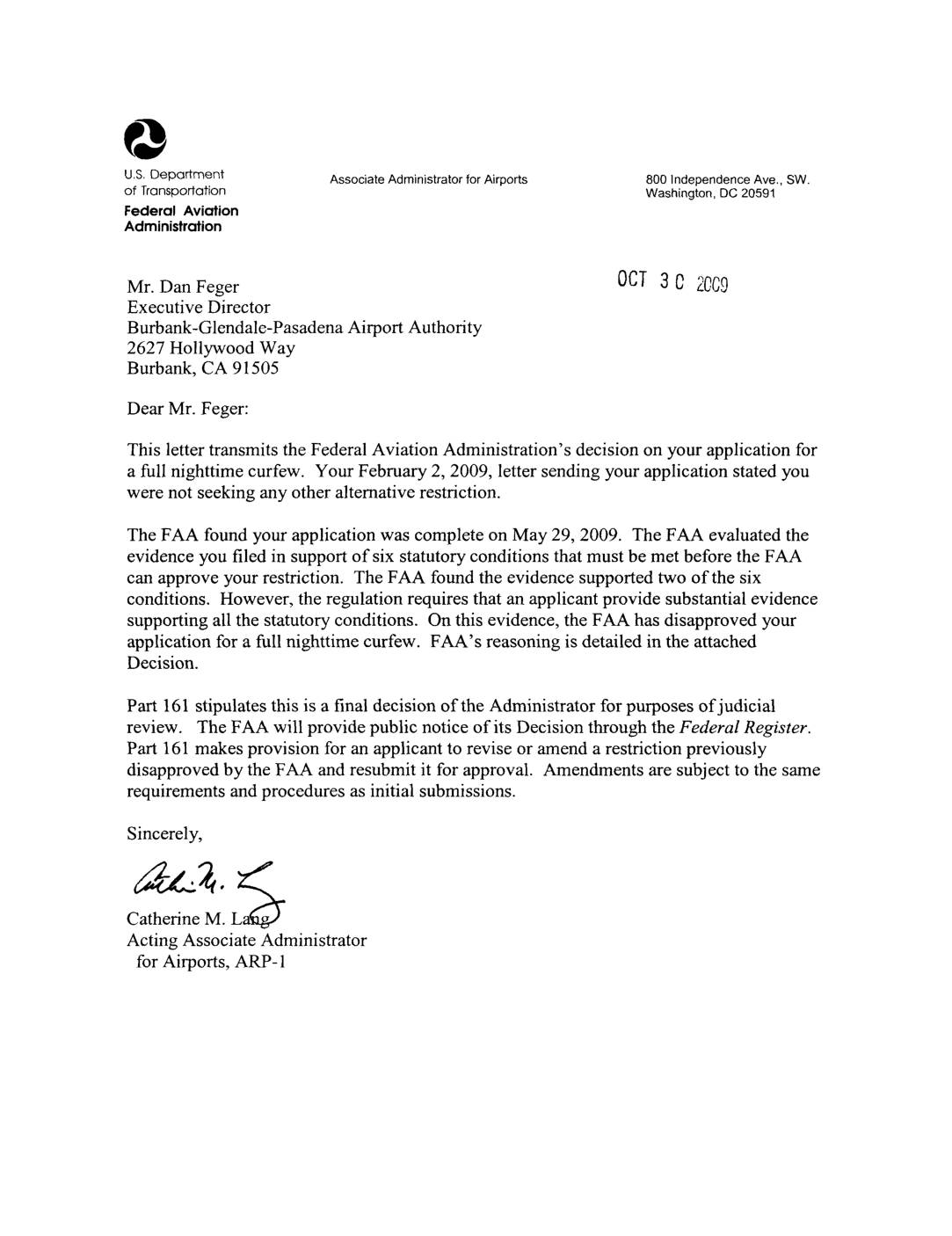
FAA Decision Letter: Disapproval of Burbank-Glendale-Pasadena Airport Authority Application for Full Nighttime Curfew at Bob Hope Airport
The FAA denied the Burbank-Glendale-Pasadena Airport Authority's 2009 application to impose a full nighttime flight curfew (10:00 p.m. to 6:59 a.m.) at Bob Hope Airport in Burbank, California. Under the Airport Noise and Capacity Act of 1990, all six statutory conditions must be supported by substantial evidence for such a restriction to be approved, but the Authority's application only satisfied two of the six required conditions. The Authority was informed it could revise and resubmit its application, subject to the same review requirements. -
 2009-10-01
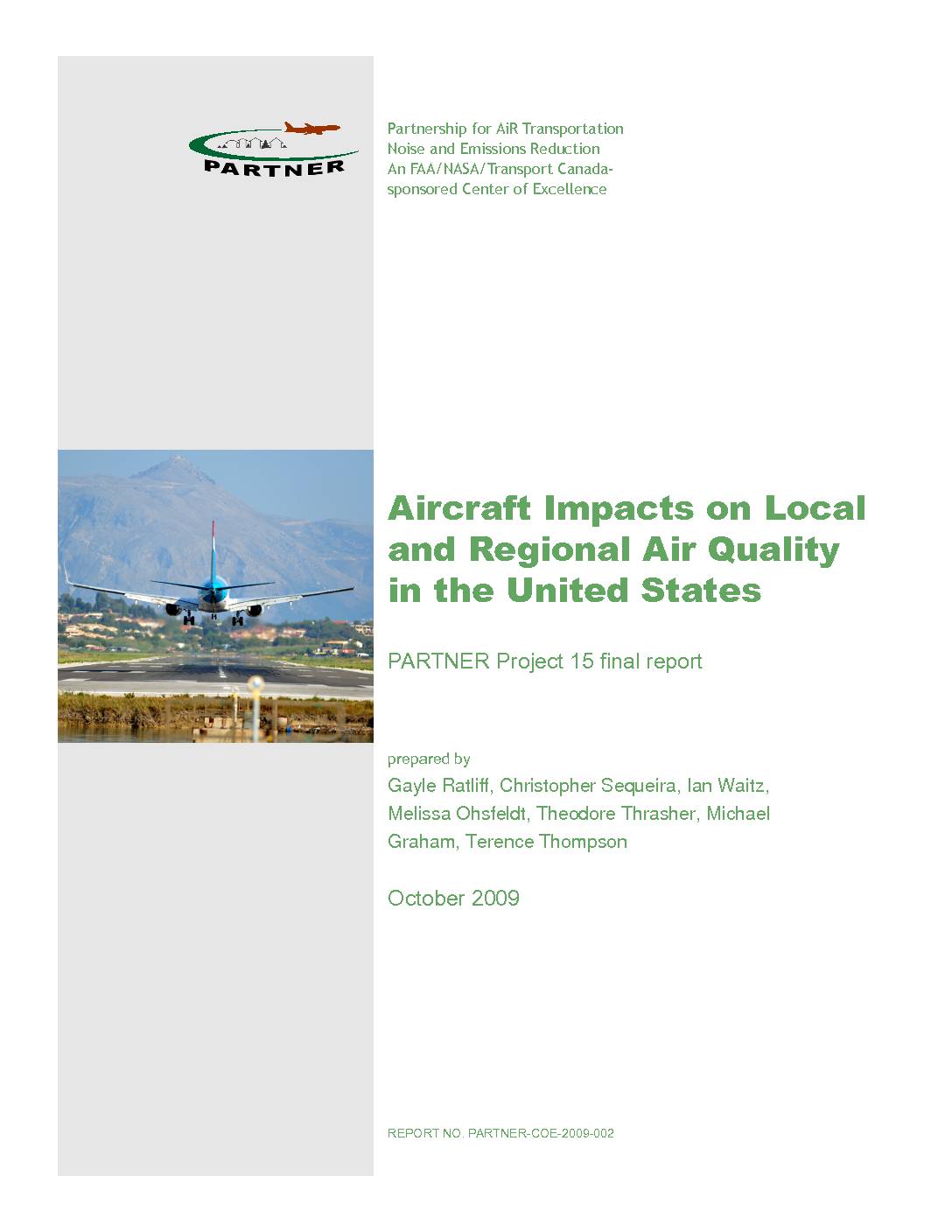
Aircraft impacts on local and regional air quality in the United States
★This 2009 research report examines how aircraft emissions affect local and regional air quality across the United States, including public health impacts near major airports. It analyzes baseline emissions inventories, the relationship between airport delays and increased fuel burn and pollution, and evaluates strategies such as continuous descent arrivals and schedule de-peaking to reduce emissions. The findings are intended to inform aviation environmental policy and air traffic efficiency improvements. -
 2009-10-01
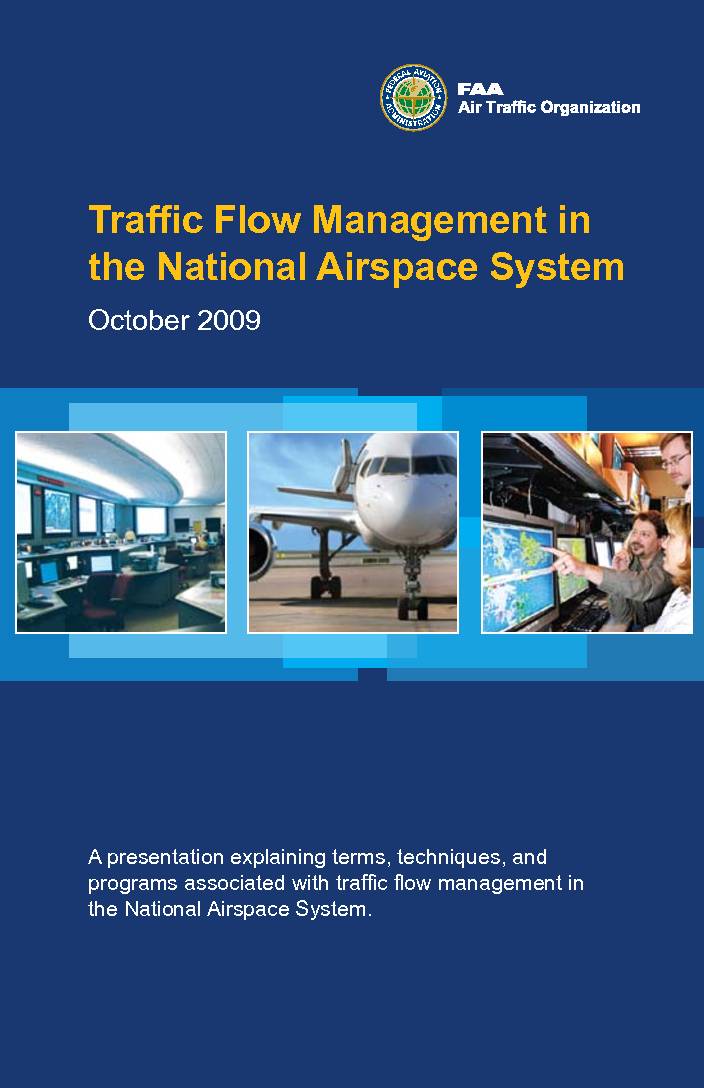
Traffic flow management in the National Airspace System
This October 2009 FAA Air Traffic Organization document explains the terms, techniques, and programs used to manage the flow of air traffic across the National Airspace System. It covers topics such as ground delay programs, ground stops, severe weather avoidance, rerouting strategies, and coordination tools used by traffic management specialists. While focused on national-level airspace operations rather than airport-specific noise policy, it provides useful background on how flight scheduling and routing decisions are made system-wide. -
 2009-09-30
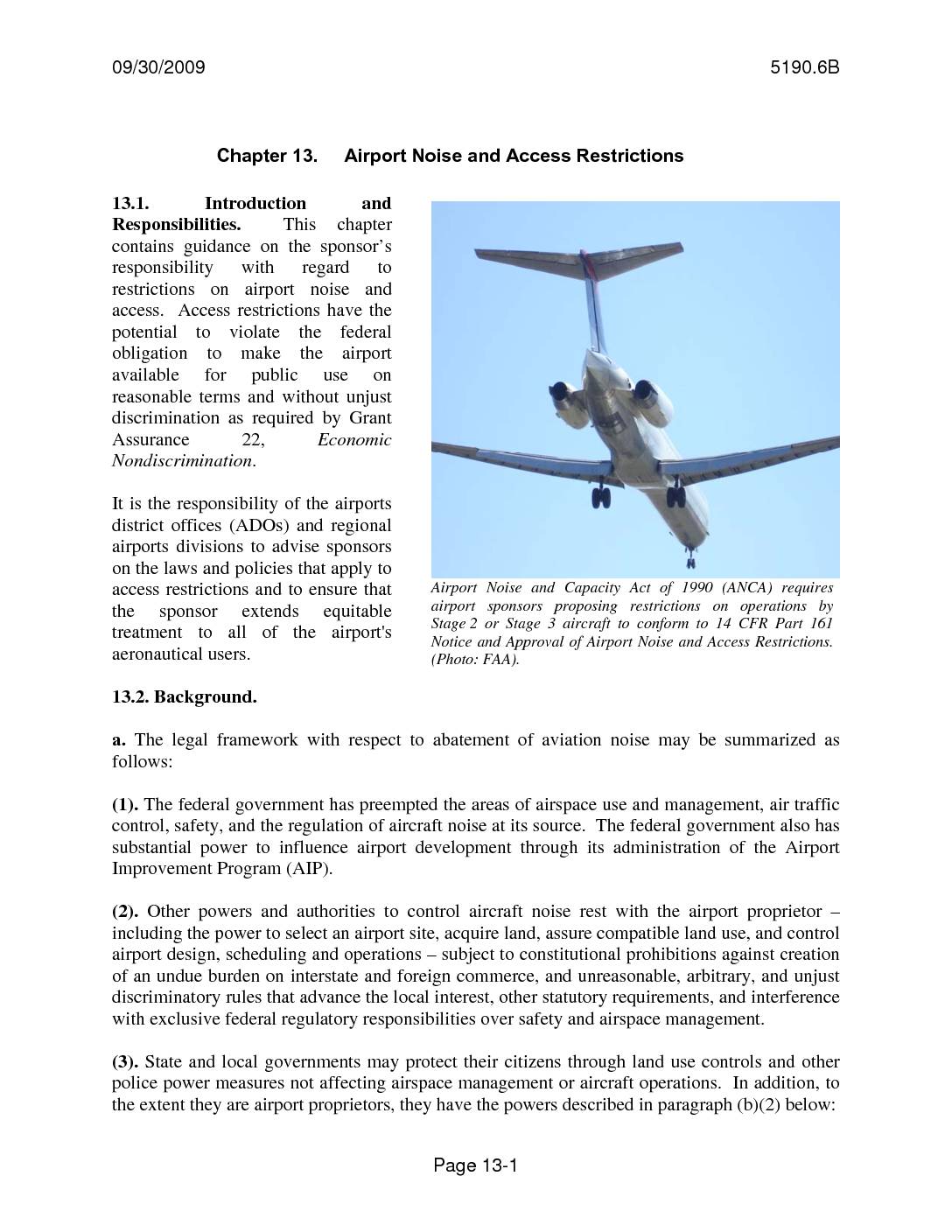
Airport noise and access restrictions
This FAA guidance document (Advisory Circular 5190.6B, Chapter 13) explains how responsibility for managing airport noise is shared among the federal government, airport operators, airlines, and local governments. The federal government controls airspace and sets aircraft noise standards, while airport sponsors like Sea-Tac have limited authority to restrict access in order to reduce noise impacts on surrounding communities, provided they follow the review and approval process required by the Airport Noise and Capacity Act of 1990 (ANCA). Any proposed restrictions affecting Stage 2 or Stage 3 aircraft must comply with 14 CFR Part 161 to ensure they do not unjustly discriminate against airport users or interfere with interstate commerce. -
 2009-09-30
FAA Airport Compliance Manual
This FAA document (Order 5190.6B), effective September 30, 2009, is the FAA Airport Compliance Manual, which guides FAA personnel on how to interpret and enforce the federal obligations that airport sponsors assume when they accept federal grant funds or federally owned property. It covers the rules and assurances airports must follow to remain in compliance with federal law, including how properties can be used and what commitments sponsors make to the U.S. government. The manual is administered by the FAA Airport Compliance Division in Washington, DC. -
 2009-09-30
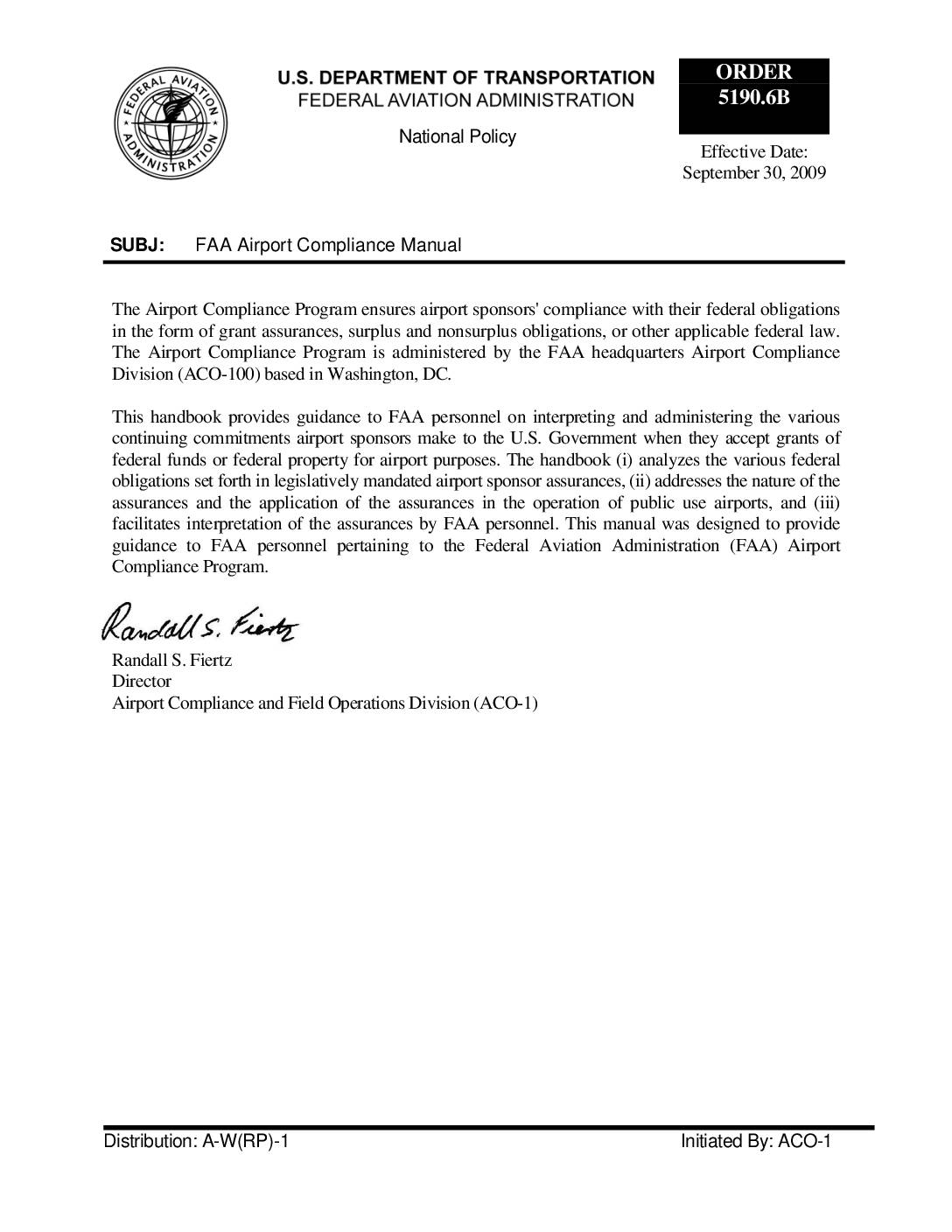
FAA airport compliance manual
The FAA Airport Compliance Manual (Order 5190.6B), effective September 30, 2009, provides guidance to FAA personnel on ensuring that airport sponsors meet their federal obligations when they accept federal funds or property for airport purposes. It analyzes grant assurances, surplus property conditions, and other legal commitments that airports must uphold, and outlines the compliance program's objectives, responsibilities, and enforcement procedures. The manual is administered by the FAA's Airport Compliance Division and serves as the authoritative reference for interpreting and managing airport sponsor obligations nationwide.