TagFAA(687)
-
 2012-09-01
King County International Airport Residential Aircraft Noise Remedy Improvements Program (RANRIP) Policies and Procedures Manual
The King County International Airport (Boeing Field) Residential Aircraft Noise Remedy Improvements Program (RANRIP) is a sound insulation program that provides home modifications to reduce aircraft noise for eligible residents living near the airport. The program, initially approved by the FAA in November 2006 and updated in September 2012, outlines policies and procedures covering homeowner eligibility, design assessments, construction processes, and post-construction inspections. Funding for sound insulation treatments is provided through the program, with the goal of measurably reducing interior noise levels for qualifying residences within the defined noise mitigation boundary. -
 2012-07-02
FAA NextGen for airports
This Federal Aviation Administration document describes how the NextGen air traffic modernization program benefits both general aviation and commercial airports through improved GPS-based approach procedures, ADS-B surveillance technology, and more efficient departure queue management systems. Key upgrades include WAAS/LPV approaches that allow aircraft to land in low-visibility conditions without expensive ground equipment, and surface surveillance tools to better track aircraft and vehicles on the ground. The document also outlines plans to optimize airspace procedures across 21 metropolitan areas to reduce delays and improve safety. -
 2012-06-11
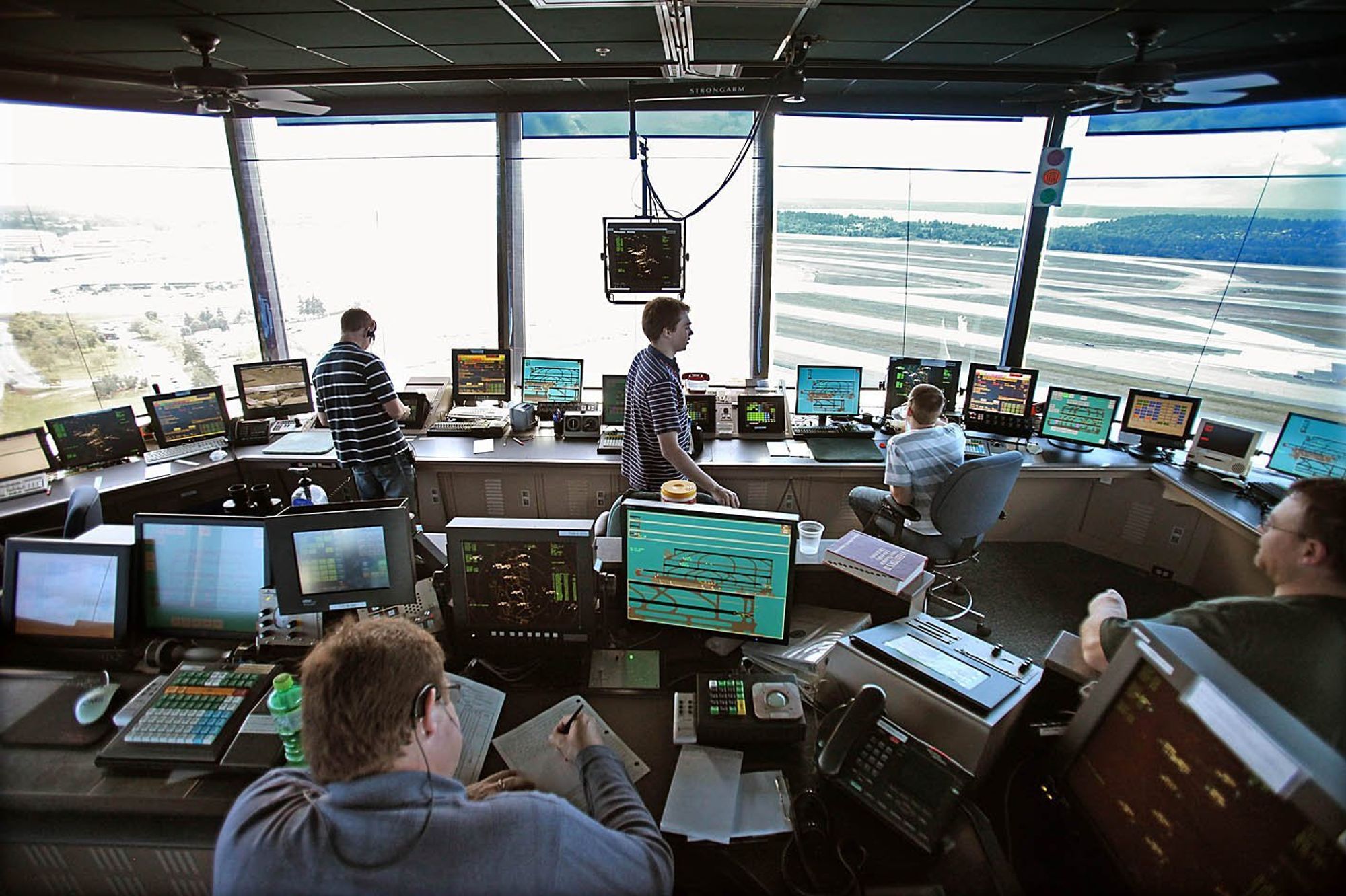
Sea-Tac Airport Air Traffic Control Tower Interior
Interior of an airport traffic control tower cab showing multiple controllers at workstations equipped with radar displays, surface movement screens, and radio equipment. A label reading 'STRONGARM' is visible on ceiling-mounted equipment, and runway infrastructure is visible through the wraparound windows below. -
 2012-05-25
Noise levels for U.S. certificated and foreign aircraft
This FAA Advisory Circular (AC 36-1H) published in 2001 and updated in 2012 provides official noise level data for U.S.-certificated and foreign aircraft, including turbojet and propeller-driven planes tested under 14 CFR Part 36 and ICAO Annex 16 standards. Noise measurements, expressed in Effective Perceived Noise Levels (EPNdB), cover takeoff, sideline, and approach conditions and are organized across multiple appendices by aircraft type and compliance stage. The document serves as a reference for tracking progress in aircraft noise reduction and supports noise policy decisions at airports across the United States. -
 2012-04-01
Grant assurances: Airport sponsors
★ 32This FAA document outlines the grant assurances that airport sponsors must agree to when accepting federal funding for airport development, planning, or noise compatibility programs. Sponsors are required to comply with a wide range of federal laws, regulations, and executive orders — including civil rights, environmental, and labor standards — for the duration of the project's useful life, generally up to 20 years. Key provisions include unlimited-duration obligations related to exclusive rights, airport revenue, and real property acquired with federal funds. -
 2012-02-21
Federal Aviation Administration Categorical Exclusion Declaration: Greener Skies Over Seattle, Seattle TRACON
The FAA issued a Categorical Exclusion Declaration allowing limited testing of new Required Navigation Performance (RNP) arrival procedures at Seattle-Tacoma International Airport, under the Greener Skies Over Seattle initiative. The test procedures, including optimized flight paths and descent profiles, were designed to reduce aircraft noise, fuel burn, and emissions while improving safety and efficiency. The exclusion, signed in February 2012, determined that the test phase would not require further environmental review, as it was a short-term evaluation to collect operational and noise data. -
 2012-02-14
USC TITLE 49—TRANSPORTATION § 47133 – Restriction on use of revenues
This section of U.S. transportation law restricts how airports receiving federal assistance can spend their revenues, generally limiting spending to airport capital and operating costs. However, it explicitly clarifies that nothing in the law prevents the use of airport revenue—on or off airport grounds—for noise mitigation purposes, which is directly relevant to communities affected by airport noise such as those near Sea-Tac. Additional provisions outline exceptions for prior financing agreements and the sale of private airports to public sponsors. -
HR 658 – FAA Modernization and Reform Act of 2012
FAA Modernization and Reform Act of 2012 – Title I: Authorizations – Subtitle A: Funding of FAA Programs – (Sec. 101) Authorizes appropriations to the Secretary of Transportation (DOT) out of the Airport and Airway Trust Fund for FY2012-FY2015 for: (1) airport planning and development and noise compatibility planning programs, (2) Federal Aviation Administration (FAA) -
 2012-01-01
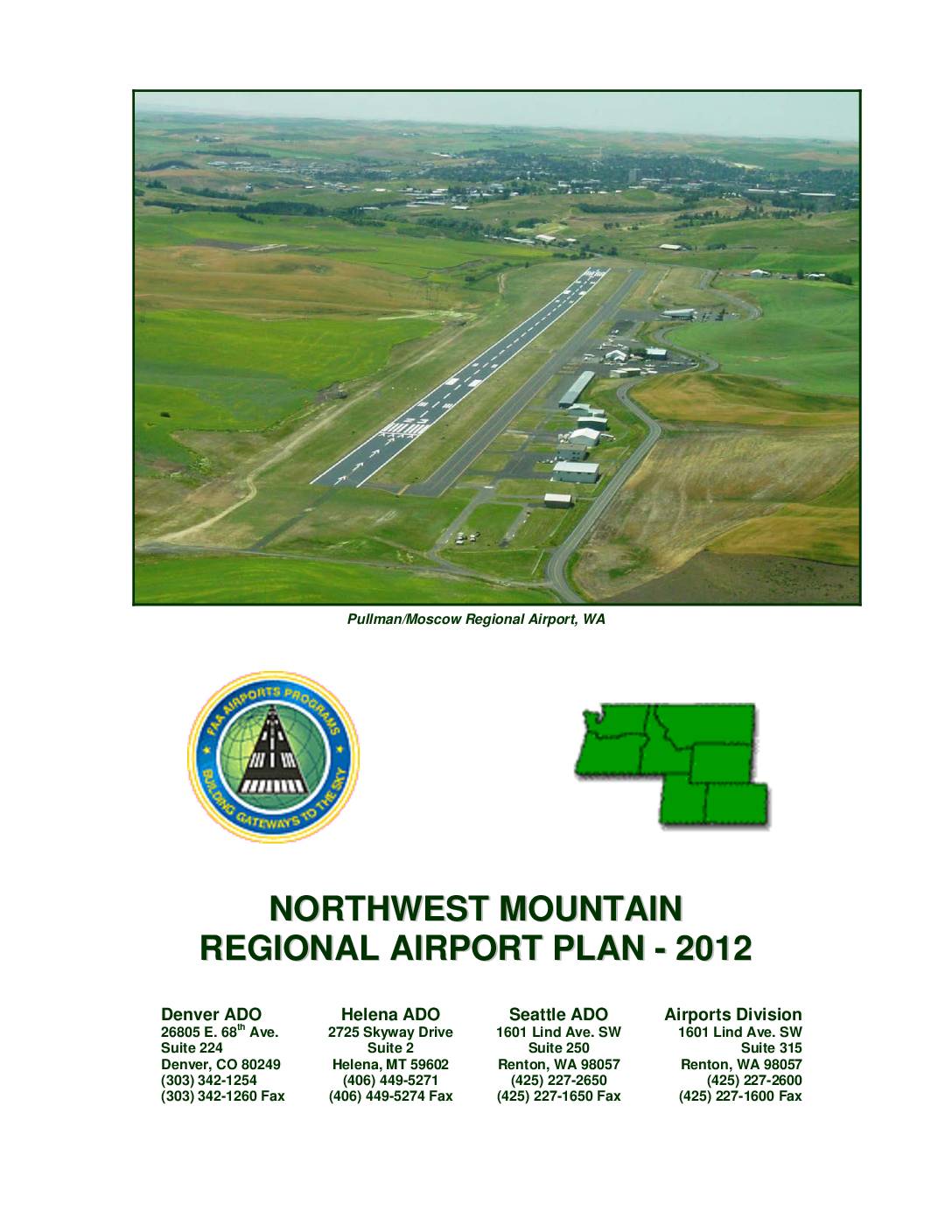
FAA Northwest Mountain Regional Airport Plan – 2012
The Northwest Mountain Regional Airport Plan (RAP) 2012 outlines the FAA's priorities for airport system development across the Northwest Mountain Region, covering safety improvements, runway upgrades, and investment strategies for 136 focus airports. The plan addresses key initiatives such as runway safety areas, wildlife hazard assessments, and preparation for NextGen technologies, with funding decisions guided by a regional Board of Directors overseeing the Airport Improvement Program. Note that this document covers regional airport planning broadly and does not specifically address Sea-Tac Airport noise policy. -
 2010-12-06
Letter of agreement: Informal runway use program, Seattle-Tacoma International Airport
This document outlines the Runway Use Agreement between the FAA and the Port of Seattle at Seattle-Tacoma International Airport (Sea-Tac), effective December 6, 2010. It establishes preferred runway assignments for arrivals and departures under various weather and traffic conditions, while making clear that safety and air traffic management always take priority. The agreement does not change existing FAA practices but aims to provide consistency and transparency for the public regarding how runways are used.