TagFAA(687)
-
 2012-11-01
Final Environmental Assessment for Proposed Arrival Procedures to Seattle-Tacoma International Airport: Appendix F — Noise and Its Effects on People
This document explains the noise metrics used to evaluate aircraft noise around Seattle-Tacoma International Airport, including decibels (dB), A-weighted decibels (dBA), and the Day-Night Average Sound Level (DNL). It describes how sound is measured on a logarithmic scale, meaning noise levels don't add up the way ordinary numbers do, and explains why A-weighted measurements are the standard used by the FAA and EPA because they best match how human ears perceive sound. These concepts form the technical foundation for assessing the environmental impact of proposed flight arrival procedures at Sea-Tac. -
 2012-11-01
HAWKZ RNAV VER 4.2: Targets Files for Proposed New Routings — Final Environmental Assessment for Proposed Arrival Procedures to Seattle-Tacoma International Airport, Appendix D
This document is Appendix D of the Final Environmental Assessment for proposed new arrival flight procedures at Seattle-Tacoma International Airport, dated November 1, 2012. It contains TARGETS files—technical routing data packages used to define new RNAV (area navigation) flight paths, such as the HAWKZ RNAV Version 4.2 procedure, which charts a series of waypoints guiding arriving aircraft toward Sea-Tac from the south. The files were prepared in coordination with Seattle ARTCC and are intended to support evaluation of how the new routes may affect noise levels in surrounding communities. -
 2012-11-01
Appendix C: Current Published Approach Procedures Affected by the Proposed Action
This appendix from a 2012 Environmental Assessment documents the published arrival flight procedures at Seattle-Tacoma International Airport that would be affected by proposed changes to how aircraft approach the airport. It includes detailed charts for routes such as the JAWBN Three Arrival and Olympia Seven Arrival, showing waypoints, altitudes, and speed restrictions for aircraft arriving from various directions including Canada and southern Washington. These procedures define the flight paths aircraft must follow when descending into Sea-Tac, directly influencing the noise experienced by communities surrounding the airport. -
 2012-11-01
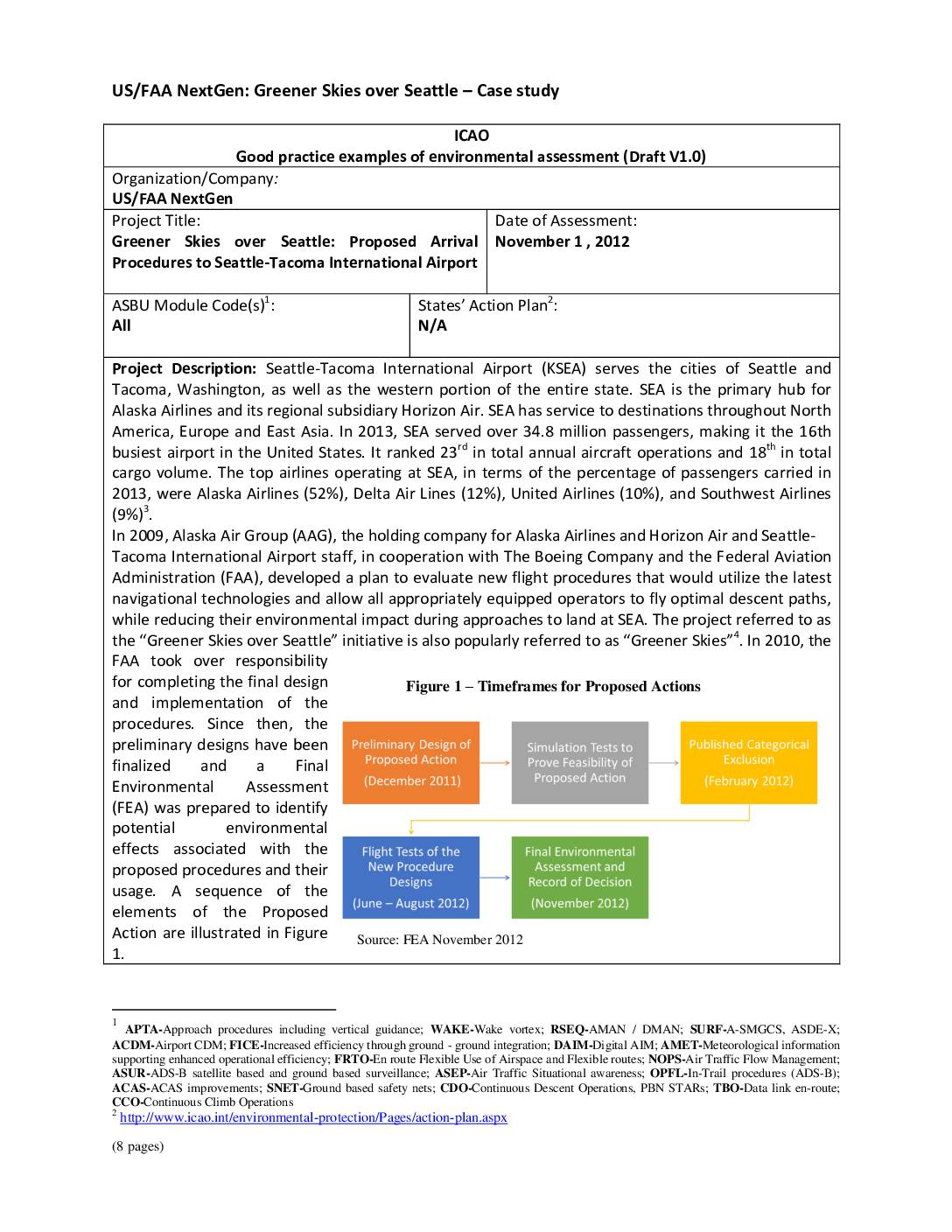
Greener Skies over Seattle: Proposed Arrival Procedures to Seattle-Tacoma International Airport — ICAO Good Practice Case Study
ICAO good practice case study documenting the US/FAA NextGen ‘Greener Skies over Seattle’ initiative — a Final Environmental Assessment (FEA) completed November 1, 2012 for proposed PBN arrival procedures (STARs and RNP with Optimized Profile Descents) at Seattle-Tacoma International Airport (KSEA/Sea-Tac Airport). Collaborative project between FAA, Alaska Air Group (Alaska Airlines, Horizon Air), The Boeing -
 2012-11-01
Final Environmental Assessment for Greener Skies Over Seattle: Proposed Arrival Procedures to Seattle-Tacoma International Airport — Volume 2 Appendices
This November 2012 Federal Aviation Administration report evaluates the environmental impacts of proposed new arrival flight procedures at Seattle-Tacoma International Airport, part of the 'Greener Skies Over Seattle' initiative. It includes detailed appendices covering noise modeling, effects of aircraft noise on communities, historic and endangered species considerations, and agency coordination records. The goal of the proposed procedures was to reduce fuel consumption and emissions while assessing changes in noise exposure for surrounding neighborhoods. -
 2012-10-31
Final environmental assessment for Greener Skies Over Seattle; proposed arrival procedures to Seattle-Tacoma International Airport
In October 2012, the Federal Aviation Administration (FAA) approved new GPS-based arrival flight paths into Seattle-Tacoma International Airport (Sea-Tac) under the 'Greener Skies Over Seattle' initiative. The new procedures, developed in partnership with Alaska Airlines, Boeing, and the Port of Seattle, use satellite navigation technology to guide arriving aircraft on more precise, fuel-efficient descent paths from the northwest and southwest. The FAA concluded that the changes would not cause significant environmental harm, issuing a Finding of No Significant Impact (FONSI) alongside its formal approval. -
 2012-10-31
Draft Environmental Assessment for Greener Skies Over Seattle: Proposed Arrival Procedures to Seattle-Tacoma International Airport, Volume 2 – Appendices
FAA Draft Environmental Assessment (EA), Volume 2 Appendices, for the Greener Skies Over Seattle project proposing new arrival procedures to Seattle-Tacoma International Airport (Sea-Tac Airport / KSEA), dated 31 October 2012. Appendices cover noise metrics (DNL, SEL, Leq, dBA), NIRS noise modeling technical report, aircraft operations and flight tracks, runway utilization, meteorological conditions, historic resource -
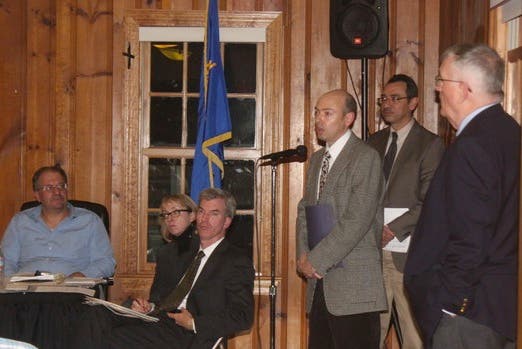
Frustrated Residents Fire Back at FAA Officials
Several individuals participate in what appears to be a public meeting or hearing in a wood-paneled room. A blue flag (possibly Washington State) is visible in the background along with a speaker system, suggesting an official or government-related gathering. -
2012-10-26
Frustrated Residents Fire Back at FAA Officials
Joseph Kellard, Patch Staff Posted Fri, Oct 26, 2012 at 4:00 pm ET Story and photos by Tara Conry Is the Federal Aviation Administration compromising safety and ignoring an agreement to reduce noise pollution in order to maximize efficiency at JFK airport? Those were the charges residents made at the Oct. 23 meeting of the -
 2012-10-18
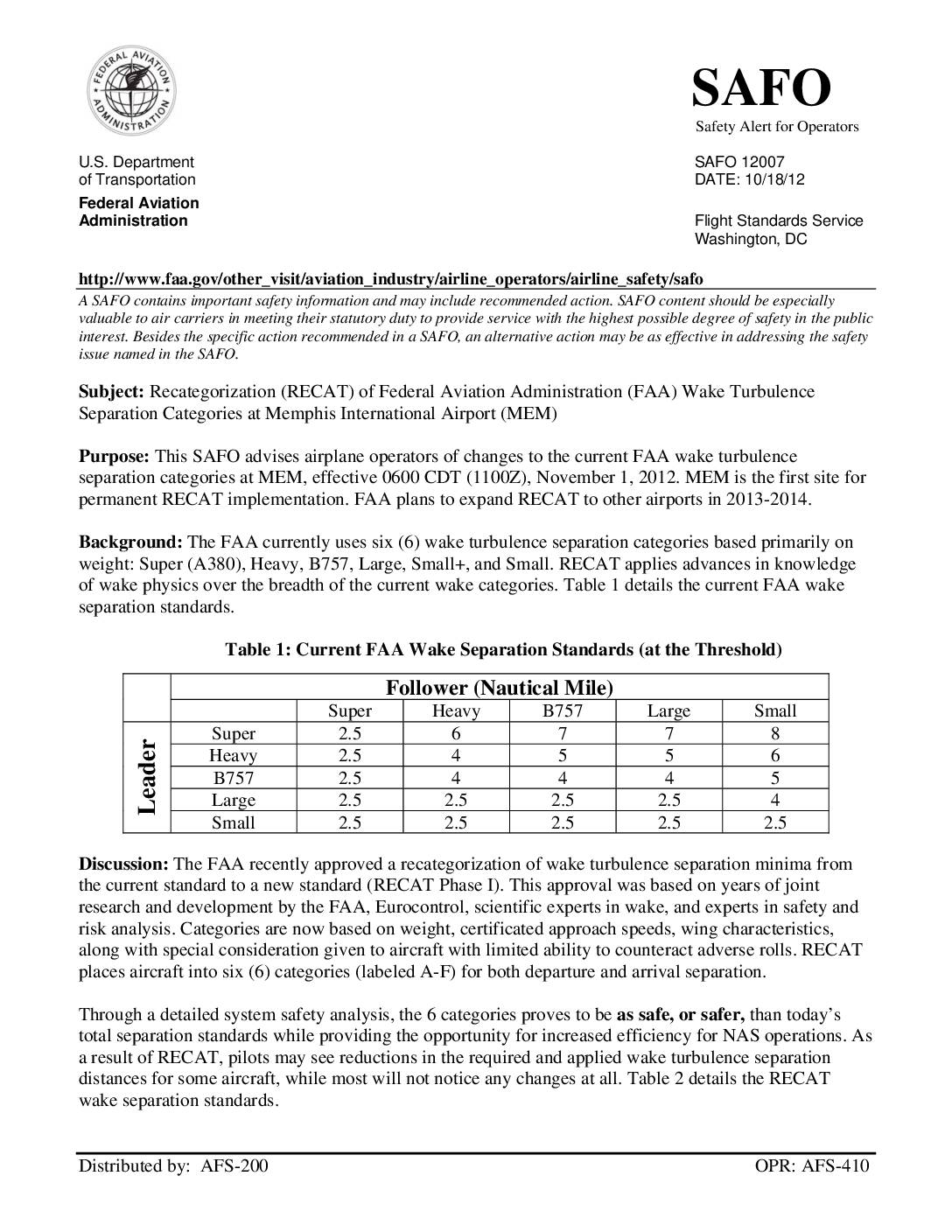
Recategorization (recat) of federal aviation administration (FAA) wake turbulence separation categories at memphis international airport (mem)
FAA Safety Alert for Operators announcing the implementation of new wake turbulence separation categories (RECAT Phase I) at Memphis International Airport, effective November 1, 2012. The document details changes from the current 6-category system to a new system based on weight, approach speeds, and wing characteristics, with specific separation standards and aircraft assignments.