The most requested documents–and all related-content
This page is an attempt to solve a problem we’ve had since the beginning: how to get visitors to study documents and all the related content which often provides the necessary context. For example, most studies are meant to be read by specialists. If you are a layperson, you may only be interested in the ‘one-pager’. This page shows you both.
PSRC Regional Aviation Baseline Study (2019)
Discussion
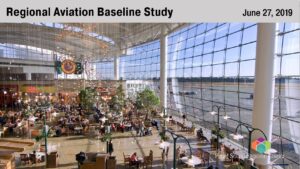
Regional Aviation Baseline Study June 27, 2019 Study Objectives • Identify the roles of each airport and the aviation activities within the region based on existing planning efforts • Provide a regional perspective on how aviation activities at airports in the region interact with each other, the community and the broader economy • Obtain input from stakeholders about their needs and build a common understanding about aviation and airspace constraints • Identify future aviation needs within the central Puget Sound Region and set the stage for future planning Regional Aviation Baseline Study
PSRC Regional Aviation Baseline Study Working Paper 1
Discussion
R e g i o n a l A v i a t i o n B a s e l i n e S t u d y : W o r k i n g P a p e r 1 Contents Chapter 1: Introduction and Summary Chapter 2: Data Collection and Inventory Chapter 3: Economic and Socioeconomic Context Chapter 4: Commercial Aviation Trends and Forecast Chapter 5: General Aviation Trends and Forecast Chapter 6: Air Cargo Trends and Forecast Chapter 7: Multimodal Connections and Access Chapter 8: Goals, Objectives, and Metrics Appendix A: Study Metrics Appendix B: Drive Times
Puget Sound Air Toxics Evaluation Final Report, October 2003
Discussion
For more information about this report, call Leslie Keill at (206) 689-4022
Regional Airport System Plan 1980-2000 (11/80)
Discussion
Vice President: John Enbom, Mayor, Mountlake Terrace Executive Director: Mart Kask This draft report has been prepared for review and policy guidance by: THE STANDING COMMITTEE ON TRANSPORTATION Mrs. Jeanette Williams, Chairman Councilman, City of Seattle Ray Aardal, Commissioner Washington State Transportation Commission Bruce Agnew, Councilman Snohomish County Jack Bujacich, Commissioner Pierce County William Bulley, Secretary Washington State Department of Transportation Richard Hays, Acting Director Pierce County PTBA John Horsley, Commissioner Kitsap County Bruce Laing, Councilman King County Robert Neir, Councilman City of Kirkland Dale Pope, Councilman City of Everett Albert Rosellini, Commissioner Washington State Transportation Commission Vic Sood, Director Community Transit Tom Swanson, Commissioner City of Bremerton Mab Tocher, Councilwoman City of Bellevue
Regional Aviation Baseline Study
PSRC is leading a baseline study to provide a clear picture of the aviation activities and needs in the region and set the stage for future planning efforts. Aviation plays a critical role for people and businesses in the growing central Puget Sound region, which is currently home to 29 airports of varied sizes and functions. Continued,
Residential Fine particle pollution University of Missouri ncr393-1991
Discussion
North Central Regional Extension Publications are subject to peer review and prepared as a part of the Cooperative Extension activities of the 13 land-grant universities of the 12 North Central States, in cooperation with the Extension Service - U.S. Department of Agriculture, Washington, D.C. The following states cooperated in making this publication available: University of Illinois University of Nebraska Mumford Hall Dept. of Ag. Communications 1301 W. Gregory Drive Lincoln, NE 68583-0918 217-333-2007 402-472-3023 *Kansas State University North Dakota State University Umberger Hall Ag. Comm. Center, Box 5655, Morrill Hall Manhattan, KS 66506 Fargo, ND 58105 913-532-5830 701-237-7881 University of Minnesota South Dakota State University Coffey Hall Ag. Comm. Center, Box 2231 St. Paul, MN 55108 Brookings, SD 57007 612-625-8173 605-688-5628 University of Missouri 115 S. Fifth St. Columbia, MO 65211 314-882-2792 *Publishing State For copies of this and other North Central Regional Extension Publications, write to: Publications Office, Cooperative Extension Service, in care of the University listed above for your state. If they do not have copies or your state is not listed above, contact the publishing state as marked with an asterisk. Fine Particle POLLUTION Residential Air Quality Airborne particles, such as smoke, dust and pollen, can cause personal discomfort, allergic reactions, and a soiling film that slowly coats walls, furnishings and draperies. While outdoor air pollutants are often visible as they spew forth from smokestacks or auto exhausts, indoor pollution may show only in the dust-laden sunbeam or smoke rising from a cigarette. About 99 percent of…
Results from soil contamination study of King County
Sea-Tac Airport Air Monitoring 11/09 Study
Sea-Tac Airport Final EIS, Feb. 1996, Vol. 1 of 7
Discussion
This statement is submitted for review pursuant to the requirements of Section 102(2)(C) of the National Environmental Policy Act of 1969 (42 U.S.C. 4321 et seq); E.O. 11990, Protection of Wetlands; E.O. 11998, Floodplain Management; the USC Subtitle VII; 42 U.S.C. 7401 et seq; 49 U.S.C. 47101 et seq; Washington State Environmental Policy Act (RCW 43.210); and other applicable laws. The proposed action will impact the 100-year floodplain as indicated on the Federal Emergency Management Agency's Flood Insurance Rate Map. This Environmental Impact Statement (EIS) is a combined National Environmental Policy Act and Washington State Environmental Policy Act (SEPA) docunient. With regard to SEPA requirements, this EIS represents the second step of a phased environmental review which began with publication d the 1992 Flight Plan Final EIS, which assessed alternatives for addressing regional aviation needs. This Final EIS also contains the draft conformity statement, as required by the Clean Air Act amendments. The Port of Seattle, operator of Seattle-Tacoma International Airport, has prepared a Master Plan Update for the Airport. The Plan shows the need to address the poor weather operating capability of the Airport through the development of a third parallel runway (Runway 16W34X) with a length of up to 8.500 feet, separated by 2,500 feet from existing Runway 16U34R, with associated taxiways and navigational aids. Other development needs include: extension of Runway 34R by 600 feet; establishment of standard Runway Safety Areas for Runways 16Rl34L and 16U34R; development of a new air traff~c control tower; development of a…
Sea-Tac Airport Pollutant Contribution Dept. Of Ecology 05/91
Discussion
The study - done at the re- quest of 33rd District state Rep. Greg Fisher (D-Des Moines) - indicates that the airport accounts for approxi- mately 8 percent of the carbon monoxide ·and 5 percent of the nitrogen oxide in King Coun- ty. Both substances are suspected carcinogens, which means they may cause cancer. "Those who live around the airport live in an air-pollution ~------------v_o_t_~ __ N_o_._12_7 ____ ~IIL ___________________________ A __ 3~ NORTH HILL SOUTH SEATAC NORMANDY PARK ~s a major polluter · hotspot," said Fisher. "It could have significant impacts on their health." POLLUTION GENER· ATED by the airport may be transported by the wind, transformed in the atmosphere and then deposited in sur- rounding areas, the report said. Taken in the aggregate, au- tomobiles still produce far more pollution than any other source, including the airport, said Jim Nolan of the Puget Sound Air Pollution Control Agency in Seattle. "But you're going to find that the airport is a great pollution producer, partly because so many vehicles travel there," Nolan said. "But in a lot of respects, au- tomobile traffic is much worse than air traffic." The Boeing plant in Renton, for example, generates 11 tons of carbon monoxide and 45 tons of nitrogen oxide each year, Nolan said. The · airport gel'lerates 3,628 tons of carbon monoxide and 1,897 tons of nitrogen oxide annually, according to the report. Automobiles in King County generate 322,037 tons of carbon monoxide annually, according to statistics from the air-pollution control…
Sea-Tac Airport Spatial Nitrogen Dioxide Study 2009
Discussion
Previous air pollution modeling efforts and current facility expansion activities at Sea-Tac International Airport have raised concerns about elevated nitrogen dioxide (NO2) levels in the surrounding community. The goals for this project were to 1) assess compliance with the 100 micrograms per cubic meter annual national ambient air quality standard (NAAQS) for NO2, 2) quantify any local concentration gradients, and 3) evaluate the impact of aircraft operations on local NO2 levels. The scope of this project included annual NO2 measurements throughout the community; samplers were located in areas near the north and south ends of the airport where aircraft operations would most likely affect ambient concentrations. Three-week integrated NO2 measurements were continuously performed at 16 locations using Yanagisawa NO2 diffusion badges. Additionally, Washington State Department of Ecology (WDOE) performed continuous nitrogen oxides (NOX) measurements using Federal Reference Method chemiluminescent analyzers and collected meteorological data at two of the sampling locations. Annual average NO2 measurements at all sites were well below the NAAQS. Consistent spatial concentration gradients were observed throughout the study. NO2 levels decreased from east to west. NO2 levels generally decreased with distance from both the airport runways and local freeways. Hourly NOX and meteorological data from WDOE monitoring stations were used to identify local source impacts by comparing measured NOX levels by wind direction. Because NOX is primarily emitted as nitric oxide (NO), concentration of this species varied more with wind direction than NO2. Evidence of a small but discernable airport impact on NOX levels was observed near…
Sea-Tac International Airport Impact Mitigation Study (HOK)
SeaTac Oxides Of Nitrogen and Particulate Matter Study 1999
Seattle Greenhouse Gas Inventory Full Report (2005)
Discussion
2005 Inventory of Seattle Greenhouse Gas Emissions: Community & Corporate
Shared Airspace Study Sea-Tac & King County International Airports 10/28/1981
SKCDOH Community Health and Airport Operations Related Pollution Report December 2020
Discussion
Community Health and Airport Operations Related Noise and Air Pollution: Report to the Legislature in Response to Washington State HOUSE BILL 1109
Spatial and Temporal Patterns of Airborne Toxic Species in Seattle Neighborhoods 2006
Discussion
Spatial and Temporal Patterns of Airborne Toxic Species in Seattle, WA Neighborhoods Paper # 456 Hal Westberg, Brian Lamb and Doris Montacastro Laboratory for Atmospheric Research Washington State University Pullman, WA 99111 John Williamson Washington Department of Ecology 3190 160th Ave. SE Bellevue, WA 98008
SR-509 – Corridor Completion FEIS
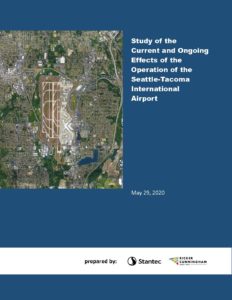
Stantec: Study of the Current and Ongoing Effects of the Operation of the Seattle-Tacoma International Airport
Discussion
Study of the Current and Ongoing Effects of the Operation of the Seattle-Tacoma International Airport May 29, 2020
Study of Ongoing Effects of Sea-Tac Pre-Proposal Conference
Discussion
The Department of Commerce touches every aspect of community and economic development. We work with local governments, businesses and civic leaders to strengthen communities so all residents may thrive and prosper. Safety / Crime Victims Business Assistance We strengthen communities Planning Infrastructure Community Facilities Housing http://www.commerce.wa.gov/ Agenda • Staff Introductions • Brief Overview of the Background & Purpose • RFP - Project Basics • Objectives and Scope of Work • Timelines • Minimum Qualifications • Proposal Contents • Scoring • Questions Brief Overview of the Background & Purpose (a) PURPOSE: The purpose of this action is to initiate and complete a study (Study) of the current and on-going impacts of the Sea-Tac International Airport and report those findings to the Washington State Legislature. The State Department of Commerce (Commerce) is responsible for defining the parameters (scope) of the Study in a statement of work. (b) BACKGROUND: The Washington State Legislature formally asked Commerce on 3/21/2018 to complete a study that evaluates the current and on-going impacts of the Seattle-Tacoma International Airport. Commerce must implement provisions of Sections of Engrossed Substitute Senate Bill (ESSB) 6032–Section 127(63) that requires a study on the current and on-going impacts of the Seattle-Tacoma International Airport. (c) POLICY BASIS: The Washington State Legislature enacted Engrossed Substitute Senate Bill (ESSB) 6032 during the 2018 regular session. Section 127(63) (referred to as “the Proviso”) provides in part that, $300,000 of the general fund—(state appropriation) for fiscal year 2019 and $300,000 of the general fund—(local appropriation) are provided solely…