TagUltrafine Particulates(77)
-
 2022-08-08
UFP Advisory Group Meeting Minutes: August 8, 2022
Meeting minutes of the Ultrafine Particle (UFP) Advisory Group held August 8, 2022, covering indoor air quality research and aircraft impacts on schools near Sea-Tac Airport. Key topics include Phase I findings from the MOV-UP study showing 50% UFP infiltration reduction to 10% with HEPA air purifiers in classrooms, Principal Component Analysis (PCA) of particle -
 2022-08-01
Urban ultrafine – advisory group meeting, August 2022
A University of Washington research team held an advisory group meeting in August 2022 to discuss ultrafine particle (UFP) pollution in urban areas near airports. The meeting covered topics including indoor air quality in schools affected by aircraft emissions, short-term health effects of UFPs, and plans for mobile air quality monitoring. The multidisciplinary team includes environmental health scientists, researchers, and public health experts examining how aviation-related pollution impacts surrounding communities. -
 2021-12-01
MATES V draft report, chapter 5: Ultrafine particles and black carbon measurements
This report chapter examines measurements of ultrafine particles (UFPs) — very tiny airborne particles smaller than 0.1 micrometers — and their potential health effects, including risks to neurological, respiratory, and cardiovascular health. UFPs make up roughly 90% of all airborne particles and are primarily produced by fuel combustion sources such as diesel engines, gasoline engines, and jet engines. People living near heavily trafficked roads, airports, refineries, and railyards may face elevated exposure to these particles. -
2021-12-01
MATES V draft report, chapter 5: Ultrafine particles and black carbon measurements
This report chapter examines measurements of ultrafine particles (UFPs) — very tiny airborne particles smaller than 0.1 micrometers — and their potential health effects, including risks to neurological, respiratory, and cardiovascular health. UFPs make up roughly 90% of all airborne particles and are primarily produced by fuel combustion sources such as diesel engines, gasoline engines, and jet engines. People living near heavily trafficked roads, airports, refineries, and railyards may face elevated exposure to these particles. -
 2021-03-29
Characterizing Ultrafine Particulate Matter and Black Carbon Exposure Levels for a Seattle-Based Cohort From a Mobile Monitoring Campaign
This research presentation describes a mobile air monitoring study conducted in Seattle to measure ultrafine particulate matter and black carbon pollution levels for elderly residents participating in the Adult Changes in Thought (ACT) study, which investigates aging and dementia. Researchers used a vehicle-mounted monitoring system to collect repeated short-term air quality samples across the Seattle area, aiming to estimate long-term pollution exposure for cohort participants aged 65 and older. The study is funded by the National Institute of Environmental Health Sciences and the National Institute on Aging. -
2021-03-29
Characterizing Ultrafine Particulate Matter and Black Carbon Exposure Levels for a Seattle-Based Cohort From a Mobile Monitoring Campaign
Presentation by Magali Blanco, PhD (University of Washington Department of Environmental and Occupational Health Sciences) on ultrafine particulate matter (UFP) and black carbon (BC) exposure characterization for the Adult Changes in Thought (ACT) Seattle-based elderly cohort using a mobile monitoring campaign. Funded by NIEHS and National Institute on Aging (R01ES026187). Co-authors include Amanda Gassett, Timothy -
 2021-01-01
Healthy Air, Healthy Schools study executive summary
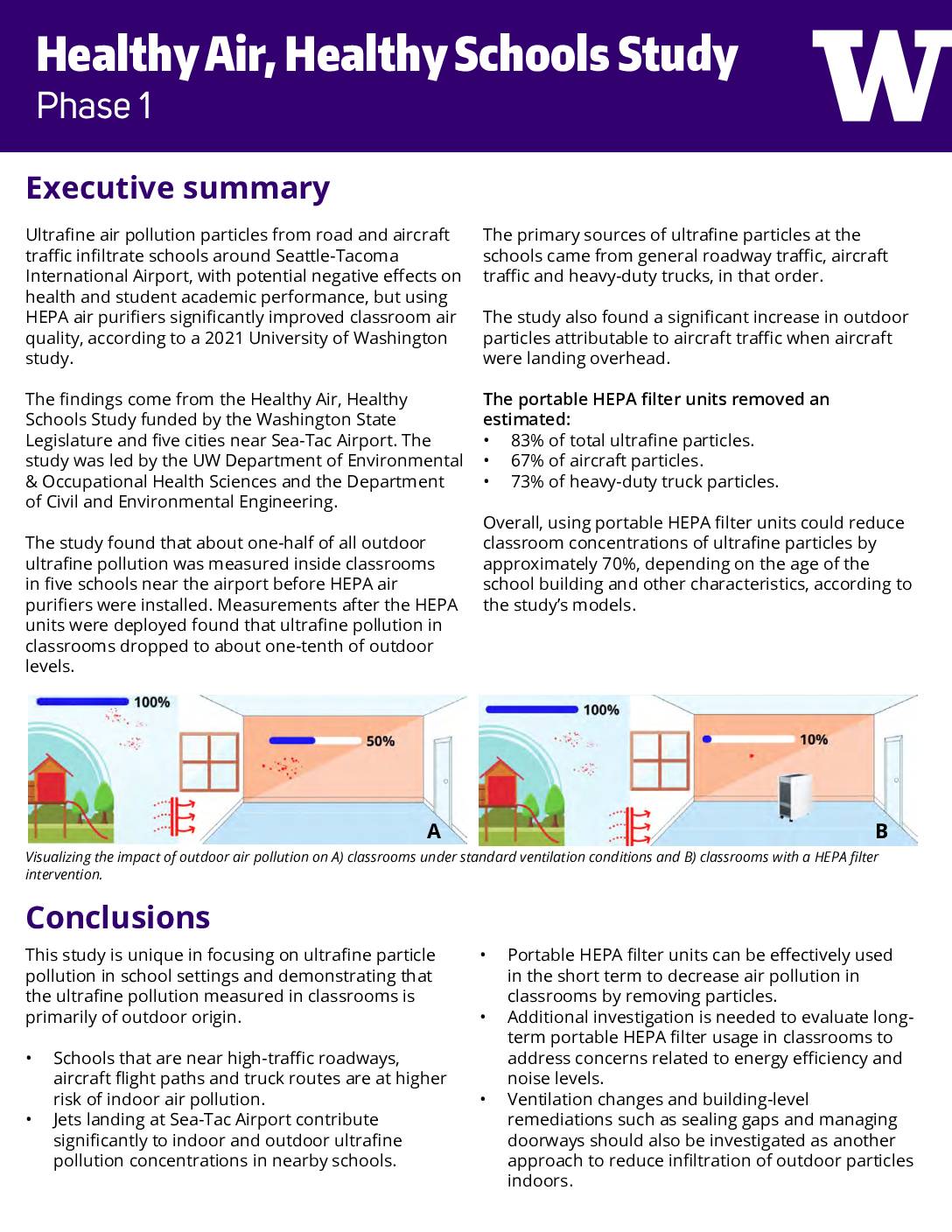
A 2021 University of Washington study found that ultrafine air pollution particles from road and aircraft traffic near Seattle-Tacoma International Airport were infiltrating nearby school classrooms, with indoor levels reaching roughly half of outdoor concentrations before any intervention. Installing portable HEPA air purifiers reduced classroom ultrafine particle levels to about one-tenth of outdoor levels, cutting overall particle concentrations by an estimated 70%. A follow-up Phase 2 study is now underway in 30 Washington schools to examine longer-term air quality improvements and their effects on student health and academic performance. -
 2020-12-05
The relationship between flight traffic, ultrafine particles and noise from the Seattle Aircraft Air and Noise Study
Researchers from the University of Washington School of Public Health examined how aircraft flight traffic at Seattle-Tacoma International Airport relates to ultrafine particle pollution and noise levels in surrounding communities. The study highlights that neighborhoods such as Beacon Hill and other South King County areas already rank among the most environmentally burdened in Washington State, facing cumulative hazards including both air and noise pollution from aircraft. The findings are intended to inform policy discussions about the health impacts of airport operations on nearby, often disadvantaged, communities. -
 2020-10-19
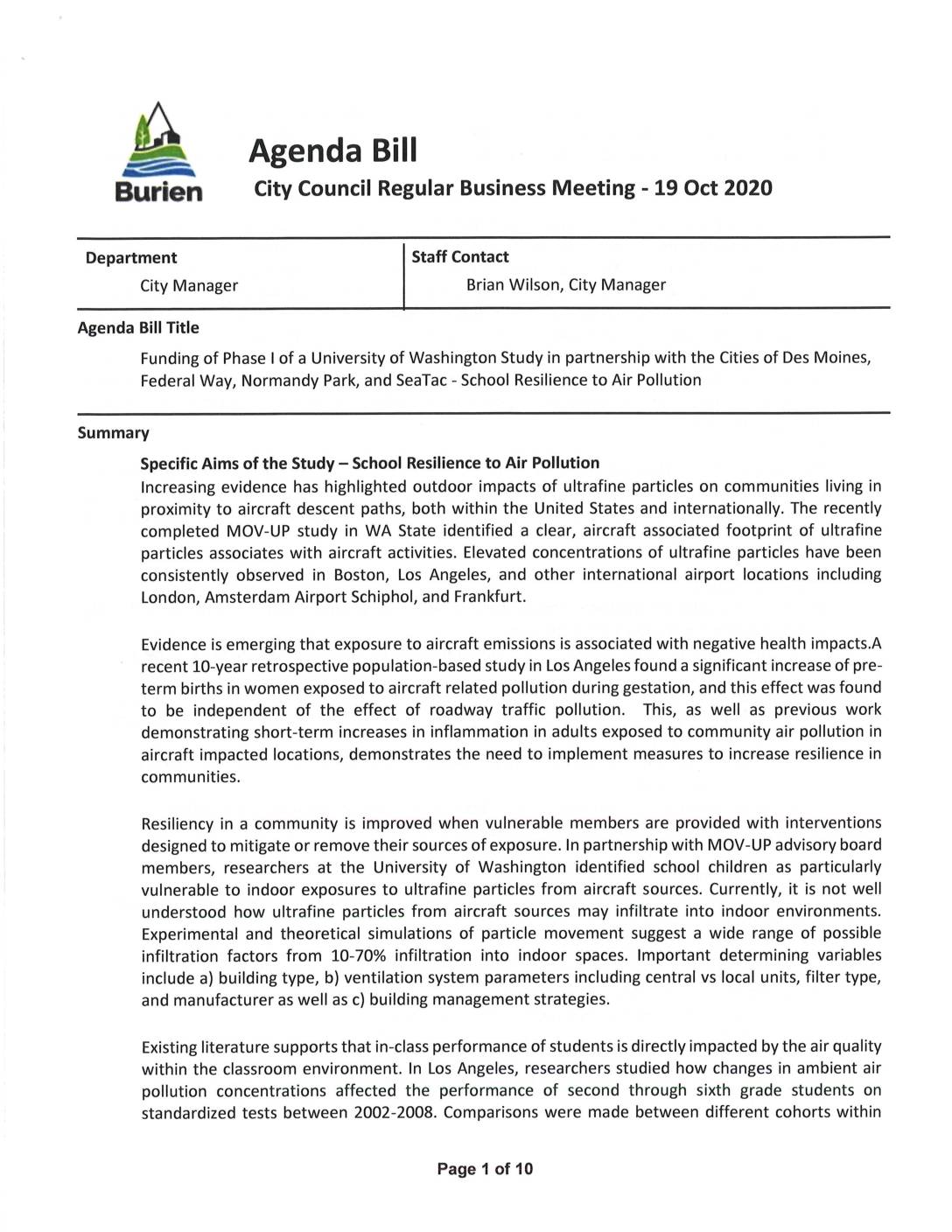
Funding of Phase I of a University of Washington study in partnership with the cities of Des Moines, Federal Way, Normandy Park, and SeaTac — School resilience to air pollution
In October 2020, the City of Burien considered joining Des Moines, Federal Way, Normandy Park, and SeaTac in funding a $62,500 University of Washington study examining how ultrafine particles from aircraft emissions penetrate school buildings near Sea-Tac Airport. The first phase of the study would assess the air filtration efficiency of five schools located north and south of the airport, while a proposed second phase ($250,000) would test interventions to improve indoor air quality and measure their impact on student health and academic performance. Each participating city was asked to contribute $12,500, with the City Manager recommending approval of an Interlocal Agreement to move the project forward.