TagSea-Tac Airport(2010)
-
 1978-02-06
Background report on Concorde flight operations
This 1978 background report, prepared for the Washington State House of Representatives, examines the potential impact of allowing Concorde supersonic jet flights at Seattle-Tacoma International Airport (SeaTac). It finds that even one Concorde flight per day would expose an additional 1,000 residents to severe aircraft noise and could increase the Port of Seattle's property acquisition costs by $10–15 million. The report also explores the legal boundaries of airport noise regulations following a landmark court case that affirmed airport proprietors may set their own noise rules, provided those rules are reasonable, non-arbitrary, and non-discriminatory. -
 1978-01-01
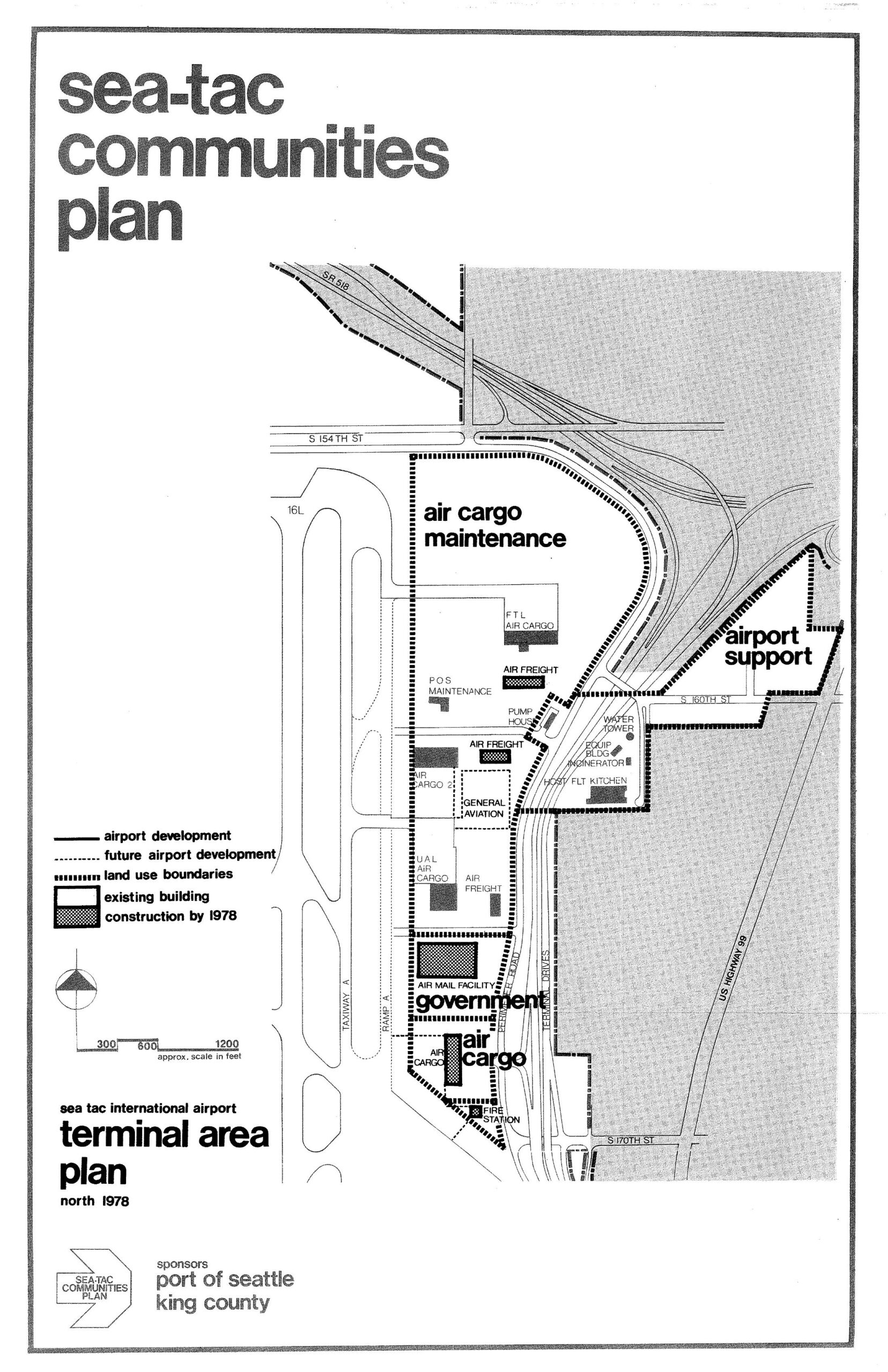
Sea-Tac International Airport North Terminal Area Plan Map, 1978
A land-use planning map from the Sea-Tac Communities Plan showing the north terminal area of Sea-Tac International Airport as of 1978, delineating zones for air cargo maintenance, airport support, government, and general aviation facilities, with existing buildings and planned construction indicated. The plan was sponsored by the Port of Seattle and King County, and shows key roadways including S 154th St, S 160th St, S 170th St, and US Highway 99. -
 1978-01-01
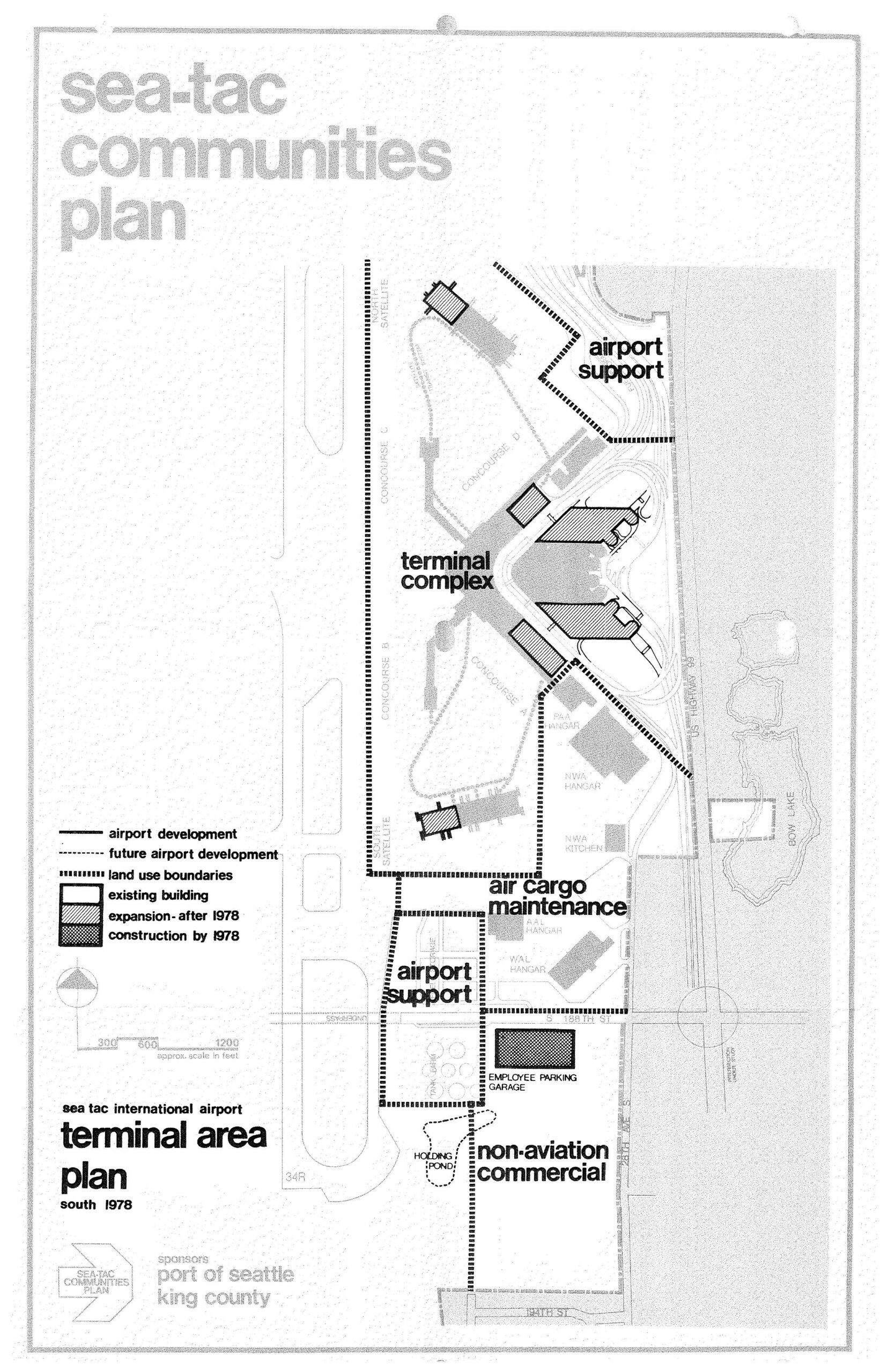
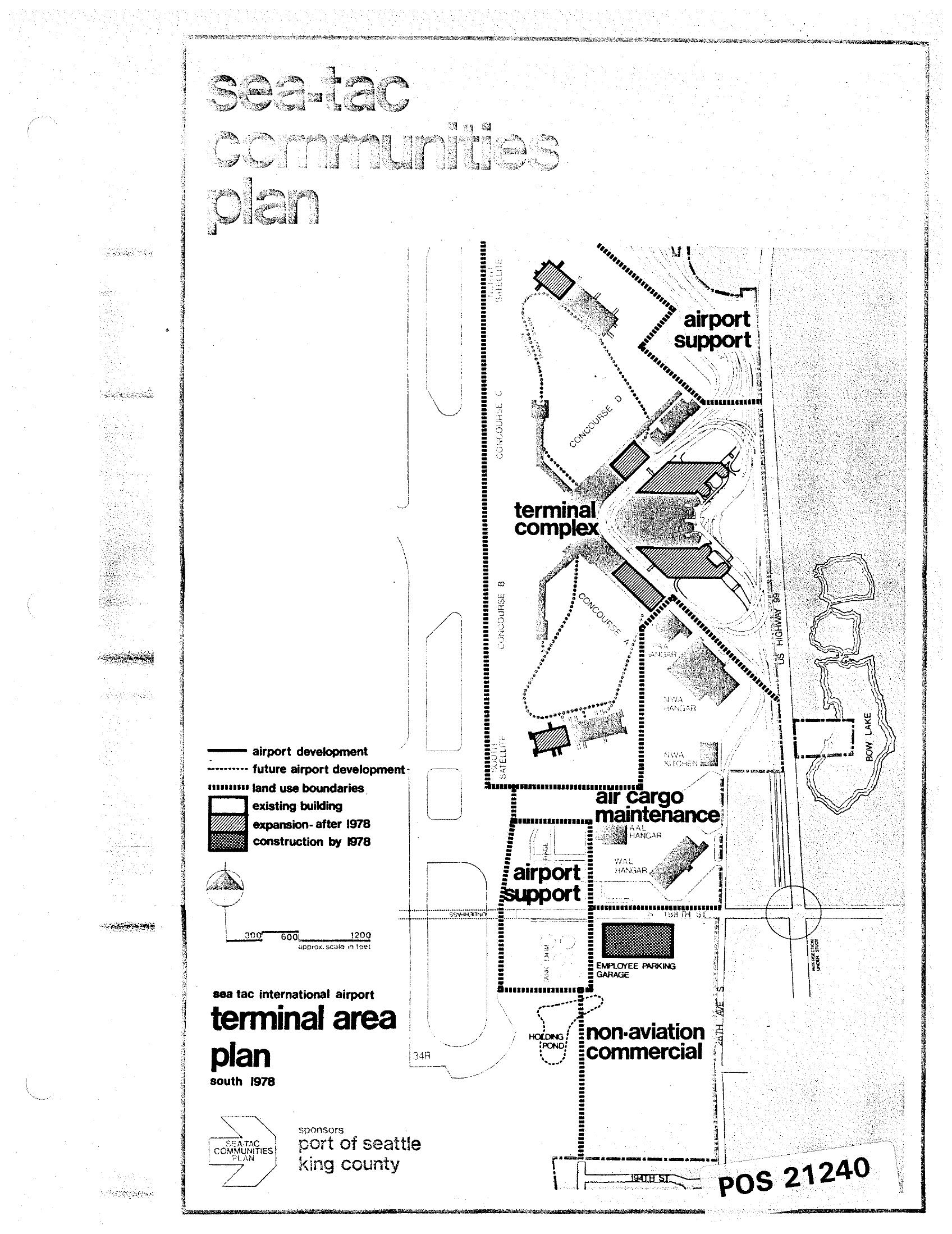
Sea-Tac International Airport Terminal Area Plan South — STCP, 1978
A planning map from the Sea-Tac Communities Plan, sponsored by the Port of Seattle and King County, depicting the Sea-Tac International Airport terminal area as of 1978. The map identifies land use zones including the terminal complex, airport support areas, air cargo maintenance, non-aviation commercial, and an employee parking garage, with a legend distinguishing existing buildings, post-1978 expansions, and construction completed by 1978. -
 1978-01-01
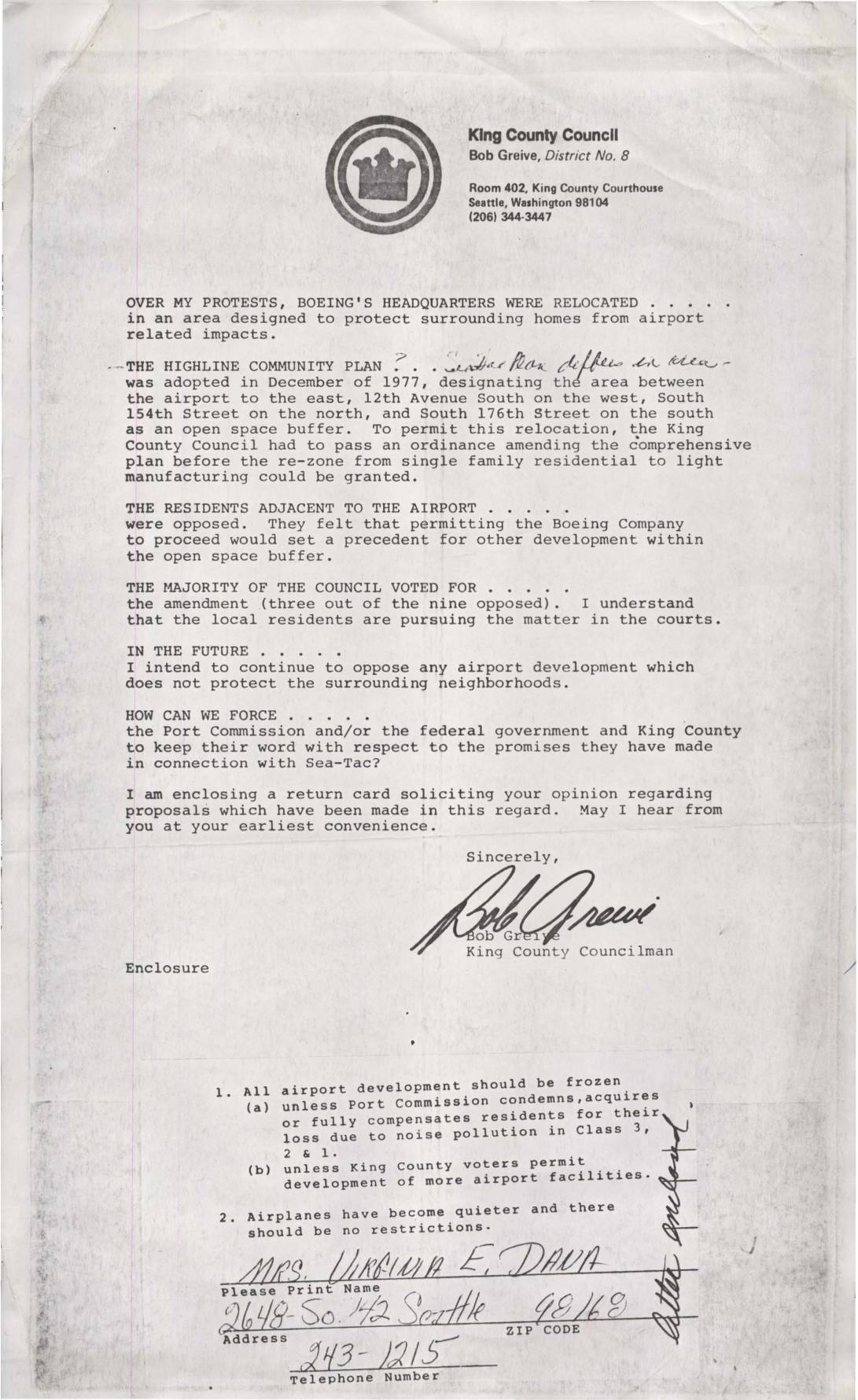
Letter from King County Councilman Bob Grieve on Boeing HQ Relocation and Sea-Tac Airport Development
King County Councilman Bob Greive wrote to constituents explaining his opposition to Boeing's headquarters relocation into an area designated as an open space buffer under the 1977 Highline Community Plan, which was meant to protect neighborhoods surrounding Sea-Tac Airport from noise and development impacts. Despite protests from nearby residents and three dissenting council votes, the majority approved an ordinance amending the comprehensive plan to allow rezoning from single-family residential to light manufacturing. Greive solicited public opinion on proposals to hold the Port Commission, federal government, and King County accountable for promises made regarding Sea-Tac's impact on surrounding communities. -
 1978-01-01
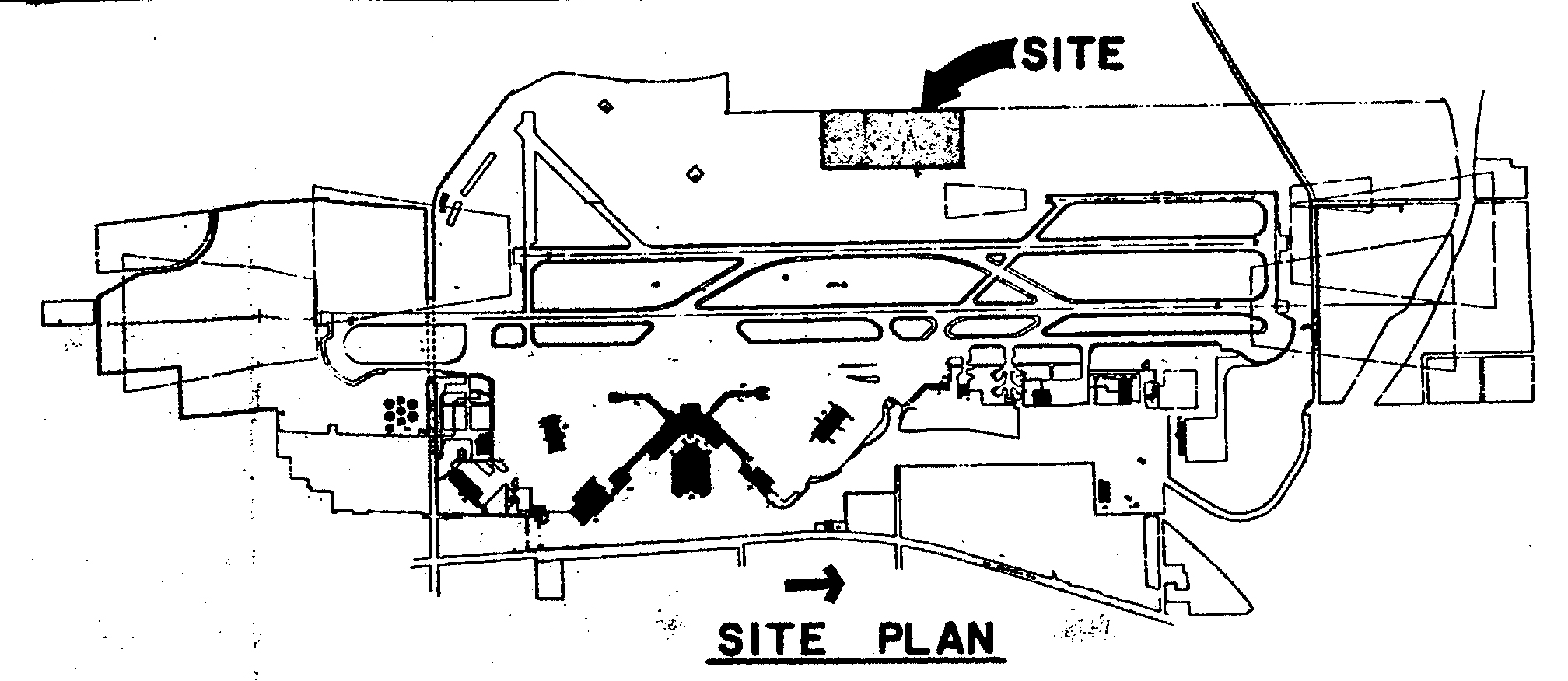
Boeing Headquarters Proposal Map
A site plan diagram of Seattle-Tacoma International Airport, with an arrow and label identifying a specific 'SITE' location in the northern portion of the airport property. The plan shows runway configurations, taxiways, terminal areas, and surrounding land uses. -
 1978-01-01
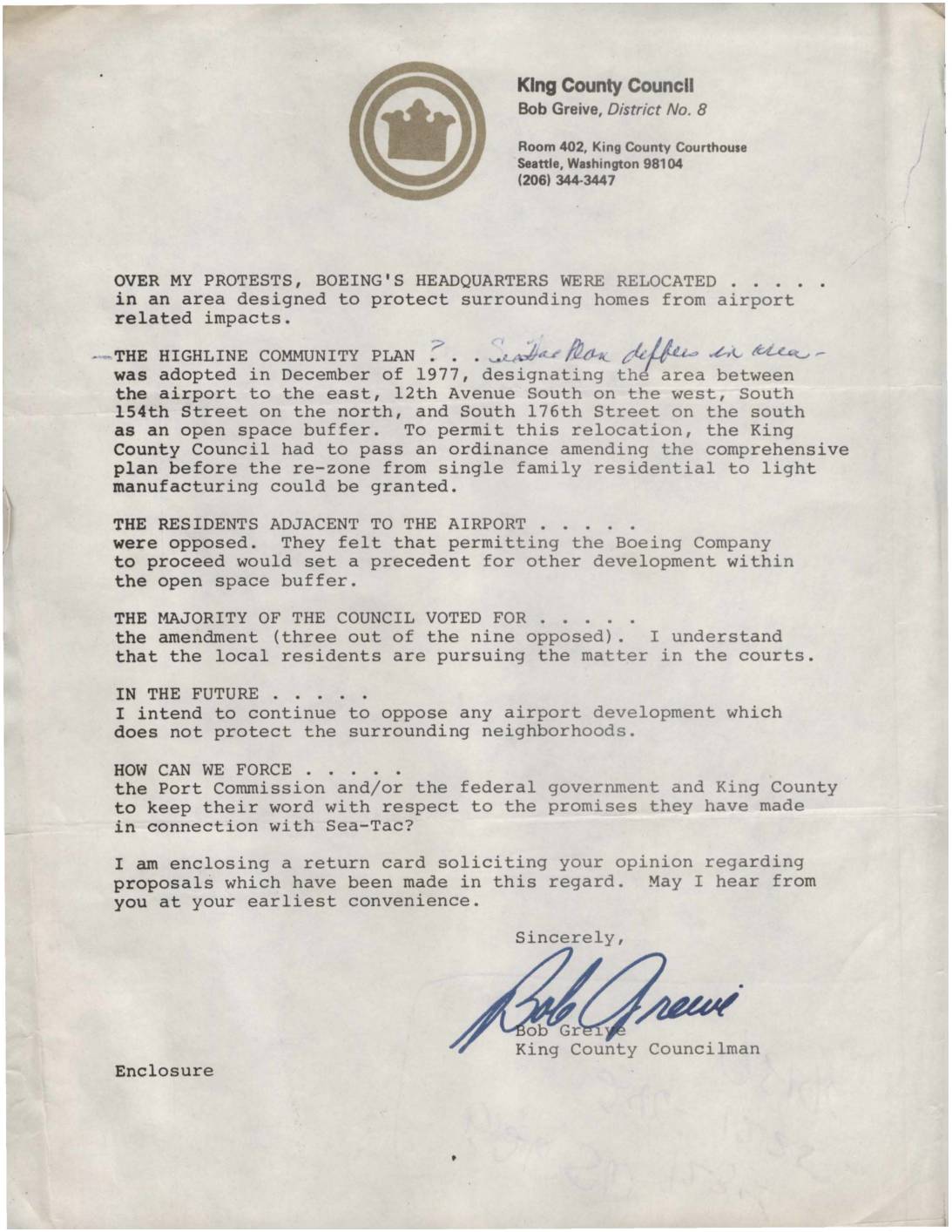
Letter from King County Councilman Bob Grieve on Boeing HQ Relocation and Highline Community Plan
King County Councilman Bob Greive wrote to constituents expressing his opposition to the relocation of Boeing's headquarters into an open space buffer zone near Sea-Tac Airport, an area designated under the 1977 Highline Community Plan to protect nearby residents from airport-related impacts. Despite his protests, the King County Council voted to amend the comprehensive plan and rezone the land from single-family residential to light manufacturing, with only three of nine council members opposing the measure. Greive vowed to continue fighting airport development that threatened surrounding neighborhoods and asked residents for their input on how to hold the Port Commission, federal government, and King County accountable to their promises regarding Sea-Tac. -
 1978-01-01
Sea-Tac International Airport Terminal Area Plan — Land-Use Map from the Sea-Tac Communities Plan (1978)
A land-use map from the Sea-Tac Communities Plan showing the Sea-Tac International Airport terminal area as of south 1978, sponsored by the Port of Seattle and King County. The map identifies zones including the terminal complex, airport support, air cargo maintenance, and non-aviation commercial areas, with a legend distinguishing existing buildings, expansions after 1978, and construction by 1978. Document reference number POS 21240. -
 1977-09-27
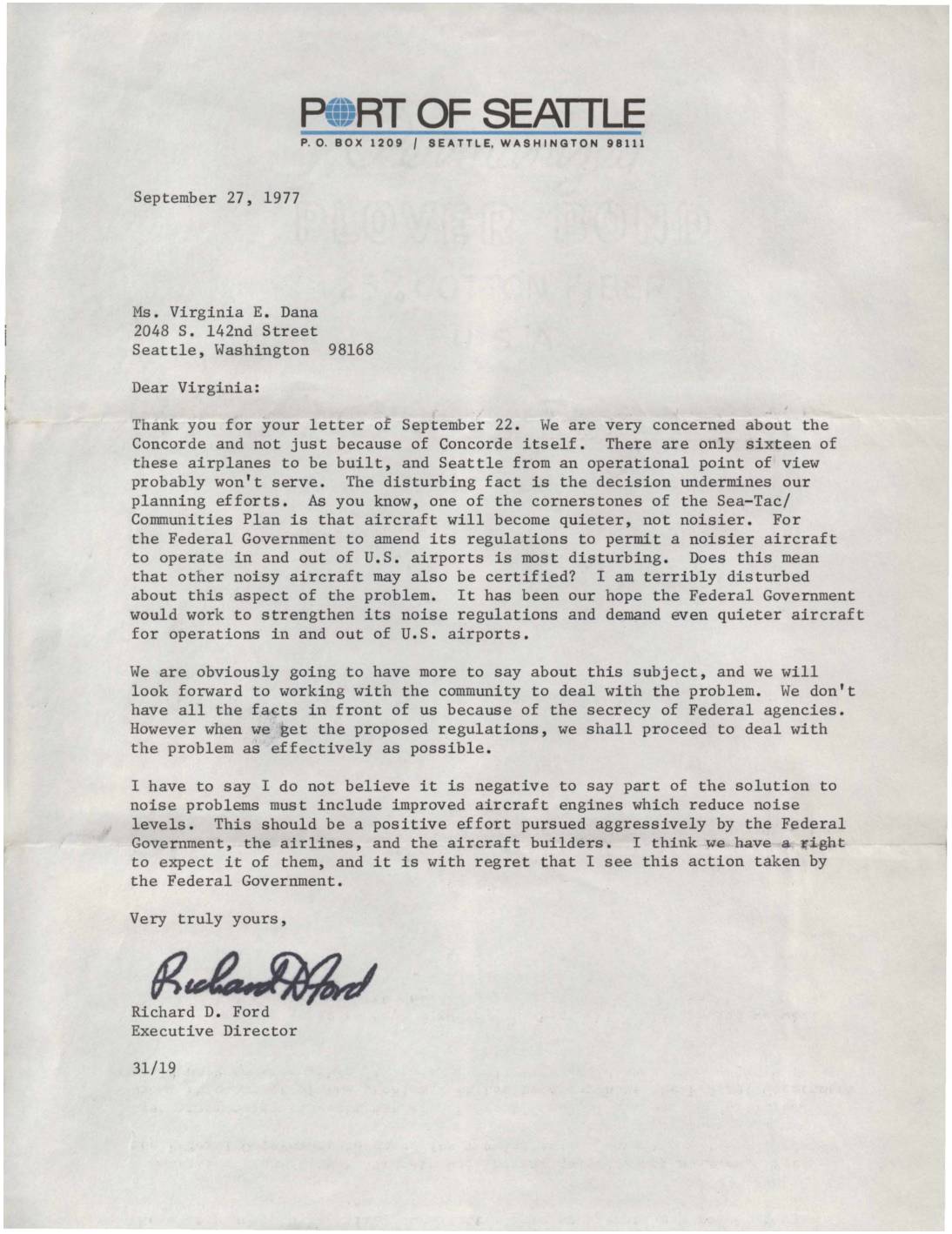
Letter from Port of Seattle Executive Director Richard D. Ford regarding Concorde aircraft noise concerns
In this September 1977 letter, Port of Seattle Executive Director Richard D. Ford responds to a community member's concerns about the Concorde supersonic jet, expressing alarm that the Federal Government amended its noise regulations to allow a noisier aircraft to operate at U.S. airports. Ford warns this decision undermines the Sea-Tac/Communities Plan, which was built on the expectation that aircraft would become progressively quieter over time. He calls on the federal government, airlines, and aircraft manufacturers to aggressively pursue quieter engine technology as a necessary solution to airport noise problems. -
 1977-05-26
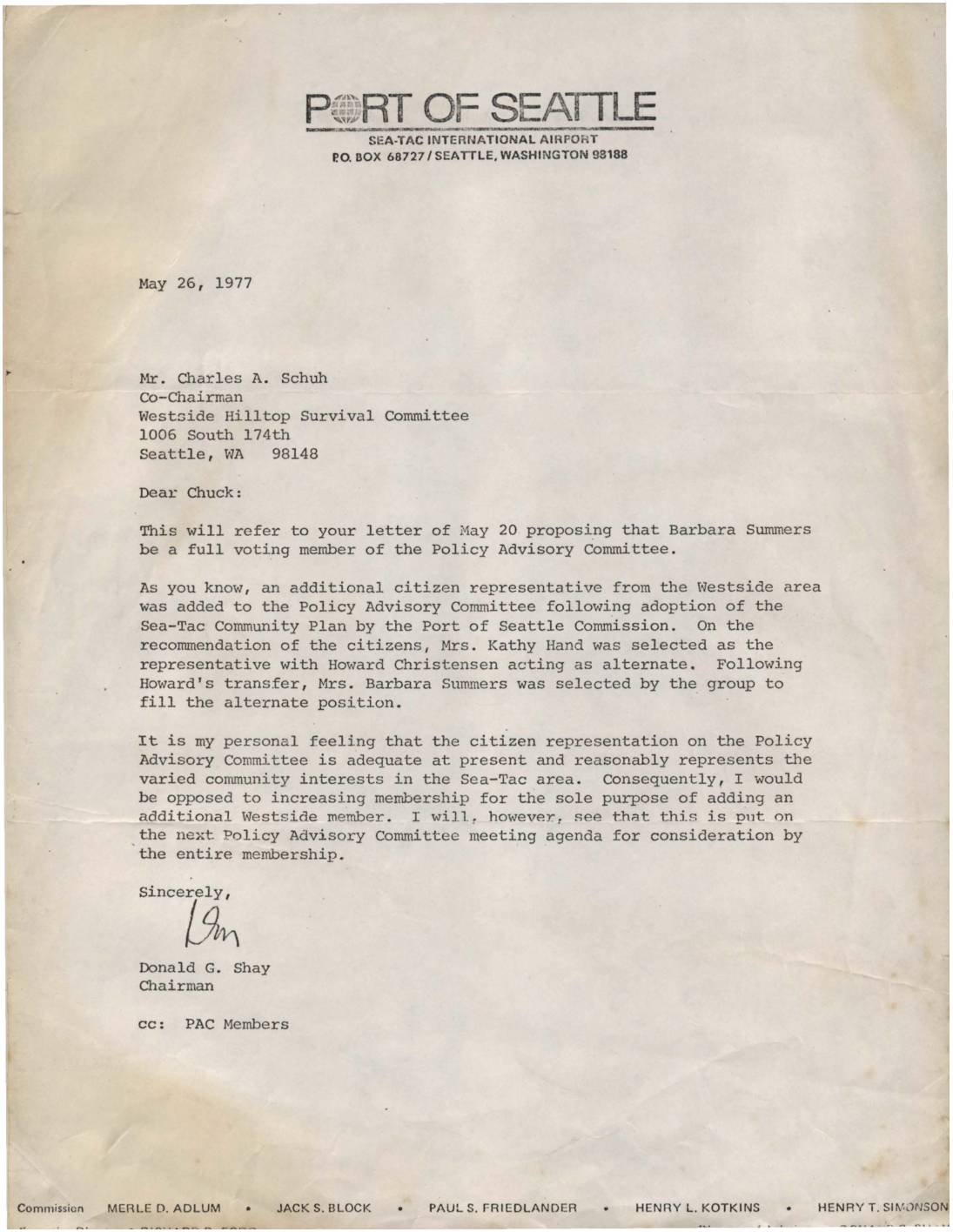
Letter to Charles Schuh regarding Barbara Summers and Policy Advisory Committee membership
In this May 26, 1977 letter, Port of Seattle Chairman Donald G. Shay responds to a request from the Westside Hilltop Survival Committee to make Barbara Summers a full voting member of the Policy Advisory Committee (PAC). Shay explains that Summers currently serves as an alternate representative for the Westside area and expresses his personal opposition to expanding PAC membership solely to add another Westside representative. He agrees, however, to place the matter on the next PAC meeting agenda for consideration by the full membership. -
 1977-01-01
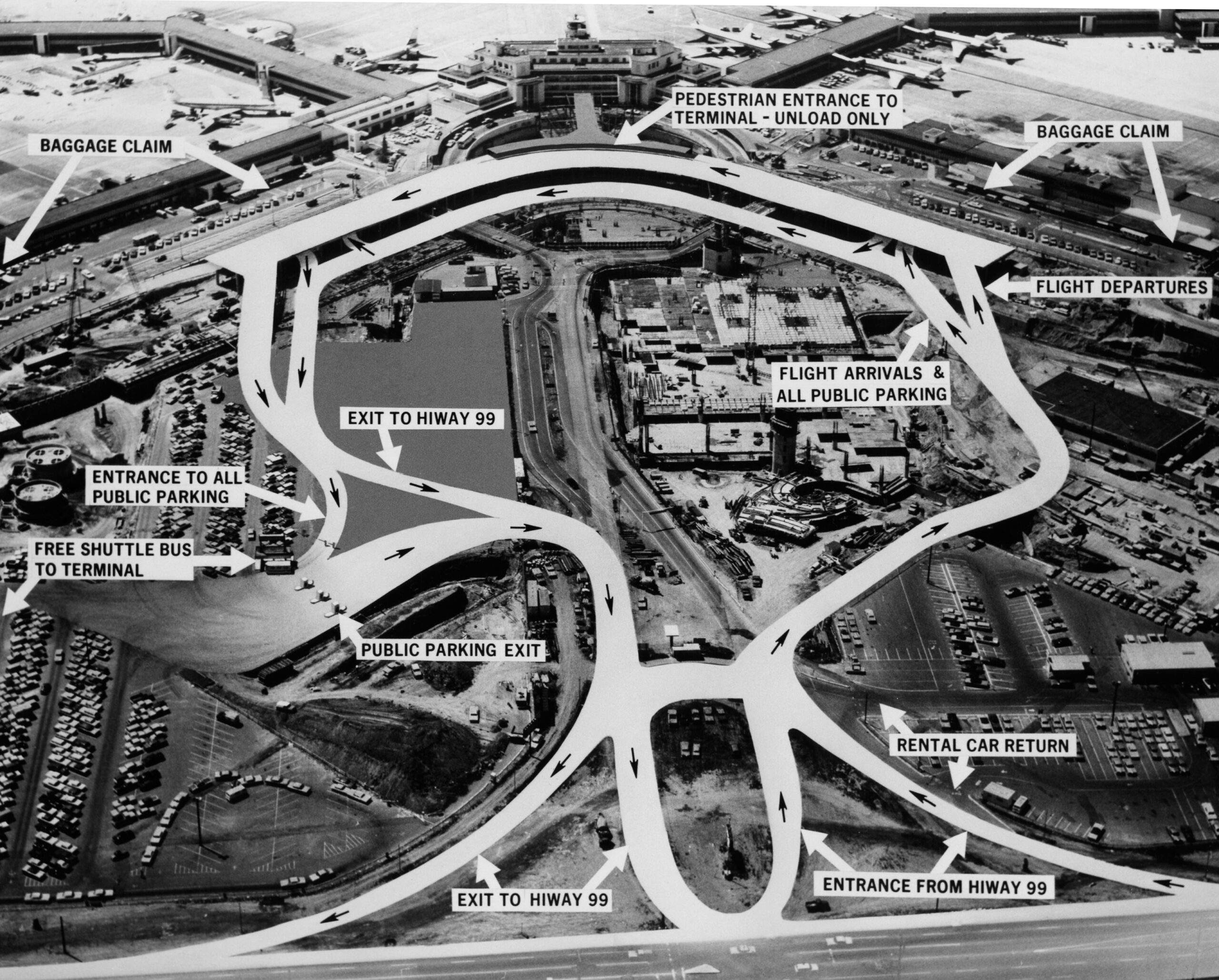
Sea-Tac access road patterns
An annotated aerial photograph of Seattle-Tacoma International Airport showing vehicular traffic flow patterns, with labeled destinations including Baggage Claim, Flight Arrivals, Flight Departures, Rental Car Return, Public Parking entrances and exits, and connections to Highway 99. A free shuttle bus service to the terminal from public parking lots is also indicated.