TagNoise(262)
-
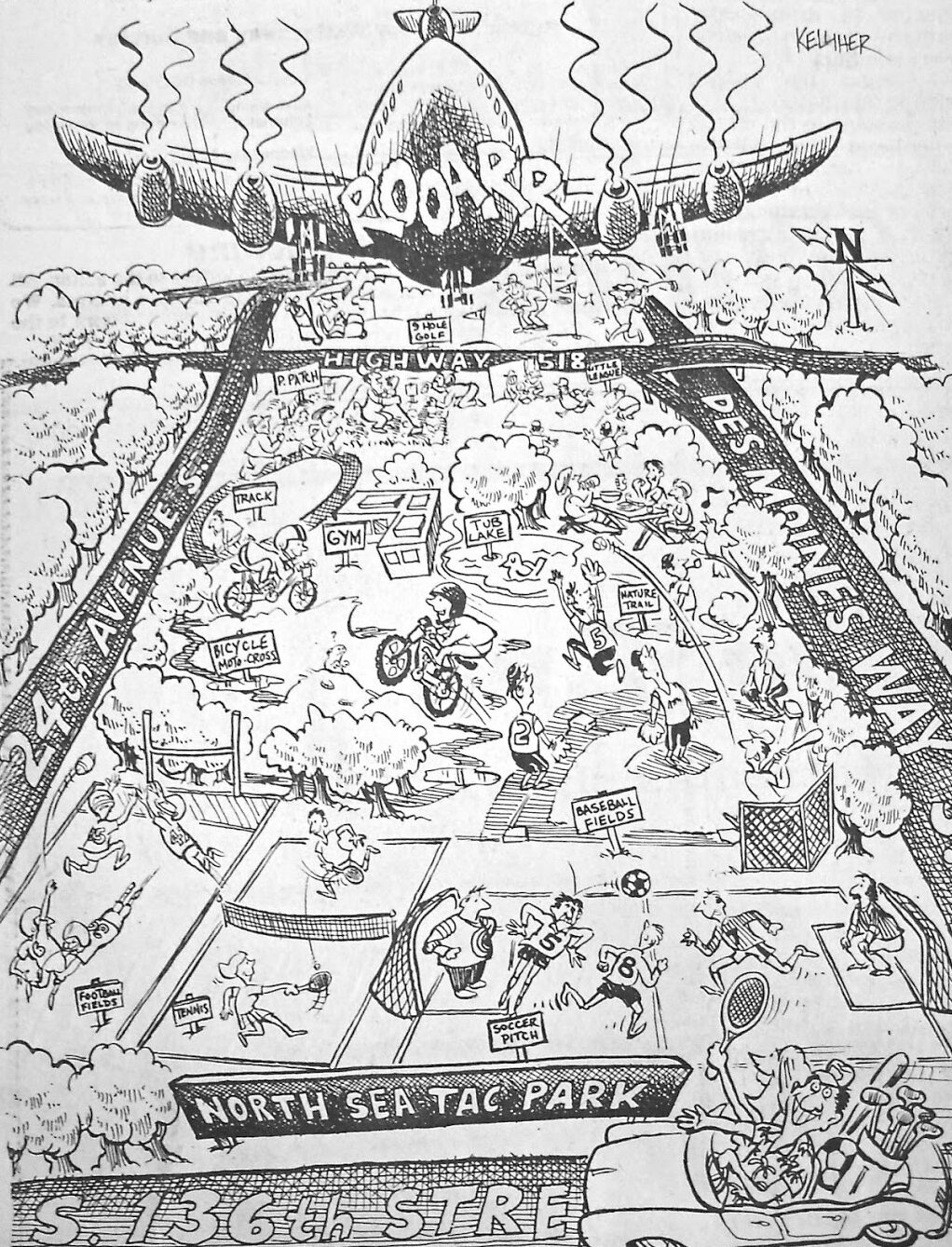
Highline Times Kelliher Cartoon Airplane Noise over North Sea-Tac Park
A cartoon illustrated map of North SeaTac Park, signed by artist 'Kelliher,' showing the park's amenities including a soccer pitch, baseball fields, tennis courts, football fields, bicycle motocross, gym, track, nature trail, 9-hole golf, little league, and Tub Lake. The park is bounded by Highway 518, 24th Avenue S., Des Moines Way, and S. 136th Street, with a roaring airplane overhead referencing Sea-Tac Airport noise impacts on the area. -
 2018-10-22
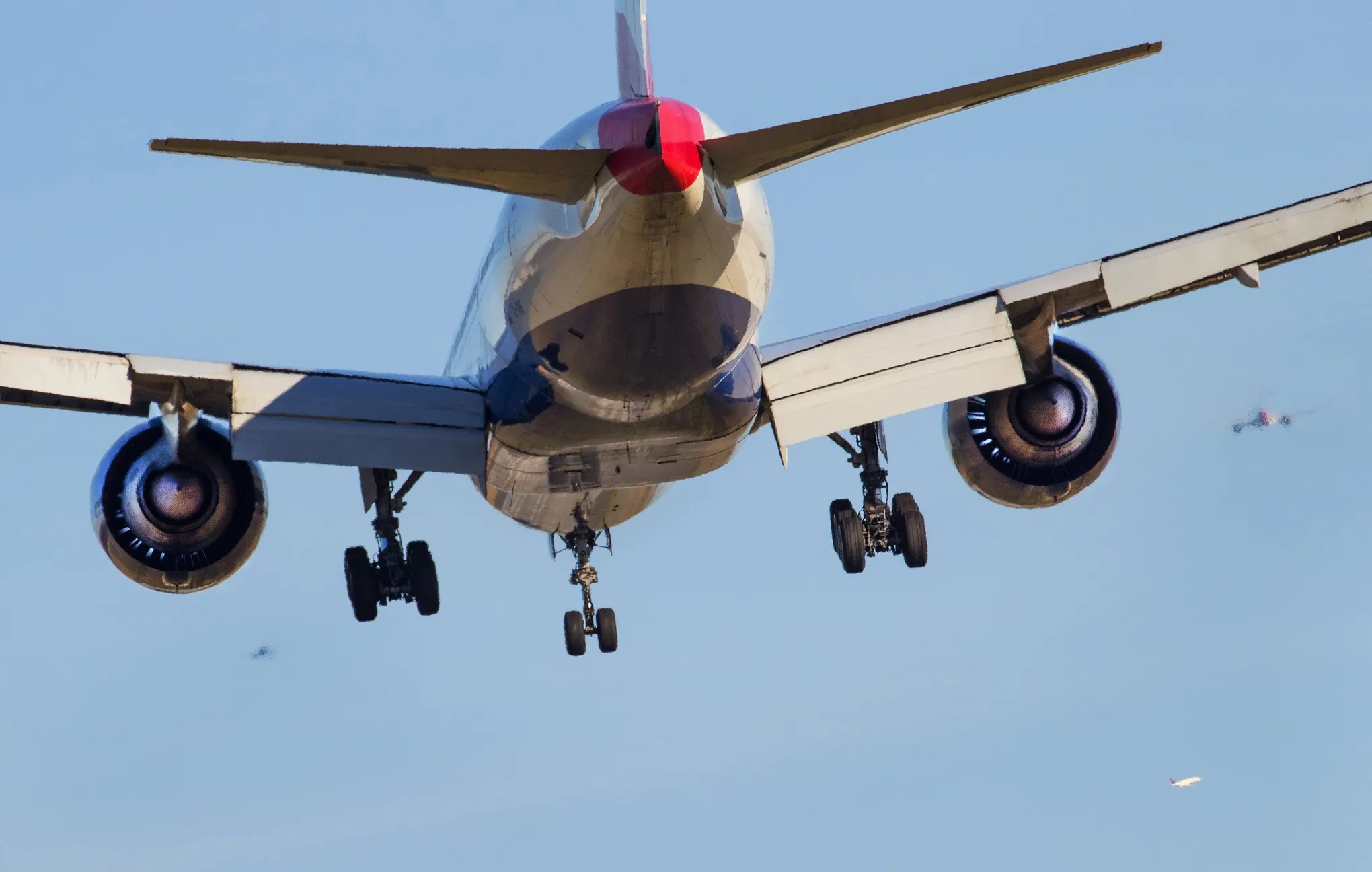
Twin-Engine Widebody Jet on Final Approach at Sea-Tac Airport
A twin-engine widebody commercial jet, viewed from below and behind, is captured on final approach with all landing gear fully deployed. The aircraft features a red nose cone and red tail markings consistent with a major carrier livery, possibly American Airlines or a similar operator, but no registration or text is clearly legible. -
 2018-10-01
Noise of the Future
A 2018 Boeing presentation by Senior Manager Robert Stoker outlines the aviation industry's progress in reducing aircraft noise and fuel consumption, noting roughly a 90% reduction in noise footprint and 70% improvement in fuel efficiency since the 1950s. The document highlights Boeing's current fleet — the 737 MAX, 747-8, 787, and 777X — each delivering significant reductions in both noise footprint (ranging from 30% to 60% smaller) and fuel/CO2 emissions compared to the models they replace. -
 2018-08-15
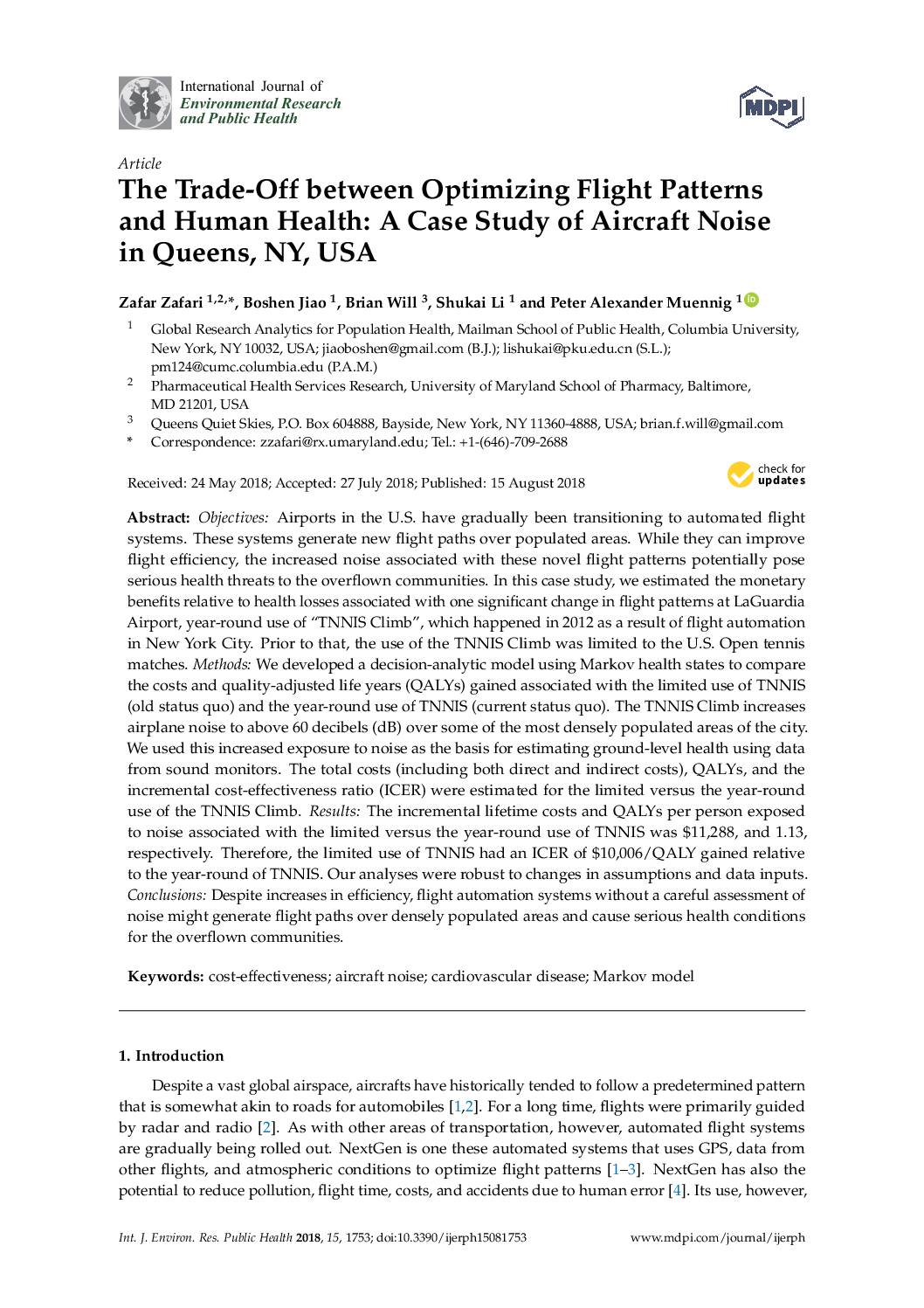
The Trade-Off between Optimizing Flight Patterns and Human Health: A Case Study of Aircraft Noise in Queens, NY, USA
Peer-reviewed article published in the International Journal of Environmental Research and Public Health (MDPI) by Zafari, Jiao, Will, Li, and Muennig (Columbia University/University of Maryland) examining the health and economic costs of year-round use of the TNNIS Climb departure route at LaGuardia Airport (LGA), Queens, NY, implemented in 2012 under the FAA NextGen automated flight -
 2018-08-13
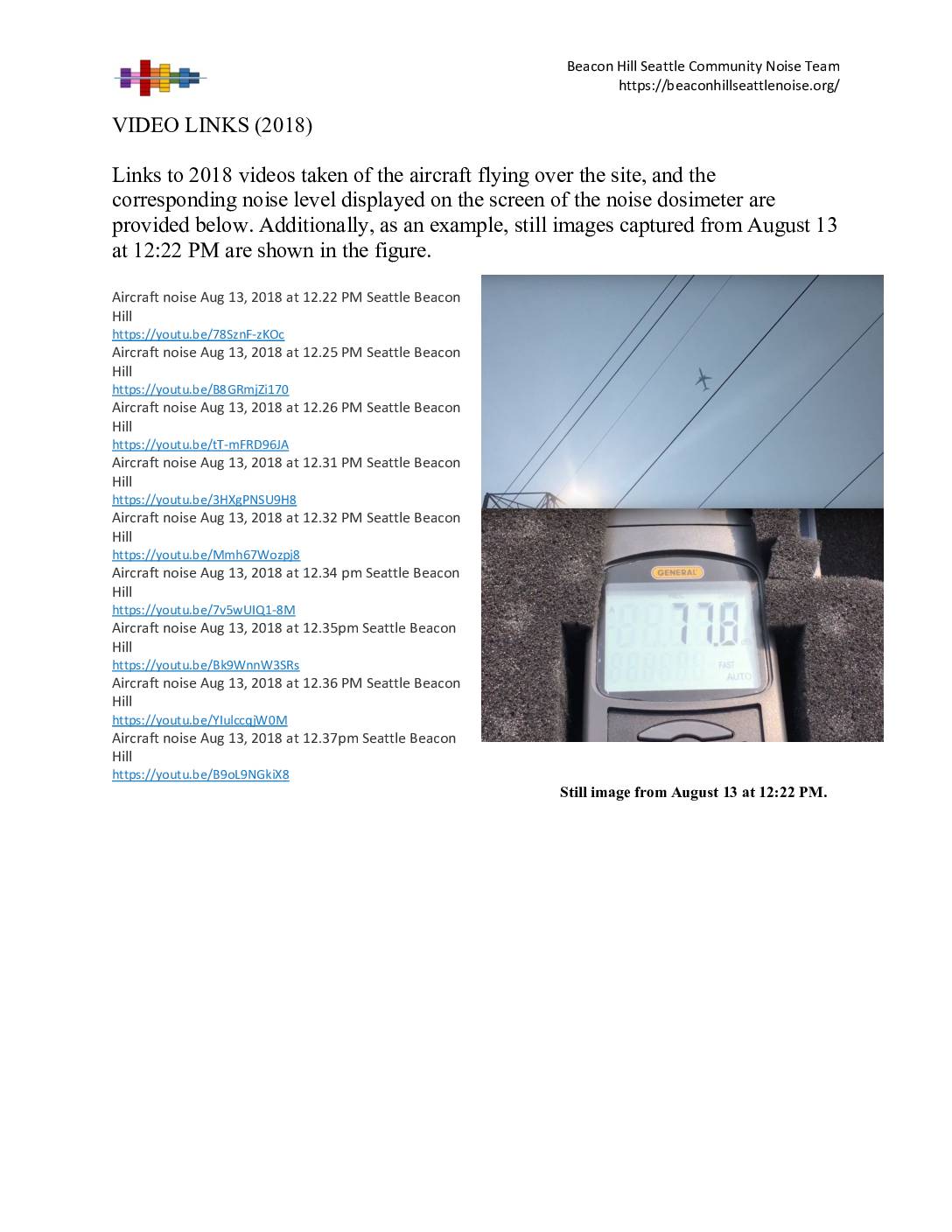
Video Links (2018): Aircraft Noise Recordings, Beacon Hill Seattle Community Noise Team
The Beacon Hill Seattle Community Noise Team recorded aircraft flying over their neighborhood on August 13, 2018, capturing both video and real-time noise levels using a handheld noise dosimeter. Nine videos from that afternoon show aircraft passing overhead between 12:22 PM and 12:37 PM, with a still image from 12:22 PM displaying a reading of 77.8 decibels on the dosimeter. These recordings were compiled as community evidence of aircraft noise impacts in the Beacon Hill area near Sea-Tac Airport. -
2018-08-06
Categorical Exclusions, Metroplexes, and Aircraft Noise Complaints
August 6, 2018 IN10947 The Federal Aviation Administration (FAA) has initiated changes to airspace and flight procedures to take advantage of new technologies deployed under NextGen, a comprehensive air traffic modernization initiative that relies on satellite-based navigation and tracking to improve efficiency and airspace capacity. In some neighborhoods, however, FAA’s changes have increased overflights triggering -
 2018-06-01
From the City Manager: Airport issues
Normandy Park City Manager Mark Hoppen outlines the city's efforts to address Sea-Tac Airport noise and air quality concerns, noting that direct lawsuits against the FAA have had limited success. Key initiatives include a joint jurisdictional response to the Sustainable Airport Master Plan, a Washington State baseline airport conditions study, and a University of Washington ultrafine particulates study aimed at building evidence for federal health-based legislation. Residents are encouraged to review two StART Meeting presentations on aircraft noise and arrival altitudes, particularly slide 37 of the Altitude Analysis, which shows an increase in cargo flights potentially linked to local noise complaints. -
 2018-05-23
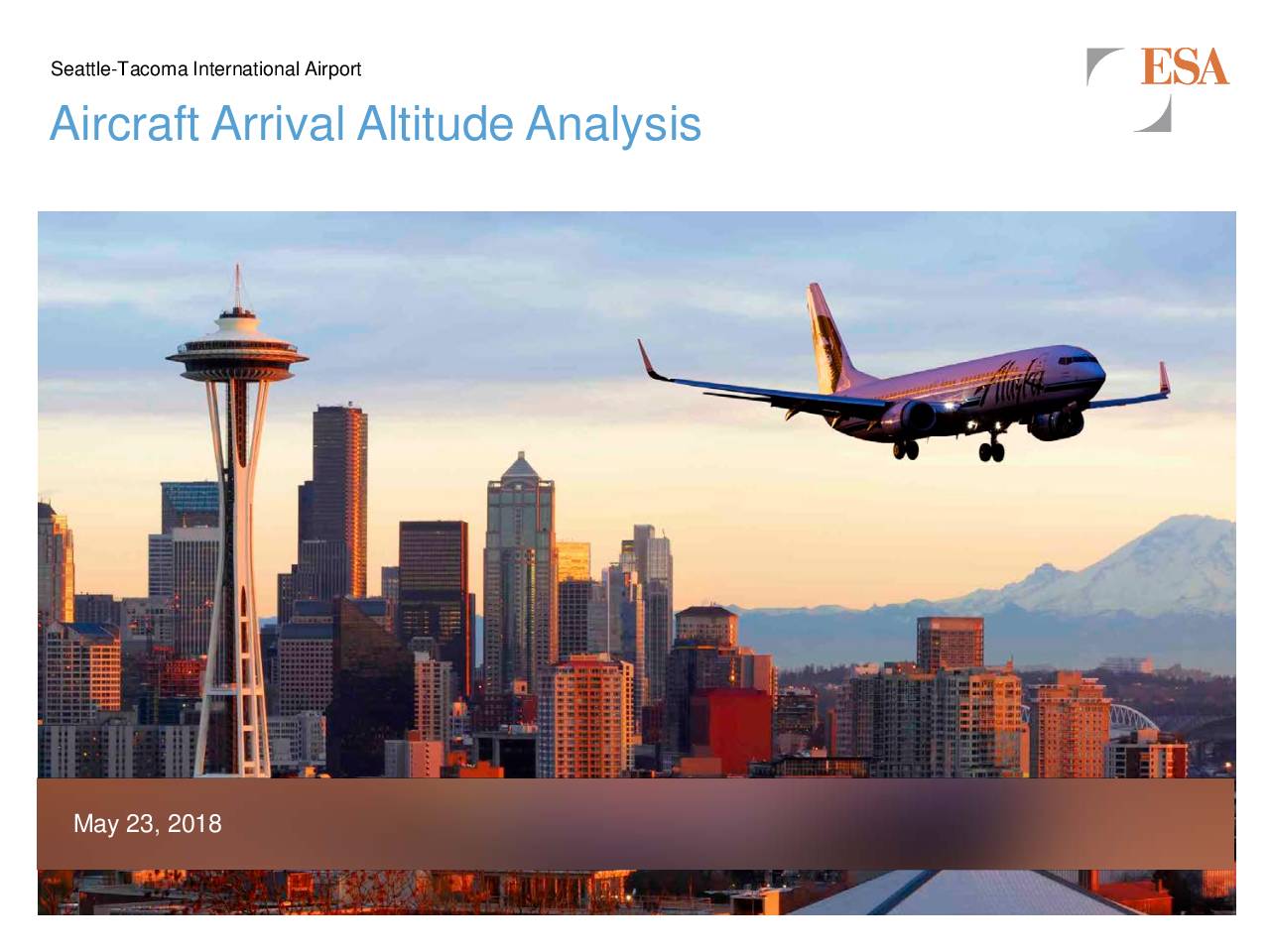
Sea-Tac Airport Aircraft Arrival Altitude Analysis
This May 2018 draft report by ESA analyzes changes in aircraft arrival altitudes at Seattle-Tacoma International Airport across 2013, 2015, and 2017, examining how those changes relate to noise exposure for surrounding communities. Key findings from earlier meetings indicate that while overall arrival numbers increased and traffic flow direction remained stable, there was a notable shift in runway use from center runways to right and left runways, along with changes in the mix of narrow-body and wide-body aircraft types serving the airport. -
 2018-05-07
Response to noise analyses by FAA contained in Section 5.2.7 noise and noise-compatible land use from CATEX on page 34
This document presents a community challenge to the FAA's environmental review (CATEX) of new flight routes near Seattle-Tacoma International Airport, arguing that the FAA's own noise analyses show significant noise increases in the surrounding General Study Area that exceed the agency's own significance thresholds. The authors contend that the FAA could not rely on the outdated 2013-2018 Port of Seattle Part 150 noise study, and that the FAA's independent analyses revealed noise level jumps ranging from 5.2% to nearly 60% across various decibel contours. The document concludes that the FAA's declaration of 'no noise impacts' is implausible given data showing that portions of previously quiet neighborhoods now experience non-compatible land use noise levels above 65 dB DNL. -
 2018-05-01
Health based criteria for use in managing airport and aircraft noise
This 2018 Harvard University master's thesis by Bryan Johnson examines health-based criteria that could be used to better manage noise from airports and aircraft. The research explores how noise exposure standards and guidelines could be grounded in public health evidence, offering a framework for more effective noise policy. It is relevant to ongoing discussions about managing community noise impacts around busy airports like Sea-Tac.