TagNoise Mitigation(218)
-
 2024-07-12
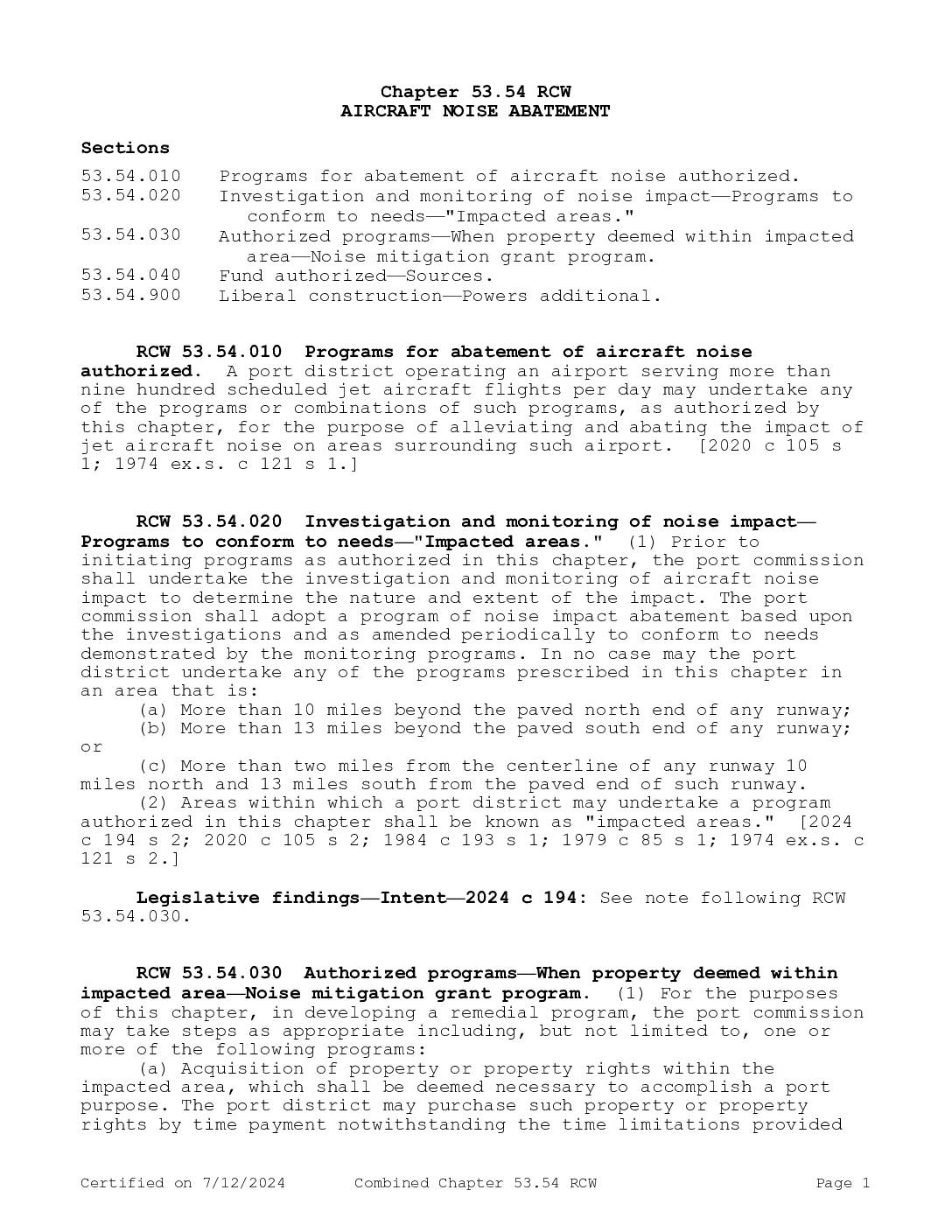
Chapter 53.54 RCW: Aircraft noise abatement
Chapter 53.54 RCW authorizes Washington port districts operating large airports (such as Sea-Tac) to carry out programs that reduce the impact of jet aircraft noise on surrounding neighborhoods, including purchasing properties, providing soundproofing, and offering transaction assistance to affected homeowners. The law defines 'impacted areas' with specific distance limits from runways and allows properties within those boundaries to receive noise mitigation benefits. Recent 2024 updates expand the program to allow inspection, repair, or replacement of previously installed noise mitigation equipment that is no longer working as intended or has caused structural damage. -
 2024-05-16
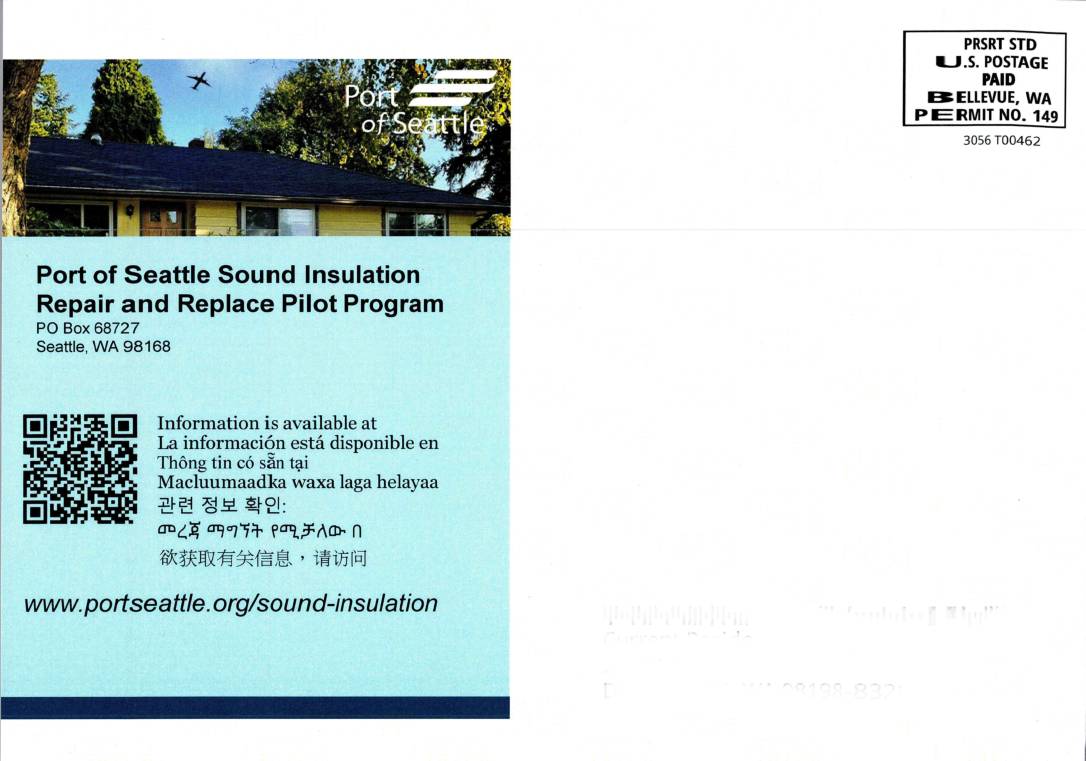
Port Of Seattle Sound Insulation Repair and Replace Pilot Program Survey Notice
The Port of Seattle mailed this notice to residents near Sea-Tac Airport informing them about the Sound Insulation Repair and Replace Pilot Program, which aims to address aircraft noise in affected homes. Recipients were advised that a formal survey about the program would be mailed to them in early June. Program information and resources are available in multiple languages at www.portseattle.org/sound-insulation. -
 2024-05-11
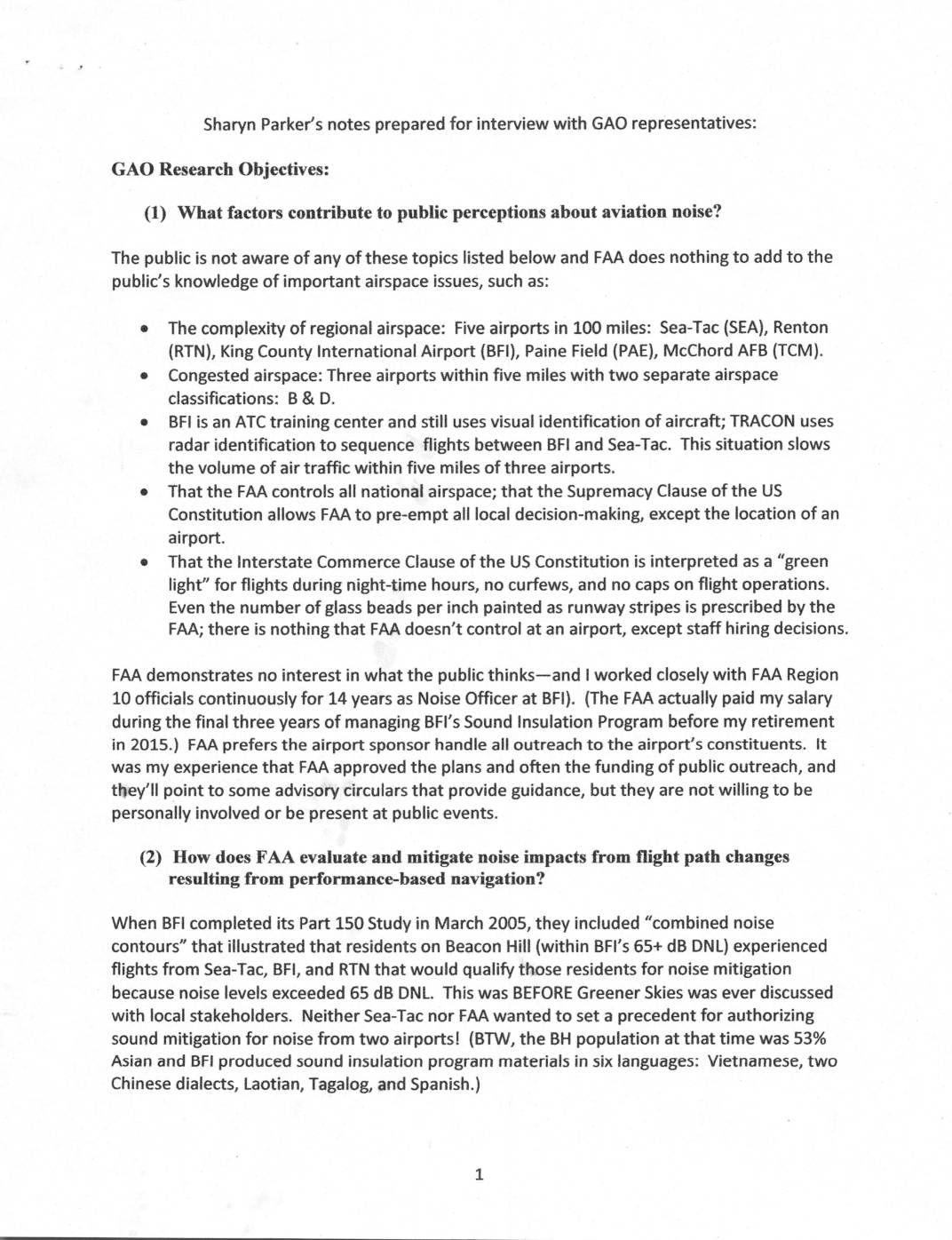
Sharyn Parker’s notes prepared for interview with GAO representatives
Former King County International Airport (BFI) Noise Officer Sharyn Parker's prepared notes for a GAO interview outline significant concerns about FAA regulatory failures and Sea-Tac Airport's inadequate noise mitigation practices in the Seattle region. Parker argues that the FAA has consistently failed to require Sea-Tac to update noise exposure maps, enforce timely sound mitigation programs, or conduct meaningful public outreach — particularly for minority communities disproportionately affected by flight path changes like the Greener Skies/RNP initiative. The notes also highlight contradictions between Sea-Tac's deliberately low flight-operation projections in its Part 150 noise studies and the far higher growth figures used in its capital development plans. -
 2024-05-07
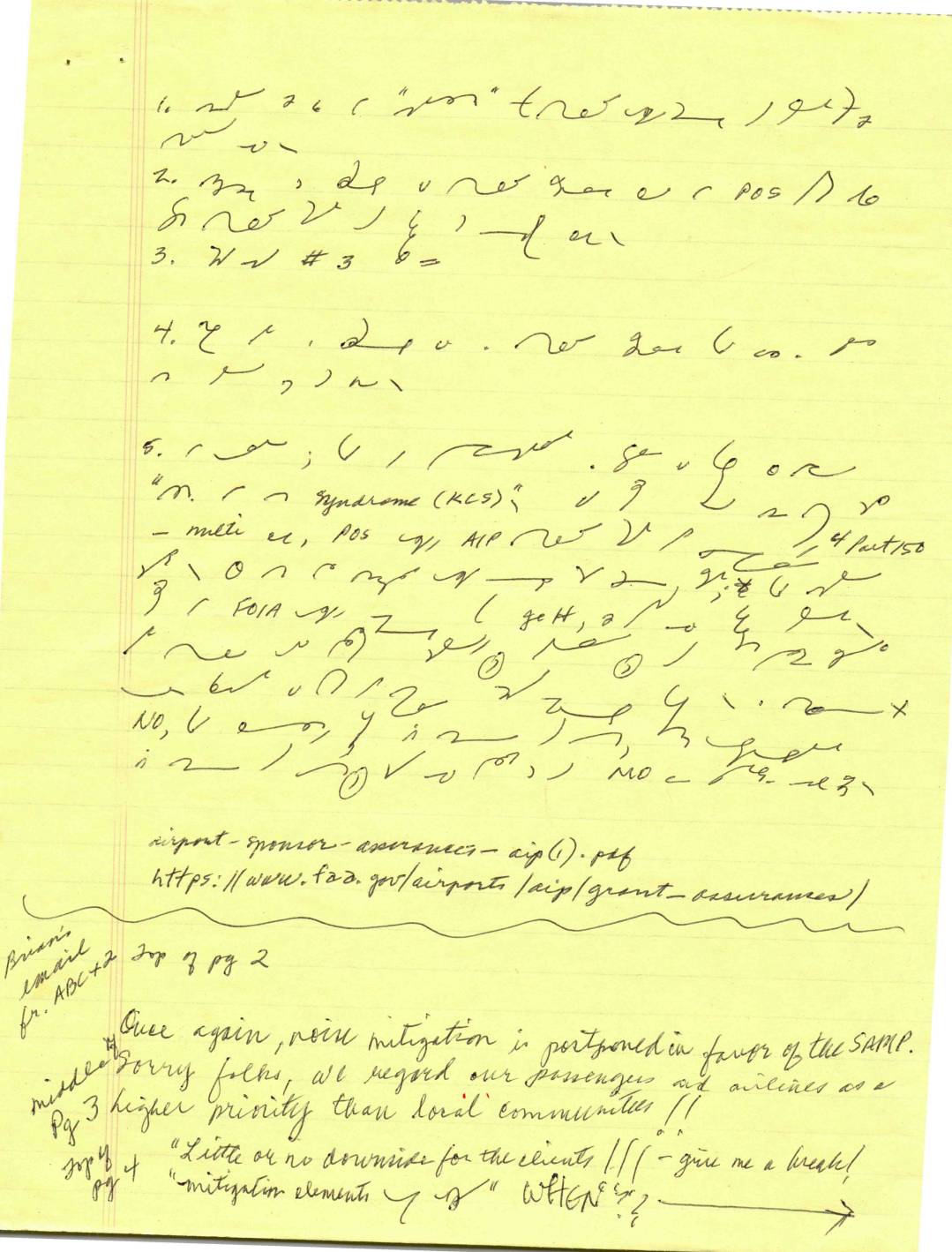
Handwritten notes on airport grant assurances and noise mitigation
Handwritten notes reviewing an FAA document on airport grant assurances, referencing noise mitigation policy and Kandahar Corridor Syndrome (KCS). The notes criticize the postponement of noise mitigation efforts in favor of the SAMP (Sustainable Airport Master Plan), quoting language suggesting 'little or no downside for the clients' and expressing concern that passengers and airlines are being prioritized over local communities. A URL referencing FAA airport grant assurances (airport-sponsor-assurances-aip(1).pdf) is also included. -
 2024-05-06
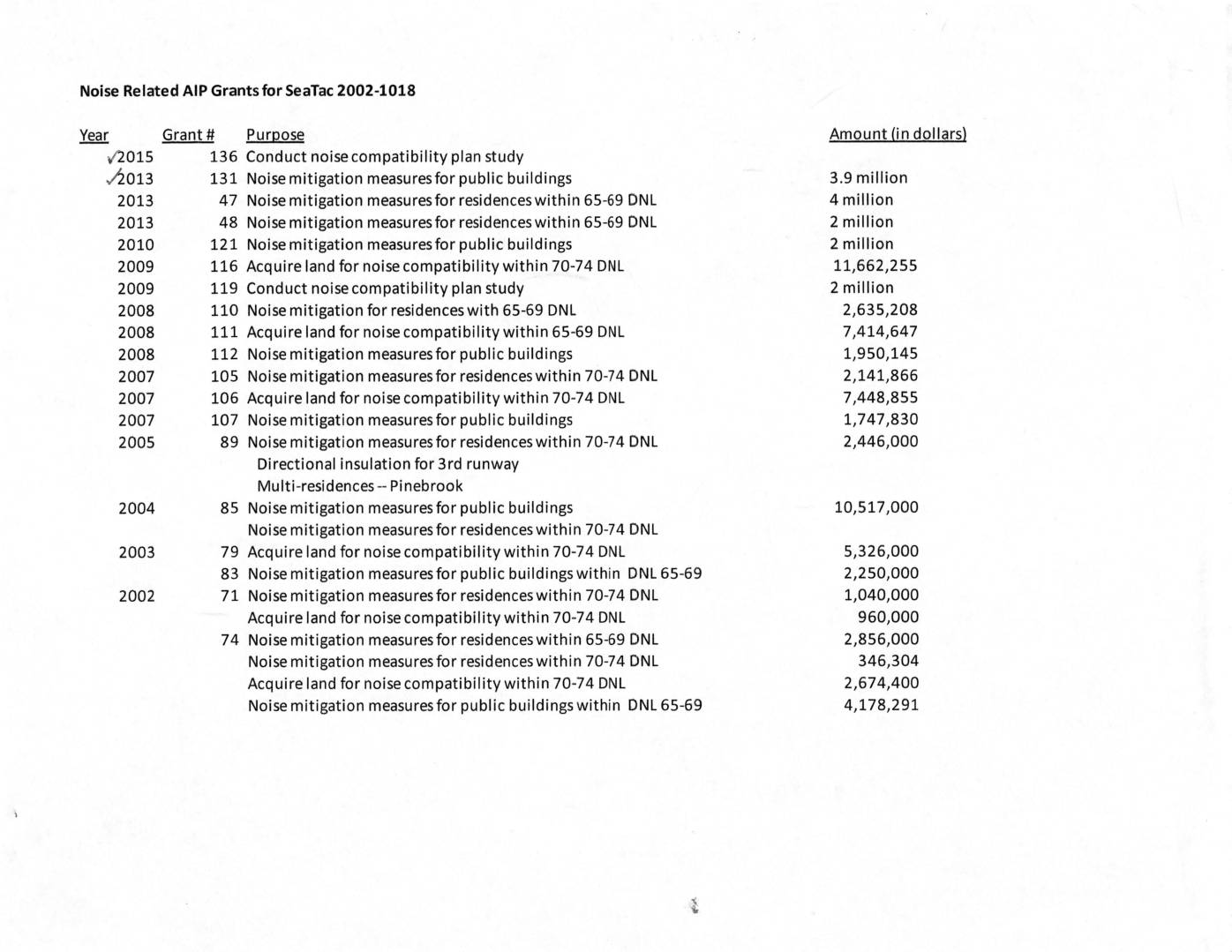
Noise related AIP grants for SeaTac 2002-1018
This document details noise-related Airport Improvement Program (AIP) grants awarded to Seattle-Tacoma International Airport (Sea-Tac) from 2002 through 2015, covering purposes such as noise mitigation for residences and public buildings, land acquisition for noise compatibility, and noise compatibility plan studies. Grant amounts range from hundreds of thousands to over eleven million dollars, targeting properties within various Day-Night Level (DNL) noise contours of 65-69 and 70-74 DNL. An accompanying federal assistance application (SF-424) shows a 2015 grant totaling approximately $4.8 million for property acquisition, relocation, and sound insulation, signed by Port of Seattle's Managing Director of Aviation. -
 2024-05-06
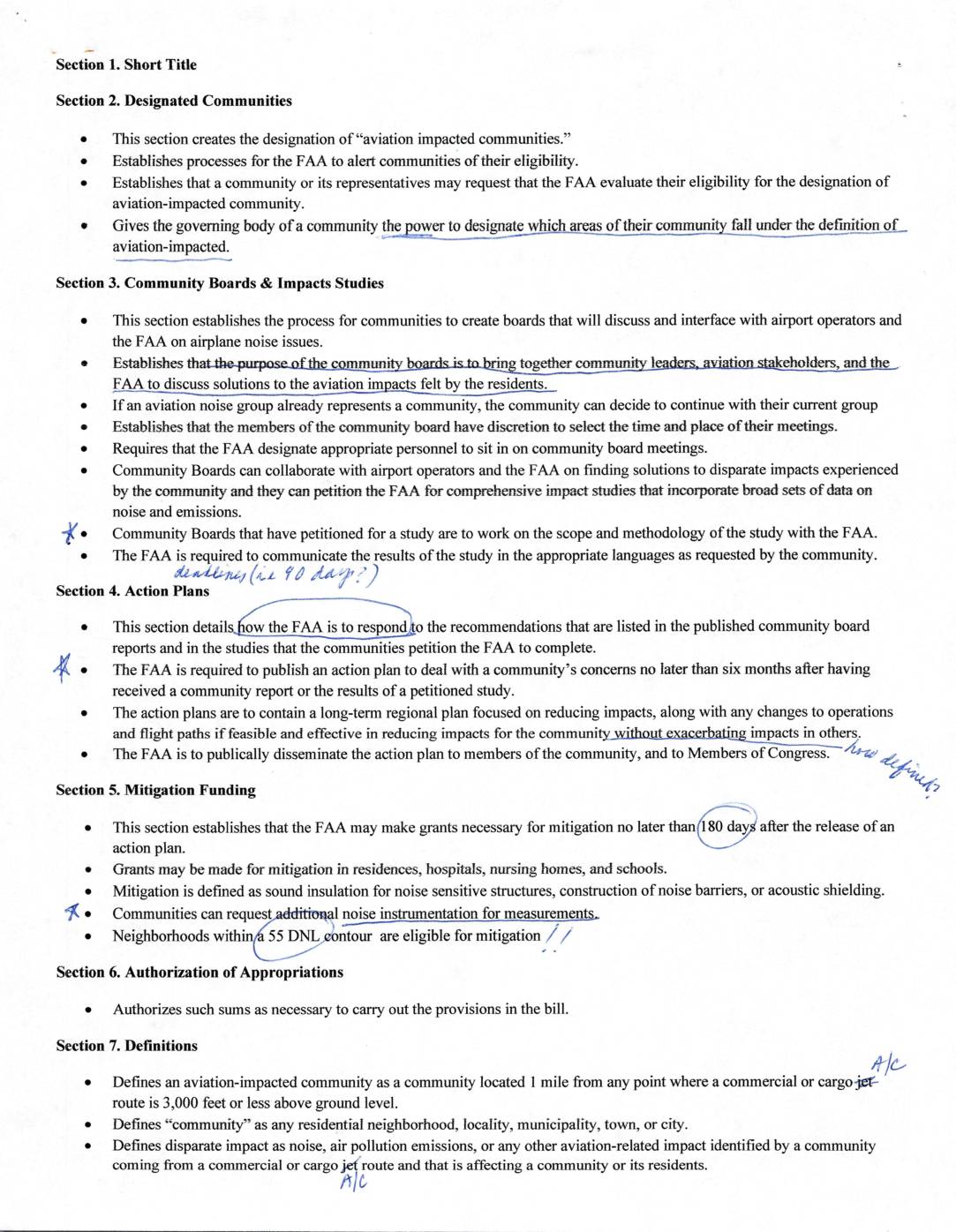
Airport impacted communities act summary
This legislative summary outlines a proposed bill to protect communities near busy flight routes from aviation noise and pollution. It establishes a process for the FAA to designate 'aviation-impacted communities' located within one mile of low-altitude commercial or cargo flight paths, create local community boards to engage with the FAA and airport operators, and develop action plans and mitigation funding for affected residents. Key provisions include grants for sound insulation and noise barriers, eligibility for neighborhoods within a 55 DNL contour, and requirements for the FAA to respond to community concerns within set deadlines. -
 2024-05-06
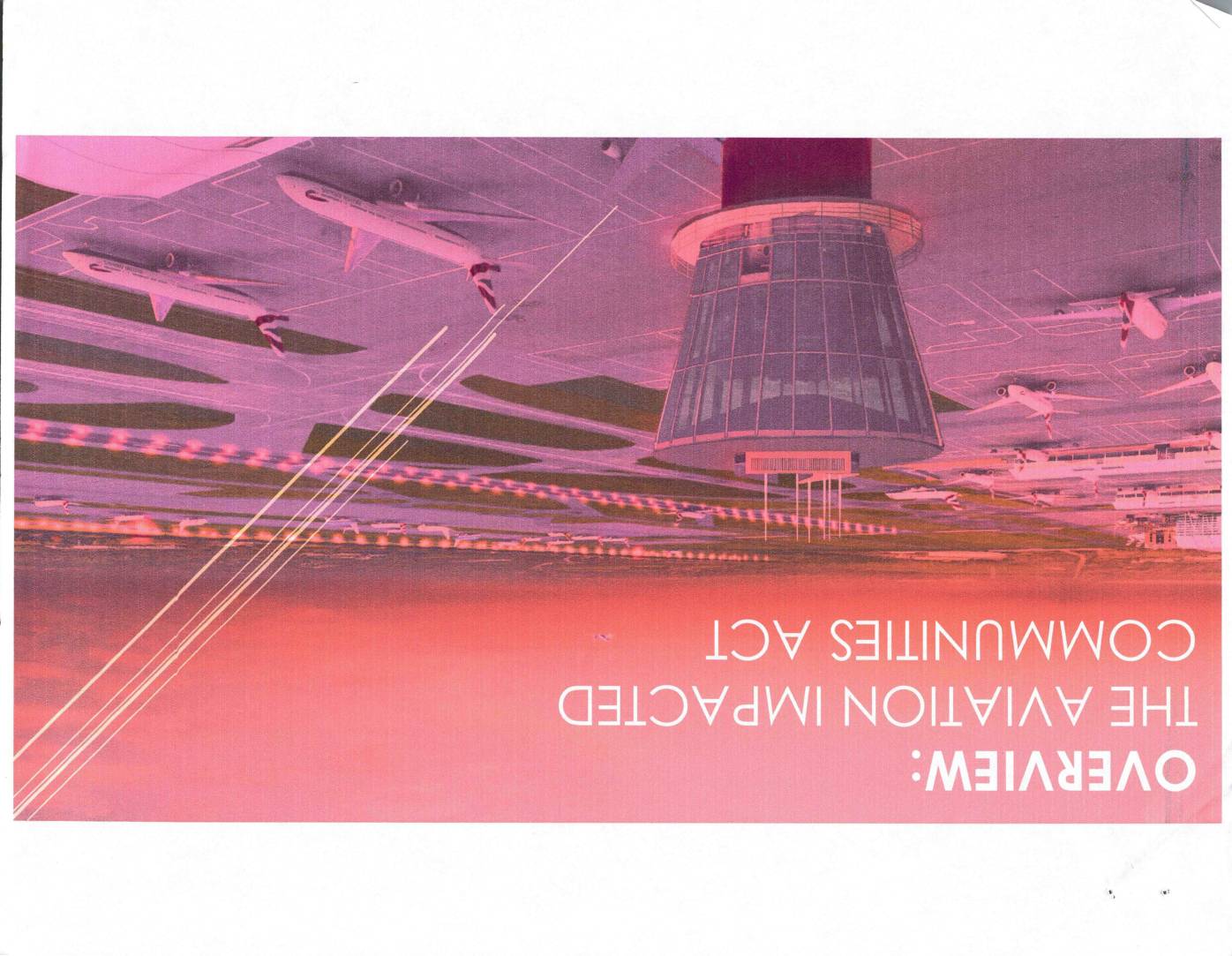
Overview: The Aviation Impacted Communities Act
This document provides an overview of the Aviation Impacted Communities Act, which establishes a formal process for communities affected by airport noise and flight paths. The process begins with the FAA notifying eligible communities of their 'designated community' status, then proceeds through board formation, meetings, studies, action plans, and ultimately grants for mitigation funds. A community qualifies as 'aviation impacted' if it is located no more than one mile from any commercial or cargo jet route at 3,000 feet or less above ground level. -
 2024-03-19
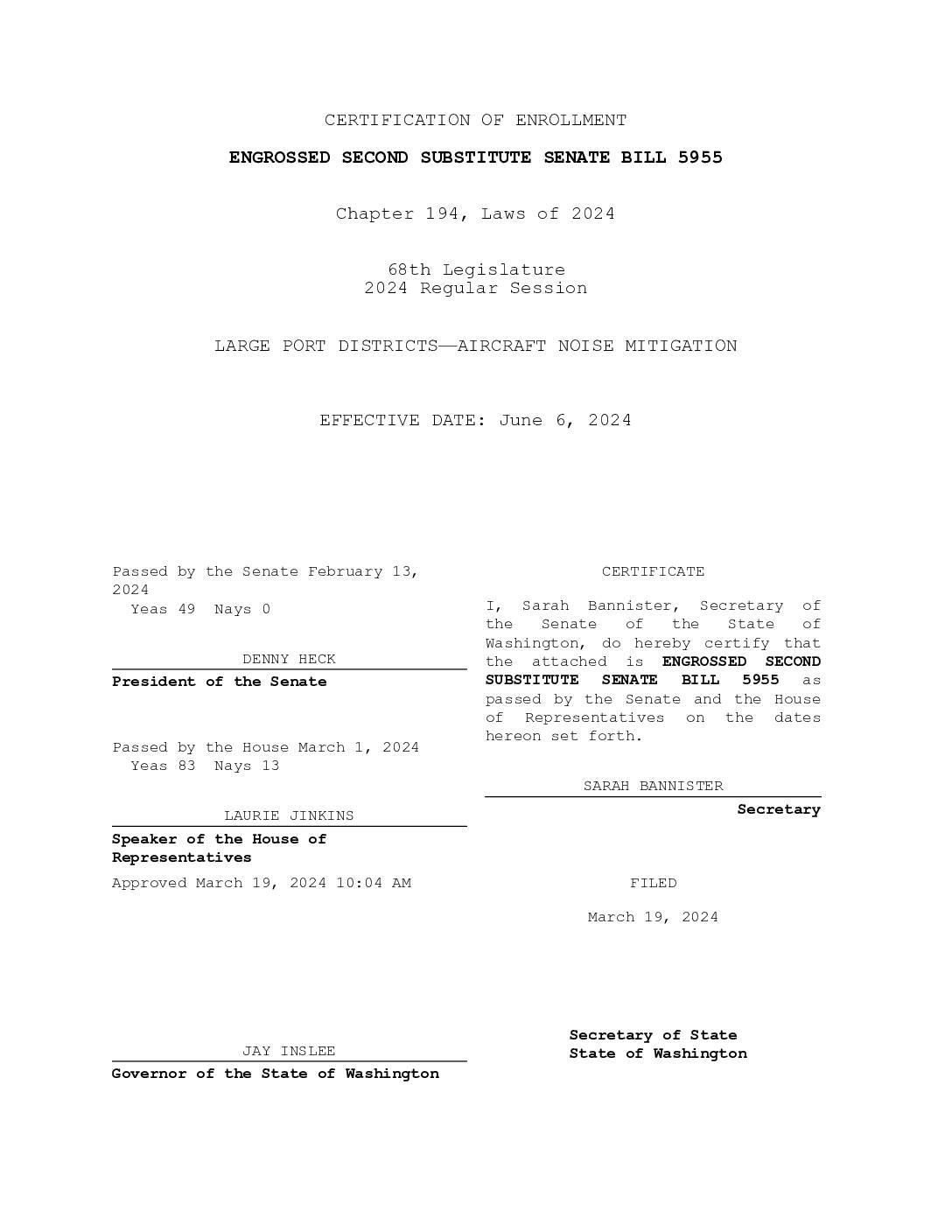
Engrossed Second Substitute Senate Bill 5955: Large Port Districts—Aircraft Noise Mitigation
Washington State's Engrossed Second Substitute Senate Bill 5955, signed into law on March 19, 2024, addresses aircraft noise mitigation for large port districts like the Port of Seattle, which operates Seattle-Tacoma International Airport. The law allows the port to repair or replace noise mitigation equipment that is no longer functioning properly or has caused structural damage to nearby properties, using non-federal local funding. It also acknowledges that communities of color — including Black, Hispanic, Native Hawaiian, and Pacific Islander residents in King County — are disproportionately impacted by airport noise, and establishes a state partnership to improve equity and responsiveness in noise mitigation efforts. -
 2024-03-13
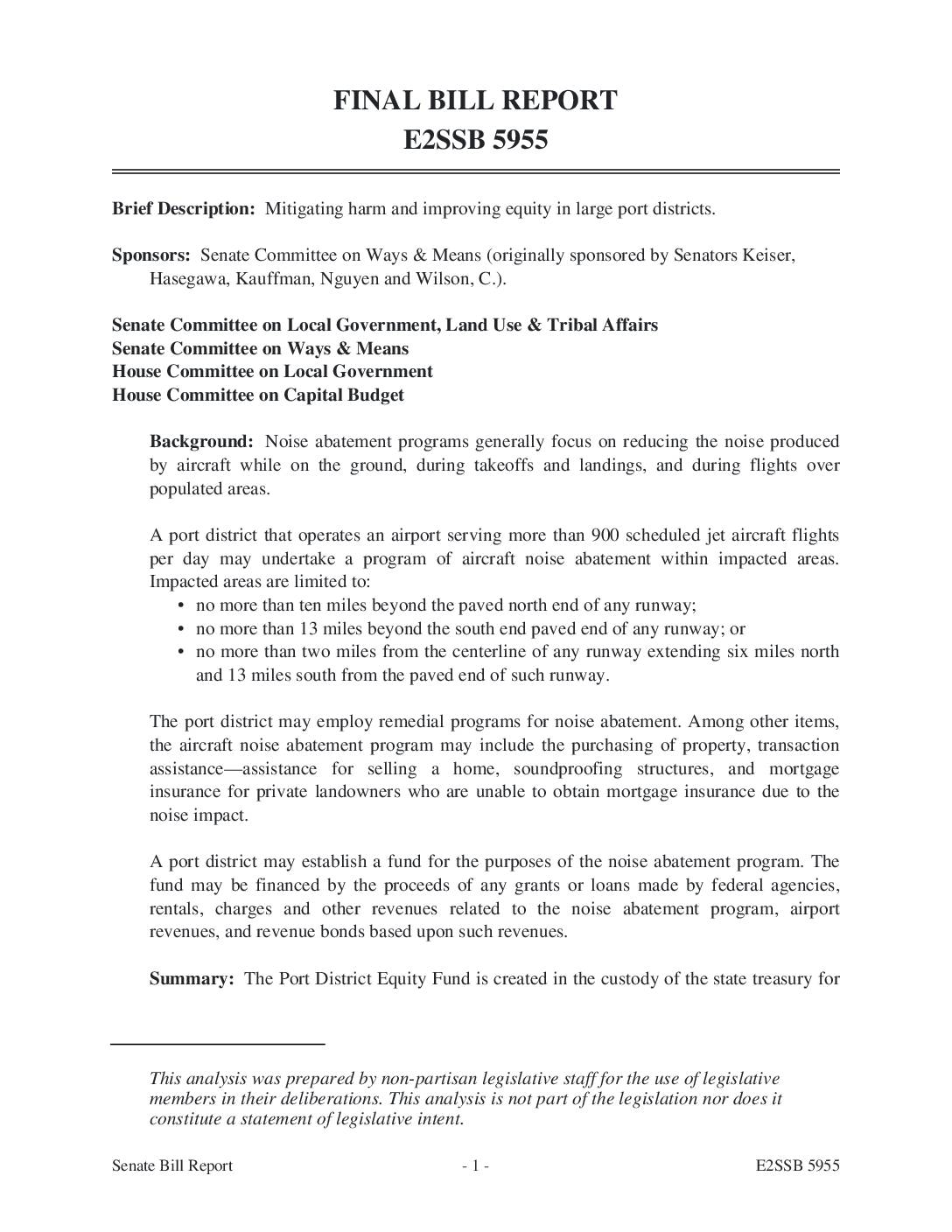
Final Bill Report: E2SSB 5955 — Mitigating Harm and Improving Equity in Large Port Districts
Washington State E2SSB 5955 creates the Port District Equity Fund to help large port districts, such as the Port of Seattle, repair or replace failing aircraft noise mitigation equipment in nearby homes and properties. The Department of Commerce administers the grant program, which requires port districts to match at least half of state funding, and mandates annual public reporting on inspections and repairs. The program is set to expire July 1, 2029, with a legislative audit review, and will be fully repealed by July 1, 2030. -
 2024-02-26
Five Typical Examples of Port Package Damage
These images document window condition issues including fogging between glass panes, condensation buildup, mold growth, and deteriorating frames and seals. The photos show evidence of moisture intrusion and seal failure in residential windows, with visible mold, rust stains, and dirt accumulation along window tracks and sills. Such conditions are commonly associated with prolonged exposure to noise-related vibration and humidity in properties near high-traffic areas like airports.