TagFAA(687)
-
House Passes Graves’ Bill to Incentivize Timely Airport Project Construction & Cost Savings
Press Release Washington, D.C. – A bill introduced by Congressman Sam Graves (MO-06) to ensure that Airport Improvement Program (AIP) funds can be used by airports to incentivize the early completion of critical runway and airport projects was approved by the House of Representatives today. North Missouri airports depend on AIP funding to make needed improvements. The -
 2020-09-30
National Plan of Integrated Airport Systems (NPIAS) 2021–2025
The National Plan of Integrated Airport Systems (NPIAS) 2021–2025 is a federal planning document published by the U.S. Department of Transportation's Federal Aviation Administration on September 30, 2020. It outlines the nation's airport infrastructure needs and investment priorities for a five-year period under Title 49 U.S. Code, Section 47103. While it covers the broader national airport system, it provides context for understanding federal aviation policy that can influence noise management decisions at airports like Sea-Tac. -
 2020-09-23
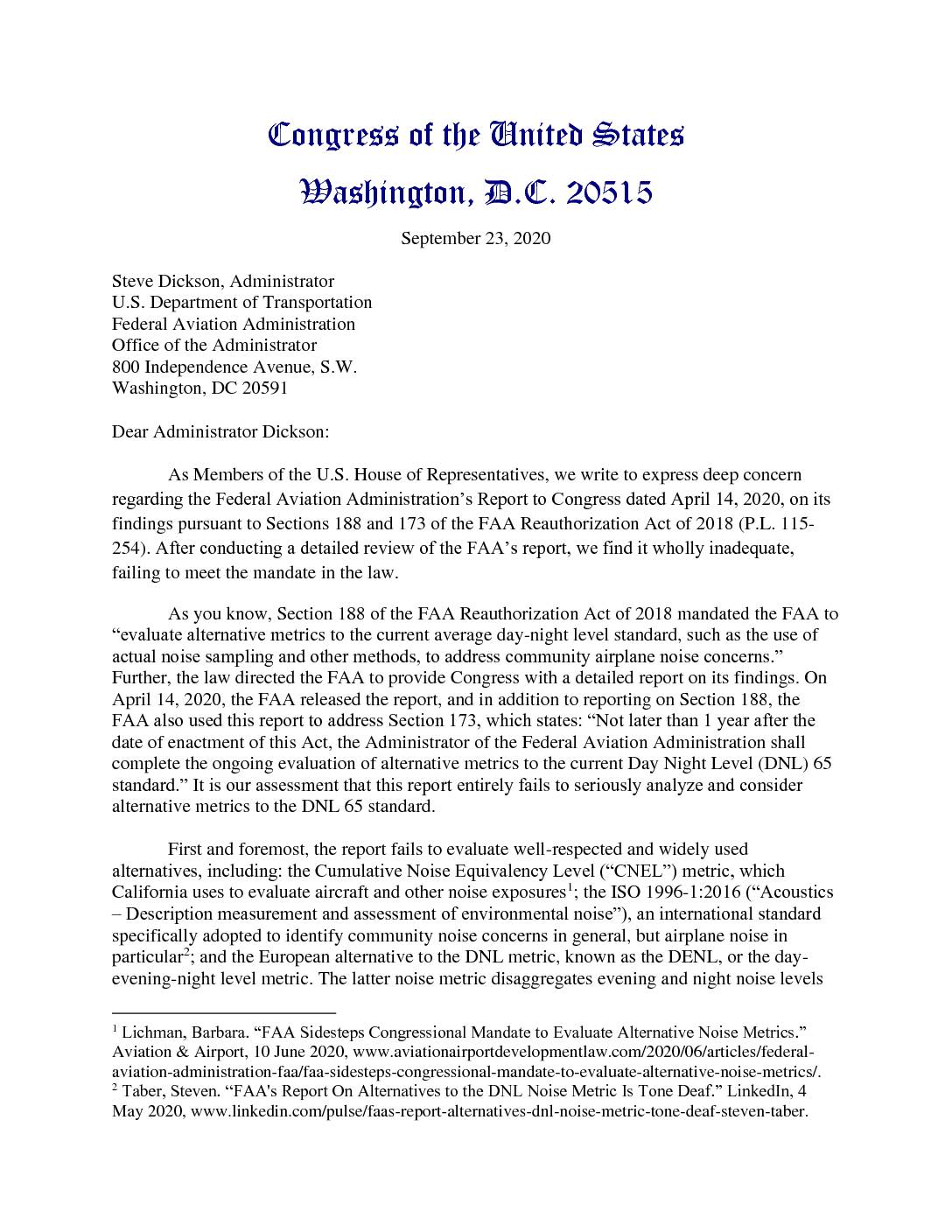
Congressional letter to FAA Administrator Steve Dickson on alternative noise metrics report
Currently, FAA law has extremely complicated rules for establishing a noise boundary around airports. (A noise boundary is a geographic area inside which there is a certain acceptable noise level.) This is referred to as the DNL65. and it has several major flaws. The FAA Reauthorization Act Of 2018 attempted to address these flaws in several ways. This letter, from a caucus of Congressmen engaged on airport community issues complains to the Administrator that the spirit of the law is not being adhered to and demands that he make attempts to put his agency into compliance. The language is fairly technical, however there are a couple of basic points they raise: First, that the noise boundary be determined by actual noise measurements (currently the noise boundaries are 'modeled' and those calculations often do not reflect in any way the lived experience for residents.) Second, that the 'acceptable' noise level of sixty five decibels (hence DNL65) has been determined to be far too high to conform with current understandings of healthy living. -
 2020-09-22
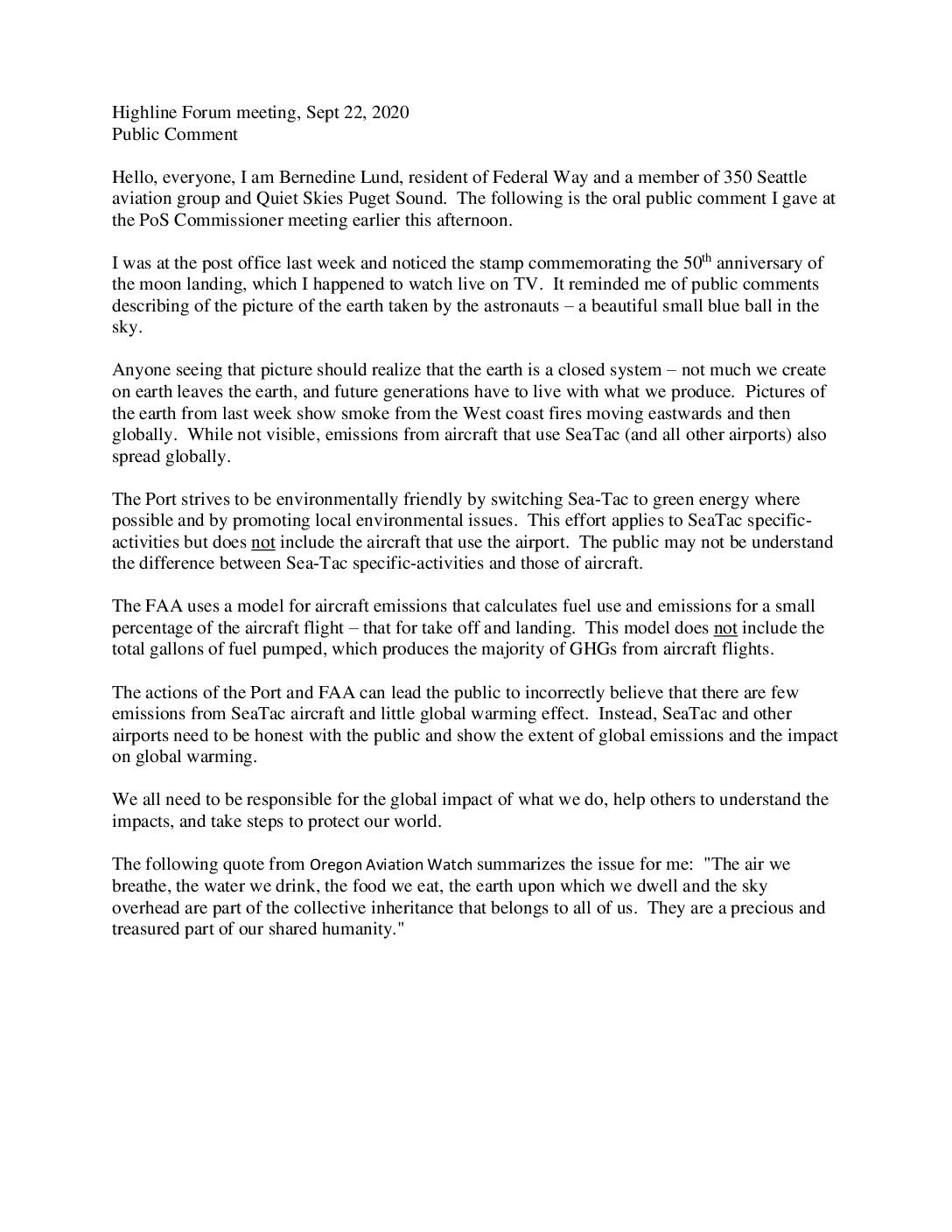
Highline Forum Public Comment by Bernedine Lund on Aircraft Emissions and Sea-Tac Airport
At a September 2020 Highline Forum meeting, Federal Way resident Bernedine Lund argued that Sea-Tac Airport and the FAA are misleading the public about aircraft emissions by only measuring fuel use during takeoff and landing, while ignoring the far larger greenhouse gas output of full flights. She called on the Port and FAA to be transparent about the total global climate impact of aircraft using Sea-Tac. Her comments emphasized that environmental responsibility must extend beyond airport-specific operations to include the aircraft themselves. -
 2020-09-15
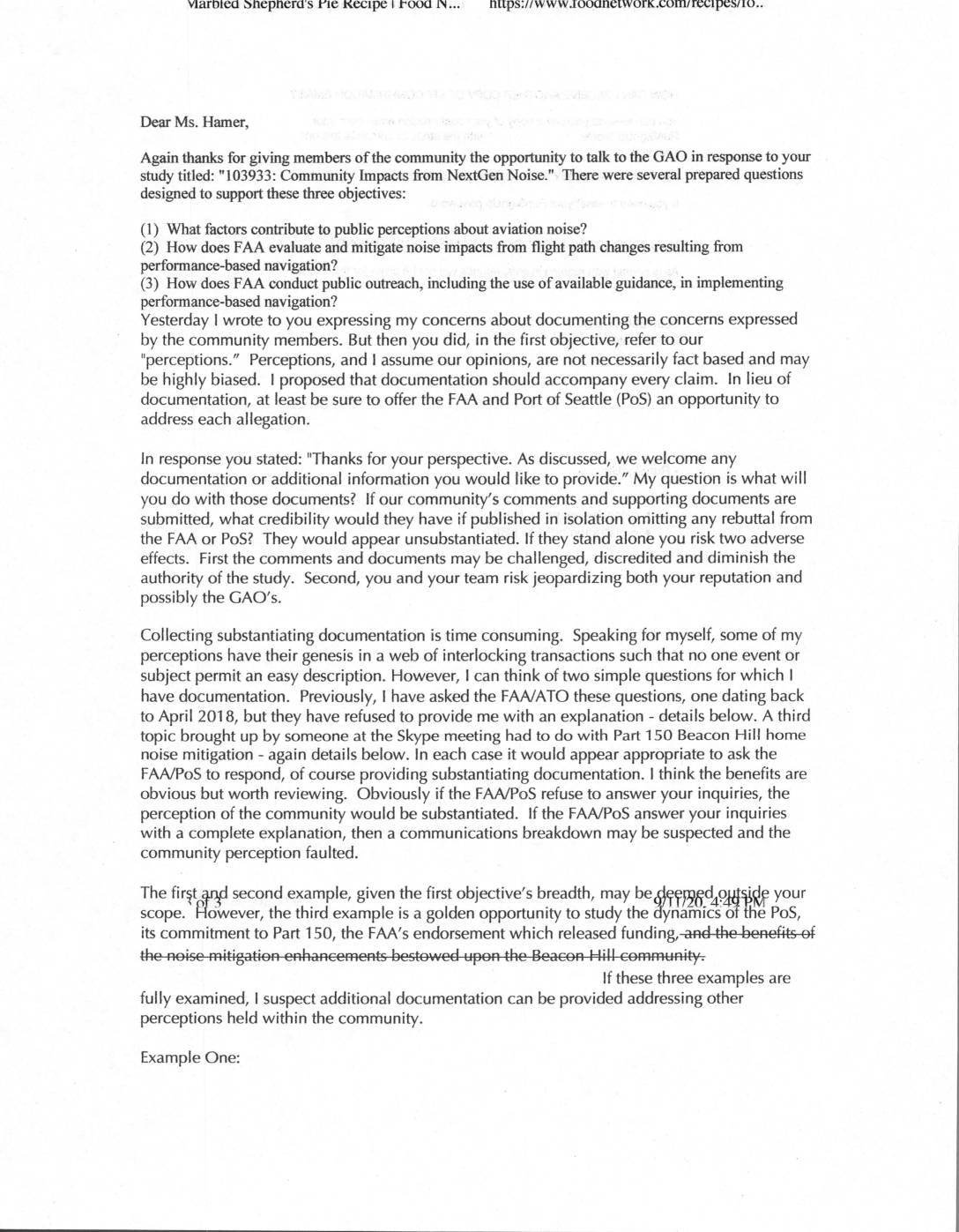
Letter to Ms. Hamer regarding GAO study 103933: Community impacts from NextGen noise
A community member wrote to a GAO researcher studying NextGen aviation noise impacts near Seattle-Tacoma International Airport, urging that community complaints be paired with responses from the FAA and Port of Seattle to ensure credibility. Key concerns raised include an outdated noise exposure map that has not been updated despite significant growth in air traffic, and the FAA's alleged refusal to answer questions submitted as far back as April 2018. The letter argues that without official rebuttals or supporting documentation, community perceptions risk appearing unsubstantiated and could undermine the integrity of the GAO study. -
 2020-09-15
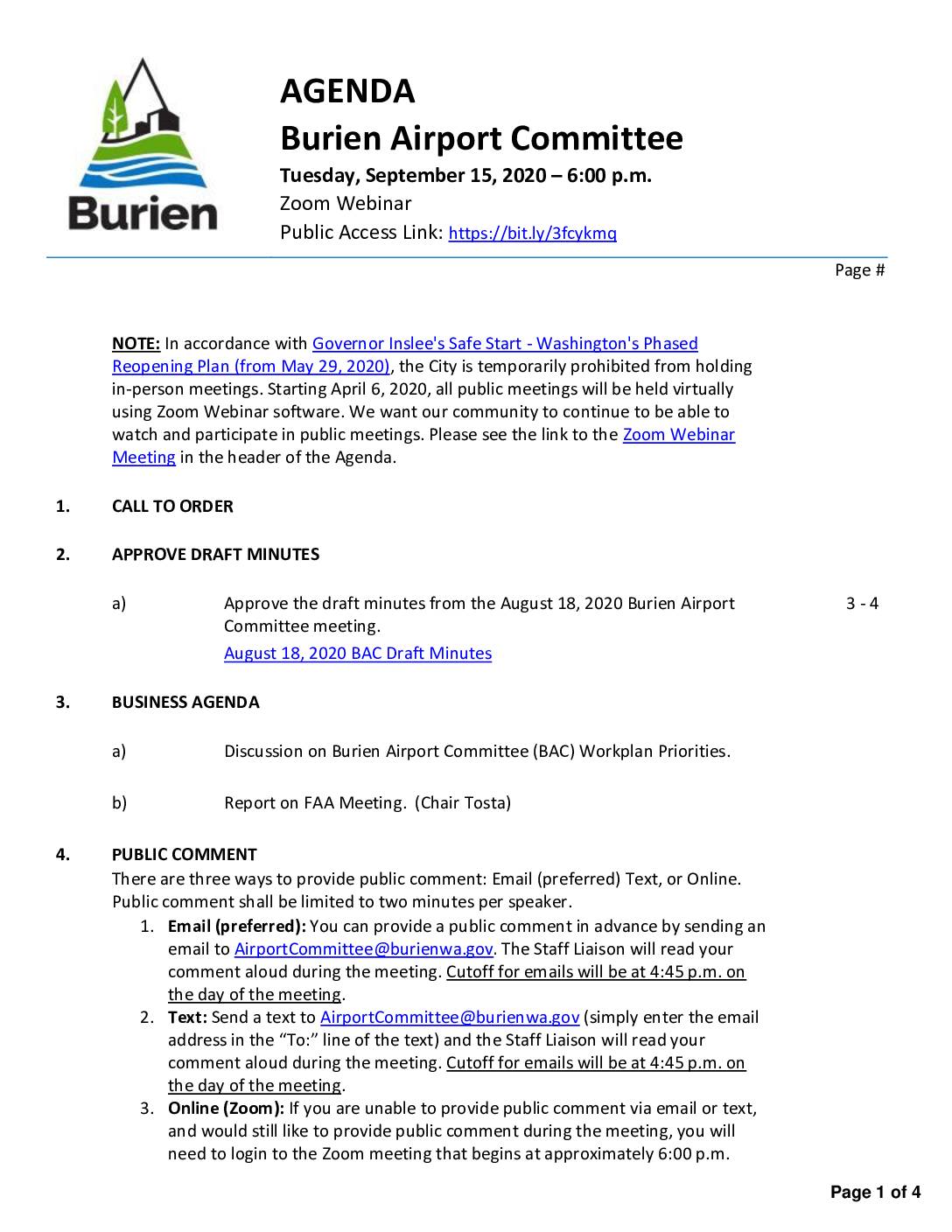
Burien Airport Committee agenda, September 15, 2020
The Burien Airport Committee held a virtual meeting on September 15, 2020, to discuss workplan priorities related to Sea-Tac Airport issues, including community outreach, noise complaints, environmental justice, and preparation for the release of the Supplemental Airport Master Plan (SAMP) Environmental Assessment. The agenda also included a report from Chair Nancy Tosta on a recent FAA meeting, and approval of minutes from the August 18, 2020 meeting. Due to COVID-19 restrictions, the meeting was conducted via Zoom, with public comments accepted by email, text, or online participation. -
 2020-09-02
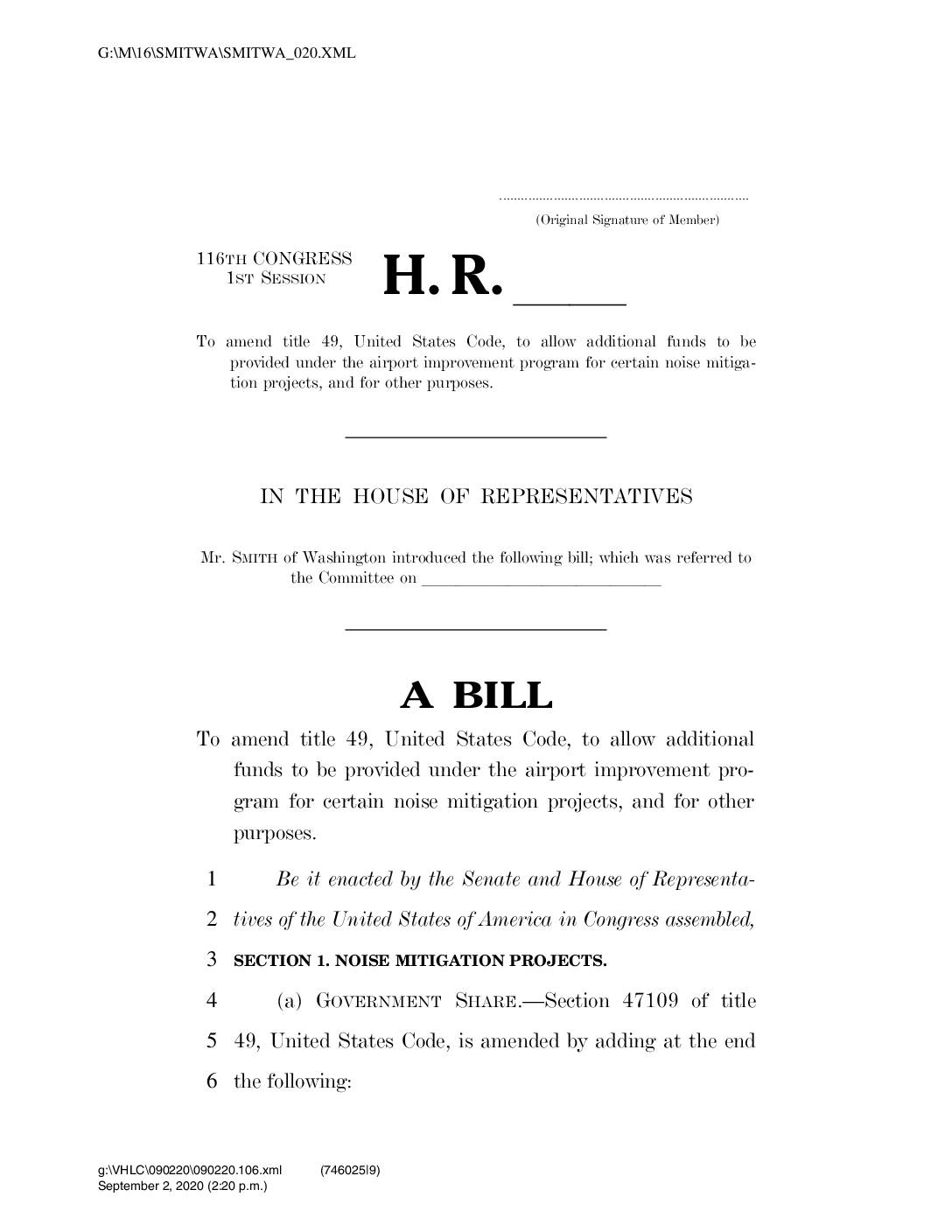
Airport Improvement Program Noise Mitigation Projects Bill
A bill introduced in the 116th Congress by Representative Smith of Washington would allow airports to receive additional federal funding under the Airport Improvement Program for noise mitigation projects on buildings that have already received such assistance. The bill would permit the Secretary of Transportation to waive the usual restriction on repeat federal funding if increased aircraft noise, deteriorating soundproofing, or damage caused by prior mitigation work justifies further action. Eligible buildings must fall within the DNL 65 noise standard and be certified by a state-licensed building inspector, making this legislation particularly relevant to communities near high-traffic airports like Seattle-Tacoma International. -
 2020-09-01
Sustainable Aviation Fuel: Review of Technical Pathways
This U.S. Department of Energy report, prepared by researchers from Pacific Northwest National Laboratory, the National Renewable Energy Laboratory, and the University of Dayton, reviews the technical pathways for producing Sustainable Aviation Fuel (SAF) — alternative fuels designed to reduce the environmental impact of commercial aviation. The report synthesizes findings from multiple expert workshops and evaluates various methods for converting renewable resources into jet fuel. It is intended to inform policymakers, fuel producers, and aviation stakeholders about viable routes toward cleaner air travel. -
New aircraft-noise rule would do little to quiet the skies: government report
By Jon Hemmerdinger 24 August 2020 A ban on aircraft that do not meet new noise standards would do little to reduce overall aircraft noise and would impose costly requirements on airlines and aerospace manufacturers. That is according to a 20 August report from the US Government Accountability Office into the likely impact of a -
 2020-08-20
Comments on the FAA EA: SAMP Environmental Assessment
This document presents formal public comments opposing an FAA Environmental Assessment for expansion projects at Seattle-Tacoma International Airport, arguing that the stated justification for growth is misleading because FAA safety regulations would naturally cap operations without new gates. The comments raise concerns about disproportionate air pollution health impacts on nearby residents, flawed emissions modeling dating back to the 1990s, and inadequate environmental justice and cumulative impact analyses. The author contends that adding gates and terminals is the true driver of increased flight operations, not an unavoidable surge in demand that would occur regardless of expansion.