TagFAA(687)
-
 2021-01-11
Washington Action Plan—FAA Policy Concerning Airport Revenue—2021 Update
The Washington State Department of Revenue submitted this 2021 report to the Legislature updating the state's action plan regarding Federal Aviation Administration (FAA) policy on airport revenue. The FAA requires that any state or local taxes on aviation fuel enacted after December 30, 1987—including the hazardous substance tax, petroleum products tax, and local sales and use taxes—be spent exclusively on airport and aviation purposes. The report also recommends a method for separately tracking the amounts collected from these taxes on aviation fuel, developed in consultation with the Washington State Department of Transportation's Aviation Division. -
 2021-01-01
Community perspectives on legislation: Aircraft noise and emissions legislation in the next Congress
A 2021 presentation by Darlene Yaplee, founding member of the Aviation-Impacted Communities Alliance (AICA), argues that the FAA's current systems for assessing and addressing aircraft noise and health impacts are outdated and in need of legislative reform. The document outlines community perspectives on aircraft noise and emissions legislation, covering problem framing, insights for future laws, noise reduction strategies, and real examples of community input. Residents across impacted communities are calling for meaningful relief from the noise and emissions burdens caused by modern air traffic. -
 2021-01-01
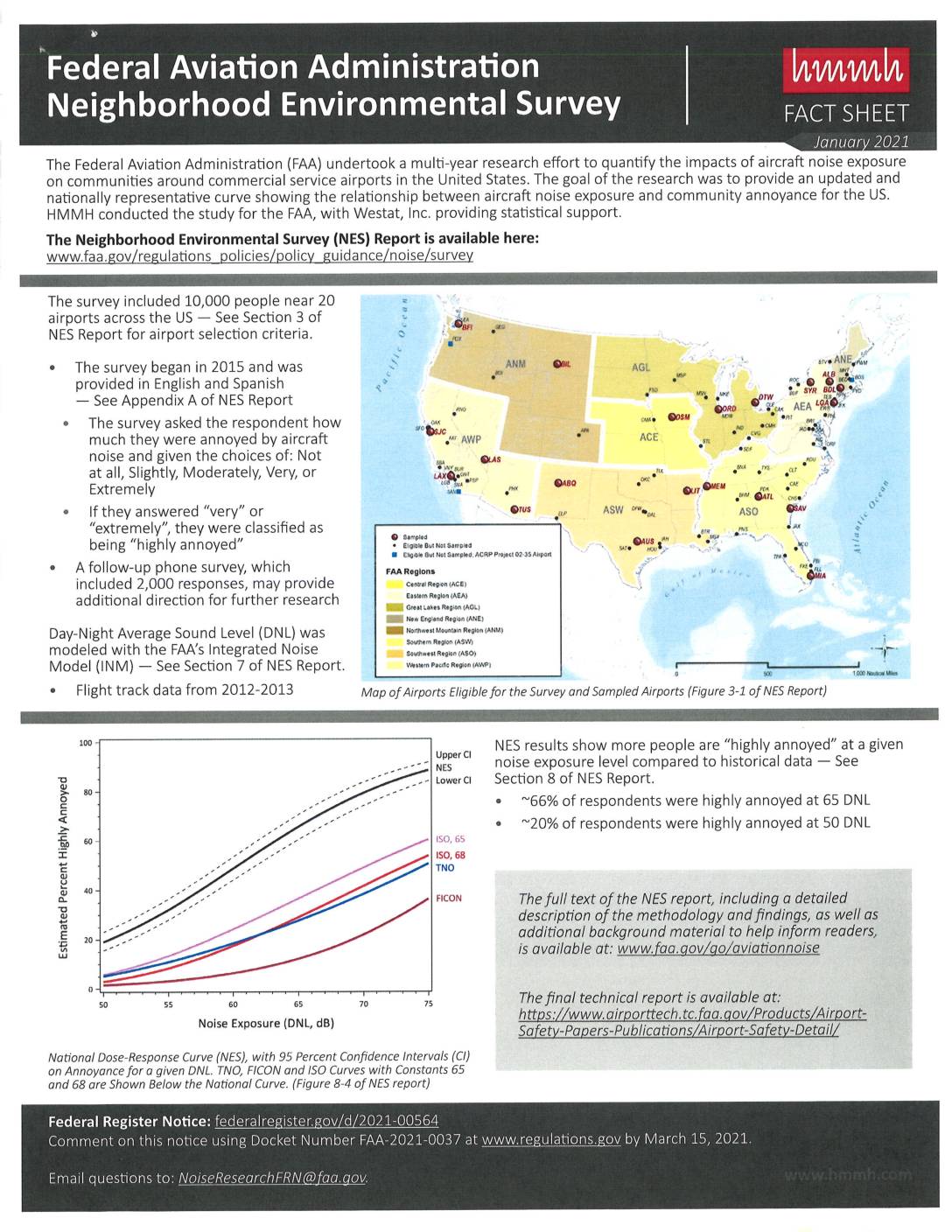
Neighborhood Environmental Survey fact sheet
The FAA conducted a large-scale Neighborhood Environmental Survey (NES) of 10,000 people near 20 U.S. airports to measure how aircraft noise affects community annoyance, finding that significantly more people are bothered by noise than older studies suggested — about 66% of respondents were highly annoyed at 65 decibels (DNL) and 20% at 50 decibels. The agency uses the Day-Night Average Sound Level (DNL) metric to measure noise exposure and is reviewing whether its longstanding 65 DNL threshold for 'significant' noise impact should be updated. The FAA is seeking public comment on these research findings before making any changes to official noise policy. -
U.S. Implementing 1st-Ever Airplane Emission Rules; Critics Say They’re Ineffective
A Southwest Airlines flight takes off as United Airlines planes sit parked on a runway at Denver International Airport in April. Michael Ciaglo/Getty Images The U.S. is regulating greenhouse gas emissions from commercial aircraft for the first time. But critics are saying the rules will be ineffective. The Environmental Protection Agency said Monday the rules -
 2020-12-23
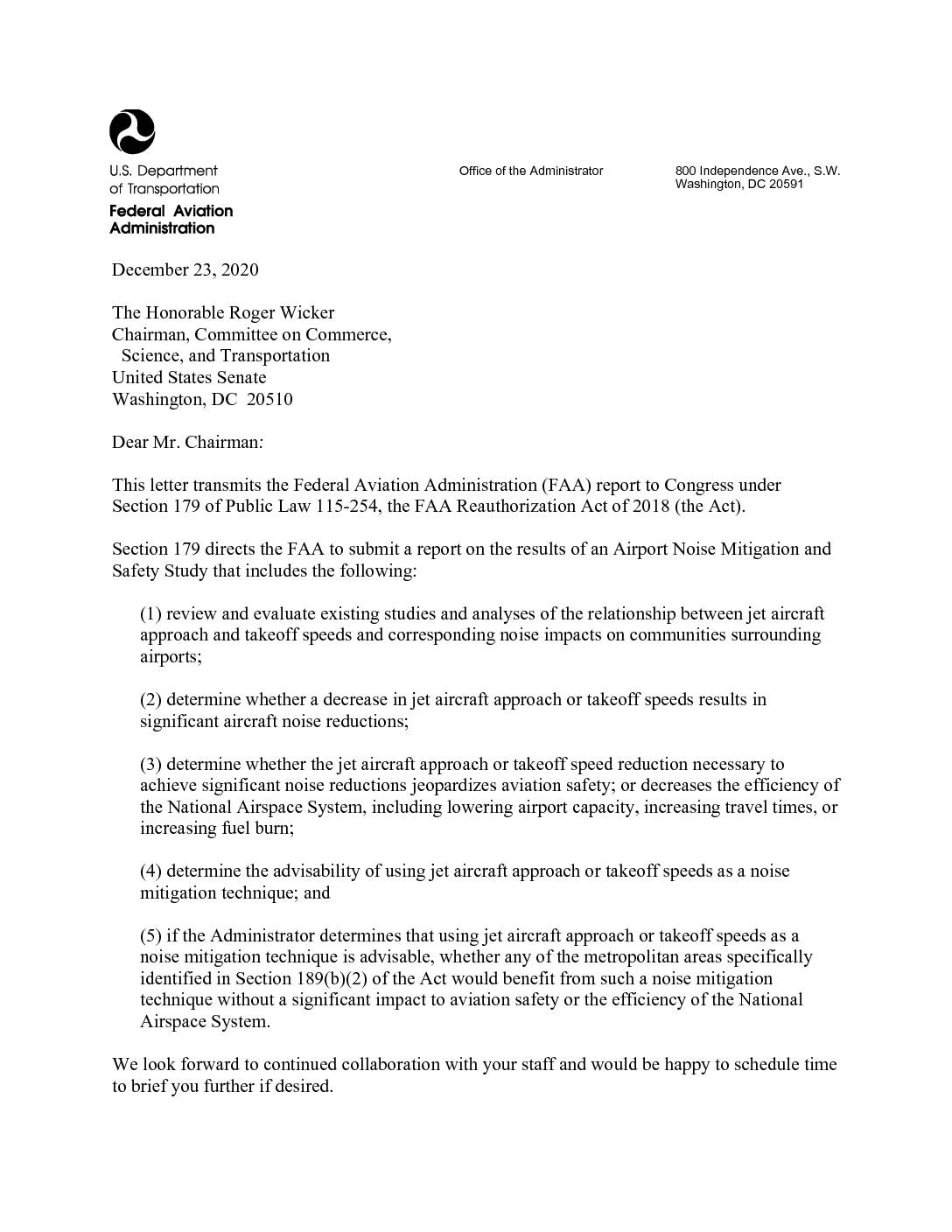
FAA Report to Congress on Airport Noise Mitigation and Safety Study
In December 2020, FAA Administrator Steve Dickson transmitted a report to Congress fulfilling a requirement under the FAA Reauthorization Act of 2018, which directed the agency to study whether reducing jet aircraft approach and takeoff speeds could meaningfully lower noise for communities surrounding airports. The study was required to assess whether any such speed reductions would compromise aviation safety or reduce the efficiency of the National Airspace System, including effects on airport capacity, travel times, and fuel consumption. The report was sent to key congressional leaders overseeing transportation and commerce policy. -
 2020-12-21
Airfield Simulation Modeling History and Summary: Sustainable Airport Master Plan, Seattle-Tacoma International Airport
LeighFisher memorandum summarizing airfield simulation modeling conducted for the Port Of Seattle Sustainable Airport Master Plan (SAMP) and follow-on NEPA review at Sea-Tac Airport. Covers TAAM (Total Airport and Airspace Modeller) model development from 2015 through mid-2017, including initial calibration to 2014 activity, FAA-requested recalibration to 2016 activity, maximum sustainable throughput experiments, and revised future-year -
2020-12-21
Airfield Simulation Modeling History and Summary: Sustainable Airport Master Plan, Seattle-Tacoma International Airport
LeighFisher memorandum summarizing airfield simulation modeling conducted for the Port Of Seattle Sustainable Airport Master Plan (SAMP) and follow-on NEPA review at Sea-Tac Airport. Covers TAAM (Total Airport and Airspace Modeller) model development from 2015 through mid-2017, including initial calibration to 2014 activity, FAA-requested recalibration to 2016 activity, maximum sustainable throughput experiments, and revised future-year -
 2020-12-01
Administrator’s Fact Book
The FAA Administrator's Fact Book (December 2020) is an official reference document compiled by the FAA Office of Communications outlining the agency's core mission and vision. The FAA's mission is to provide the safest and most efficient aerospace system in the world, while its vision emphasizes advancing safety, efficiency, environmental responsibility, and global leadership with accountability to the American public. This document serves as a foundational overview of FAA priorities, which directly inform federal aviation and noise policies affecting airports such as Seattle-Tacoma International Airport. -
 2020-10-27
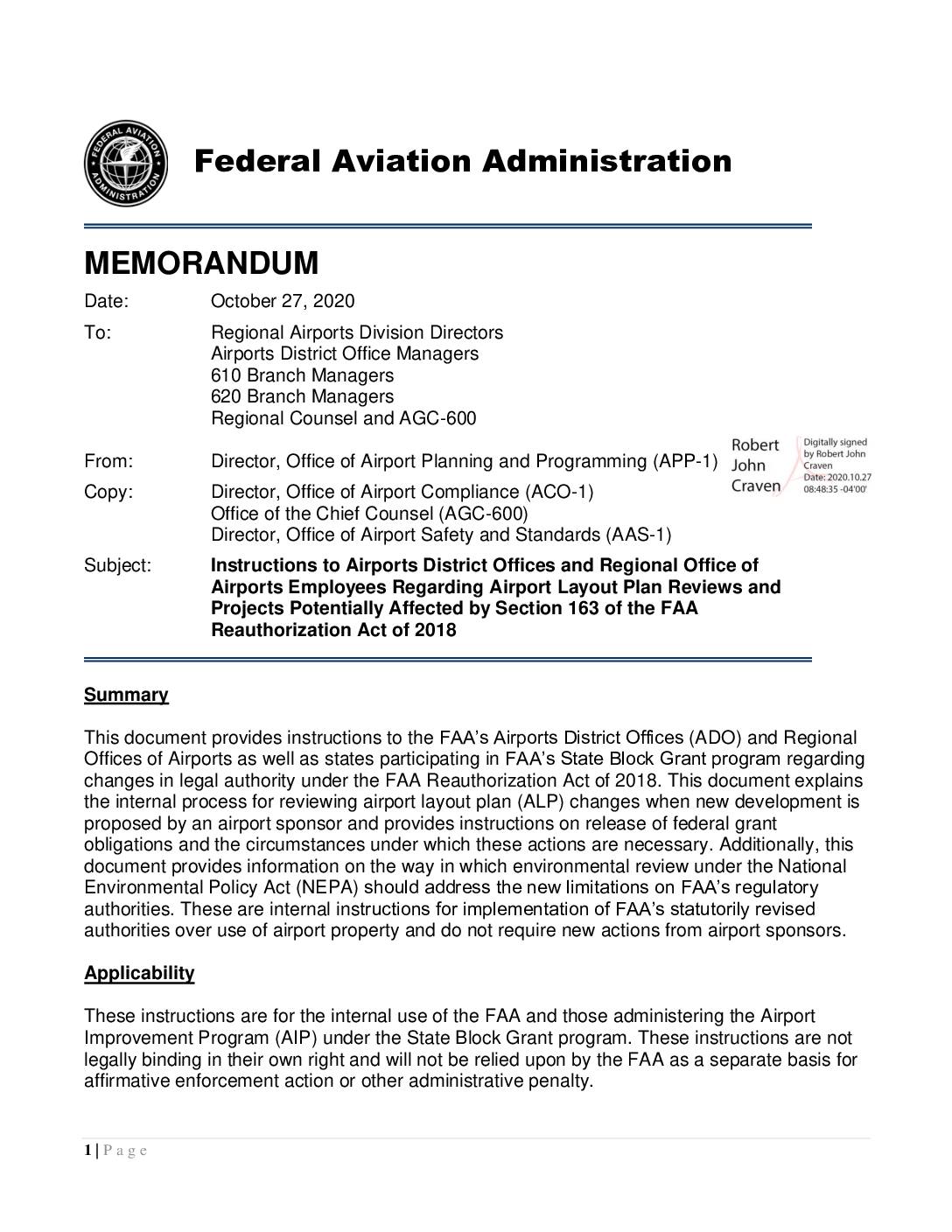
Instructions to Airports District Offices and Regional Office of Airports employees regarding Airport Layout Plan reviews and projects potentially affected by Section 163 of the FAA Reauthorization Act of 2018
This October 2020 FAA memorandum provides internal guidance to airport district offices on how to implement changes brought by Section 163 of the FAA Reauthorization Act of 2018, which limited the FAA's authority over airport land use and layout plan approvals. The memo outlines a two-step screening process for reviewing proposed airport land use changes, explaining when the FAA retains approval authority versus when it must simply accept changes. Note that this document addresses general FAA airport oversight procedures nationwide and does not specifically concern Sea-Tac Airport noise policy. -
HR5912 – Expedited Delivery of Airport Infrastructure Act of 2020
116th CONGRESS 2d Session H. R. 5912 AN ACT To amend title 49, United States Code, to permit the use of incentive payments to expedite certain federally financed airport development projects. Be it enacted by the Senate and House of Representatives of the United States of America in Congress assembled, SECTION 1. Short title. This