TagFAA(687)
-
Airline Close Calls Happen Far More Often Than Previously Known
FLIGHT RISKS By Sydney Ember and Emily SteelGraphics by Leanne Abraham, Eleanor Lutz and Ella KoezeAug. 21, 2023 On the afternoon of July 2, a Southwest Airlines pilot had to abort a landing at Louis Armstrong New Orleans International Airport. A Delta Air Lines 737 was preparing to take off on the same runway. The sudden maneuver avoided a possible collision by seconds. Near miss NEW -
Close Calls and the New York Times: What You Need to Know
The U.S. aviation system is the safest in the world, but one close call is one too many. The FAA and the aviation community are pursuing a goal of zero serious close calls, a commitment from the Safety Summit in March. The same approach virtually eliminated the risk of fatalities aboard U.S. commercial airlines. Since 2009, -
 2023-08-16
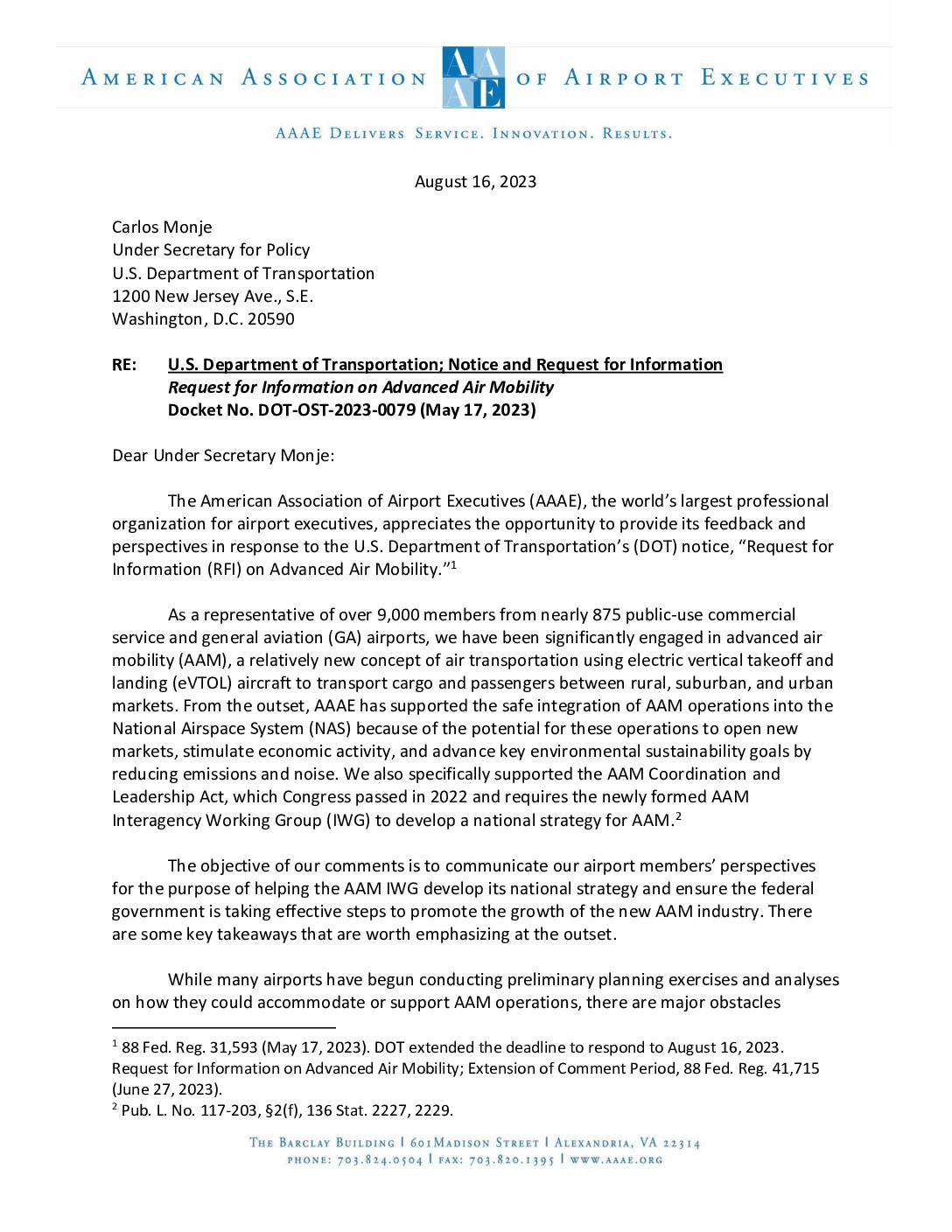
AAAE Response to DOT Request for Information on Advanced Air Mobility (Docket No. DOT-OST-2023-0079)
The American Association of Airport Executives (AAAE) submitted formal comments to the U.S. Department of Transportation in August 2023 regarding the future of Advanced Air Mobility (AAM), including electric vertical takeoff and landing (eVTOL) aircraft. The letter highlights key obstacles facing airports, such as limited electrical power supply, uncertainty about commercial viability, and a lack of FAA guidance on safely integrating these new aircraft into airport facilities. It also raises concerns about new safety risks, particularly the challenges of firefighting lithium-ion battery fires from electric aircraft, urging the FAA to provide clearer emergency response protocols. -
 2023-08-15
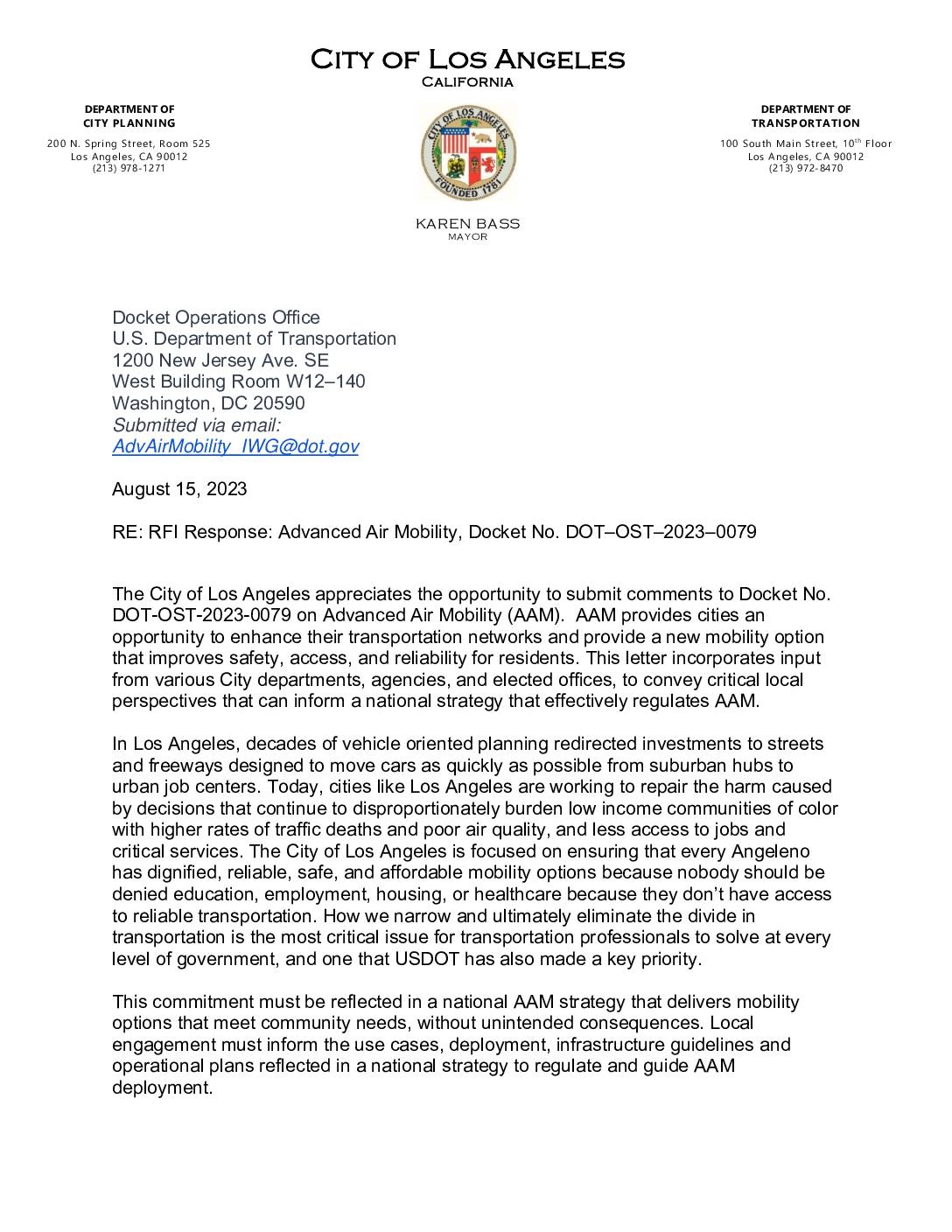
City of Los Angeles RFI Response: Advanced Air Mobility, Docket No. DOT-OST-2023-0079
The City of Los Angeles submitted formal comments to the U.S. Department of Transportation in August 2023 regarding Advanced Air Mobility (AAM), calling for stronger local government involvement in shaping national AAM policy. The letter emphasizes safety, equity, and environmental concerns, including the need for rigorous aircraft noise, vibration, and frequency analysis to protect communities already burdened by past transportation decisions. Los Angeles urges federal agencies to require independent environmental studies and ensure that low-income communities and communities of color are not further harmed by the rollout of new aerial vehicle technologies. -
 2023-08-14
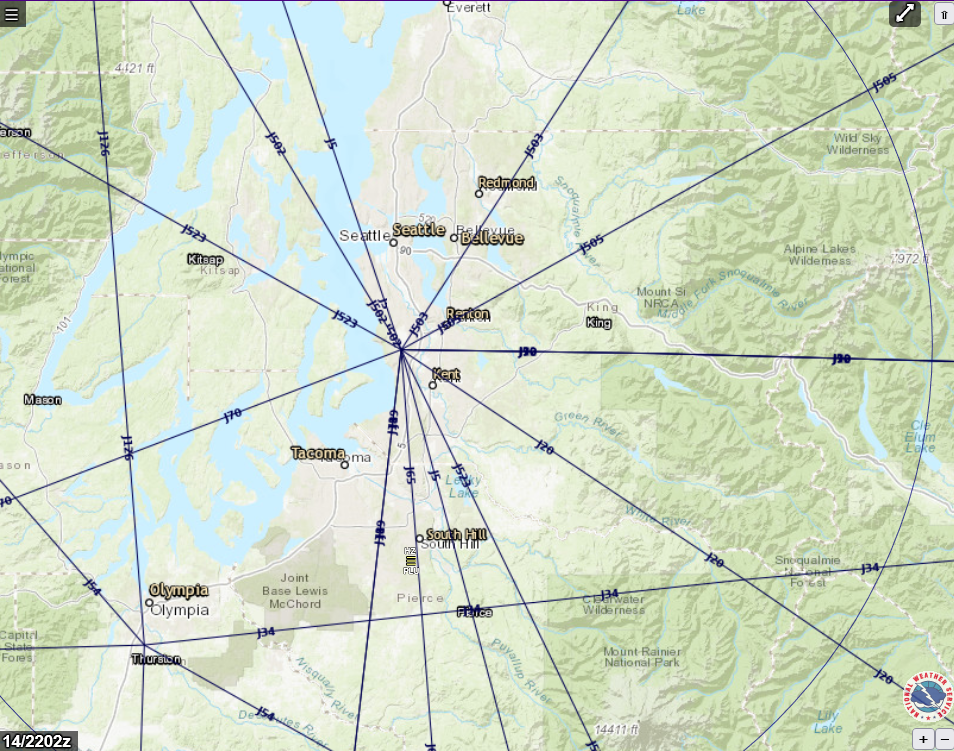
FAA Jet Route Chart Centered on Seattle-Tacoma Area – 14/2202z
A National Weather Service (NWS)-branded interactive aviation map showing FAA high-altitude jet routes (J-routes) radiating from a central fix near Seattle-Tacoma International Airport (Sea-Tac), with surrounding cities including Seattle, Bellevue, Renton, Kent, Tacoma, and Olympia visible. The map is timestamped 14/2202z and displays multiple labeled jet airways (J20, J34, J90, J523, etc.) overlaid on a terrain basemap of the greater Puget Sound region. -
 2023-08-14
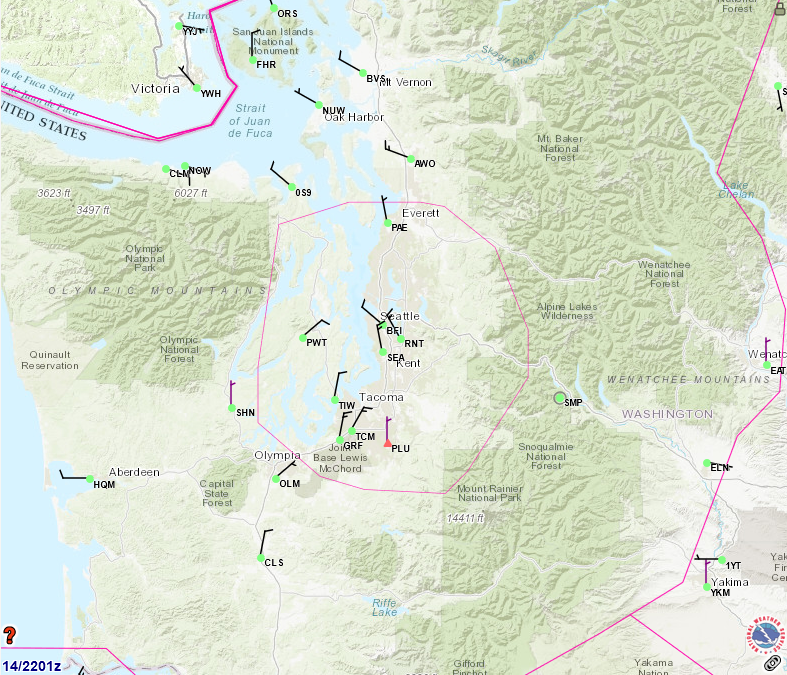
FAA Aviation Weather/Flight Track Map – Seattle-Tacoma Region
An FAA or aviation weather service map dated the 14th at 2201 Zulu, showing airports, airways, and airspace boundaries (including a pink ADIZ/TRACON boundary) across the Seattle-Tacoma metropolitan area and western Washington state. Visible airport identifiers include SEA (Seattle-Tacoma International), BFI (Boeing Field), PAE (Paine Field/Everett), RNT (Renton), TIW (Tacoma Narrows), OLM (Olympia), and numerous others, with a weather.gov watermark visible in the lower right. -
What is a TRACON?
The area from 6-50 miles will affect you with or without a second airport. It’s an FAA acronym. Terminal Radar Approach Control. And if you live in any of the areas considered for a Second Airport, including Enumclaw or Pierce and Thurston Counties, keep reading. TRACONs are FAA facilities that house air traffic controllers who -
Wing walking flights in Sequim draw lawsuit and FAA investigation
By Dominic Gates Seattle Times aerospace reporter In Sequim, on the north coast of the Olympic Peninsula, you can sign up for a daring thrill ride available nowhere else in America: Mason Wing Walking will take you up in an airplane to about 3,500 feet where you can climb out of the open cockpit and -
 2023-08-10
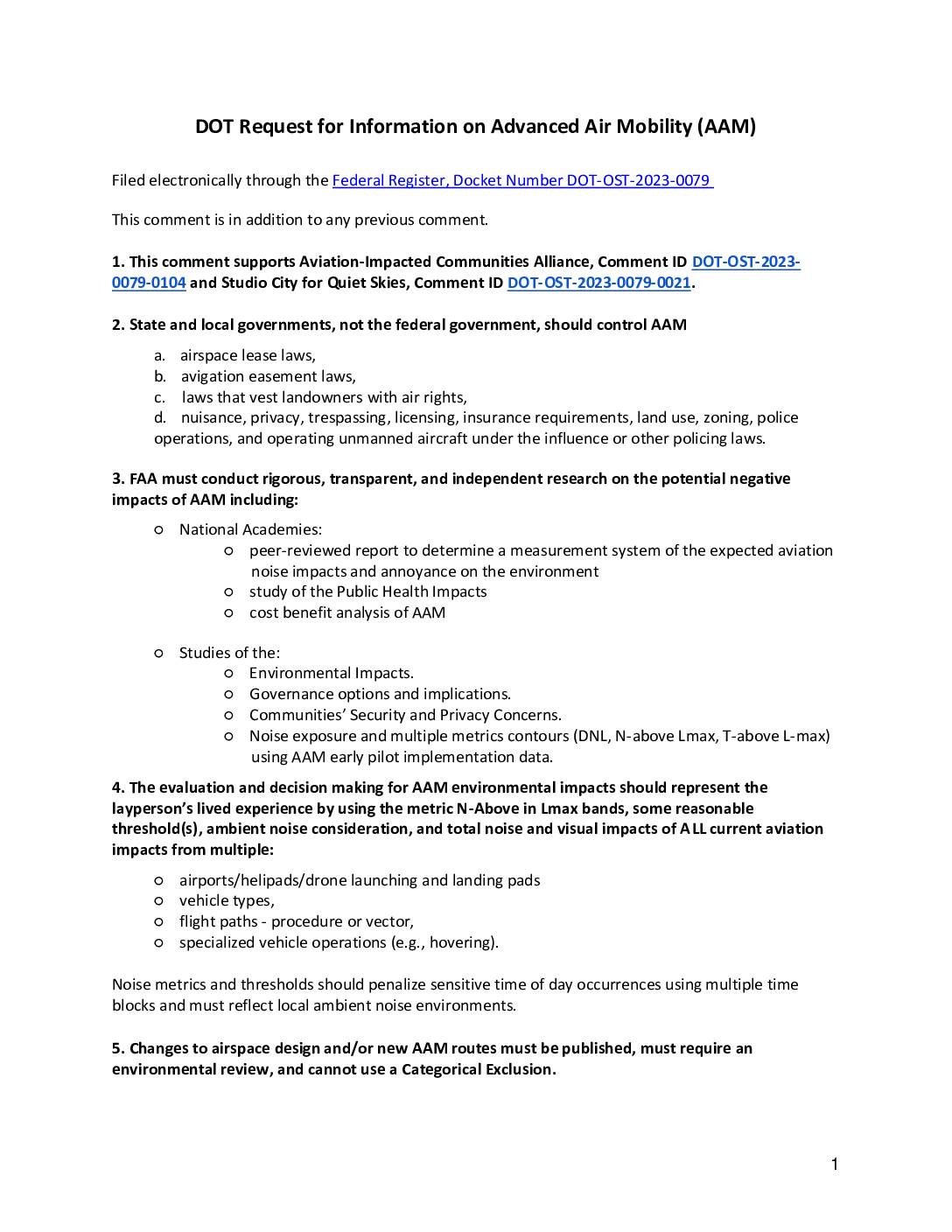
DOT request for information on Advanced Air Mobility (AAM)
A public comment submitted to the Department of Transportation argues that communities should have a stronger voice in shaping Advanced Air Mobility (AAM) policy, including drones and air taxis, before decisions are made. It calls on the FAA to conduct independent research on noise, health, environmental, and privacy impacts, and to use better noise measurement tools that reflect residents' real-world experience. The comment also urges regulators to avoid repeating mistakes made during the NextGen rollout, where communities were excluded from the process until after key decisions had already been implemented. -
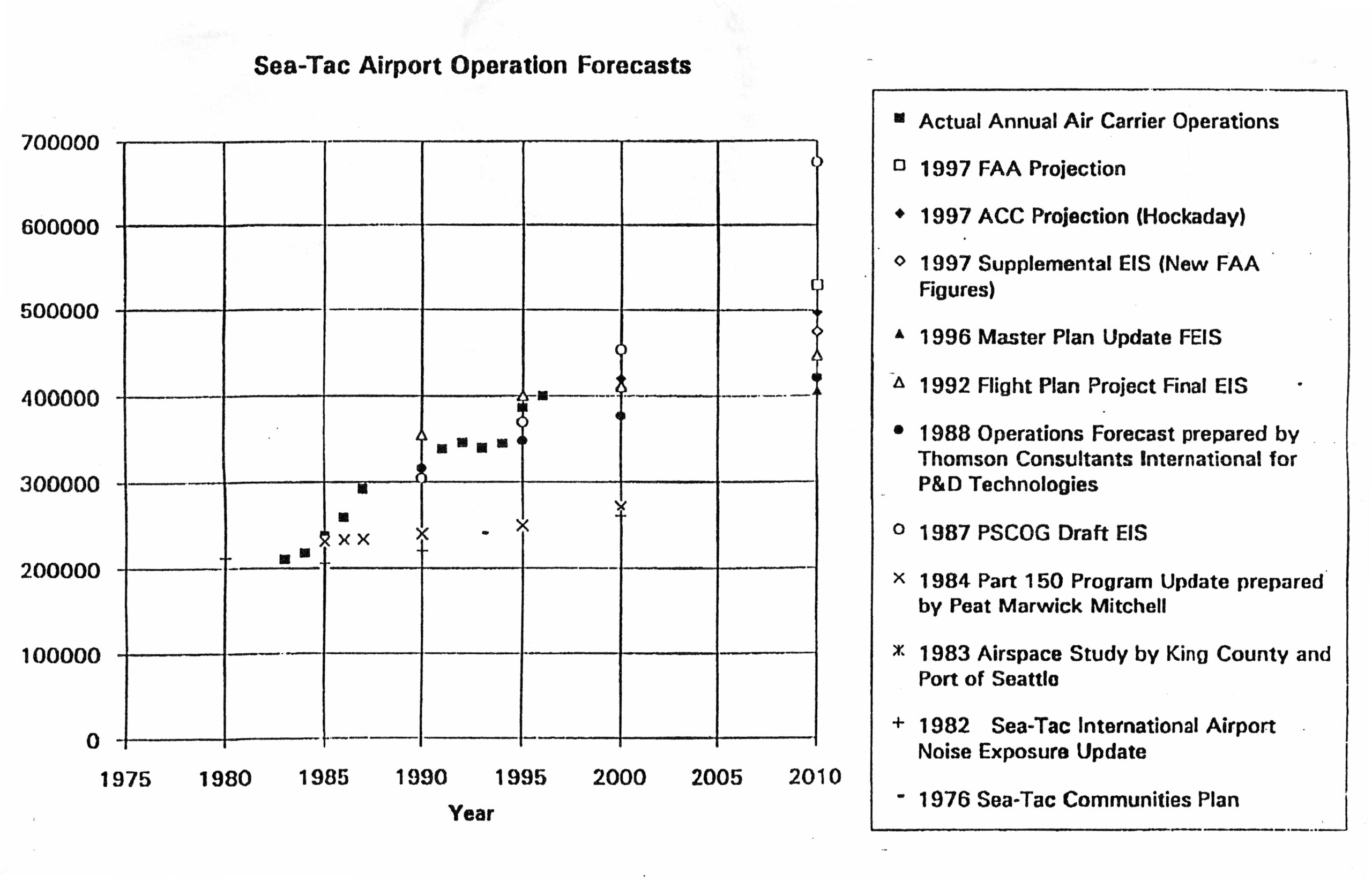
Sea-Tac Airport Comparison of Air Carrier Operations Forecasts vs. Actuals, 1975–2010
A scatter plot comparing multiple historical and projected annual air carrier operations forecasts for Seattle-Tacoma International Airport, spanning approximately 1975–2010. The chart overlays actual operations data against projections from sources including 1997 FAA and ACC (Hockaday) projections, the 1992 Flight Plan Project Final EIS, the 1996 Master Plan Update FEIS, the 1987 PSCOG Draft EIS, and several earlier studies dating back to a 1976 Sea-Tac Communities Plan, illustrating how successive forecasts consistently overestimated growth relative to actual operations.