TagFAA(687)
-
 2023-05-02
Eliminate Aviation Gasoline Lead Emissions Initiative (EAGLE): Aviation Noise & Emissions Symposium presentation
The Eliminate Aviation Gasoline Lead Emissions Initiative (EAGLE) is a coalition of government and industry partners, including the FAA and major aviation associations, working to eliminate lead emissions from aviation gasoline by the end of 2030 without compromising the safety or efficiency of general aviation. The initiative operates through four key pillars: supply chain infrastructure and deployment, research and innovation, unleaded fuel evaluation and authorization, and regulation and policy activities. A presentation on the initiative was delivered at the Aviation Noise & Emissions Symposium at U.C. Davis on May 2, 2023. -
 2023-05-01
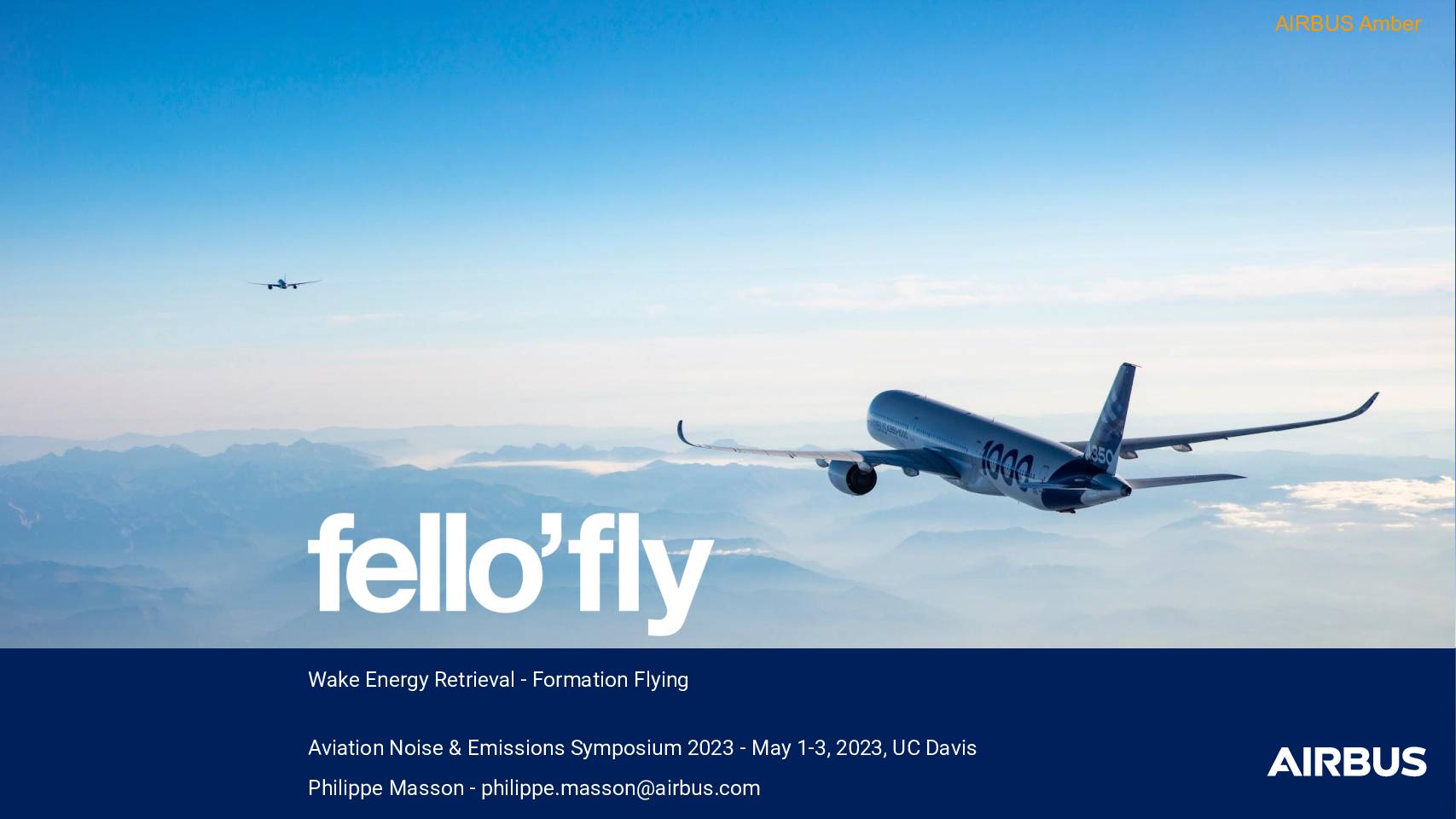
Fello’fly: Wake Energy Retrieval – Formation Flying
Airbus's 'fello'fly' program explores formation flying as a fuel-saving technique, where a follower aircraft positions itself in the smooth updraft of a leading aircraft's wake to recover otherwise wasted kinetic energy. This approach can reduce trip fuel consumption and emissions by around 5% for the follower aircraft, making it most beneficial on long-haul routes exceeding 2,000 nautical miles. Key factors affecting savings include aircraft pairing, the follower's position on the vortex, time spent in formation, and fuel used to enter the formation. -
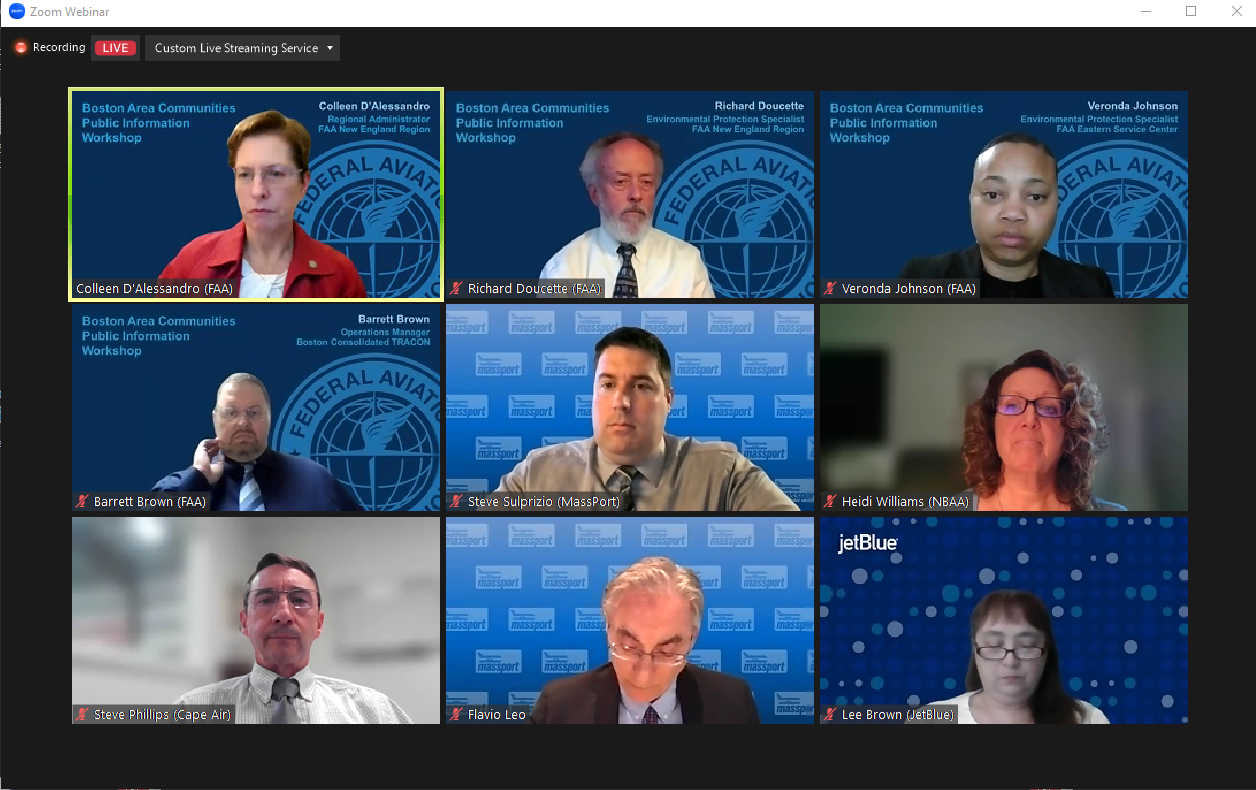
FAA New England Region Boston Area Communities Public Information Workshop Zoom Webinar
A recorded Zoom webinar for the Boston Area Communities Public Information Workshop featuring FAA New England Region officials and aviation industry representatives, including Colleen D'Alessandro (FAA Regional Administrator), Richard Doucette and Veronda Johnson (FAA Environmental Protection Specialists), Barrett Brown (FAA Boston TRACON Operations Manager), Steve Sulprizio and Flavio Leo (MassPort), Heidi Williams (NBAA), Steve Phillips (Cape Air), and Lee Brown (JetBlue). This event is unrelated to Sea-Tac Airport and pertains to FAA noise and environmental matters in the Boston/New England region. -
 2023-04-28
The foundational elements of the Federal Aviation Administration civil aviation noise policy: The noise measurement system, its component noise metrics, and noise thresholds
The FAA is reviewing its civil aviation noise policy, which is based on decades-old research, to better address how aircraft noise affects communities near airports like Sea-Tac. The review examines noise measurement systems, acceptable noise thresholds, and the impact of aviation noise on residents—including annoyance, sleep disturbance, and health effects. Public and stakeholder input is being sought to help modernize the policy. -
 2023-04-24
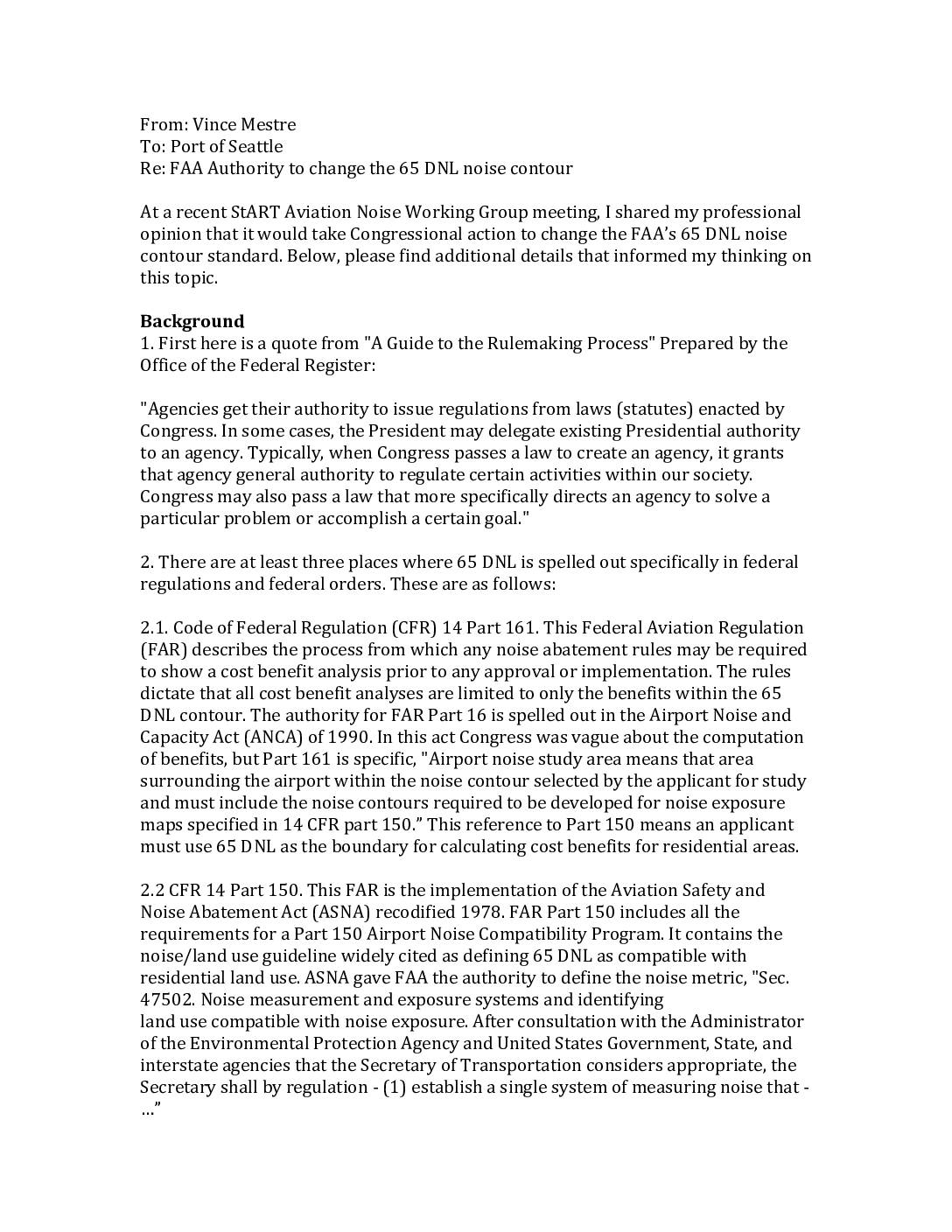
FAA authority to change the 65 DNL noise contour
Aviation noise consultant Vince Mestre explains to the Port of Seattle why changing the FAA's 65 DNL noise contour standard — the threshold used to determine acceptable aircraft noise near residential areas — would likely require an act of Congress rather than a simple regulatory update. The 65 DNL standard is embedded in at least three federal regulations and orders (CFR 14 Parts 150 and 161, and FAA Order 1050.1F), all of which trace their authority back to enabling legislation such as the Aviation Safety and Noise Abatement Act (ASNA) of 1978 and the Airport Noise and Capacity Act (ANCA) of 1990. Because the FAA's rulemaking authority is granted and bounded by those Congressional statutes, modifying ASNA would most likely be required before the FAA could formally lower or otherwise change the noise compatibility standard. -
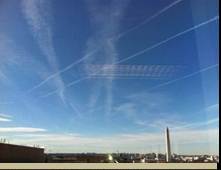
Heavy Aircraft Traffic Over Washington D.C. National Airspace
View of the Washington Monument and the National Mall skyline in Washington, D.C., with numerous aircraft contrails crossing the blue sky above. The dense grid of contrails suggests heavy air traffic over the capital area. -

-
Aging, unreliable runway safety device leaves U.S. airports vulnerable
By Alan Levin A crucial safety system that’s relied on to avoid potentially fatal collisions at major U.S. airports is aging and plagued by outages that have left travelers unprotected for months at a time. At some airports, it hasn’t ever been installed. The technology — which tracks vehicles on or near runways to alert -
 2023-04-06
Sound Insulation Treatment Repair and Replacement Program Act
The Sound Insulation Treatment Repair and Replacement Program Act, introduced by Rep. Adam Smith (WA-09), would allow the FAA to waive a rule that currently prevents airports from using Airport Improvement Program (AIP) funds to repair or replace sound insulation in the same home more than once. The bill addresses problems caused by faulty materials and poor installation during noise mitigation programs in the 1980s and 1990s, which have led to structural damage and mold in some homes near airports like Sea-Tac. Eligible homeowners must have their issues verified by an FAA-compliant noise auditor, and repairs are generally limited to residences still within the airport's current 65 DNL noise contour.