TagFAA(687)
-
 2025-08-11
Part 150 Study Technical Review Committee: Meeting #4 Agenda, August 11, 2025
This document is the agenda and attendance record for the fourth meeting of the Part 150 Study Technical Review Committee, held on August 11, 2025, at Seattle-Tacoma International Airport. The meeting covered updates on Phase 1 Noise Exposure Mapping, a kickoff for Phase 2 Noise Compatibility Program planning, and a review of the project schedule. Representatives from neighboring cities, airlines, King County, the FAA, and the Port of Seattle participated as members or liaisons. -
2025-08-08
Stone LLP | Complete List of FAA Grant Assurances
Complete List Of FAA Grant Assurances Complied by the Airport & Aviation Attorneys at STONE LLP Grant Assurances Applicable To Airports and Airport Sponsors As of the writing of this webpage, the FAA mandates a total of 39 grant assurances and these apply to each airport’s performance of its grant agreement with the federal government -
 2025-08-08
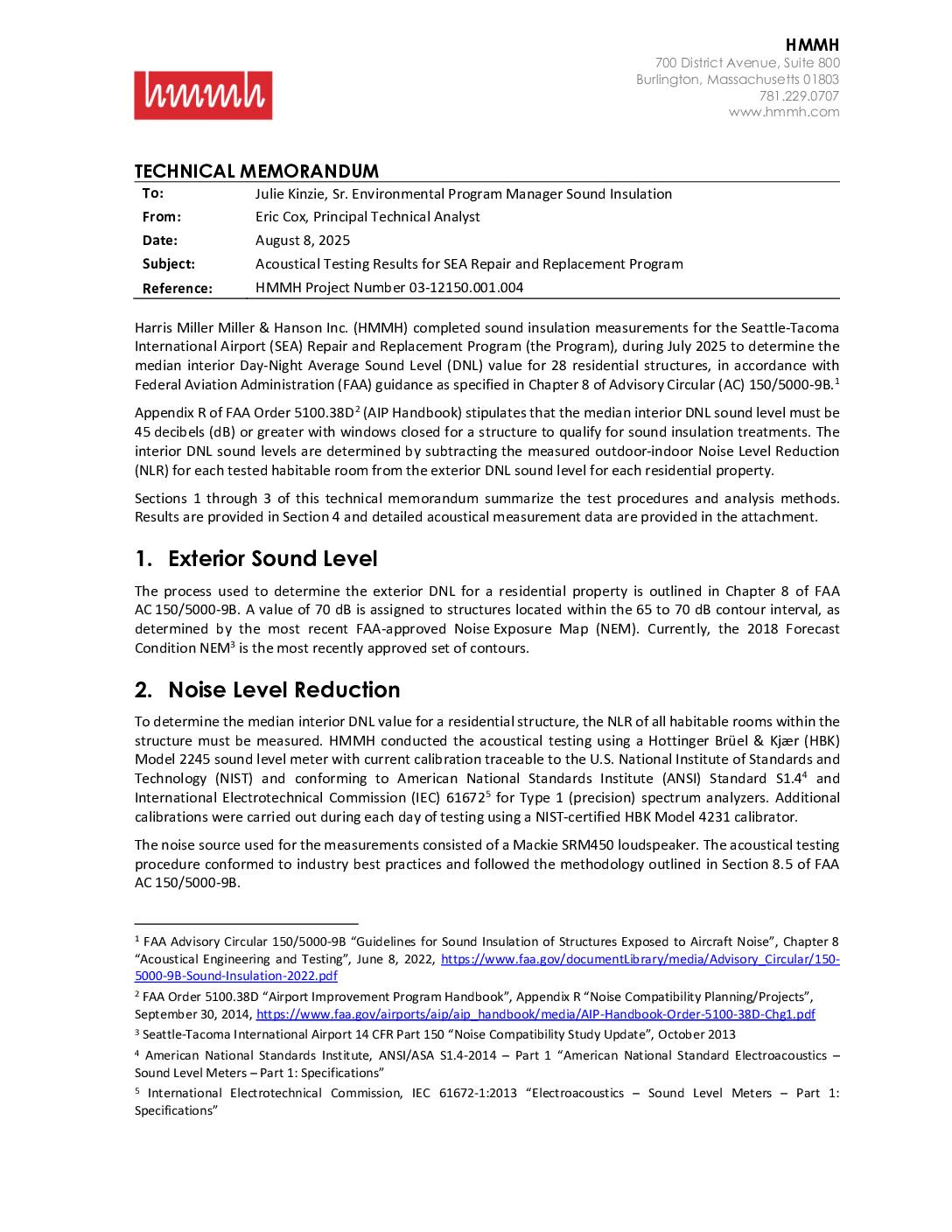
Acoustical Testing Results for SIRRPP — August 2025
This August 2025 technical report by Harris Miller Miller & Hanson Inc. (HMMH) presents the results of interior sound insulation testing conducted at 28 homes near Seattle-Tacoma International Airport (SEA) in July 2025. Using FAA-approved measurement methods, acoustical engineers tested every habitable room in each home to determine how much aircraft noise penetrates indoors, with a threshold of 45 decibels (dB) required for a home to qualify for sound insulation assistance. Of the 28 structures tested, only two met the 45 dB qualification threshold, while nine others had at least one room exceeding that level but did not qualify under current FAA policy. -
 2025-08-07
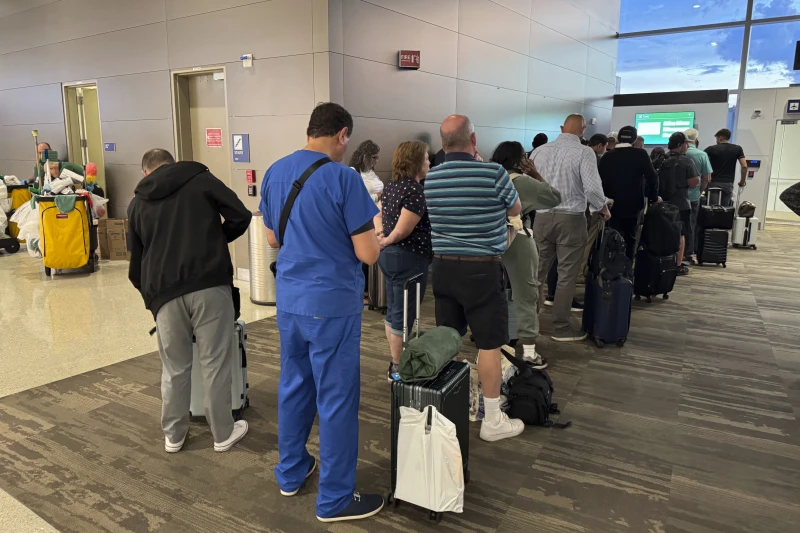
More than 1,000 United Airlines flights delayed in the US due to technology problem
By JACK BROOK and LISA BAUMANN A technology issue prompted United Airlines to ground planes at major U.S. airports Wednesday and more than 1,000 flights were delayed. The impacted system, called Unimatic, houses flight information that is fed to other systems including those that calculate weight and balance and track flight times, according to United. It’s not clear -
 2025-07-28
Appendix D: Biological Opinion and Essential Fish Habitat Response for Seattle-Tacoma International Airport Sustainable Airport Master Plan Near-Term Projects
The National Marine Fisheries Service (NMFS) issued a Biological Opinion on July 28, 2025, in response to a Federal Aviation Administration consultation request regarding near-term construction projects outlined in the Seattle-Tacoma International Airport Sustainable Airport Master Plan. The opinion evaluates potential effects of these projects on endangered species and critical fish habitat under the Endangered Species Act and the Magnuson-Stevens Fishery Conservation and Management Act. NMFS reviewed and independently verified analyses from the FAA's Biological Evaluation, incorporating findings related to the proposed action area, species status, and effects on critical habitat. -
 2025-07-28
Appendix D: Biological Resources — ESA Section 7(a)(2) Biological Opinion and EFH Response for Sea-Tac Airport Sustainable Airport Master Plan Near-Term Projects
The National Marine Fisheries Service (NMFS) issued a Biological Opinion on July 28, 2025, in response to a Federal Aviation Administration (FAA) consultation request regarding the Seattle-Tacoma International Airport Sustainable Airport Master Plan Near-Term Projects. The opinion evaluates potential effects of the planned airport projects on endangered species and critical fish habitat under the Endangered Species Act and the Magnuson-Stevens Fishery Conservation and Management Act. The review drew on a Final Biological Evaluation prepared by the FAA to assess impacts on species status, critical habitat, and the surrounding environment. -
 2025-07-16
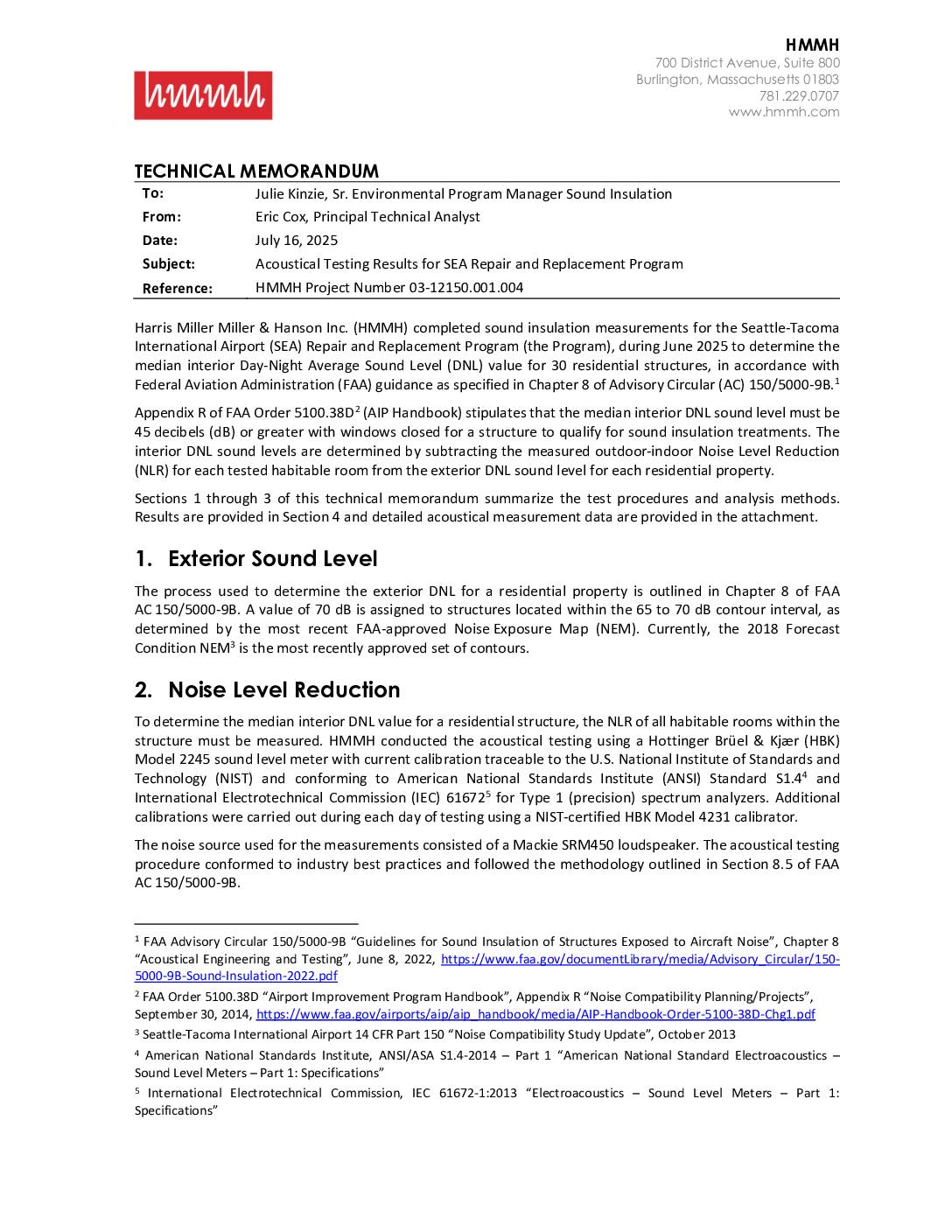
Acoustical Testing Results for SIRRPP — July 2025
Harris Miller Miller & Hanson Inc. (HMMH) conducted sound insulation measurements at 30 homes near Seattle-Tacoma International Airport in June 2025 to determine whether interior noise levels meet the federal threshold for sound insulation assistance. Using FAA-approved testing methods, the study found that only 3 of the 30 homes had median interior Day-Night Average Sound Levels (DNL) at or above the qualifying 45 dB threshold, while an additional 3 homes had individual rooms exceeding that level. The results inform eligibility decisions under the SEA Repair and Replacement Program, which is governed by FAA Advisory Circular 150/5000-9B and the Airport Improvement Program Handbook. -
 2025-07-07
Significant Changes to the National Environmental Policy Act Affecting Airport Projects
The National Environmental Policy Act (NEPA) has seen seismic changes in the past several months. On June 30, 2025, FAA rescinded its previous NEPA procedures and issued new Order 1050.1G, Environmental Impacts: Policies and Procedures, to address the recent rescission of the Council on Environmental Quality (CEQ) NEPA regulations, recent Executive Orders, and a recent -
 2025-07-02
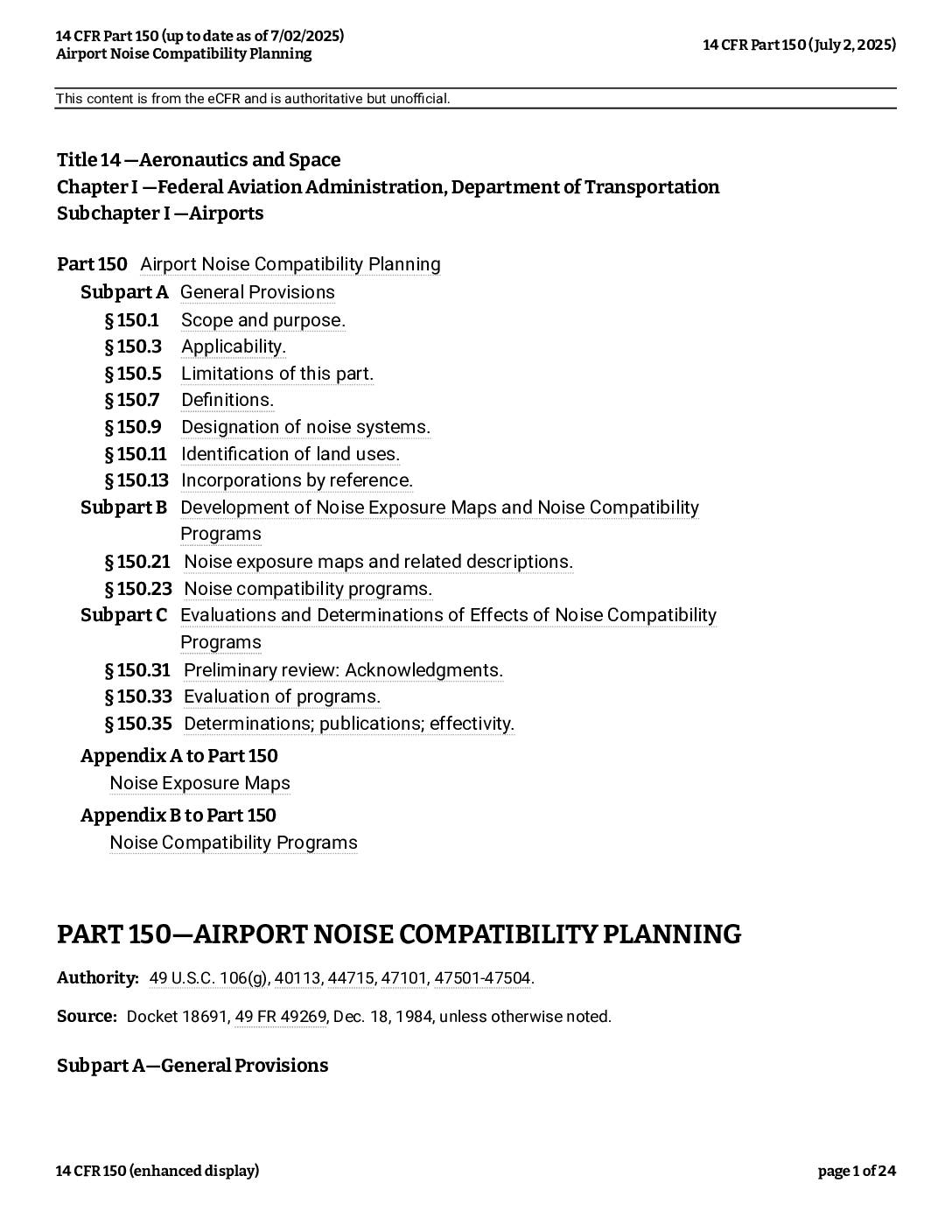
14 CFR part 150 — Airport noise compatibility planning
14 CFR Part 150 sets out the federal rules for airport noise compatibility planning, establishing how airports must measure noise, map affected areas, and develop programs to reduce conflicts between aircraft noise and nearby land uses. It defines key terms such as day-night average sound level (DNL), compatible and noncompatible land use, and noise exposure maps, and it outlines the process by which the FAA reviews and approves or disapproves airport noise compatibility programs. Importantly, FAA approval of such a program does not itself commit federal funding or authorize specific actions without further environmental review. -
 2025-06-05
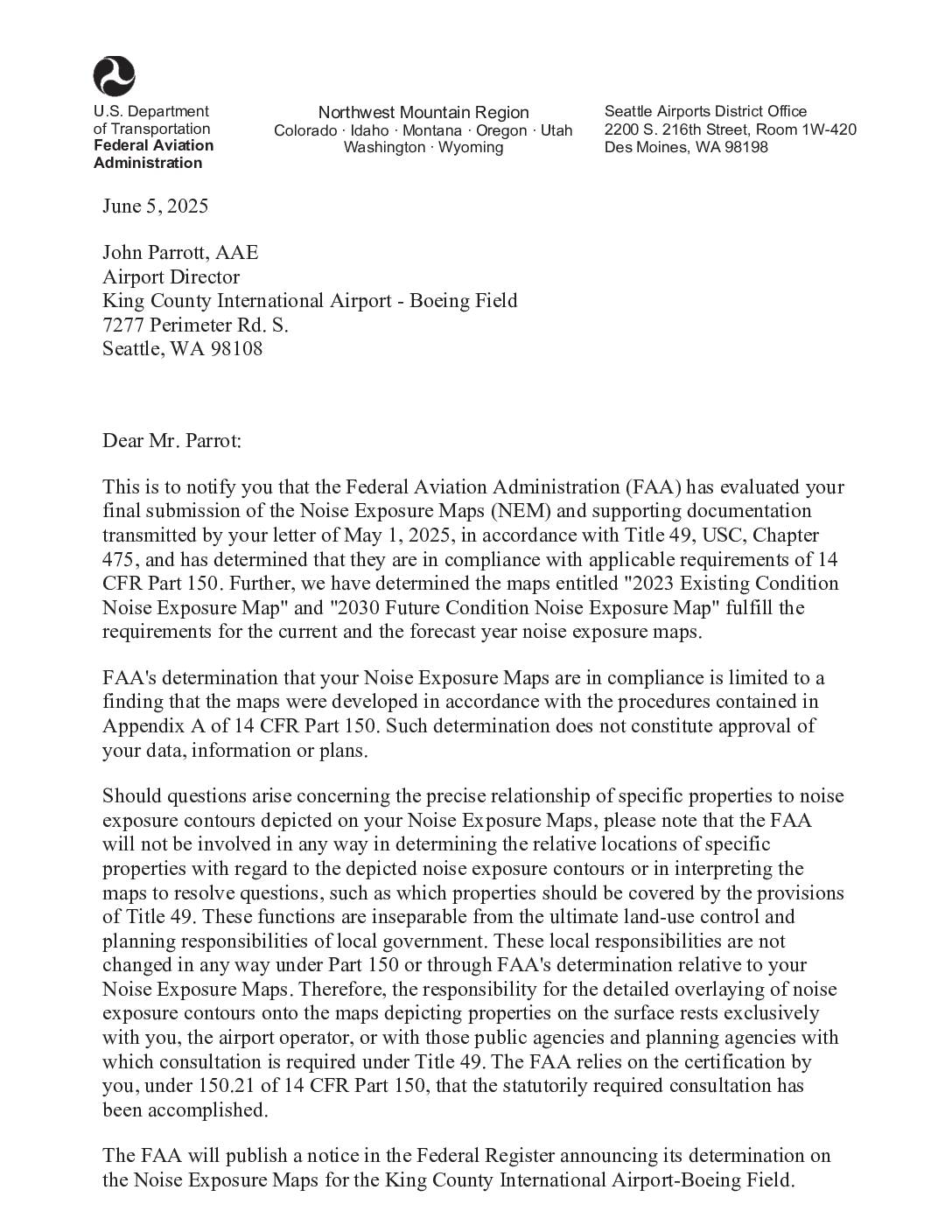
FAA Letter: Noise Exposure Maps Compliance Determination for KCIA – Boeing Field
FAA Seattle Airports District Office letter dated June 5, 2025, from Acting Manager Ryan C. Zulauf to Airport Director John Parrott at King County International Airport – Boeing Field (BFI), determining that the submitted Noise Exposure Maps (NEM) comply with 14 CFR Part 150 and Title 49 USC Chapter 475. The FAA approves the ‘2023