TagFAA(687)
-
 2025-04-24
Trump’s Transportation Secretary Sean P. Duffy: Follow the Law
Thursday, April 24, 2025 WASHINGTON, D.C. – U.S. Transportation Secretary Sean P. Duffy issued a reminder to all recipients of federal transportation funding that they must comply with federal laws. Non-compliance may lead to enforcement actions. “Federal grants come with a clear obligation to adhere to federal laws,” said U.S. Transportation Secretary Sean P. Duffy. -
 2025-04-18
Roundtable engagement guidance: How the FAA engages with Airport and Community Roundtables
This FAA guidance document explains how Airport and Community Roundtables work as forums where local governments, communities, and aviation stakeholders can collaboratively discuss concerns about nearby airport operations. The FAA participates in these roundtables to provide technical expertise but does not vote on issues, and roundtables can submit formal recommendations for changes to flight procedures or airspace operations. Any recommended changes must go through a thorough FAA review process, including safety and environmental assessments, and can take several years to implement. -
 2025-03-30
Why Airline Pilots Feel Pushed to Hide Their Mental Illness
Is the F.A.A. really ensuring safety by disqualifying pilots who receive a diagnosis or treatment? Troy Merritt, a pilot, sought professional help for his mental-health challenges and then had to go through an arduous process to regain his certification to fly… Troy Merritt, a pilot for a major U.S. airline, returned from his 30th birthday -
-
 2025-02-26
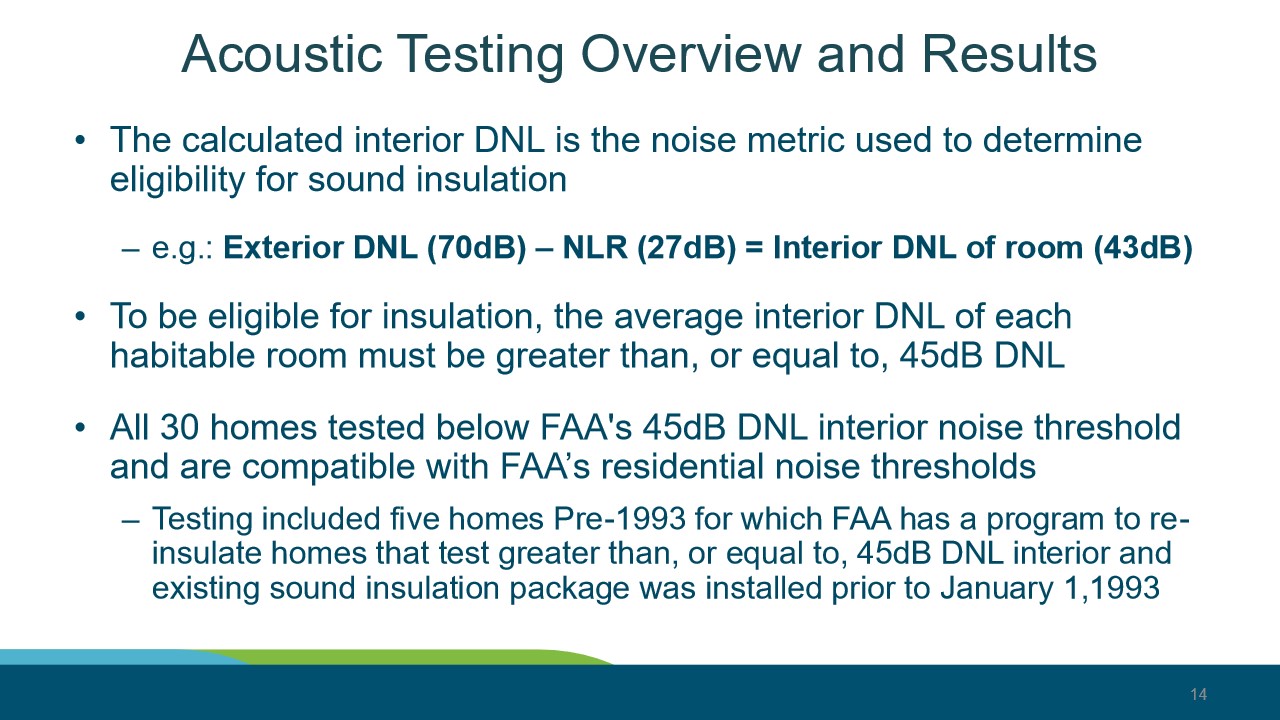
StART SIRRPP Update: Interior DNL Eligibility Threshold and Acoustic Testing Results — Slide 14 (February 26, 2025)
Slide 14 of a presentation on acoustic testing for a Sea-Tac Airport noise insulation program, explaining that interior DNL (calculated as Exterior DNL minus Noise Level Reduction) is the eligibility metric, with a threshold of 45dB DNL. All 30 homes tested fell below the FAA's 45dB DNL interior noise threshold, including five Pre-1993 homes evaluated under the FAA re-insulation program. -
 2025-02-26
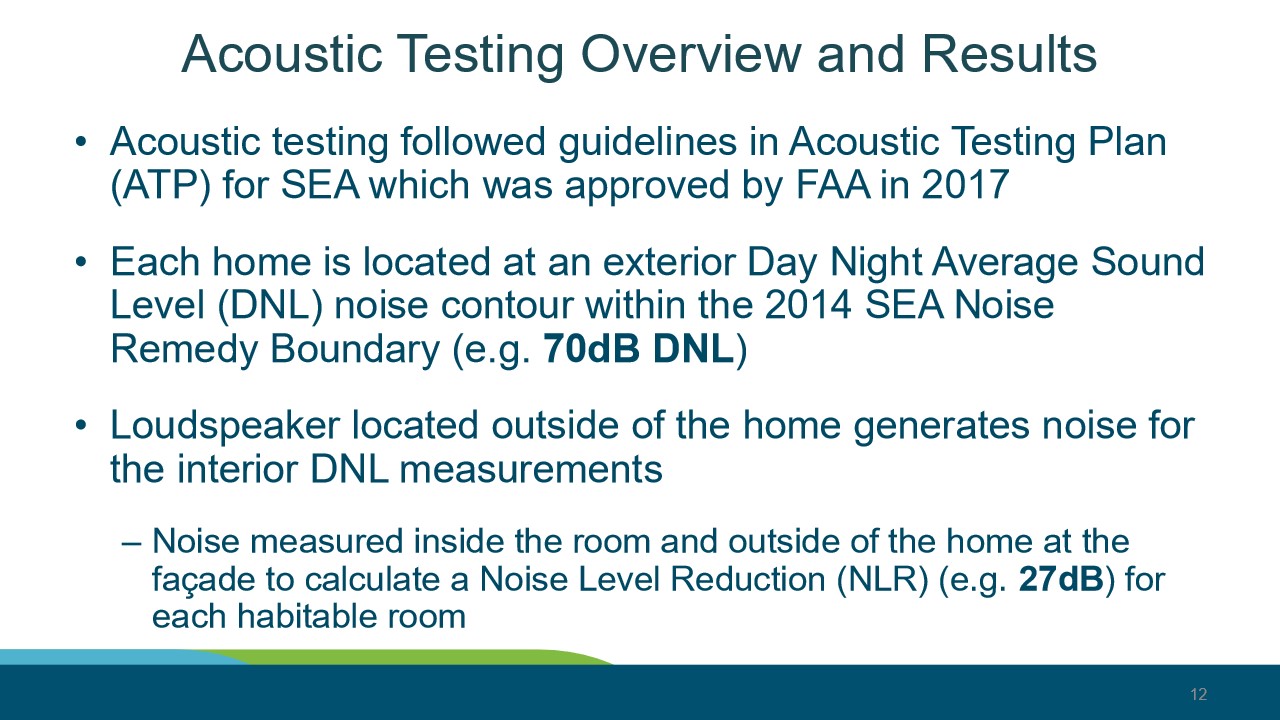
StART SIRRPP Update — Acoustic Testing Procedures and DNL Metrics — Slide 12 (February 26, 2025)
This slide from a Seattle-Tacoma International Airport (SEA) noise remedy presentation summarizes acoustic testing procedures, stating that testing followed the FAA-approved 2017 Acoustic Testing Plan (ATP). Key metrics cited include a 70dB DNL exterior noise contour threshold within the 2014 SEA Noise Remedy Boundary and a 27dB Noise Level Reduction (NLR) example calculated from interior and façade measurements. -
 2025-02-20
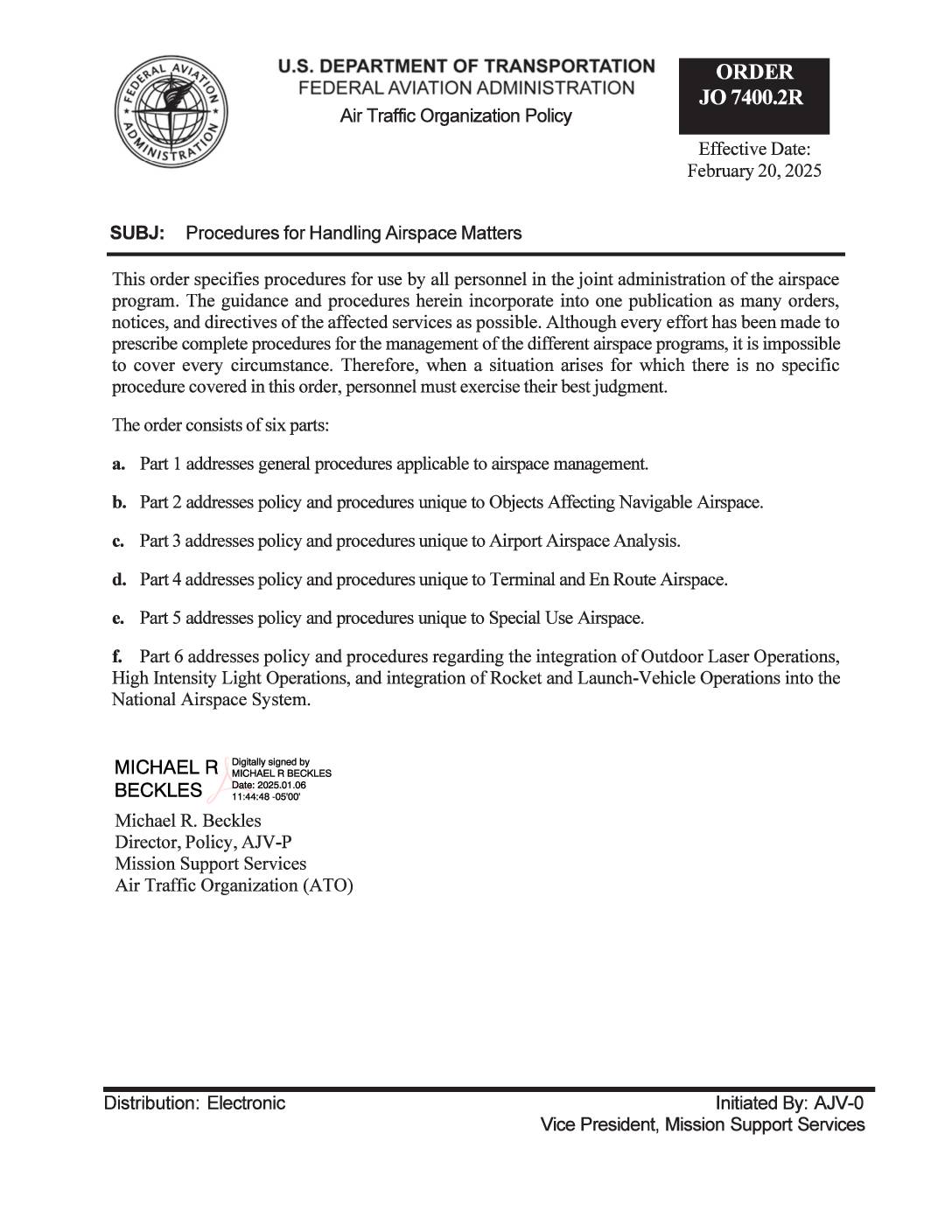
FAA JO7400.2R Handling Airspace Matters
FAA Order JO 7400.2R, effective February 20, 2025, sets out procedures for managing U.S. airspace, covering topics such as objects affecting navigable airspace, airport airspace analysis, terminal and en route airspace, special use airspace, and laser and rocket operations. The order updates policies related to surveillance facilities and airport proposals to reflect modern, contractor-supported National Airspace System technologies. Note that this document addresses broad national airspace management procedures and does not specifically cover Sea-Tac Airport noise policy. -
Exclusive: US FAA to slow arrivals at Reagan National Airport to reduce risks after crash
Summary FAA reduces Reagan National arrivals to 26 per hour for safety NTSB and FAA brief Senate on crash investigation Transportation Secretary Duffy reconsiders air traffic control staffing rules The FAA told airlines late Wednesday that the reduction from a maximum rate of 28 to 26 arrivals per hour would reduce risk but also increase -
 2025-01-14
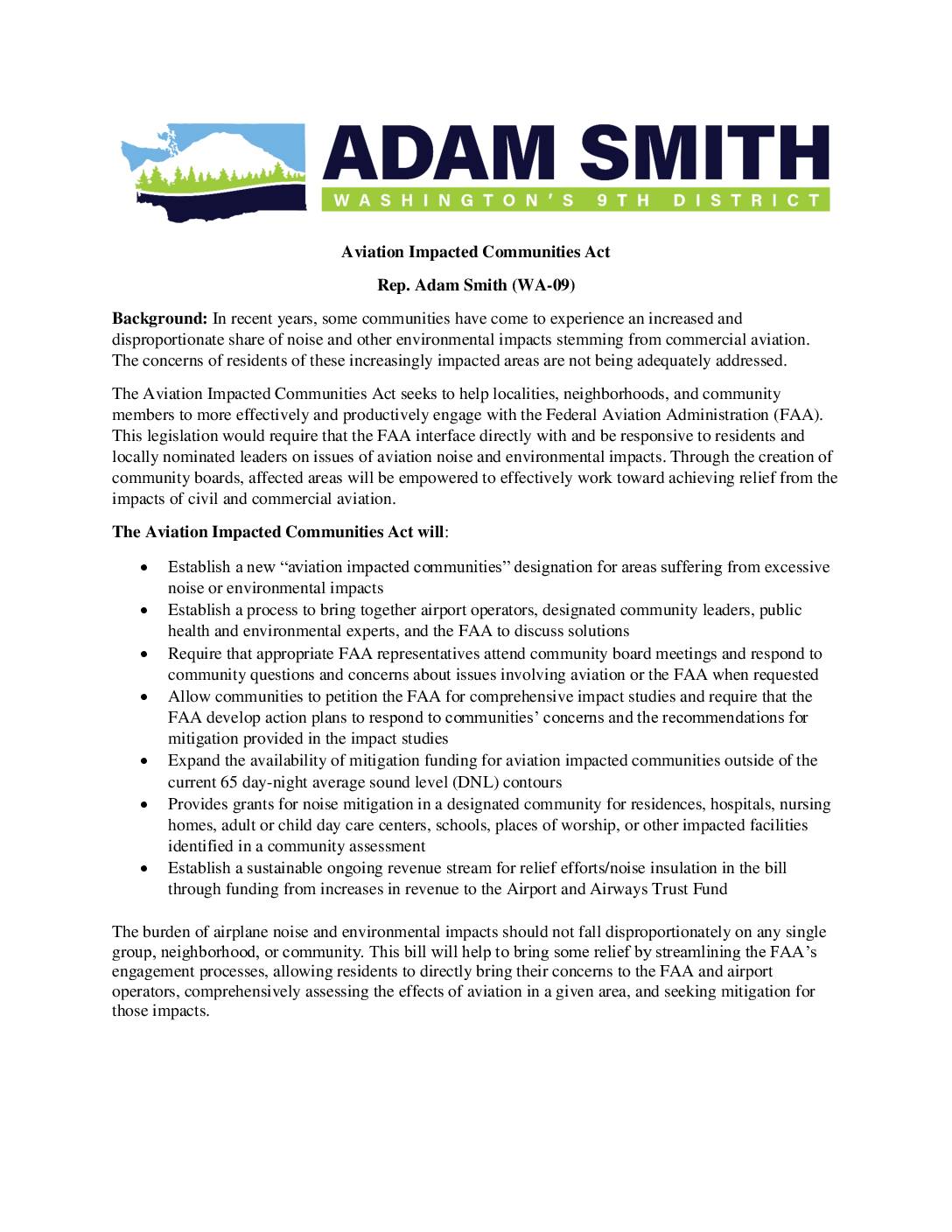
Aviation Impacted Communities Act: Fact Sheet
The Aviation Impacted Communities Act, introduced by Rep. Adam Smith (WA-09), aims to give residents and local leaders a stronger voice in addressing excessive airplane noise and environmental impacts by requiring the FAA to engage directly with affected communities through newly established community boards. The bill would create an 'aviation impacted communities' designation, allow communities to petition for comprehensive impact studies, and expand funding for noise mitigation beyond current sound-level boundaries. It also establishes a sustainable revenue stream for ongoing relief efforts through the Airport and Airways Trust Fund. -
 2025-01-13
Removing PFAS — Trading Forever Chemicals for a Safer Firefighting Foam
Drawhorn, Omie January 13, 2025 Each day Port of Seattle firefighters work to keep people and property safe. Because the Port of Seattle Fire Department (POSFD) is located at Seattle-Tacoma International Airport (SEA), they protect aircraft, travelers, staff, and airport facilities. Now, in the midst of regular firefighting activities, POSFD is taking the lead on