TagEnvironmental Justice(100)
-
 2024-05-11
NextGen effects on communities surrounding Sea-Tac Airport
This document outlines concerns raised by the Quiet Skies Coalition about how the FAA's NextGen air traffic modernization program has increased flight operations at Seattle-Tacoma International Airport, creating concentrated flight paths over low-income and minority neighborhoods like Burien. It argues that the FAA failed to engage communities before implementing new flight routes, dismissed significant noise and air quality concerns, and has not analyzed the cumulative health impacts of aircraft noise and ultrafine particle emissions on nearby residents. The document also details a successful legal challenge by the City of Burien against the FAA in the 9th Circuit Court of Appeals, which the FAA has continued to ignore. -
 2024-05-11
Burien Airport Committee resolution on Sea-Tac Airport operations and expansion
The Burien Airport Committee (BAC) recommends capping flights at Seattle-Tacoma International Airport, citing unacceptable health burdens from aircraft noise and air pollution on surrounding communities. The committee argues that decades of regional planning studies have failed to identify alternatives to concentrating all air traffic growth at Sea-Tac, and that current expansion plans will likely be insufficient beyond 2025. BAC opposes Sea-Tac's SAMP expansion plan and calls on state and regional officials to identify alternative locations for future air passenger and cargo growth. -
 2024-05-06
Answer on ‘LIMITED Update’ from FAA
This document presents a point-by-point rebuttal to an FAA 'Limited Update' regarding a new flight departure procedure at Seattle-Tacoma International Airport, arguing that the FAA has failed to conduct required safety risk analyses, properly assess cumulative noise and air quality impacts on environmental justice communities, and comply with court-ordered environmental review under NEPA. The authors contend that the FAA is understating the scope and timeline of the Sea-Tac Airport Master Plan (SAMP) expansion while dismissing significant health, noise, and emissions impacts on nearby residents. The critique calls out procedural shortcuts, incomplete public comment responses, and what it characterizes as predetermined conclusions designed to avoid full environmental scrutiny. -
 2024-05-06
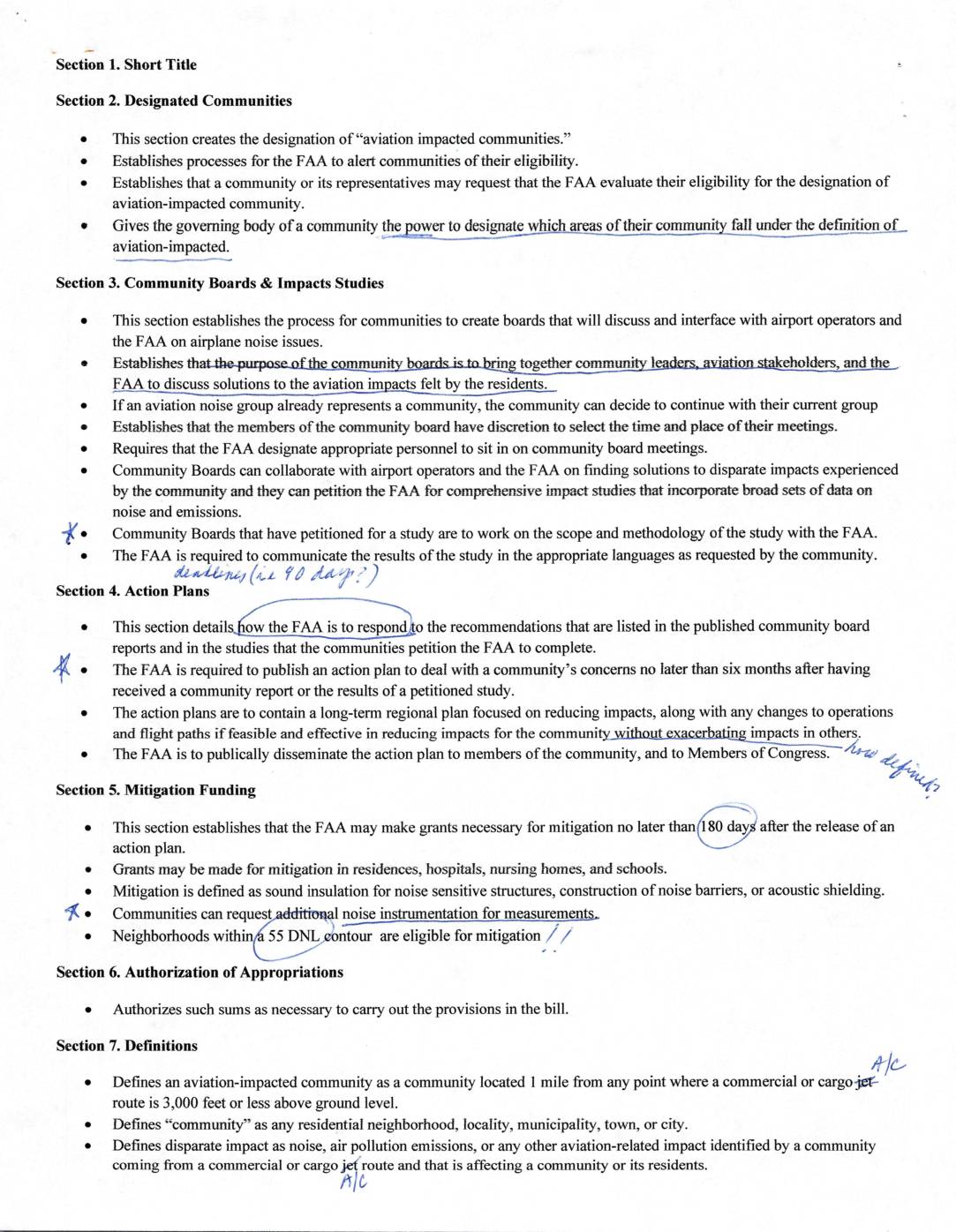
Airport impacted communities act summary
This legislative summary outlines a proposed bill to protect communities near busy flight routes from aviation noise and pollution. It establishes a process for the FAA to designate 'aviation-impacted communities' located within one mile of low-altitude commercial or cargo flight paths, create local community boards to engage with the FAA and airport operators, and develop action plans and mitigation funding for affected residents. Key provisions include grants for sound insulation and noise barriers, eligibility for neighborhoods within a 55 DNL contour, and requirements for the FAA to respond to community concerns within set deadlines. -
 2024-02-23
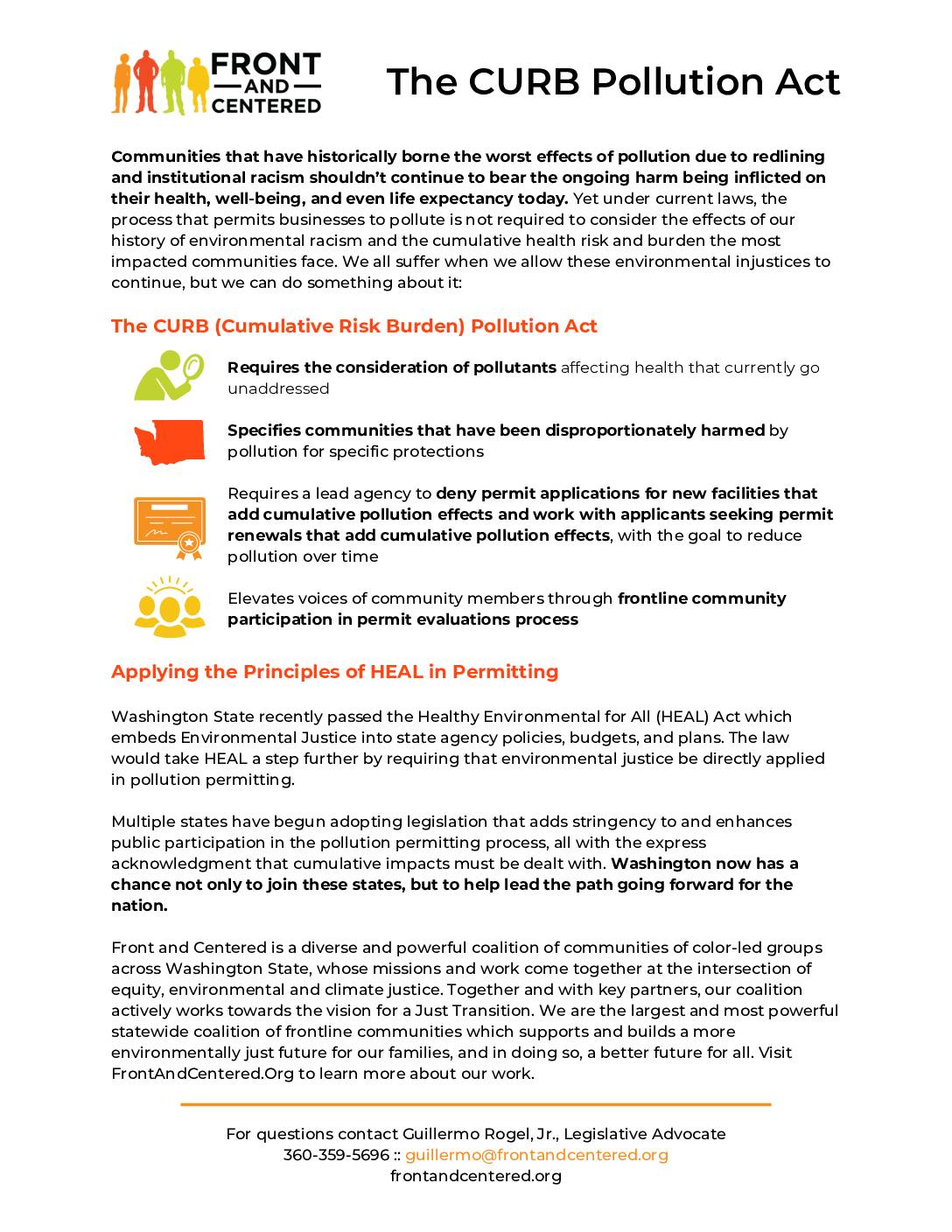
The CURB Pollution Act: Cumulative Risk Burden Pollution Act Fact Sheet
The CURB (Cumulative Risk Burden) Pollution Act is a proposed Washington State law that would require environmental justice considerations to be factored into pollution permitting decisions, with the goal of protecting communities that have historically faced disproportionate pollution burdens due to redlining and institutional racism. The act would require agencies to deny new permits that add cumulative pollution effects in overburdened communities and increase public participation in the permitting process. It builds on Washington's existing Healthy Environment for All (HEAL) Act by directly applying environmental justice principles to pollution permitting. -
 2024-02-22
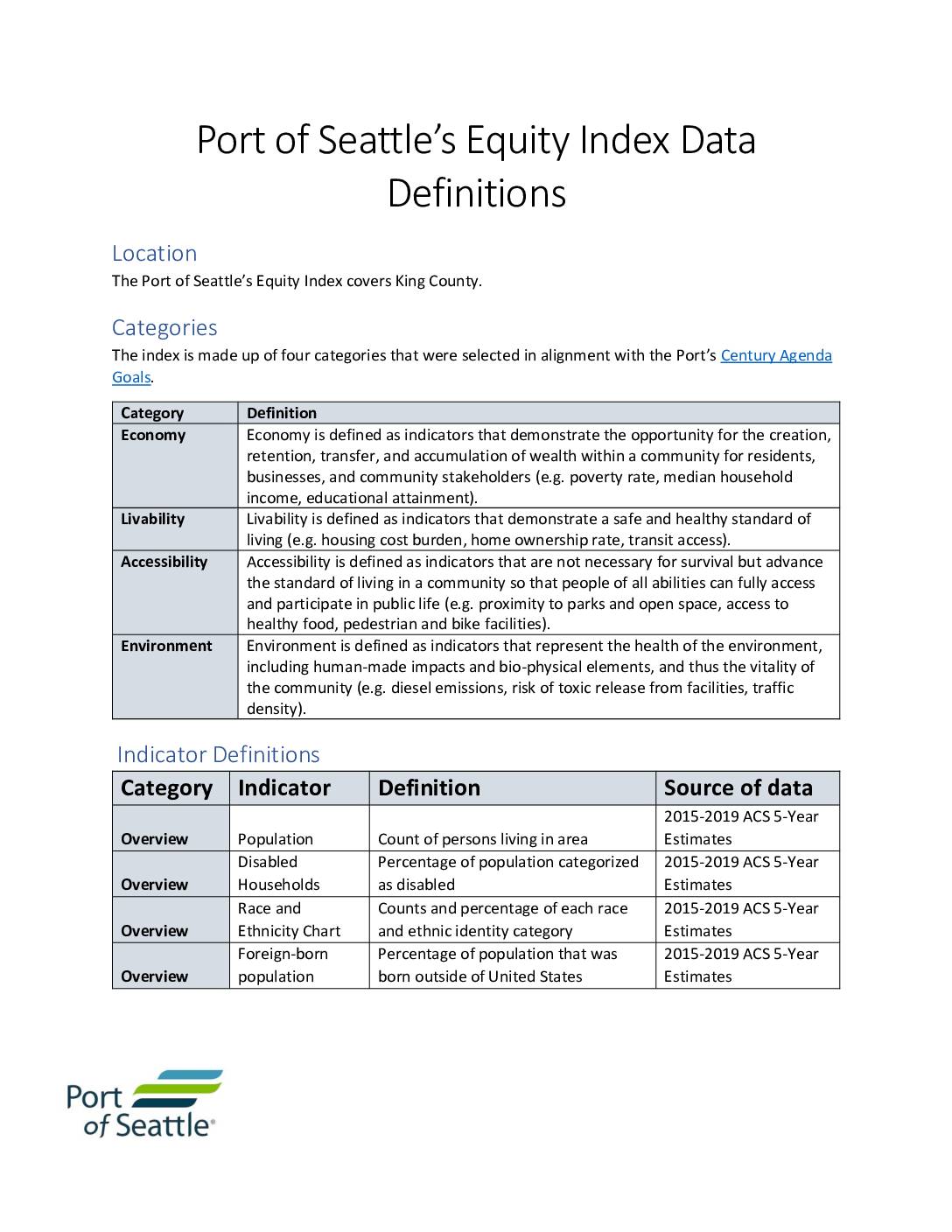
Port Of Seattle’s Equity Index data definitions
The Port of Seattle's Equity Index tracks community well-being across King County using four categories: Economy, Livability, Accessibility, and Environment. It draws on data from sources such as the U.S. Census Bureau's American Community Survey, EPA EJ Screen, and local agencies to measure indicators like poverty rate, housing cost burden, transit access, and diesel emissions. The index is designed to assess equity and quality-of-life conditions for residents and communities in the region. -
 2024-02-12
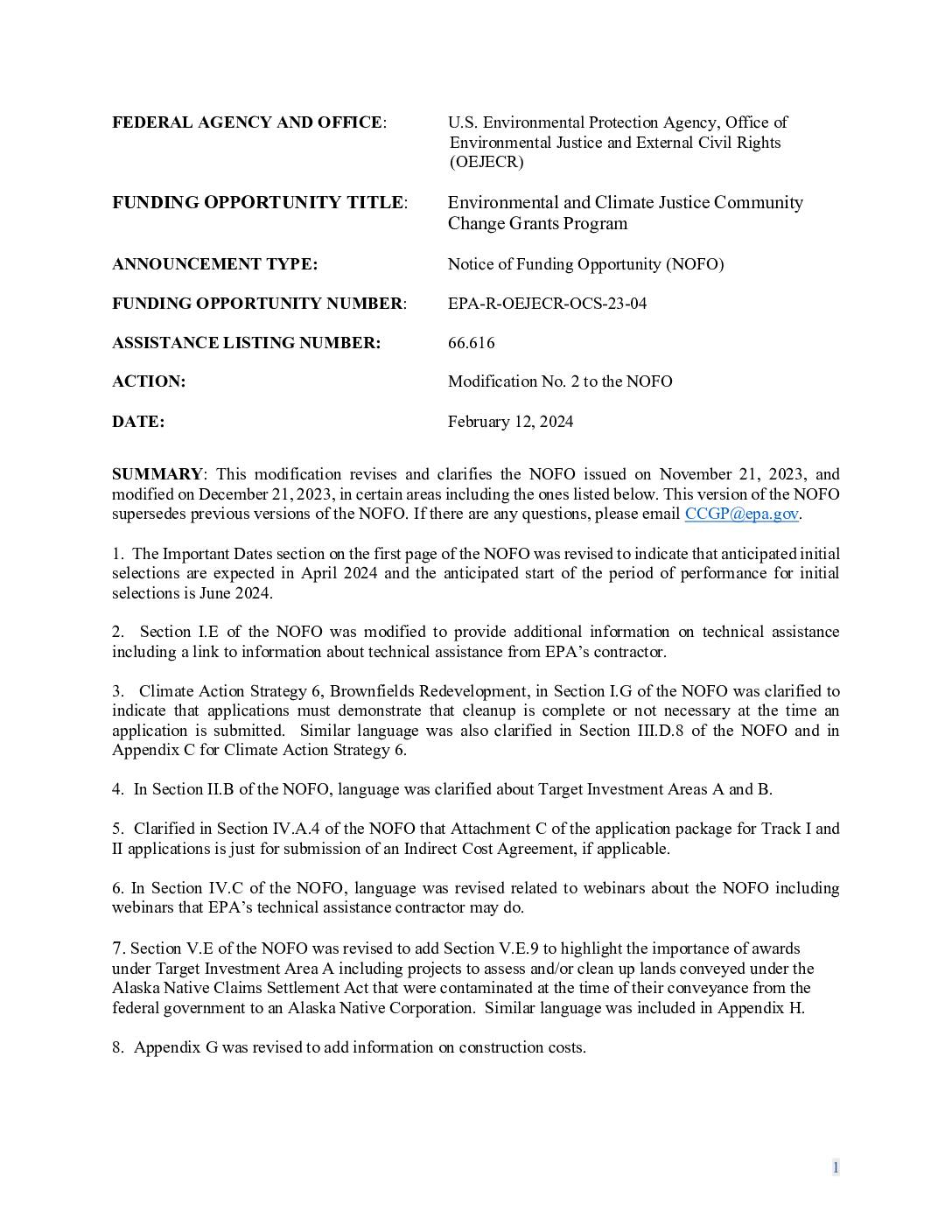
Environmental and Climate Justice Community Change Grants Program: Notice of Funding Opportunity (Modification No. 2)
This document is a federal funding opportunity from the U.S. Environmental Protection Agency (EPA) offering grants through the Environmental and Climate Justice Community Change Grants Program, with applications accepted on a rolling basis until November 21, 2024. It outlines eligibility requirements, funding tracks, and application procedures for communities seeking support for environmental and climate justice projects. Note: This document does not appear to be directly related to Sea-Tac Airport noise policy. -
 2024-01-30
HB 2070: Multiple Agency Fiscal Note Summary — Environmental Justice/SEPA Projects
This Washington State fiscal note summarizes the estimated costs of House Bill 2070, which relates to environmental justice and State Environmental Policy Act (SEPA) projects. The bill is projected to cost multiple state agencies a combined total of approximately $1.28 million in operating expenditures for 2023-25, rising to $2.64 million in 2025-27, before declining to about $1.61 million in 2027-29. The Department of Ecology, Department of Fish and Wildlife, and Office of the Attorney General are among the primary agencies expected to incur costs, with some impacts remaining indeterminate. -
 2024-01-16
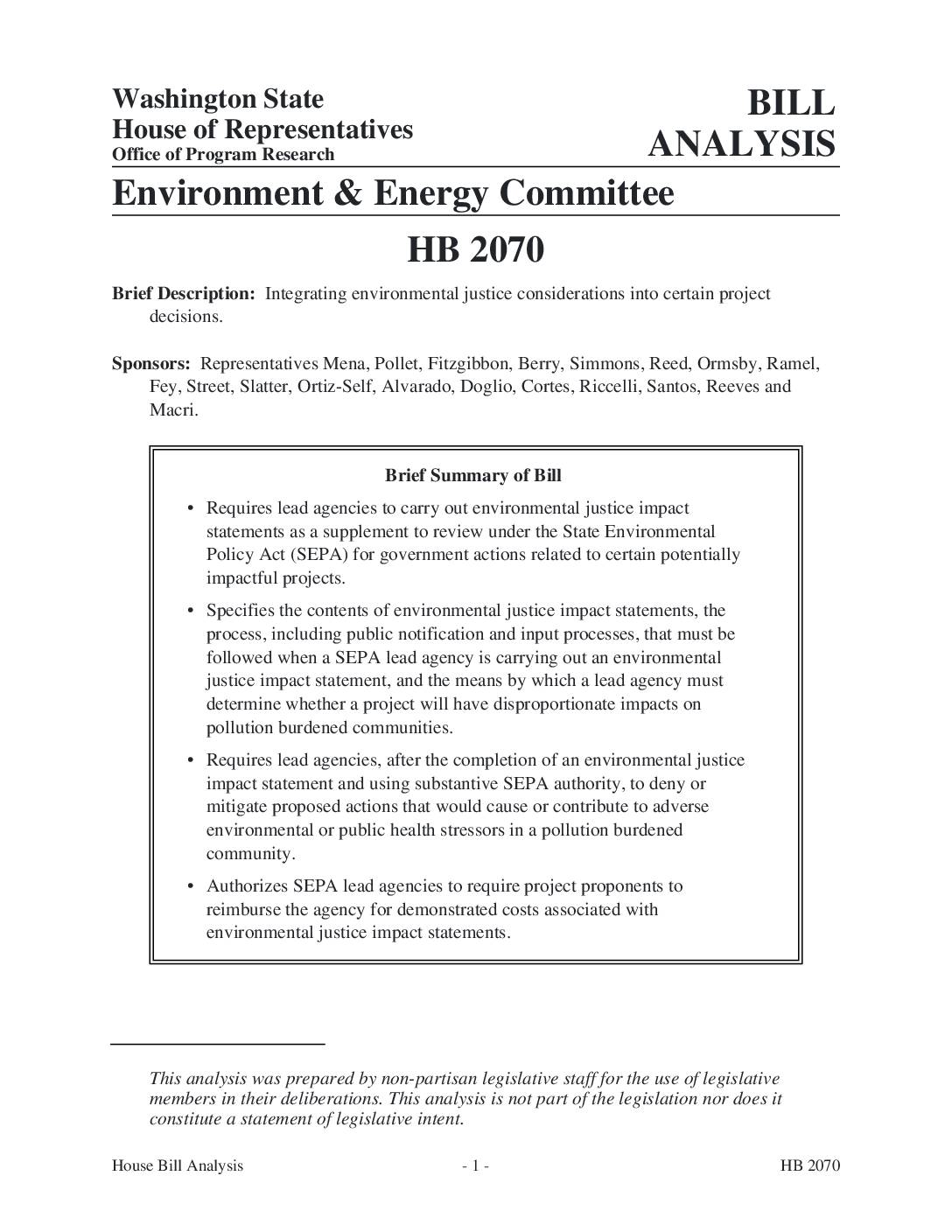
HB 2070: Bill Analysis — Integrating Environmental Justice Considerations into Certain Project Decisions
Washington State House Bill 2070 requires government agencies to complete environmental justice impact statements alongside standard environmental reviews for new, expanding, or permit-renewing projects located in pollution-burdened communities. The bill outlines what these statements must include, how affected communities must be notified and given input, and mandates that agencies deny or require mitigation for projects that would worsen environmental or public health conditions in already overburdened areas. Note that this bill addresses broad statewide environmental justice policy and does not specifically pertain to Sea-Tac Airport noise issues. -
 2024-01-08
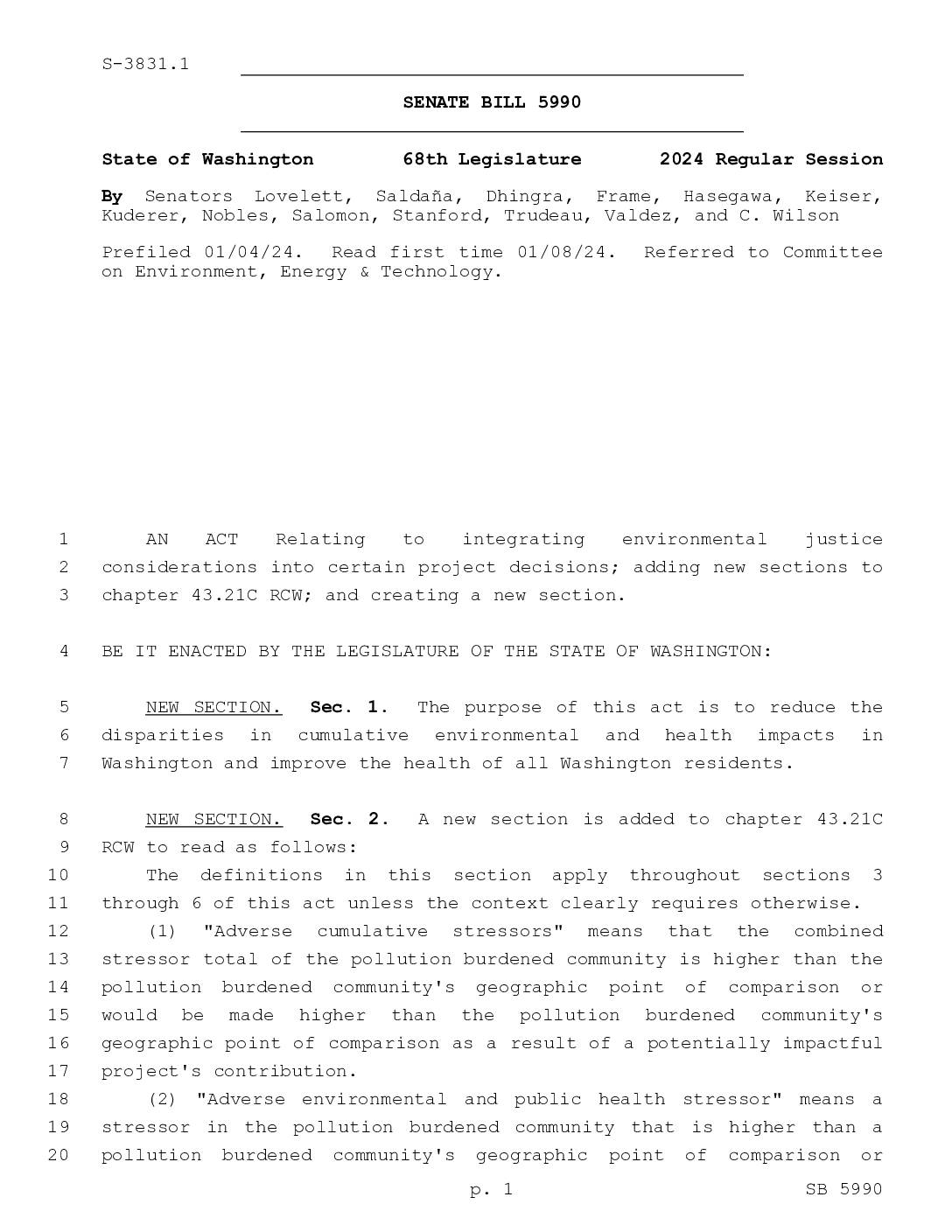
Senate Bill 5990: Integrating Environmental Justice Considerations into Certain Project Decisions
Washington Senate Bill 5990, introduced in January 2024, aims to reduce environmental health disparities by requiring assessment of cumulative pollution burdens on overburdened communities before approving new projects. The bill defines key terms such as 'disproportionate impact' and 'environmental justice impact statement,' and establishes a framework to evaluate stressors like air pollution, water quality, and public health risks. Note: this bill addresses broad environmental justice concerns statewide and does not specifically address Sea-Tac Airport noise policy.