TagEnvironmental Justice(100)
-
UW DEOHS State Of Washington Environmental Impact Mapping Tool
The University Of Washington Department of Environmental & Occupational Health Sciences (DEOHS)has developed an interactive mapping tool which displays a variety of environmental health risks by area in our state. The tool was developed by PhD student Alice Min and DEOHS associate professor Edmund Seto. You can read more about how it works and a -
 2018-09-28
Attachment 4e: Scoping Comments Received — Actual Comments with Assigned Topic Code
A Beacon Hill resident submitted scoping comments in September 2018 regarding the Sea-Tac Airport expansion, raising concerns about air quality, airplane emissions, noise impacts on children's health, traffic congestion, and environmental justice for communities of color. The commenter requested studies on health effects for nearby residents, better public outreach to non-English-speaking communities, and neighborhood noise monitoring equipment. She also expressed frustration about cost overruns on existing airport projects and the limited accessibility of the public open house held at New Holly. -
 2018-07-17
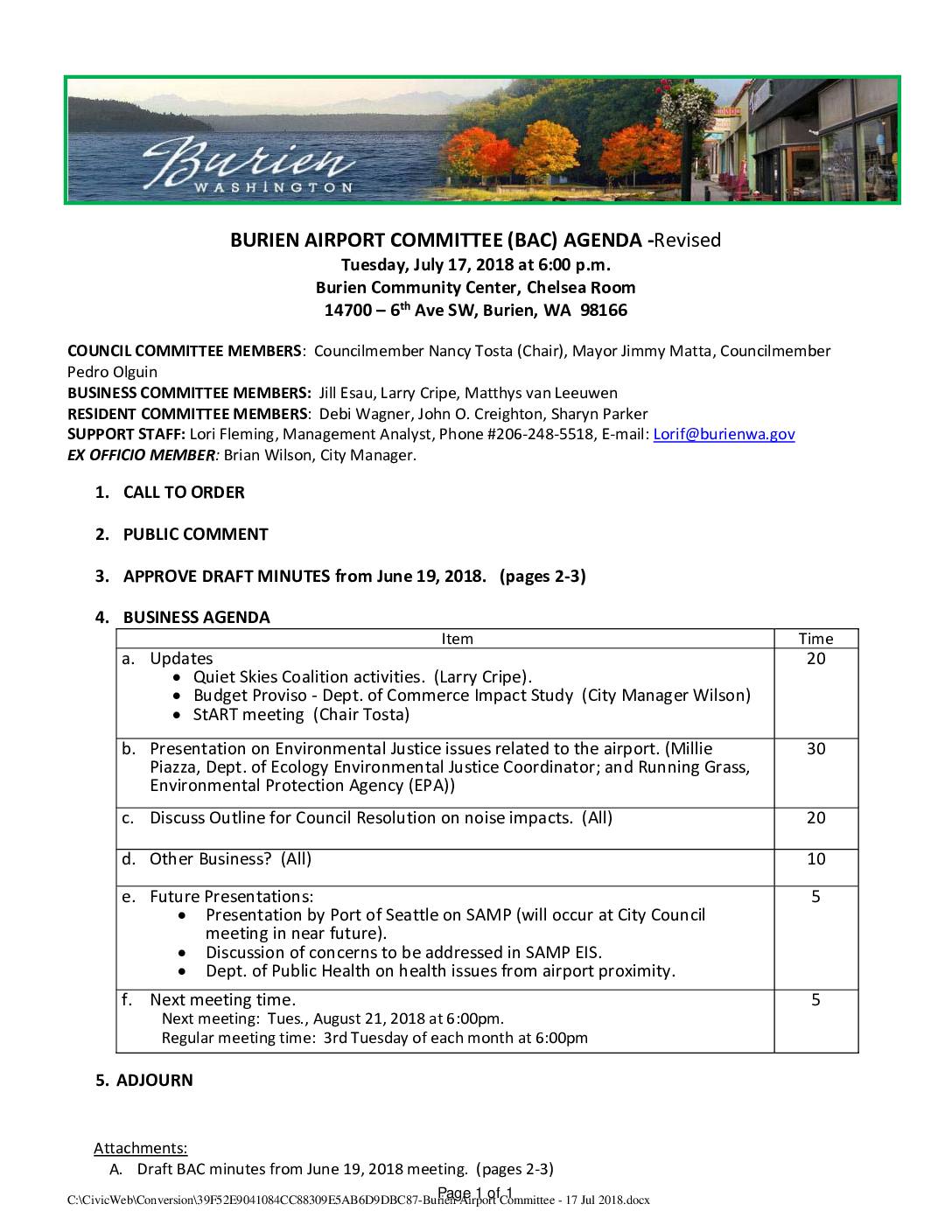
Burien Airport Committee (BAC) agenda – Revised
The Burien Airport Committee (BAC) held a revised meeting on July 17, 2018, covering updates on Quiet Skies Coalition activities, a Department of Commerce Impact Study budget proviso, and a StART meeting report. Key agenda items included a 30-minute presentation on Environmental Justice issues related to Seattle-Tacoma International Airport by representatives from the Washington Department of Ecology and the EPA, as well as a discussion on drafting a City Council resolution addressing airport noise impacts. Future agenda items included a Port of Seattle presentation on the Sustainable Airport Master Plan (SAMP) and a Department of Public Health briefing on health effects from airport proximity. -
 2018-04-10
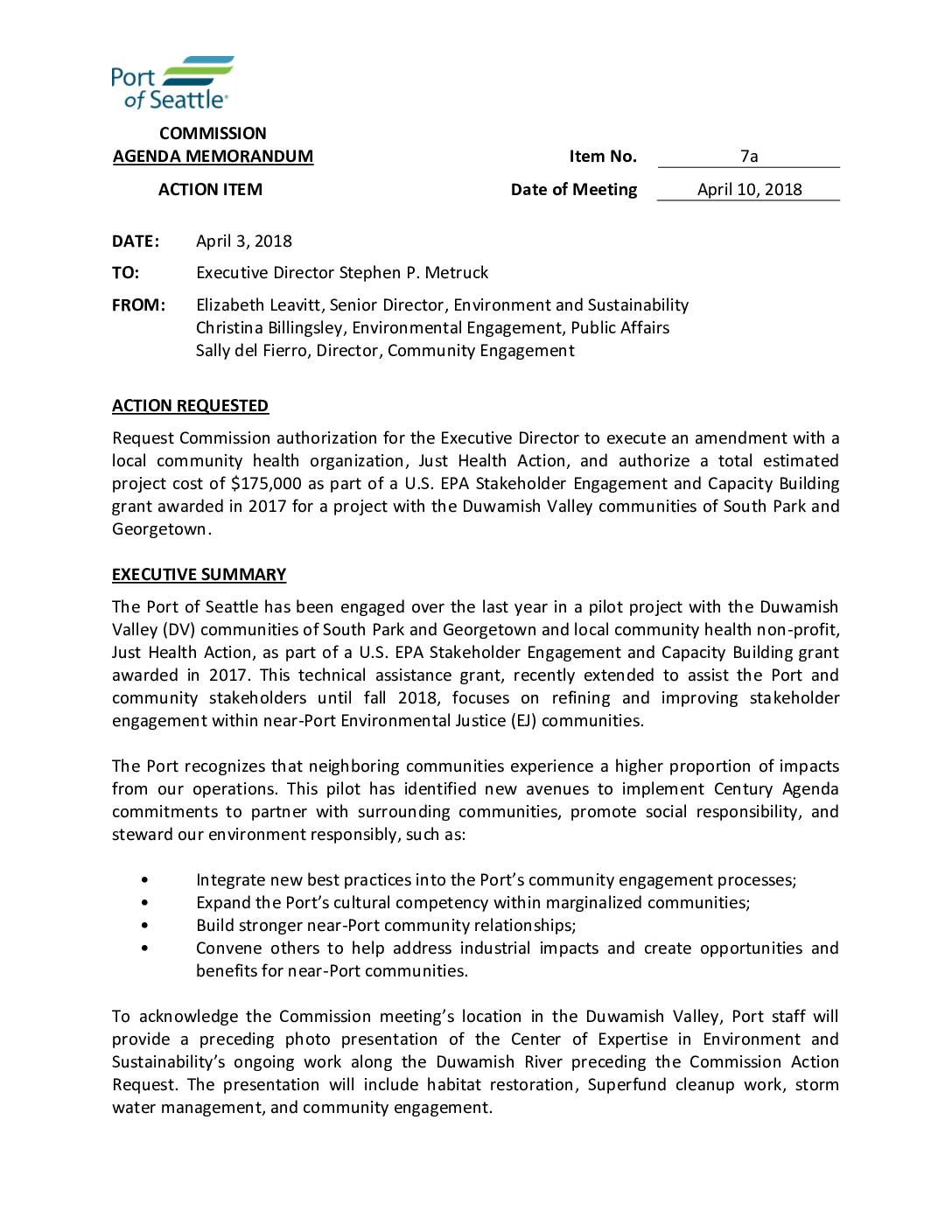
Commission agenda memorandum: Amendment with Just Health Action for Duwamish Valley community engagement project
The Port of Seattle Commission considered a request to amend a contract with Just Health Action, a local community health nonprofit, to continue a pilot project engaging residents of the Duwamish Valley neighborhoods of South Park and Georgetown. The project, supported by a U.S. EPA Stakeholder Engagement and Capacity Building grant awarded in 2017, focuses on improving the Port's community outreach practices and addressing environmental health concerns in low-income and minority communities near Port operations. The total estimated project cost was $175,000, with the amended contract value reaching $224,999. -
 2018-04-10
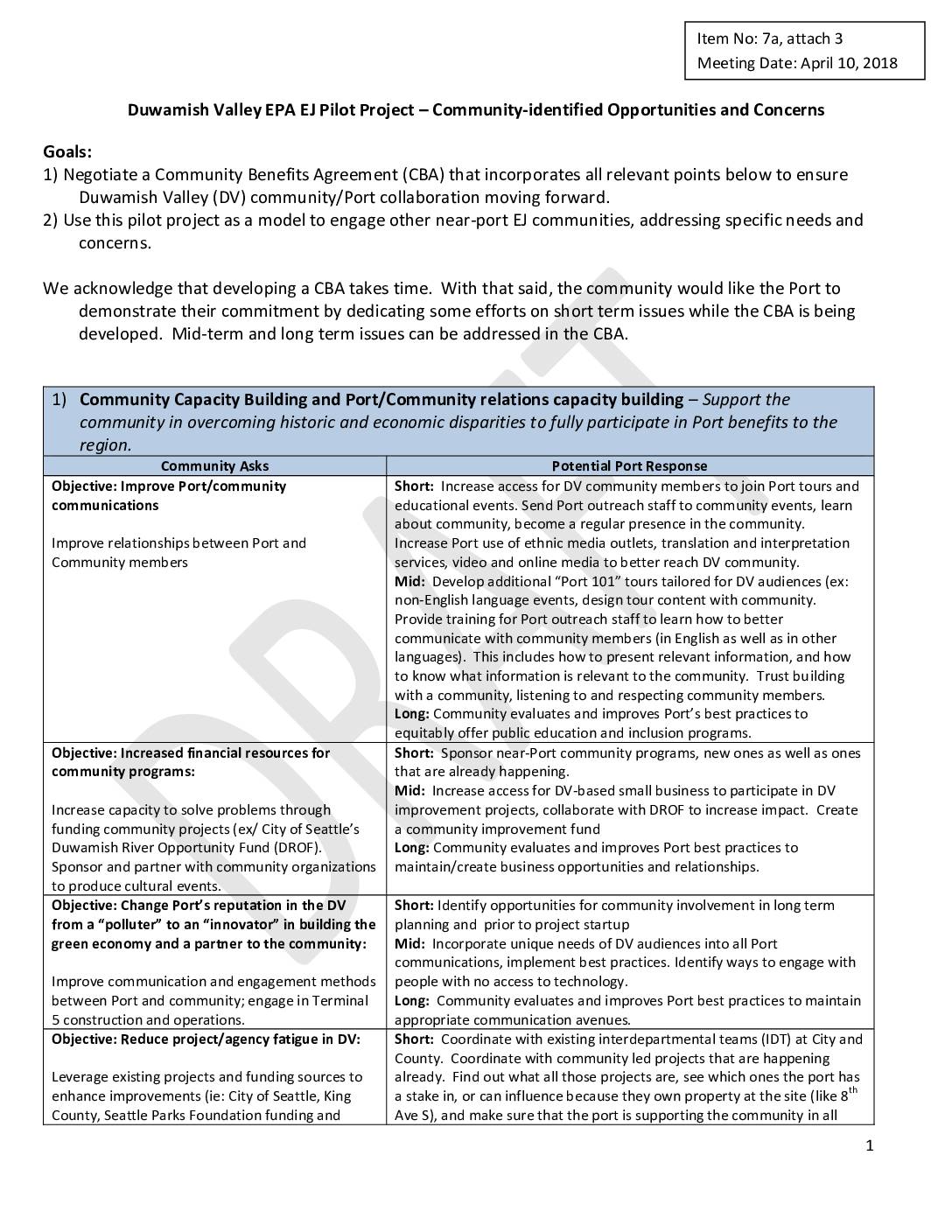
Duwamish Valley EPA EJ pilot project – community-identified opportunities and concerns
This 2018 document outlines community-identified opportunities and concerns from the Duwamish Valley EPA Environmental Justice Pilot Project, focused on improving collaboration between the Port of Seattle and nearby Duwamish Valley residents. It covers goals such as negotiating a Community Benefits Agreement, building community capacity, reducing environmental harms like air pollution and stormwater runoff, and improving green spaces and pedestrian safety. Note: this document addresses Duwamish Valley port and industrial area concerns and does not directly relate to Sea-Tac Airport noise policy. -
 2018-01-30
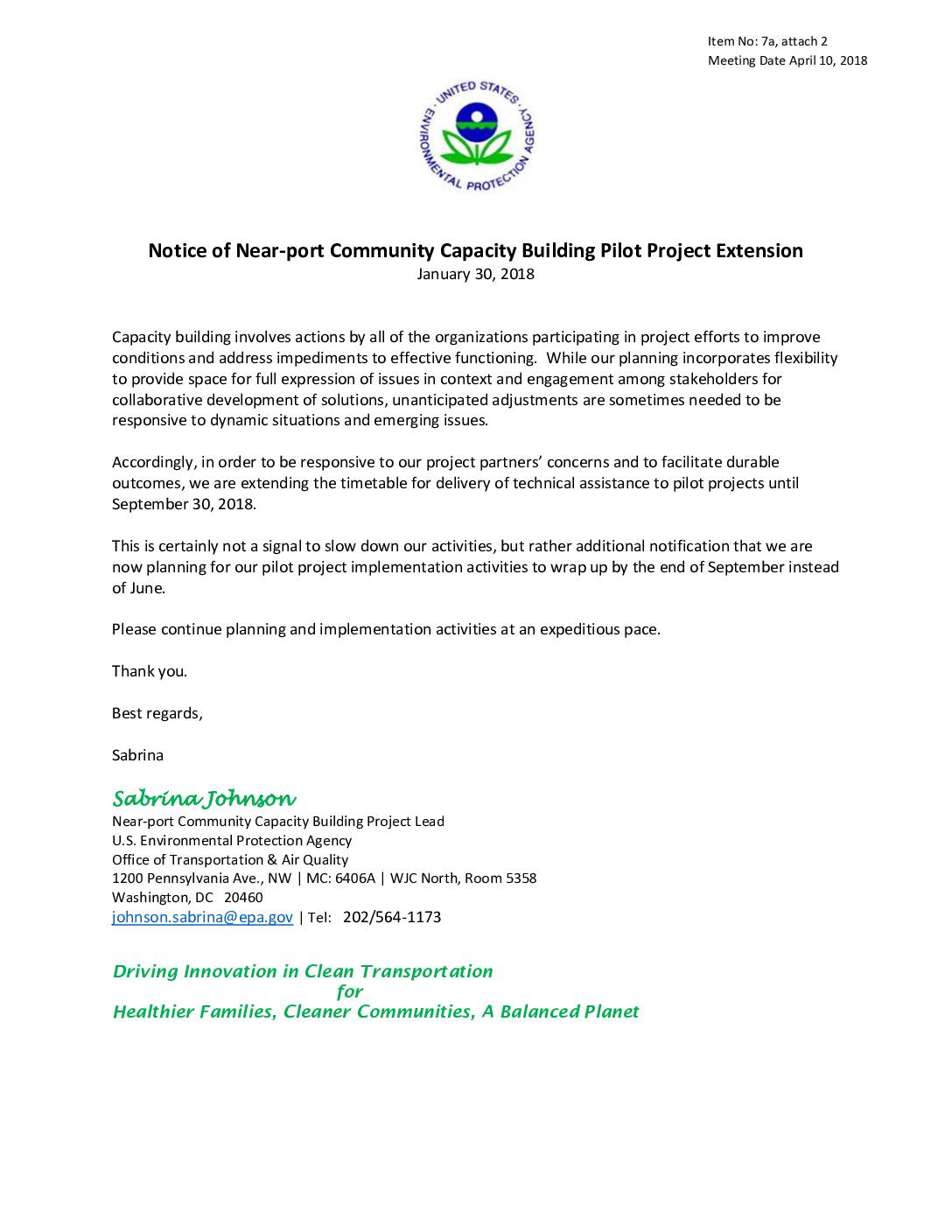
Notice of Near-port Community Capacity Building Pilot Project Extension
In January 2018, EPA project lead Sabrina Johnson notified partners that the Near-port Community Capacity Building Pilot Project deadline was extended from June to September 30, 2018. The extension was granted to better address project partners' concerns and support more durable outcomes, while still encouraging participants to maintain an expeditious pace. Capacity building under this EPA initiative focuses on improving conditions and removing barriers to effective community functioning near port areas. -
 2017-10-24
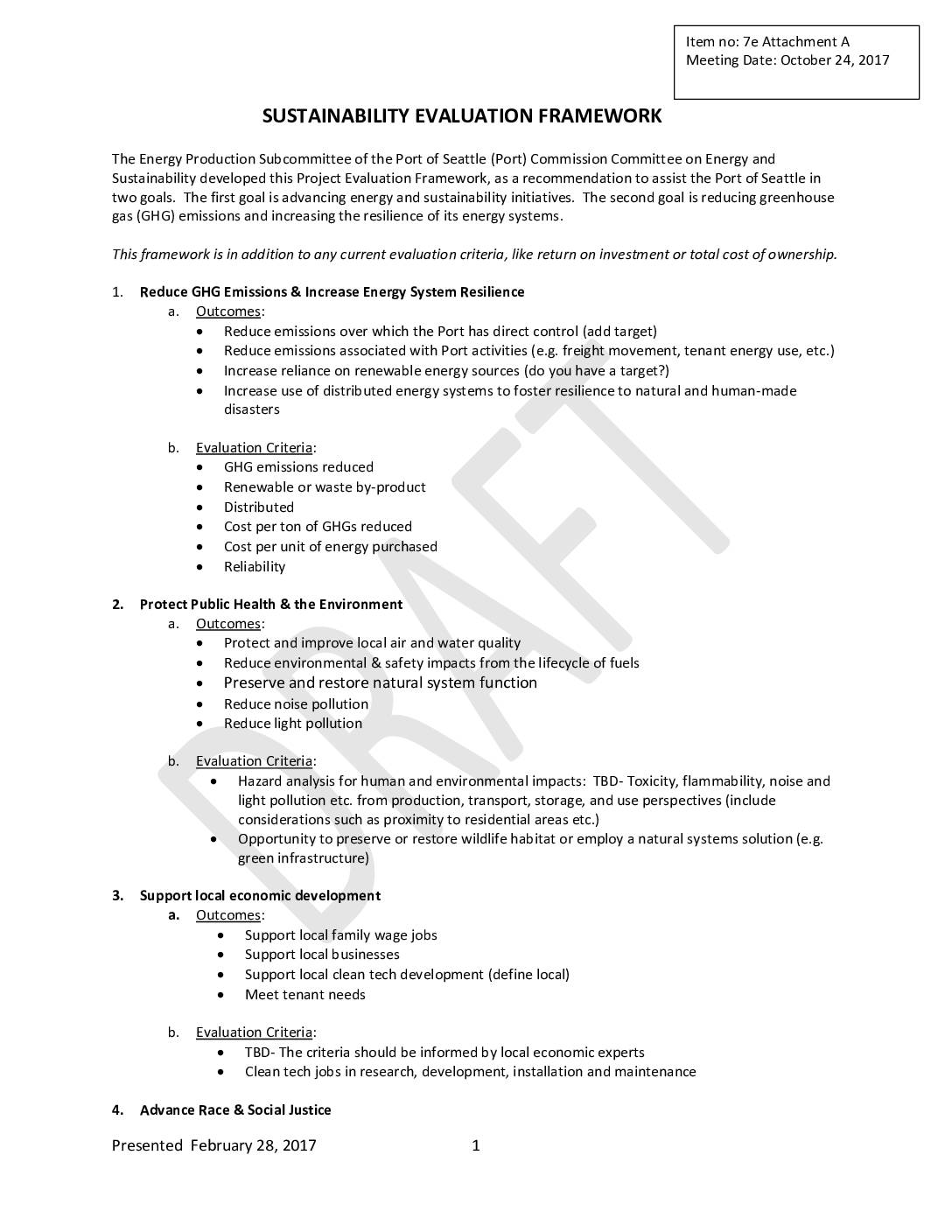
Sustainability evaluation framework
The Port of Seattle's Sustainability Evaluation Framework outlines six key goals for guiding energy and sustainability decisions: reducing greenhouse gas emissions, protecting public health and the environment, supporting local economic development, advancing race and social justice, leveraging partnerships, and encouraging innovation. Developed by the Energy Production Subcommittee, the framework provides outcomes and evaluation criteria for each goal, supplementing existing financial measures like return on investment. The subcommittee recommends the Port incorporate these considerations into its decision-making when evaluating energy sources and projects. -
 2016-07-01
Environmental Justice, before and after Executive Order 12898: What are agencies doing, how well are they doing it, and what else can be done?
This academic paper examines how U.S. federal agencies have addressed Environmental Justice (EJ) since President Clinton's 1994 Executive Order 12898, which required agencies to reduce disproportionate pollution burdens on low-income and minority communities. The author, a Bureau of Land Management social scientist, reviews agency compliance efforts, highlights case studies like the Flint water crisis, and argues that practical steps such as staff training and social science tools can help agencies consistently protect vulnerable communities regardless of shifting political priorities. -
 2015-07-01
Highway Air Toxics Impacts in the Chinatown-International District of Seattle
This document describes a 2015–2018 air quality research project by the Puget Sound Clean Air Agency focused on measuring highway-related air toxics near Interstate 5 in Seattle's Chinatown-International District and Yesler Terrace neighborhoods. The study aimed to assess cancer risks from pollutants such as benzene, formaldehyde, and diesel particulate matter in communities identified as among the most environmentally and economically vulnerable in Washington State. While not directly related to Sea-Tac Airport noise policy, the project represents regional efforts to address transportation-related environmental health impacts on minority and low-income communities in the greater Puget Sound area. -
 1994-02-11
Executive Order #12898 Federal Actions To Address Environmental Justice in Minority Populations and Low-Income Populations
Executive Order 12898, signed by President Clinton in February 1994, directs all federal agencies to identify and address disproportionately high and adverse environmental and health impacts on minority and low-income populations. It establishes an Interagency Working Group on Environmental Justice, led by the EPA, to coordinate agency strategies, data collection, and research. Each federal agency was required to develop and finalize an environmental justice strategy within 12 months, ensuring that federal programs do not discriminate based on race, color, or national origin.