TagEnvironmental Impact Statement(328)
-
 1997-01-01
Considering Cumulative Effects Under NEPA (Executive Summary)
A handbook by the Council on Environmental Quality providing framework and methods for analyzing cumulative effects in environmental assessments and impact statements under NEPA. The document outlines principles, steps, and data sources for cumulative effects analysis but does not establish new legal requirements. -
 1996-12-18
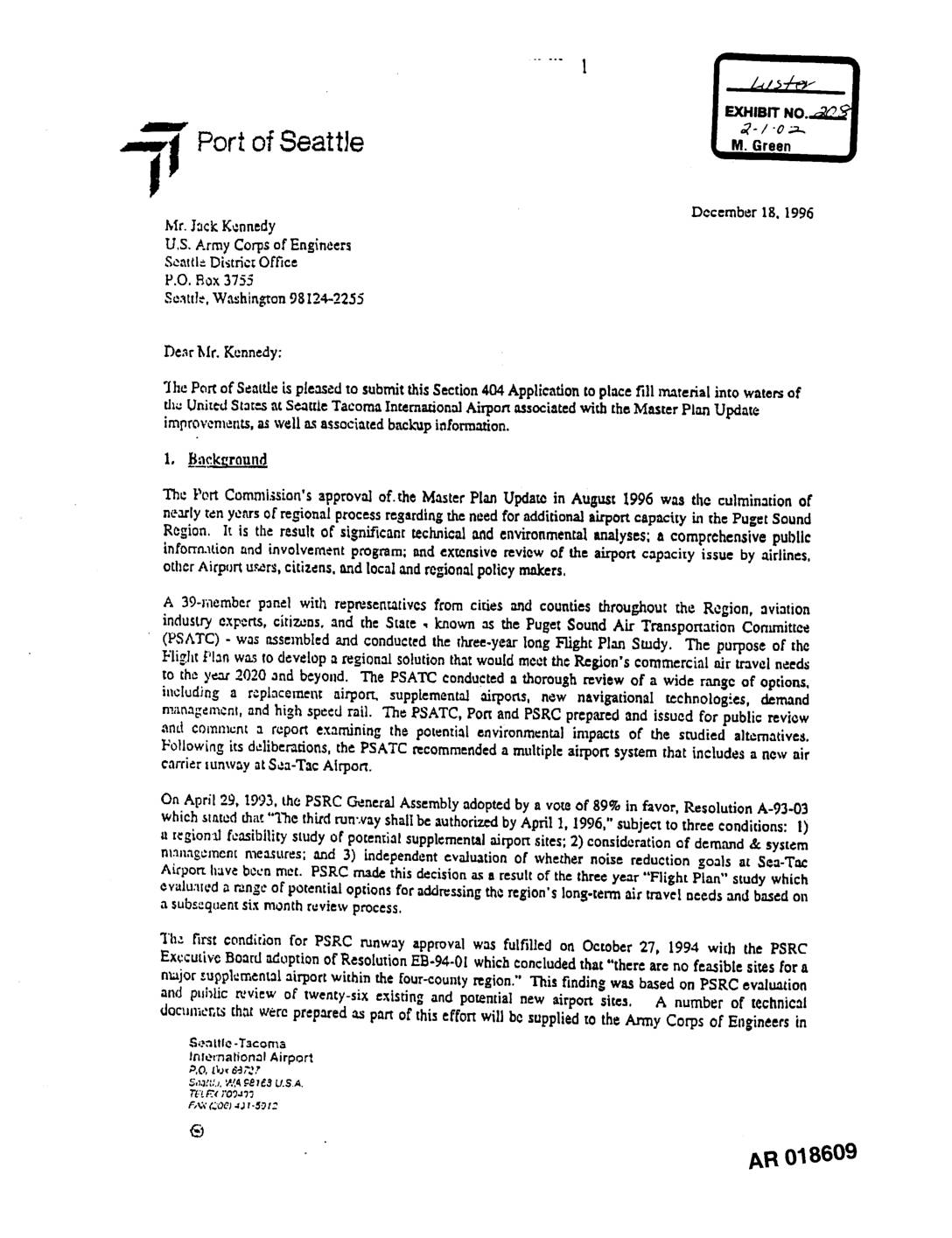
Exhibit 208: Port Of Seattle Section 404 Application Letter — Third Runway Master Plan Update Wetland Fill, Sea-Tac Airport
In December 1996, the Port of Seattle submitted a Section 404 permit application to the U.S. Army Corps of Engineers to place fill material into wetlands at Seattle-Tacoma International Airport as part of its Master Plan Update, which included construction of a third parallel runway. The proposed runway, located 2,500 feet west of the existing runways, was intended to address severe arrival delays during poor weather conditions, which reduced airport capacity from 60 to as few as 24 arrivals per hour roughly 44% of the year. The application was the result of nearly a decade of regional planning, environmental review, and public involvement, including studies confirming that no feasible supplemental airport sites existed in the four-county region. -
 1996-12-18
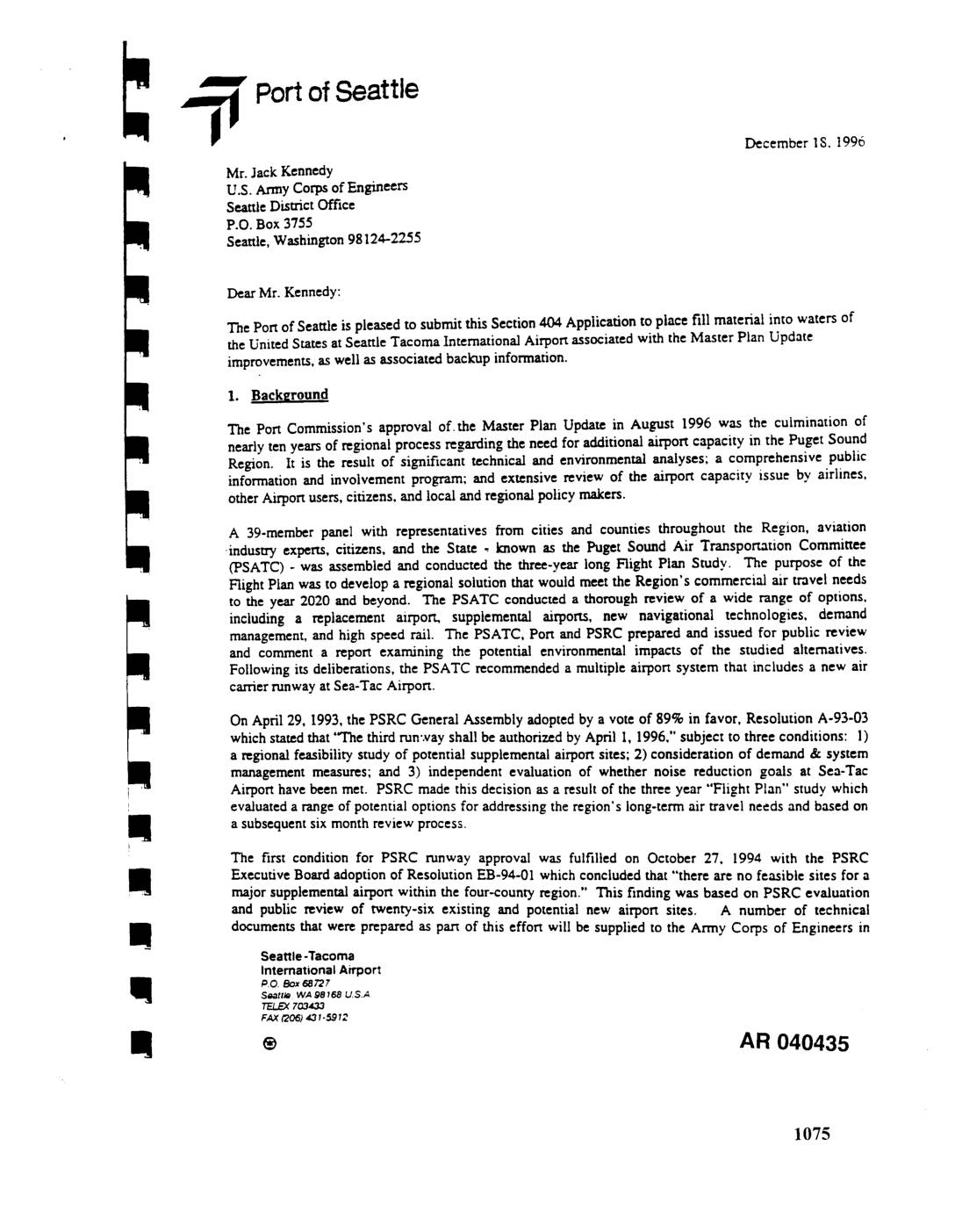
EXH AR040435: Port Of Seattle Section 404 Application Letter — Third Runway Master Plan Update
Letter dated December 18, 1996 from Barbara Hinkle, Senior Environmental Specialist, Port Of Seattle, to Jack Kennedy, U.S. Army Corps of Engineers, Seattle District Office, submitting a Section 404 Application to place fill material into waters of the United States at Seattle-Tacoma International Airport associated with the Master Plan Update. Covers background on the Puget -
 1996-12-01
Miller Creek Relocation Plan for Proposed Master Plan Update Improvements at Seattle-Tacoma International Airport
This 1996 plan by Parametrix, Inc. outlines the proposed relocation of Miller Creek to accommodate expansion improvements at Seattle-Tacoma International Airport. It assesses the creek's existing ecological conditions—including fish habitat, hydrology, and riparian vegetation—and identifies the construction impacts the relocation would cause. The document then presents mitigation goals, site selection rationale, and engineering details for redesigning the creek channel to offset environmental impacts. -
 1996-12-01
EXH AR040251: JARPA Application for Proposed Master Plan Update Improvements at Seattle-Tacoma International Airport
JARPA (Joint Aquatic Resources Permit Application) and Section 404 application submitted by Port Of Seattle to the U.S. Army Corps of Engineers (Jack Kennedy, Seattle District Office) in December 1996, prepared by Parametrix, Inc. Requests authorization to place fill material into waters of the United States at Sea-Tac Airport associated with the Master Plan Update -
 1996-11-25
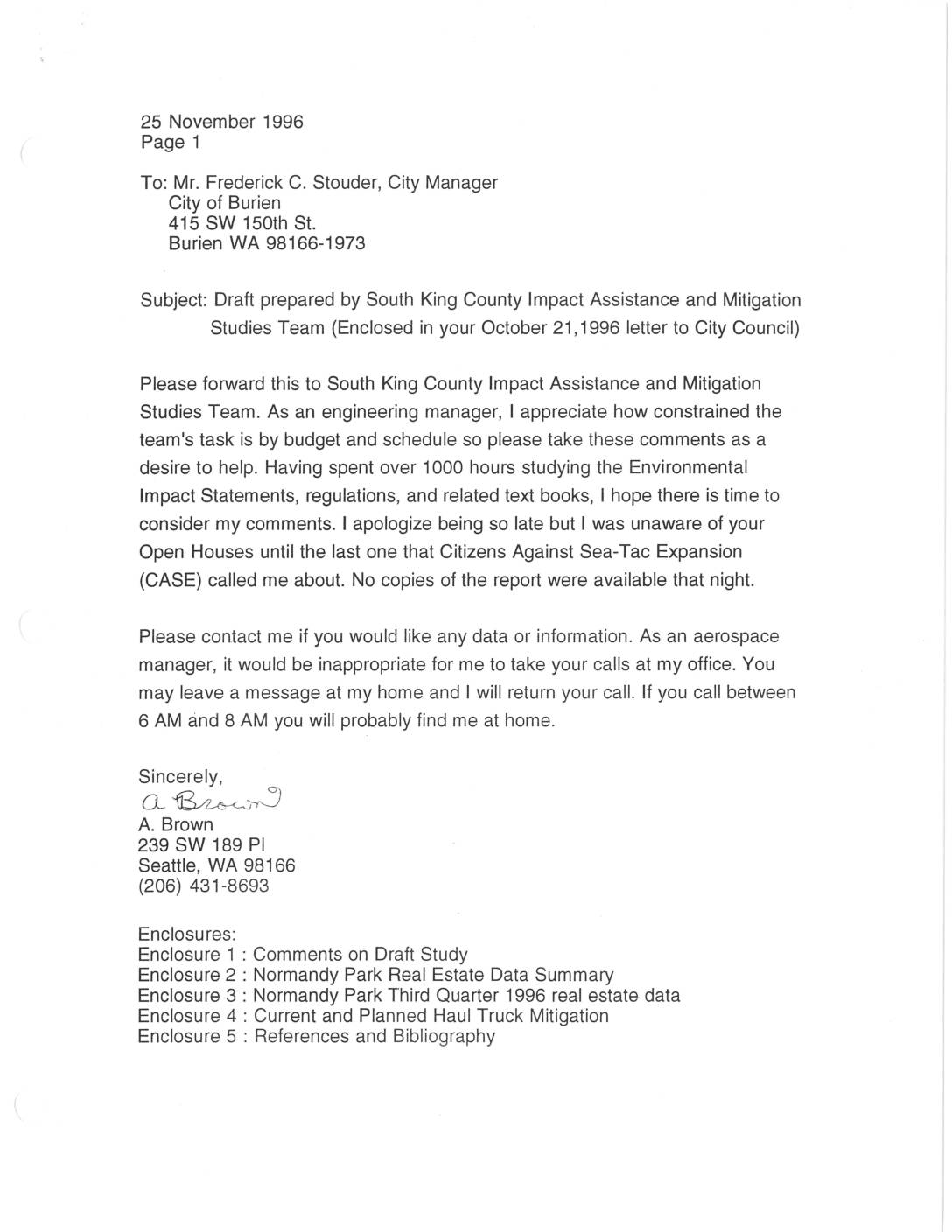
Letter from A. Brown to City of Burien: Comments on South King County Impact Assistance and Mitigation Studies Team Draft
A Normandy Park resident and aerospace engineering manager submitted detailed comments in November 1996 criticizing a draft impact study related to Sea-Tac Airport's proposed Third Runway, arguing that the analysis underestimated real estate value losses, air pollution risks, and traffic disruptions caused by the project. The letter contends that home values in Normandy Park stagnated or declined after the Third Runway was publicly announced, and that any valid property value assessment must use baseline figures from before negative publicity began. The author also challenges the study's air quality modeling assumptions and traffic analysis, warning that the Port of Seattle would selectively cite favorable findings while ignoring methodological flaws. -
 1996-10-01
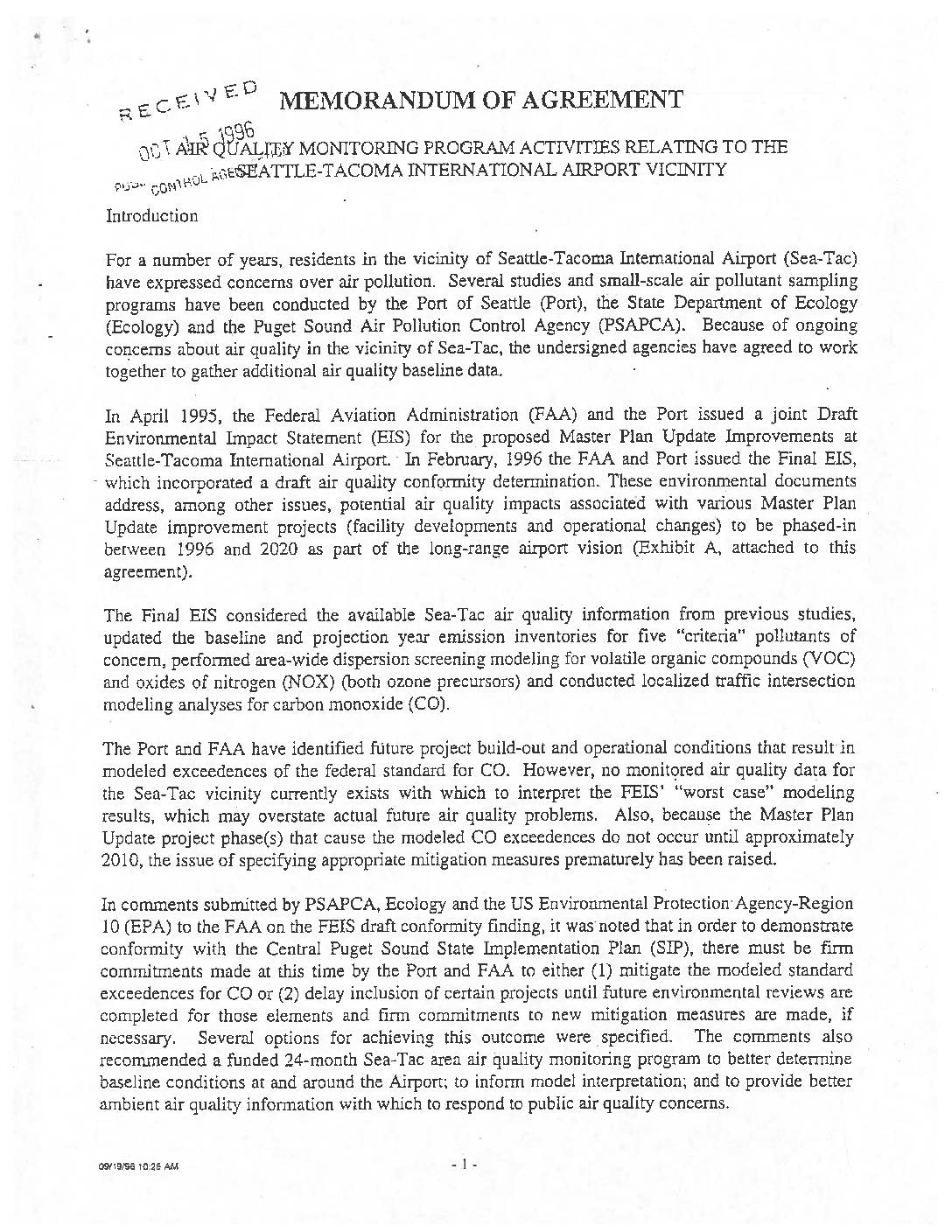
Memorandum of Agreement: Air Quality Monitoring Program Activities Relating to the Seattle-Tacoma International Airport Vicinity
This 1996 Memorandum of Agreement establishes a 24-month air quality monitoring program near Seattle-Tacoma International Airport, involving the Port of Seattle, FAA, EPA, Washington State Department of Ecology, and the Puget Sound Air Pollution Control Agency. The program, funded at $195,000, focuses on measuring carbon monoxide, nitrogen oxides, and aircraft fuel particle residue to establish baseline air quality data and evaluate potential pollution impacts from planned airport expansion projects. The Port agreed not to proceed with expansion elements projected to cause carbon monoxide standard violations until monitoring is complete and, if necessary, mitigation measures are identified. -
 1996-08-23
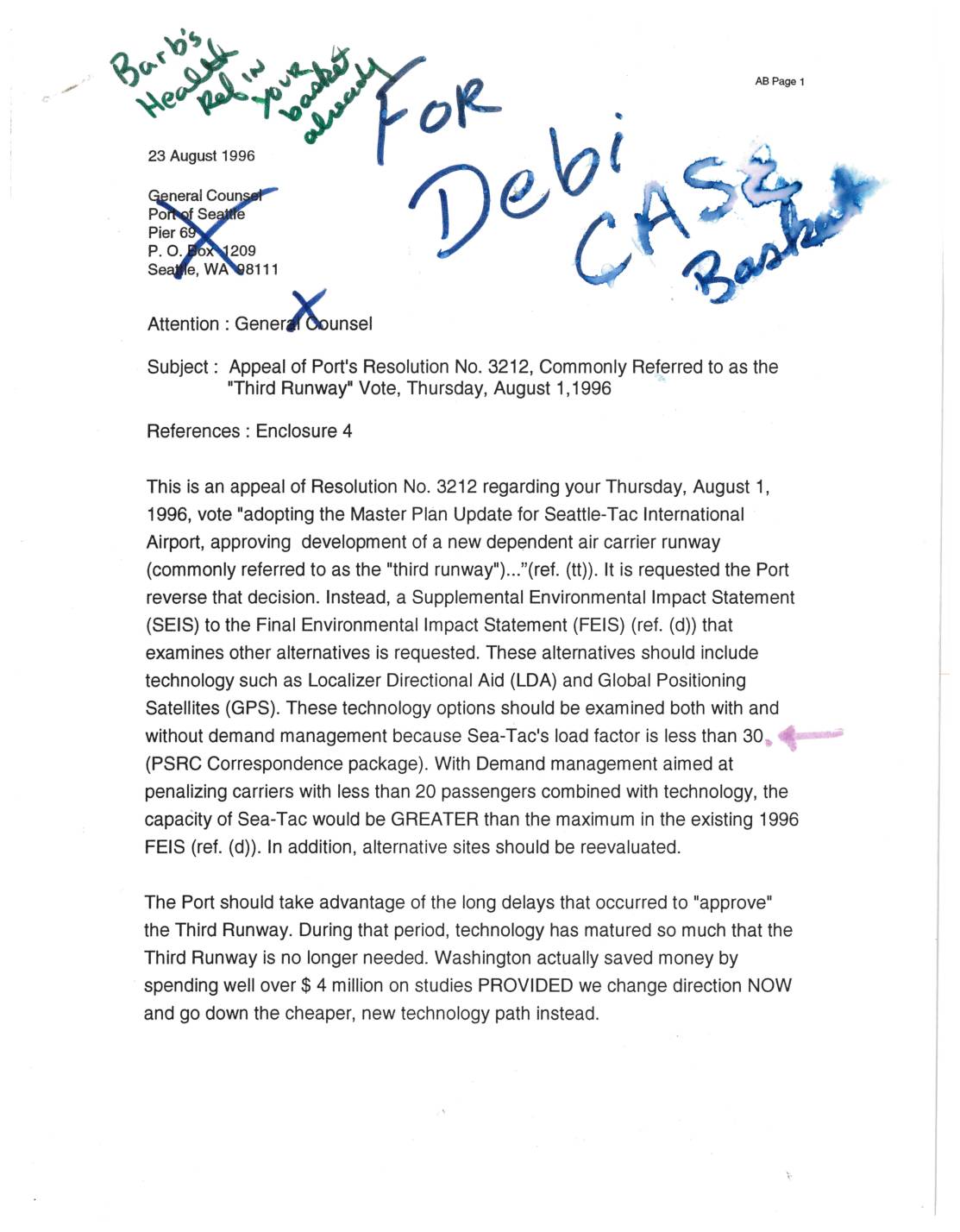
CASE & RCAA Appeal of Port Of Seattle Resolution No. 3212 (Third Runway Vote)
In August 1996, community groups CASE and RCAA formally appealed the Port of Seattle's Resolution No. 3212, which approved construction of a third runway at Seattle-Tacoma International Airport. The appeal argued that newer navigation technologies such as Localizer Directional Aid (LDA) and GPS, combined with demand management strategies, could provide equivalent airport capacity at far lower cost and with less environmental harm. The groups requested a Supplemental Environmental Impact Statement to evaluate these technology-based alternatives and reconsider the third runway decision. -
 1996-07-11
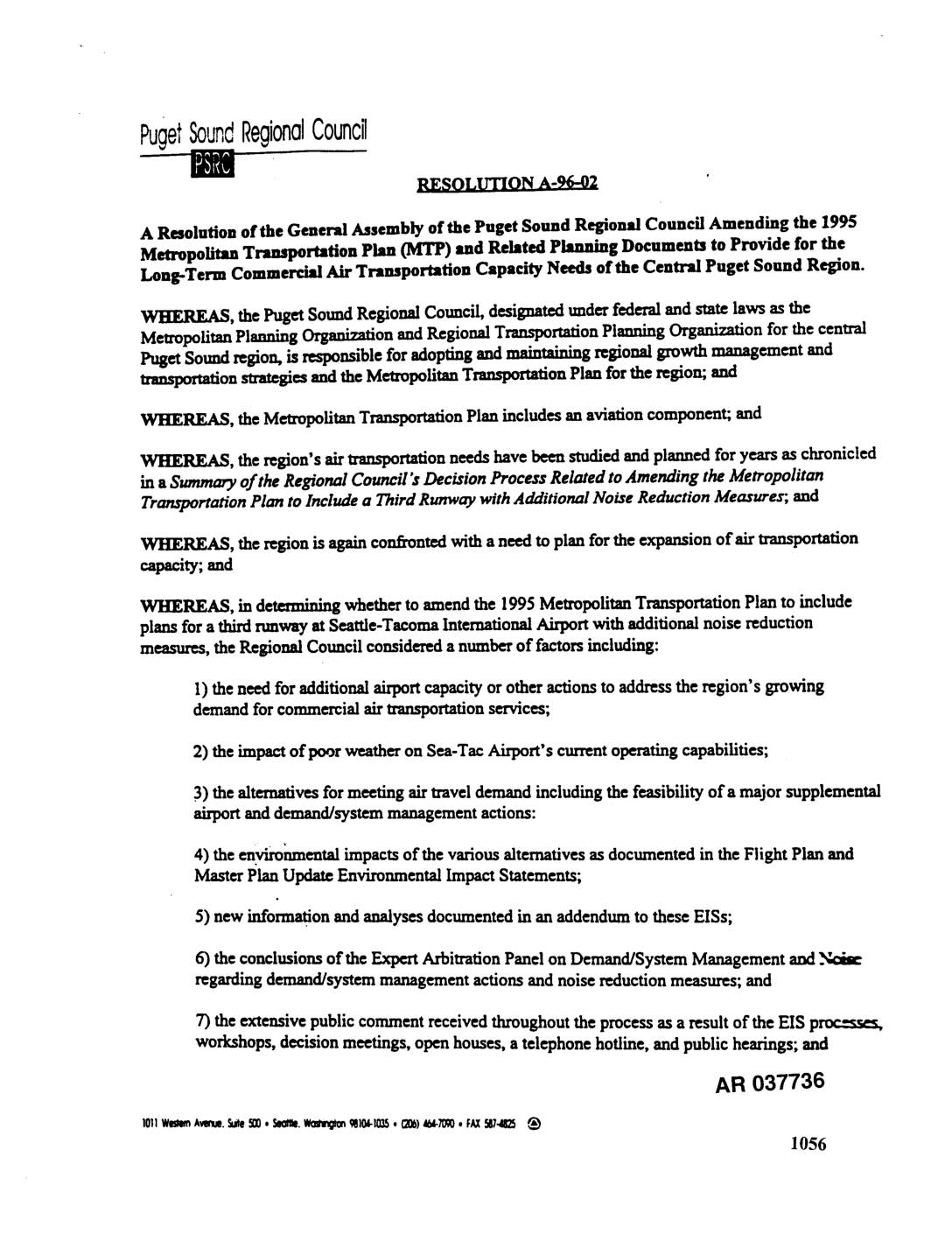
EXH AR037736: Puget Sound Regional Council Resolution A-96-02 Amending the 1995 Metropolitan Transportation Plan for Long-Term Commercial Air Transportation Capacity
Resolution A-96-02 adopted by the Puget Sound Regional Council (PSRC) General Assembly on July 11, 1996, amending the 1995 Metropolitan Transportation Plan (MTP) and Regional Transportation Plan (RTP) to include plans for a third runway at Seattle-Tacoma International Airport with additional noise reduction measures. References Resolution A-93-03, Expert Arbitration Panel on Demand/System Management and Noise, -
 1996-06-20
Summary of the Regional Council’s Decision Process Relating to Amending the Metropolitan Transportation Plan to Include a Third Runway at Sea-Tac International Airport with Additional Noise Reduction Measures
This 1996 Puget Sound Regional Council document summarizes the decision-making process behind adding a third runway at Seattle-Tacoma International Airport, tracing planning efforts from the late 1980s through 1996. It outlines how regional studies, including the Flight Plan Project and an Expert Panel evaluation, concluded that no feasible alternative airport sites existed and that options like high-speed rail or congestion pricing could not replace the need for the new runway. The amendment to the Metropolitan Transportation Plan was approved subject to conditions requiring noise reduction measures and demand management actions.