TagEnvironmental Impact Statement(328)
-
 1998-04-15
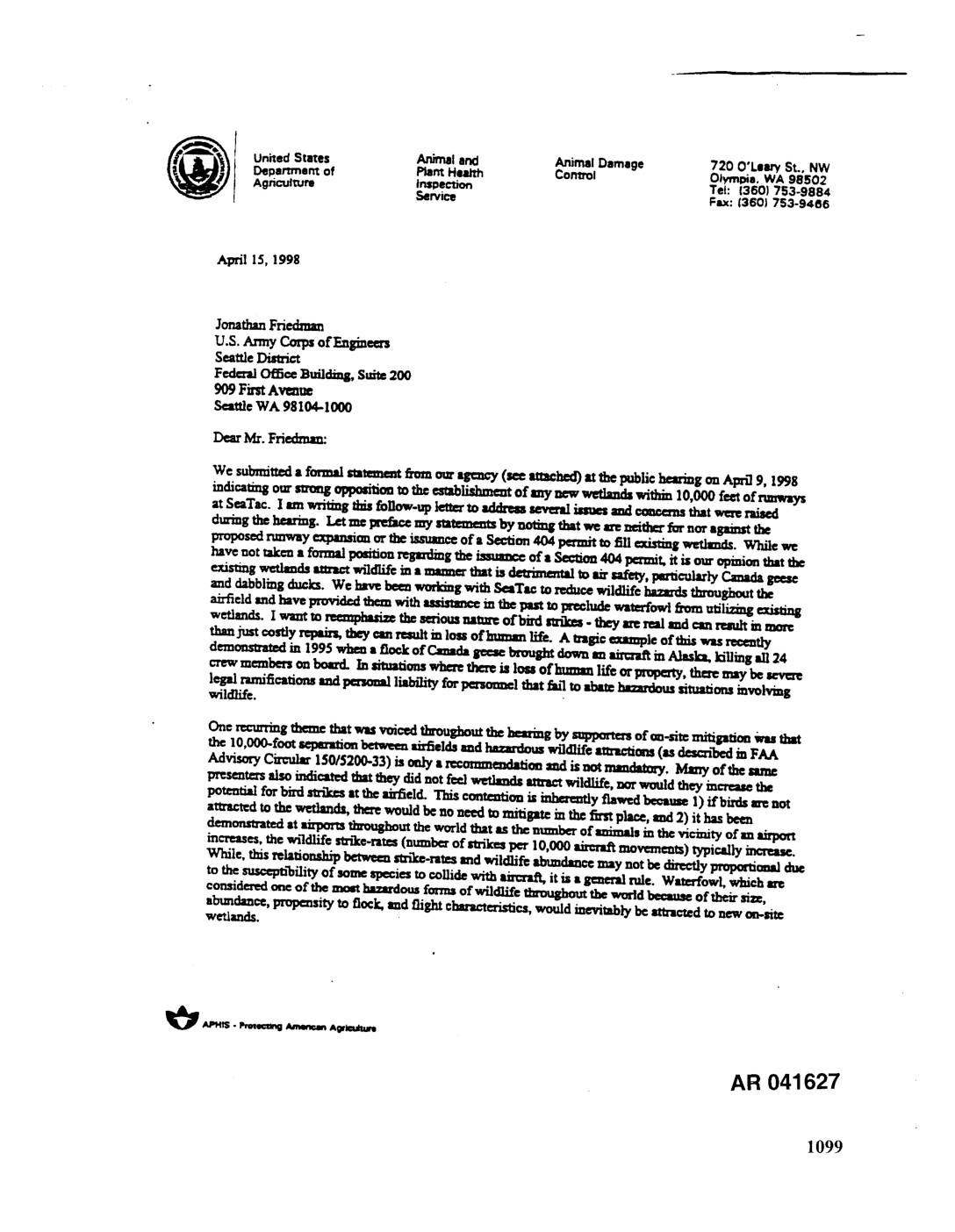
EXH AR041627: USDA APHIS Animal Damage Control Letter to U.S. Army Corps of Engineers Opposing New Wetlands Within 10,000 Feet of Sea-Tac Airport Runways
Letter dated April 15, 1998 from J. Gary Oldenburg, USDA Animal and Plant Health Inspection Service (APHIS) Animal Damage Control, State Director WA/AK/HI/Pacific Islands, to Jonathan Friedman, U.S. Army Corps of Engineers Seattle District, follow-up to public hearing of April 9, 1998. Strongly opposes establishment of any new wetlands within 10,000 feet of runways at -
 1998-04-09
EXH AR035307: Comment Binder A — Third Runway Corps/Ecology Public Comments, December 1997–April 1998
Comment Binder A compiled by Port of Seattle for Sea-Tac Airport (Seattle-Tacoma International Airport) third runway project, containing letters submitted to the U.S. Army Corps of Engineers during the initial comment period (December 19, 1997 to January 20, 1998) and comments from the joint Corps/Ecology public hearing held April 9, 1998. Includes a January 15, -
 1997-12-05
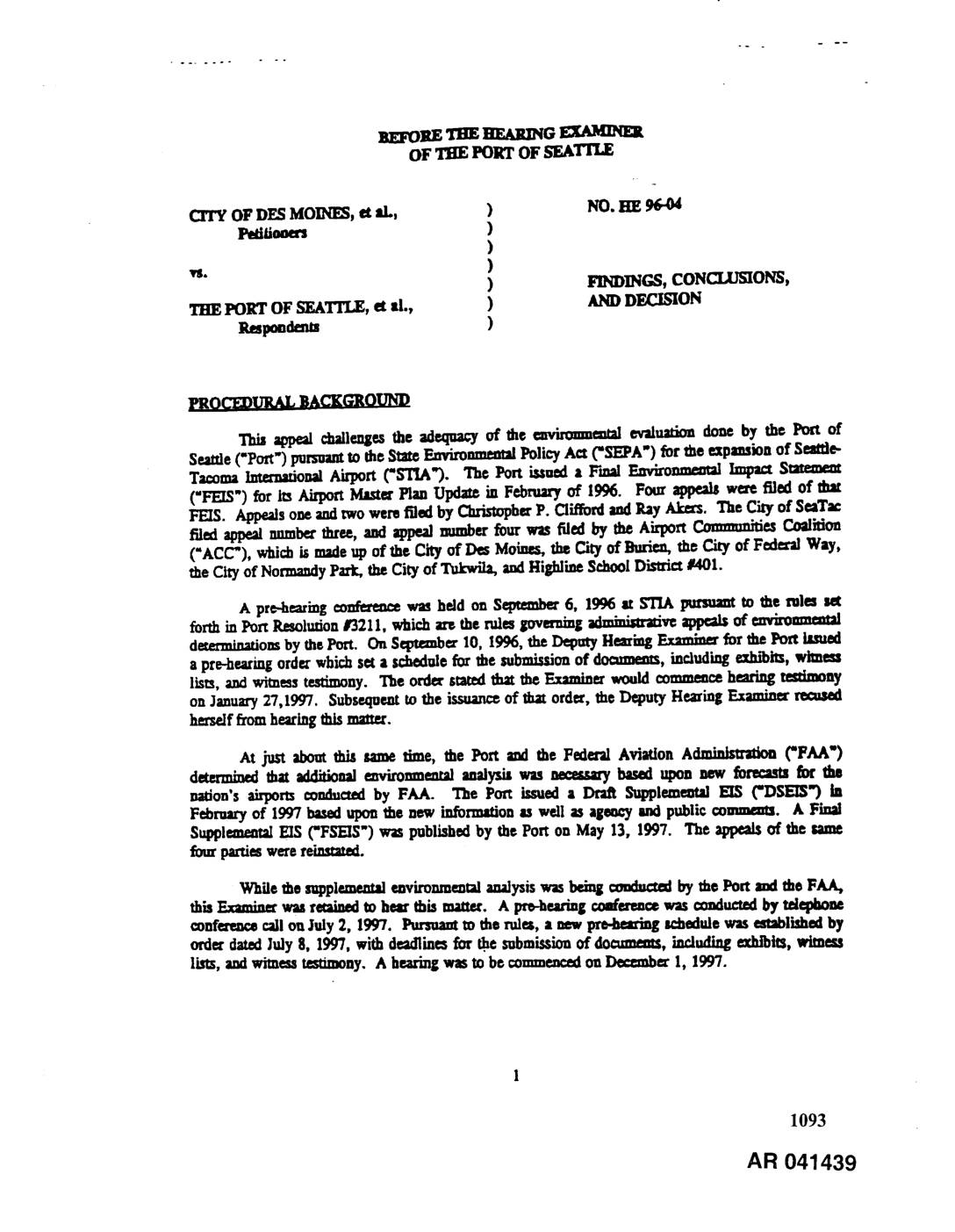
EXH AR041439: Findings, Conclusions, and Decision — City of Des Moines et al. v. Port Of Seattle (HE 96-04)
Hearing Examiner Findings, Conclusions, and Decision in case No. HE 96-04, Airport Communities Coalition (ACC) — comprising City of Des Moines, City of Burien, City of Federal Way, City of Normandy Park, City of Tukwila, and Highline School District #401 — versus Port Of Seattle regarding adequacy of the SEPA Environmental Impact Statement (EIS) and -
 1997-11-01
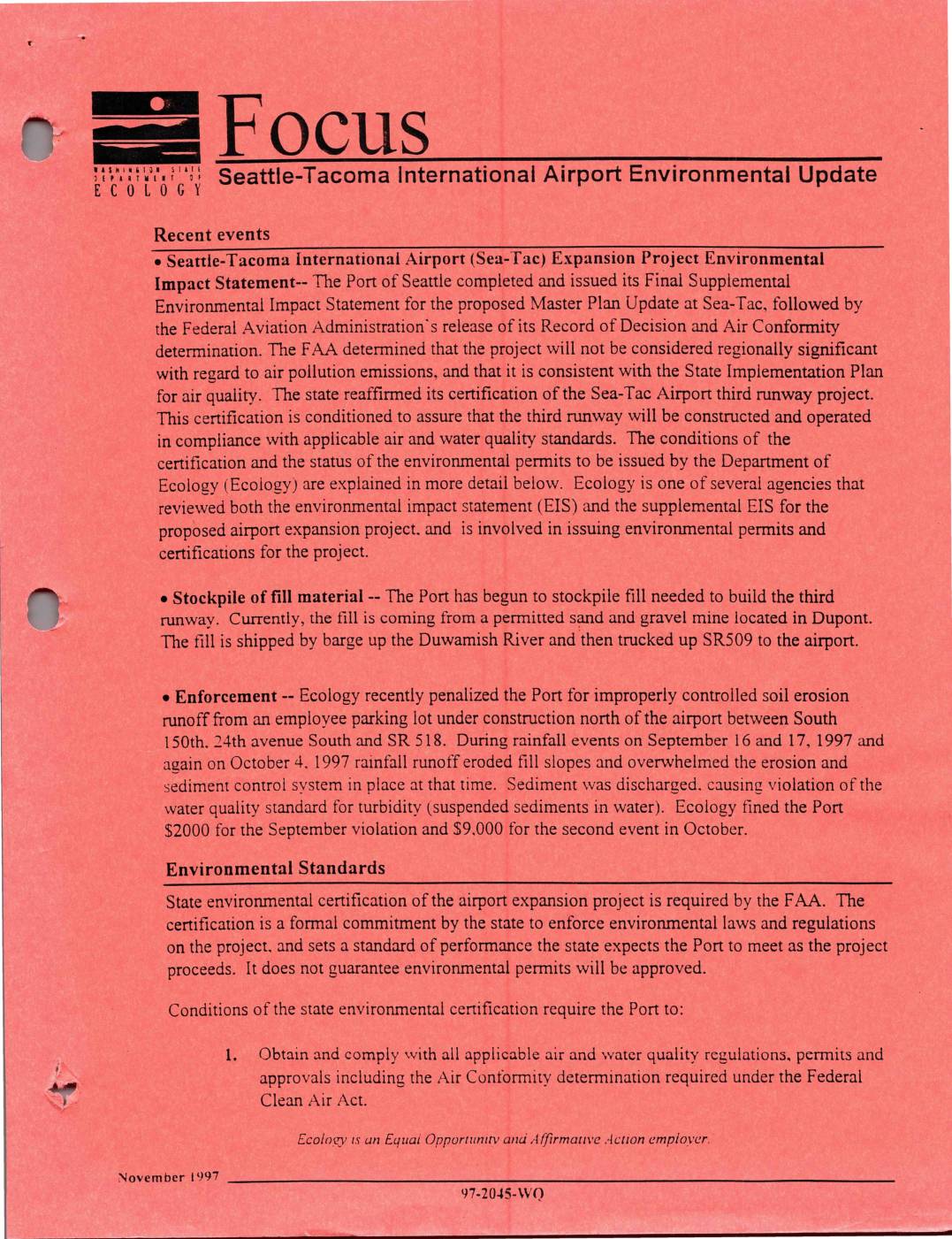
Seattle-Tacoma International Airport Environmental Update
This November 1997 environmental update from Washington State's Department of Ecology covers the Sea-Tac Airport third runway expansion project, detailing the FAA's air quality conformity determination, state environmental certification conditions, and required permits. The Port of Seattle was fined for soil erosion violations during construction of an employee parking lot, and was required to implement stormwater controls, groundwater studies, and erosion management plans. Several permits were under active review at the time, including an NPDES stormwater permit and a 404 wetland permit issued by the Army Corps of Engineers. -
 1997-07-03
EXH AR041146: FAA Record of Decision for Sea-Tac Airport Master Plan Update Development Actions
FAA Northwest Mountain Region Record of Decision (ROD) dated July 3, 1997, providing final Federal Aviation Administration approval for Sea-Tac International Airport Master Plan Update development actions adopted by Port of Seattle (POS) Commission Resolution #3212 (August 1, 1996) and amended by Resolution No. 3245 (May 27, 1997). Approves a new 8500-foot dependent air carrier -
 1997-05-28
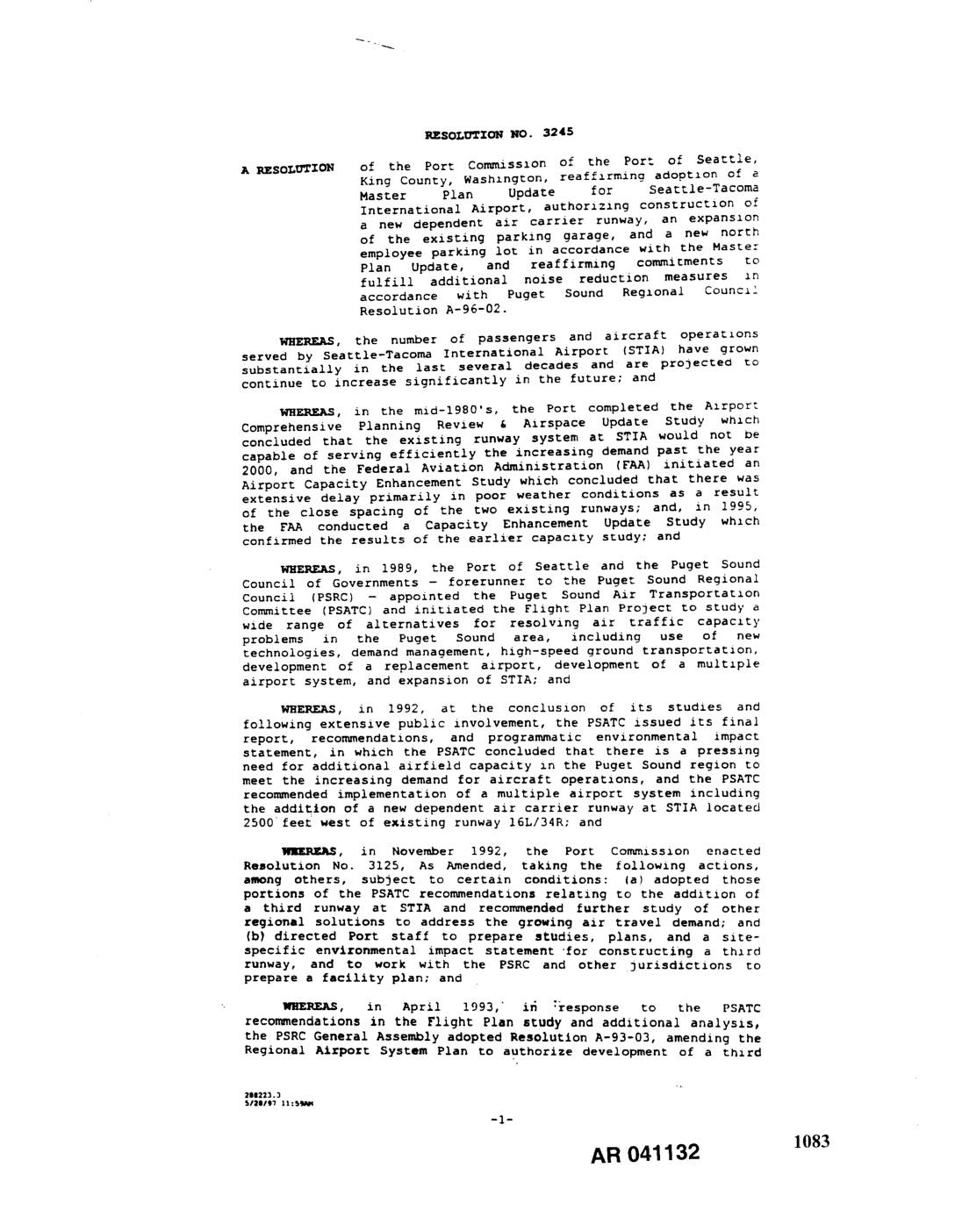
EXH AR041132: Port Of Seattle Commission Resolution No. 3245 — Reaffirming Master Plan Update and Authorizing Third Runway Construction at STIA
Port Of Seattle Commission Resolution No. 3245 reaffirms adoption of the Airport Master Plan Update for Seattle-Tacoma International Airport (STIA), authorizes construction of a new dependent air carrier runway (third runway) located 2500 feet west of existing runway 16L/34R, expansion of the existing parking garage, and a new north employee parking lot. References PSRC Resolution -
 1997-05-13
Final Supplemental Environmental Impact Statement for the Proposed Master Plan Update Development Actions at Seattle-Tacoma International Airport, Volume 1: Main Text and Appendices A through C-1
This 1997 Final Supplemental Environmental Impact Statement (SEIS) examines the environmental effects of proposed expansion plans at Seattle-Tacoma International Airport, including construction of a new third parallel runway, terminal improvements, and parking upgrades. The study was prompted by faster-than-expected growth in air travel demand during the mid-1990s, which exceeded earlier forecasts and required updated analysis of noise, air quality, wetland, and community impacts. The document was jointly prepared by the FAA and the Port of Seattle to ensure the proposed developments met federal and Washington State environmental policy requirements. -
 1997-05-07
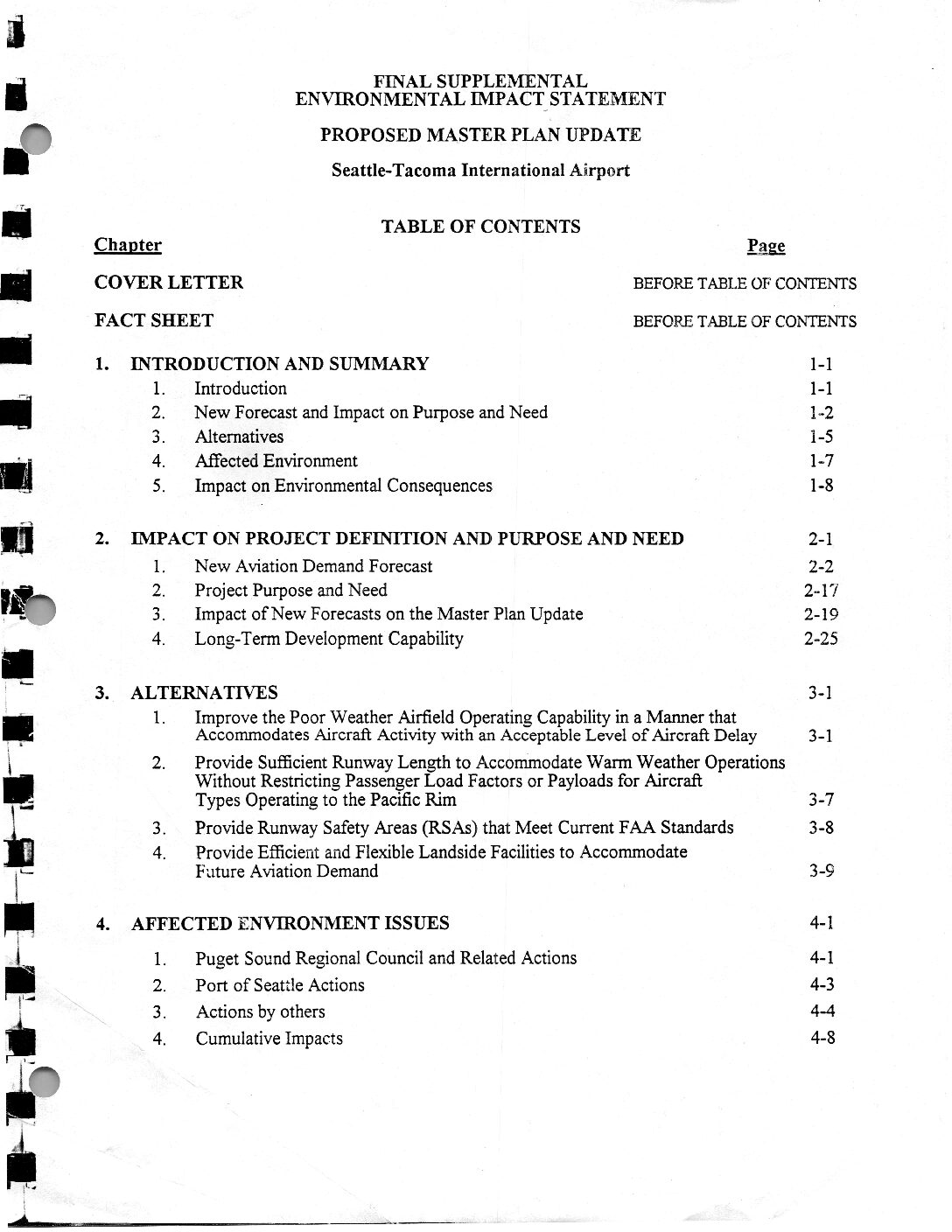
Final supplemental environmental impact statement: Proposed master plan update, Seattle-Tacoma International Airport
★ 32This Final Supplemental Environmental Impact Statement (FSEIS) evaluates proposed updates to the Master Plan for Seattle-Tacoma International Airport, examining the effects of revised aviation demand forecasts on runway capacity, safety improvements, and landside facilities. It analyzes a range of alternatives to address poor-weather airfield performance, runway length needs for Pacific Rim flights, and runway safety area compliance with FAA standards. The document also assesses environmental consequences including noise impacts on surrounding communities, air quality, wetlands, and construction effects. -
 1997-05-01
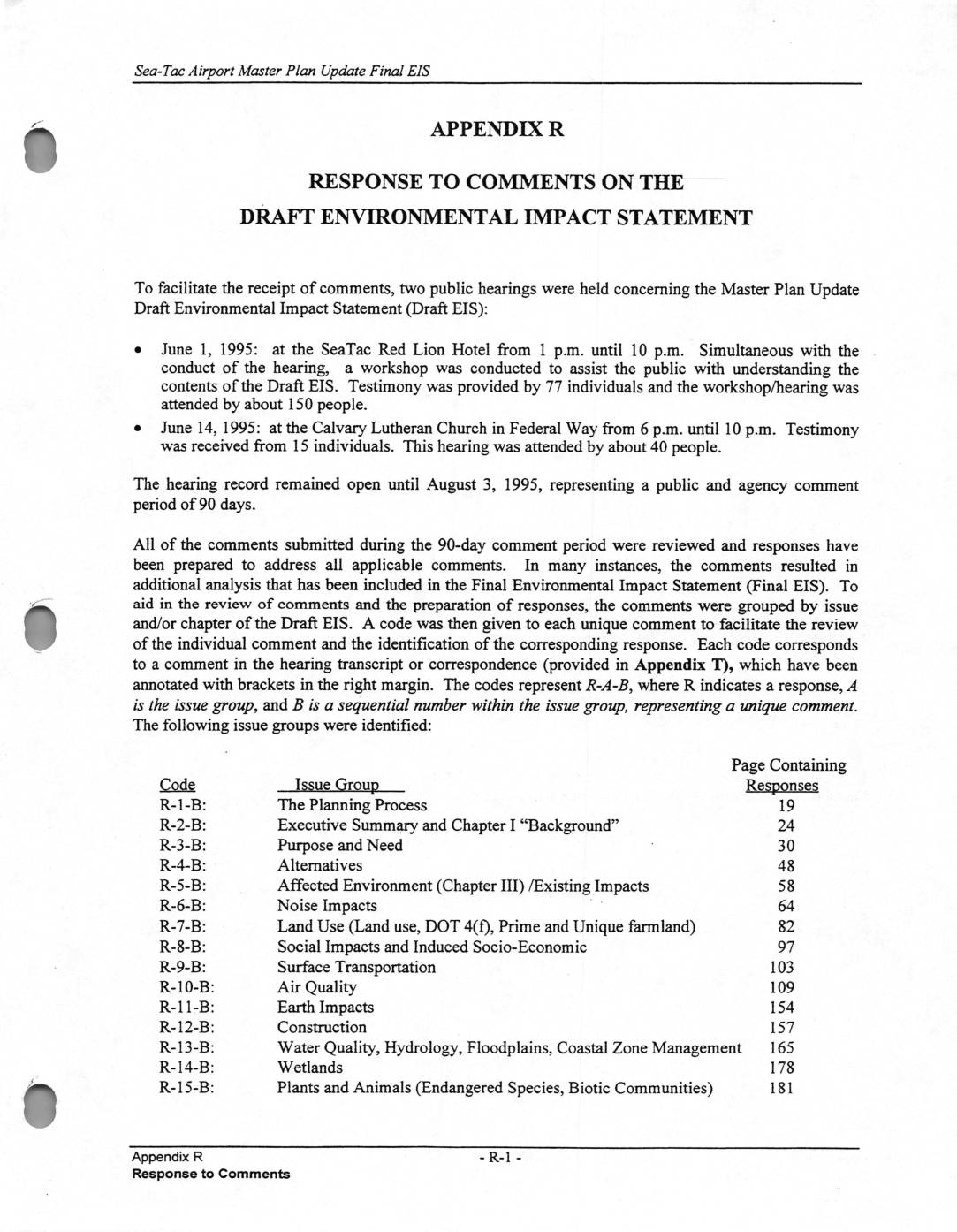
Sea-Tac Airport Master Plan Update Final EIS: Appendix R — Response to Comments on the Draft Environmental Impact Statement
This document is Appendix R of the Sea-Tac Airport Master Plan Update Final Environmental Impact Statement (EIS), containing official responses to public comments received during a 90-day comment period in 1995. Two public hearings gathered testimony on topics including noise impacts, land use, air quality, and surface transportation. A key finding was that airport activity levels were expected to grow regardless of whether improvements were built, driven by regional population and income growth rather than airport capacity alone. -
 1997-05-01
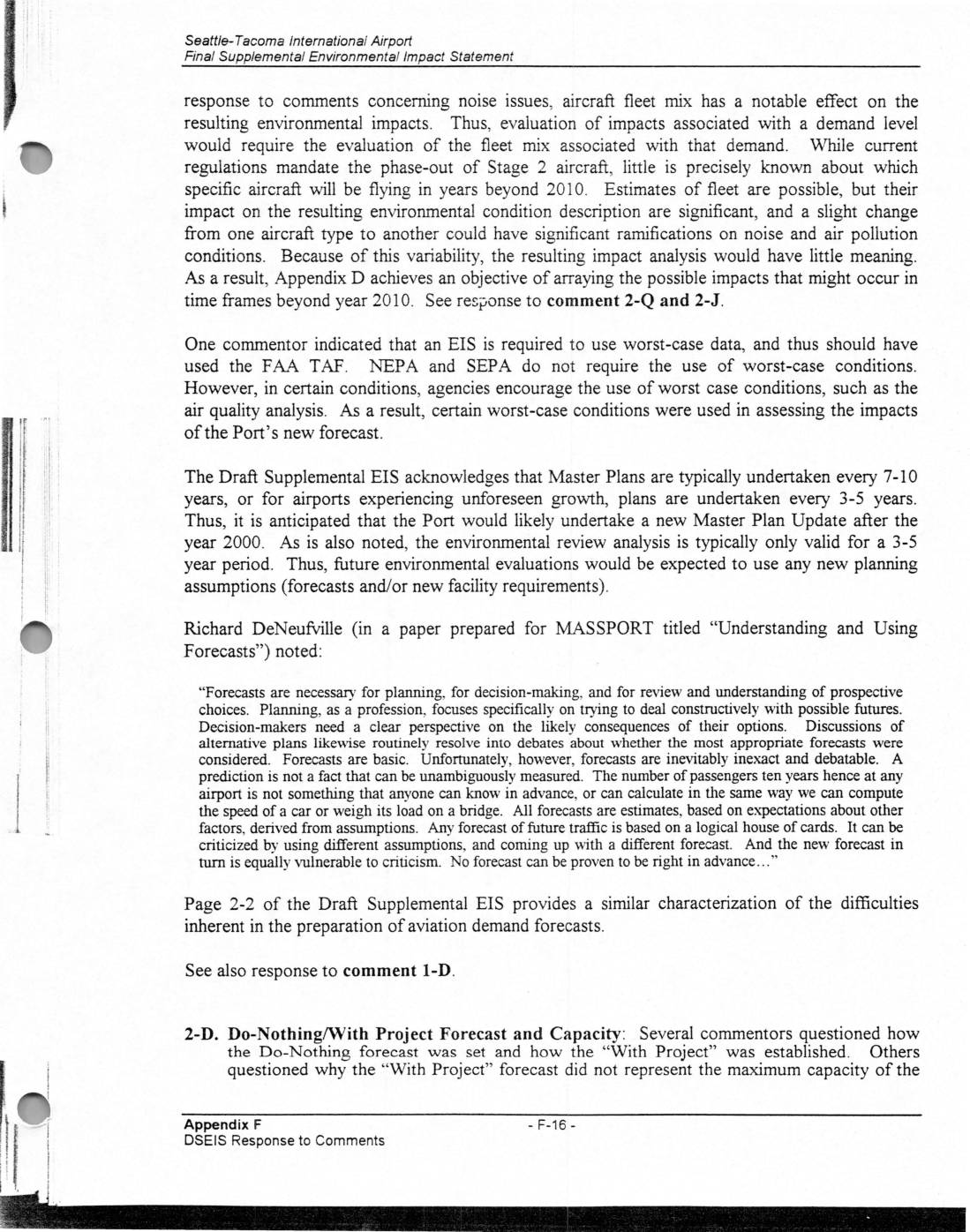
Final Supplemental EIS, Appendix F: DSEIS Response to Comments — Forecasts, Do-Nothing/With Project Capacity, and Forecast Ranges
This document is part of the Final Supplemental Environmental Impact Statement for Seattle-Tacoma International Airport, addressing public comments on aviation demand forecasts and runway capacity planning. It explains how the 'Do-Nothing' and 'With Project' (Third Runway) alternatives were evaluated based on projected passenger and operations data through 2010, noting that the existing airfield has a maximum capacity of 460,000 annual operations. The document also acknowledges the inherent uncertainty in long-range aviation forecasts and clarifies that neither NEPA nor SEPA require the use of worst-case data in environmental reviews.