Skip to content
  • STNI
  • Statistics
    • Ops and Passengers
      • King County International Airport (Boeing Field) Annual Operations
    • Financials
    • Aviation fuel uplift in the State of Washington 2018 – 2025
      • Aviation Fuel Uplift at Sea-Tac Airport
    • Air Quality Monitoring
    • Flight Tracking
      • Flow and Flight Tracks
      • Five Year Comparison
      • Busiest Hours and Days
    • SEL Noise Reports & Graphs
      • About The Permanent Noise Monitors
      • Minutes of Quiet by Noise Monitor
      • Noise Events mapped
      • Noise Events (SEL)
    • Runways
    • Employees
    • Real Estate
      • Port Properties and Trees mapped
    • Parking
  • Events
  • Protest
    • Regular Events
    • Legislation 2026
    • Complain about a particular flight
    • Advocacy Organizations
    • Media Outlets
    • People
    • The Port of Seattle
      • Commission Meetings
      • Public Records Requests
      • StART
      • Highline Forum
    • Contact Your Electeds
  • Resources
    • FAQs
      • FAA Occurrences/Accidents/Indents
    • The unSustainable Airport Master Plan
      • SAMP Public Comment Template
        • Two versions of Appendix K: NEPA/SEPA 2018 vs 2023
      • SAMP NTP: 31 projects by the numbers
      • SEPA Draft EIS (2026)
      • SAMP Record of Decision/FONSI (2025)
      • SAMP Draft EA (October 2024)
      • 2018 Scoping
    • Port Packages
      • Port Package Property Costs
      • Port Packages mapped
      • The Port Package Explainer
      • So you want a (first-time) Port Package? Start here
      • Port Package Looker Upper
      • How do I determine if I have a Port Package or Avigation Easement?
      • Progress on Port Package Update legislation
      • Having a Port Package Problem?
      • Port Package Site Visit Follow-Up
    • Document Library
    • Explainers
      • The Airport Law Cheat Sheet
      • The Grant Explainer
    • External Articles
    • History
      • Timeline
      • The Sea-Tac Communities Plan
        • Sea-Tac Communities Plan – Planning Maps
      • PSRC Third Runway Decision Process
    • Studies
    • Videos
  • Stories
  • Mission
  • Subscribe
  • Contact
Scroll down to content

Get InformedStay Informedx

I understand that you will never share my information with anyone, you will only use it to keep me updated on relevant events and that I may unsubscribe at any time.

STNI

STNISea-Tac Noise.Info

  • Solve for Sea-Tac. Solve for every airport.
  • Since 2016, working to obtain justice for everyone living under the flight path.
  • Less Noise. Cleaner Air. Better Public Health. Compensation.
  • Everything you think you know about the airport is wrong.

TagAirport Law(23)

Advanced Search Options

  • Dates
  • Media
    • External Articles
    • Images
    • PDFs
    • Video
    • Audio
  • Order By
  • 2024-07-12

    RCW 53.54.020 Investigation and monitoring of noise impact—Programs to conform to needs—”Impacted areas.”

    Washington state law defining requirements for port commissions to investigate and monitor aircraft noise impact before initiating abatement programs. Establishes geographic boundaries for “impacted areas” where port districts may undertake noise programs, with specific distance limitations from runway ends and centerlines.
    TagsAirport Law, Airport Noise Law, Noise, Port Of Seattle, RCW53
  • 2022-09-16

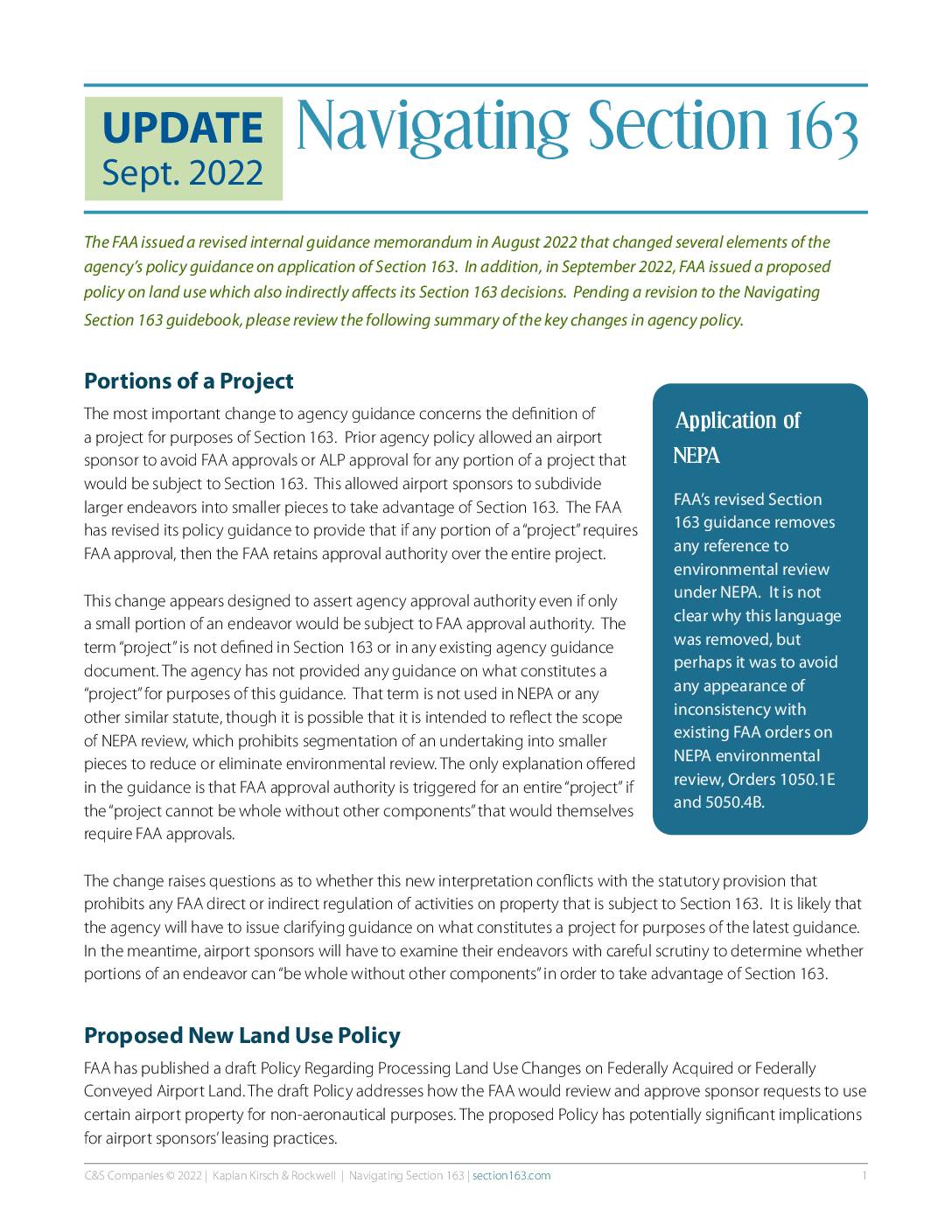
    Airport Law Alert: FAA Issues Potentially Sweeping Changes to Airport Land Use Regulation

    The FAA proposed sweeping new rules in September 2022 governing how airports can use federally acquired or conveyed land for non-aeronautical purposes, such as hotels, warehouses, and car rental facilities. Under the draft policy, airports would need FAA approval for any non-aeronautical or mixed-use activities on such land, with approvals tied strictly to lease terms and requiring renewal each time a lease expires. The changes could significantly increase the regulatory burden on airport sponsors by eliminating the previous practice of permanently designating certain property as non-aeronautical and potentially triggering environmental review requirements under NEPA.
    TagsAirport Law, FAA, Kaplan Kirsch Rockwell, Land Use, NEPA, Reauthorization Act Of 2018, Section 163
  • 2022-09-01

    Navigating Section 163: September 2022 update

    In August 2022, the FAA revised its internal guidance on Section 163, most notably changing how it defines a 'project' so that if any part of a development requires FAA approval, the agency retains authority over the entire project — limiting airports' ability to break larger efforts into smaller pieces to avoid oversight. The FAA also proposed a new land use policy in September 2022 governing how airport sponsors may use federally acquired or conveyed airport land for non-aeronautical purposes, identifying four categories of land use that determine when FAA approval is required. Airport sponsors were encouraged to submit comments on the proposed land use policy before October 17, 2022.
    TagsAirport Law, FAA, Land Use, NEPA, Section 163
  • 2019-06-01

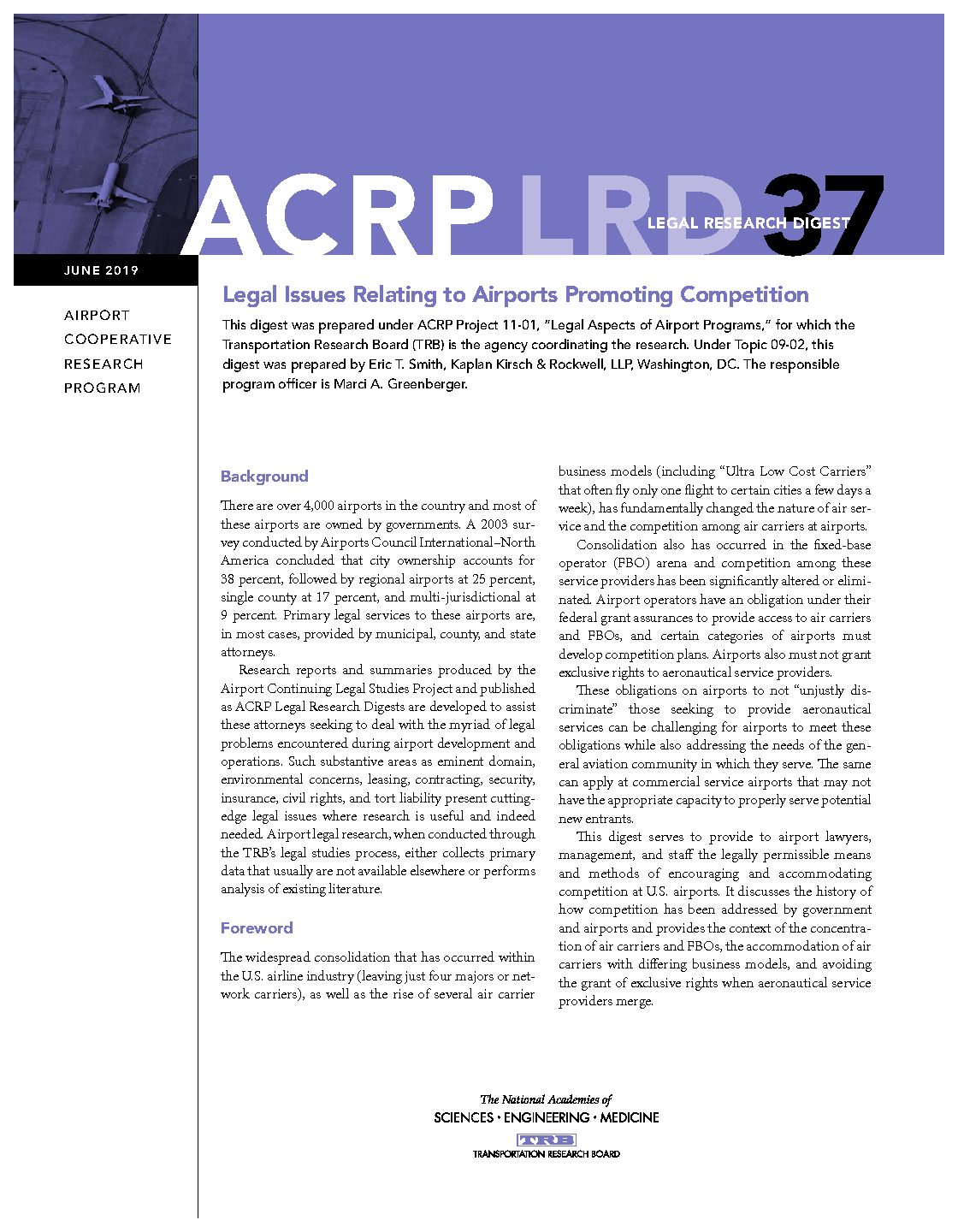
    ACRP Legal Research Digest 37: Legal Issues Relating to Airports Promoting Competition

    This 2019 legal research digest examines how U.S. airports can legally encourage competition among airlines and fixed-base operators (FBOs) while complying with federal grant requirements. It covers the impact of airline industry consolidation, the rules airports must follow to avoid unfair discrimination or granting exclusive rights, and practical strategies for accommodating carriers with different business models.
    TagsAIP, Airline Deregulation Act, Airport Cooperative Research Program, Airport Law, Passenger Facility Charges
  • 2016-03-04

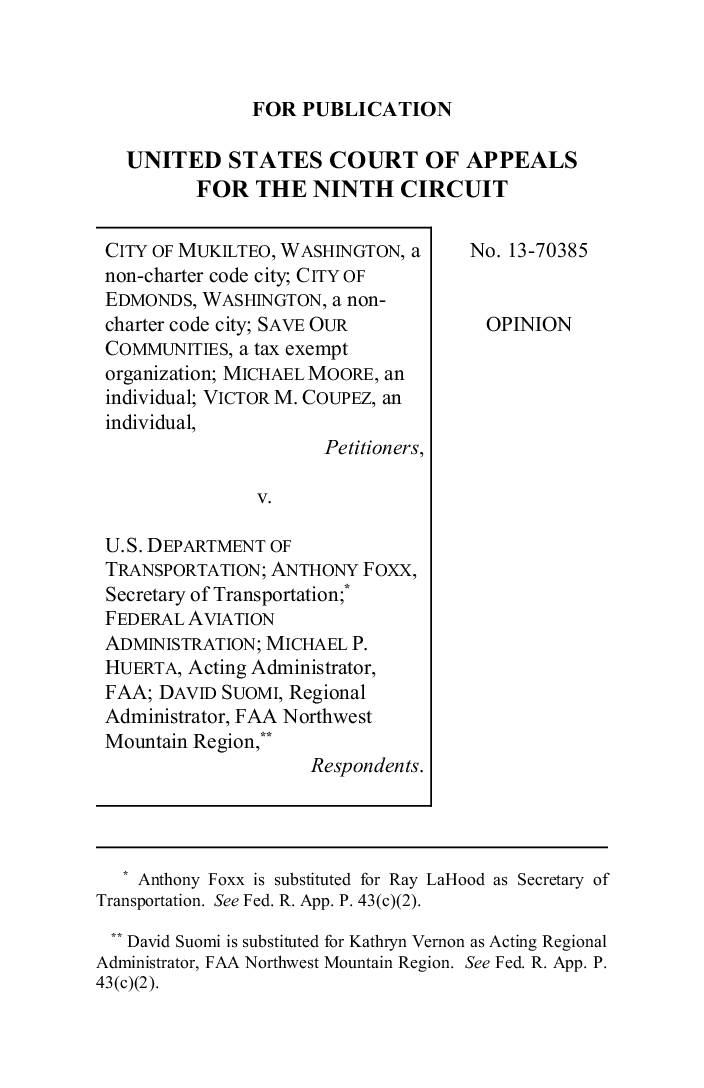
    City of Mukilteo v. U.S. Department of Transportation: Ninth Circuit Opinion on FAA Environmental Review for Paine Field Commercial Service

    A federal appeals court denied a challenge by the cities of Mukilteo and Edmonds, Washington, along with local residents and advocacy groups, to the FAA's decision to open Paine Field near Everett to commercial passenger service without requiring a full Environmental Impact Statement. The court ruled that the FAA's environmental review process was conducted in good faith and was not arbitrary or capricious, finding that the agency properly assessed foreseeable noise and environmental impacts under the National Environmental Policy Act.
    TagsAirport Law, City of Mukilteo, FAA, NEPA, Ninth Circuit Court of Appeals, Paine Field
  • Mukilteo V FAA DOT 13 70385 2016 03 04 Pdf
    2016-03-04

    City of Mukilteo v. U.S. Department of Transportation: Ninth Circuit Opinion on FAA Environmental Review for Paine Field Commercial Service

    Ninth Circuit Court of Appeals opinion (No. 13-70385) denying petition for review filed by City of Mukilteo, City of Edmonds, Save Our Communities, Michael Moore, and Victor M. Coupez against the U.S. Department of Transportation, FAA, and FAA Northwest Mountain Region. The panel, per Judge Tallman, upheld the FAA’s Finding of No Significant Impact (FONSI)
    TagsAirport Law, City of Mukilteo, FAA, NEPA, Ninth Circuit Court of Appeals, Paine Field
  • 2009-09-30

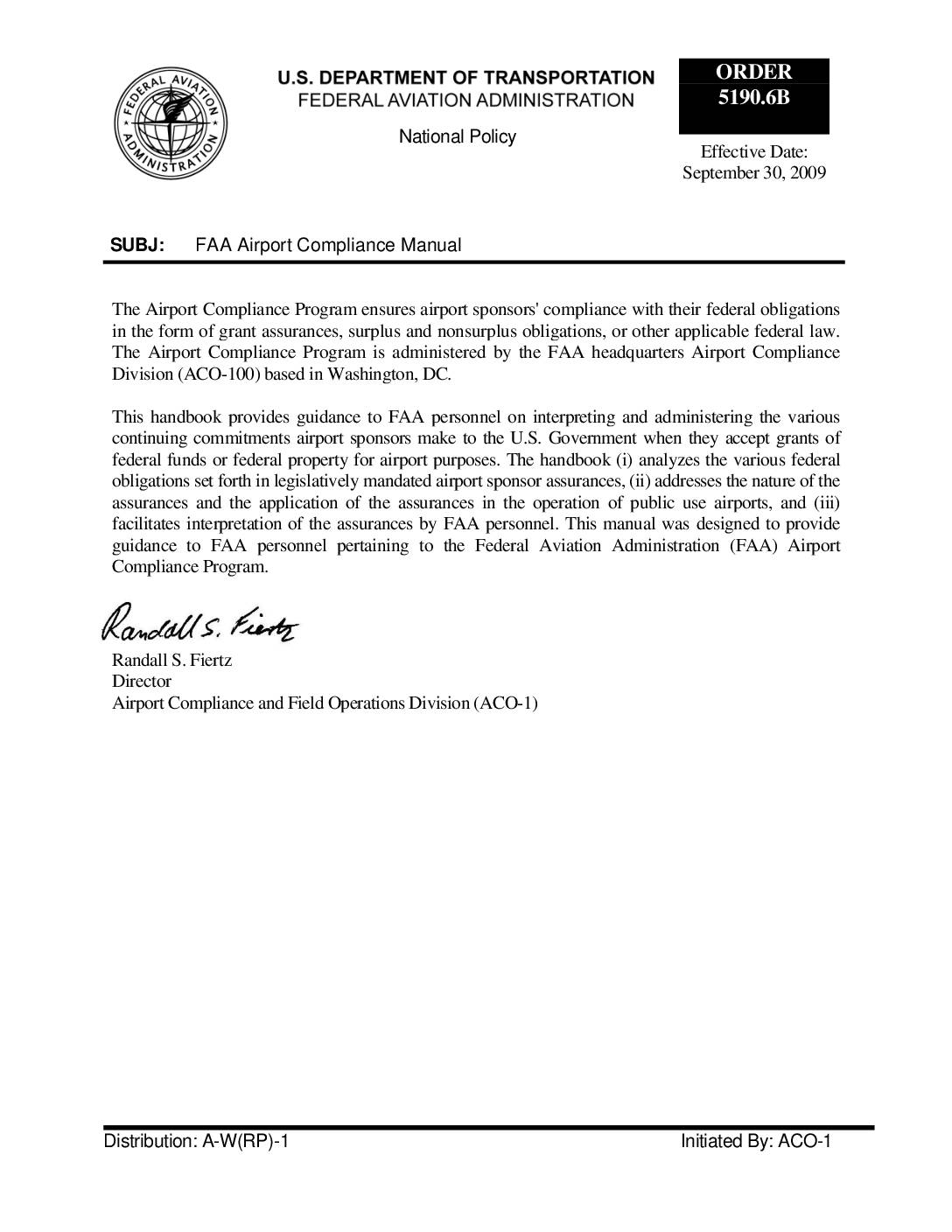
    FAA airport compliance manual

    The FAA Airport Compliance Manual (Order 5190.6B), effective September 30, 2009, provides guidance to FAA personnel on ensuring that airport sponsors meet their federal obligations when they accept federal funds or property for airport purposes. It analyzes grant assurances, surplus property conditions, and other legal commitments that airports must uphold, and outlines the compliance program's objectives, responsibilities, and enforcement procedures. The manual is administered by the FAA's Airport Compliance Division and serves as the authoritative reference for interpreting and managing airport sponsor obligations nationwide.
    TagsAIP, Airport Law, FAA, Manual
  • Airport governance and ownership 2009 national academies pdf
    2009-01-01

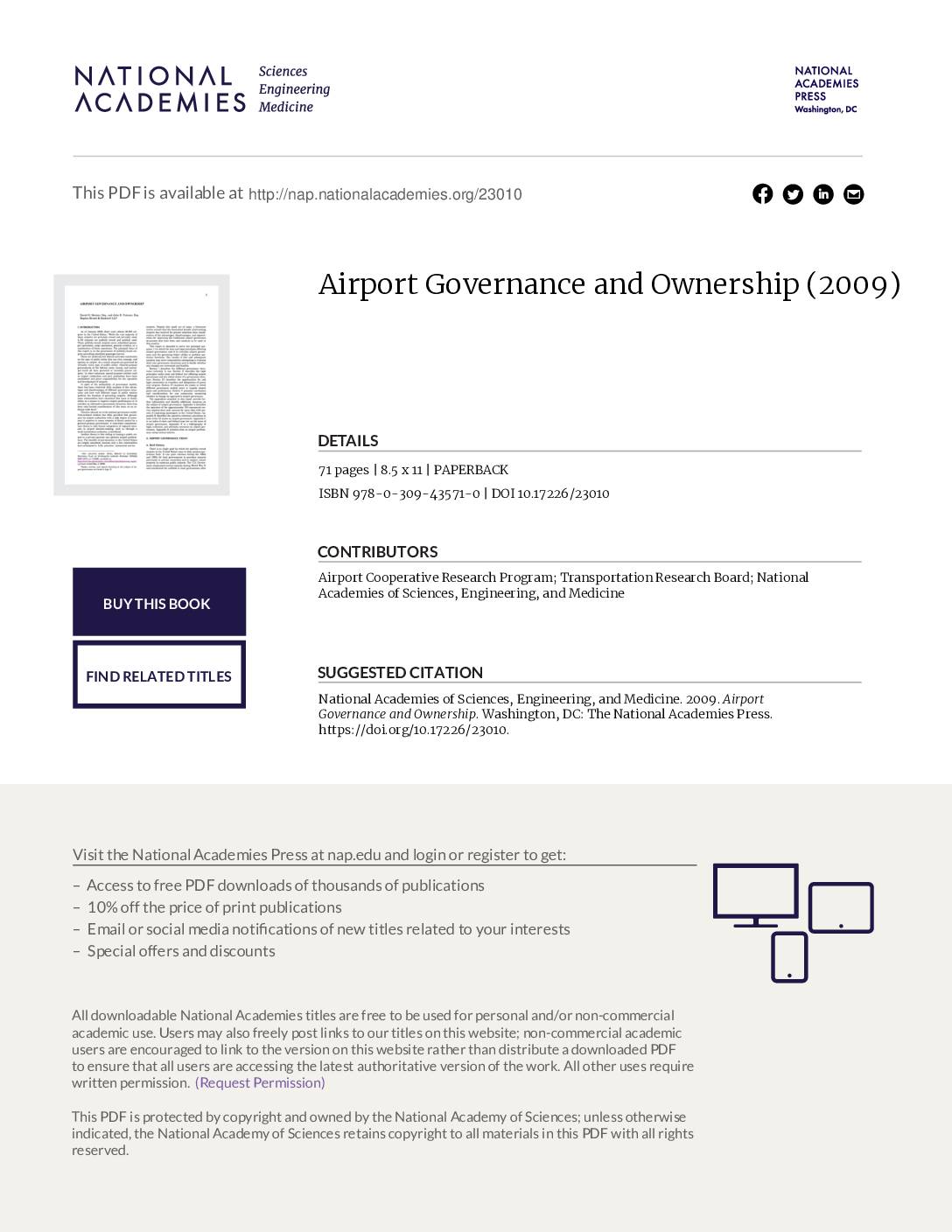
    Airport Governance and Ownership

    Report by Daniel S. Reimer and John E. Putnam of Kaplan Kirsch & Rockwell LLP, published by the Airport Cooperative Research Program, Transportation Research Board, and National Academies of Sciences, Engineering, and Medicine. Covers airport governance structures in the United States as of 2008, including general-purpose governments (city, county, state) and special-purpose entities (airport authorities,
    TagsAirport Cooperative Research Program, Airport Law, Airports, National Academies of Sciences, Transportation Research Board
  • 2009-01-01

    Airport Governance and Ownership

    This 2009 report from the National Academies examines how publicly-owned airports in the United States are governed and owned, covering the range of entities—from city governments to special airport authorities—that oversee the country's approximately 4,150 public-use airports. It analyzes the legal principles and state and federal laws that shape airport governance structures, and evaluates the advantages and disadvantages of different models, including privatization. The findings are intended to help communities assess whether their current airport governance arrangements are working effectively or could benefit from change.
    TagsAirport Cooperative Research Program, Airport Law, Airports, National Academies of Sciences, Transportation Research Board
  • 2008-01-01

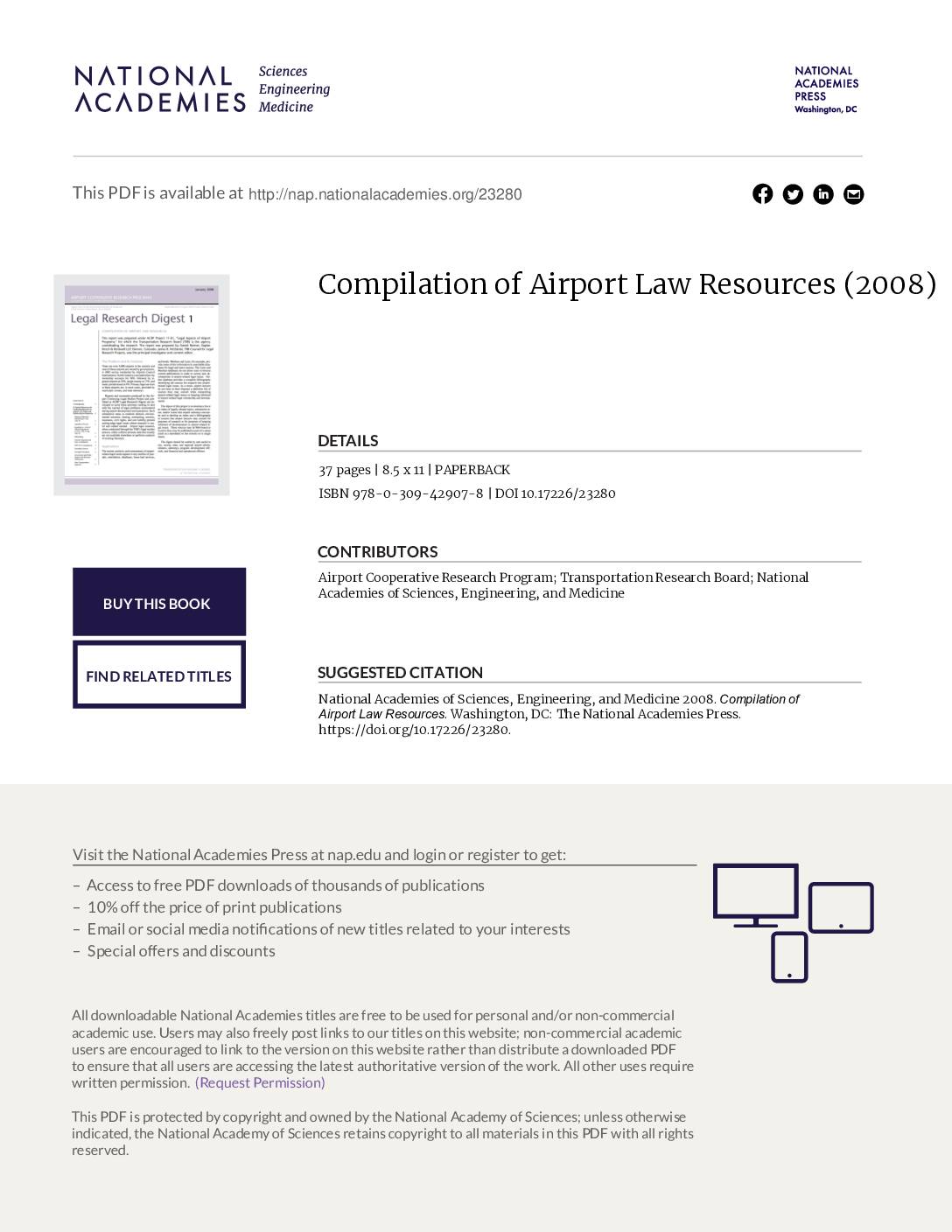
    Compilation of Airport Law Resources

    A comprehensive legal research digest that compiles and indexes airport law resources for attorneys and administrators. It provides a bibliography of federal resources, statutory materials, regulations, case law, and secondary sources related to airport legal issues including topics like eminent domain, environmental concerns, leasing, contracting, security, and liability.
    CategoriesResources TagsAirport Cooperative Research Program, Airport Improvement Program, Airport Law, Airport Law Digest, Federal Aviation Administration, National Academies of Sciences, NEPA, Transportation Research Board

Posts pagination

Page 1 Page 2 Page 3
Sidebar On/Off

Upcoming Events

  • StART SEA Stakeholder Advisory Round Table
    Add to CalendarMWednesday Aug 26, 5:00pm - 7:00pm
    Zoom (Virtual Meeting)
    START meetingagenda 2026826 final 0 pdf

    Meeting Objectives Introduce the primary feedback themes identified by StART members regarding StART’s Operating Procedures and determine areas that may warrant future discussion. 5:00 PM – Welcome Meeting Management Welcome Lead: Andrés Mantilla, Facilitator, Uncommon Bridges; Wendy Reiter, Airport Managing Director, POS 5:15 PM – Dinner: All participants eat. 5:30 PM – StART Operating Procedures

    [...]
  • Commercial Aviation Work Group
    Add to CalendarMThursday Sep 3, 10:00am - 1:30pm
    Virtual Meeting (Zoom)
    Cawg agenda sep 3 26 virtual pdf

    Meeting Agenda 10:00 a.m. – 10:15 a.m. | Welcome – Evan Nordby, Chair a. Introductions and Agenda Reviewb. Status of appointments and non-voting member invitationsc. Other updates as necessary 10:15 a.m. – 11:00 a.m. | Is it practical and legal to operate the western Washington [Puget Sound] airports as a single airport system? – Consultant

    [...]

[See all...]


Help study childhood asthma. Get free HEPA filter!

read more...

Issues

Sea-Tac Airport is currently undergoing the largest and longest expansion in its history, collectively known as the Sustainable Airport Master Plan (SAMP). Some of it you can already hear, but you’re probably not aware of what it all means. Here’s what you need to know.
read more...

Read This!

As the source for federal transportation grants, the Puget Sound Regional Council was charged with developing a system to meet the growing need for commercial aviation. When the search for a second airport failed, they authorized the Port of Seattle to build the Third Runway, with a mandate to develop a noise abatement and mitigation program. In their effort to stop the Third Runway, the ACC argued over every detail of the Port's efforts--including property buyouts and sound insulation. The dispute was meant to be settled by a three member Expert Arbitration Panel. This is their final report. It finds 2-1, that the Port's program was insufficient in several respects. Despite that, funding for the Third Runway was approved by the PSRC, and the 'Port Package' program, proceeded largely unchanged. Expert Arbitration Panel's final decision finding that the Port of Seattle had not shown sufficient reduction in real on-the-ground noise impacts to satisfy noise reduction conditions required for approval of a third runway at Sea-Tac International Airport. The majority decision concluded the Port's noise abatement programs were insufficient despite being impressive in scope.
continue...

The Podcast!

Subscribe to the only podcast devoted to policies, politics, history, impacts for people living under the flight path everywhere. It’s definitely not just about noise!
  • Sea-Tac Noise.Info
  • Connect with STNI

    • Subscribe
    • Port Package Problem?
    • Donate
    • Podcast
    • Socials
      • Facebook
      • X (Twitter)
      • Bluesky
      • Instagram

    "Aerials of Sea-Tac Airport’s Third Runway construction, 10 September 2007." — , 2007

  • Learn

    • Frequently Asked Questions
    • Explainers
    • Youtube
    • Research Requests
    • Make a complaint
  • Goals

    Fulfill the promises of 1976:
    • Compensation
    • Reduced noise
    • Improved air quality
    • Environmental remediation
Login/Register
©2026•Data Privacy

Message

We use cookies to provide basic functionality. We also provide access to search engines in order to provide site analytics. We do not sell or share your data.
V V