TagWashington State Legislature(119)
-
 2023-09-28
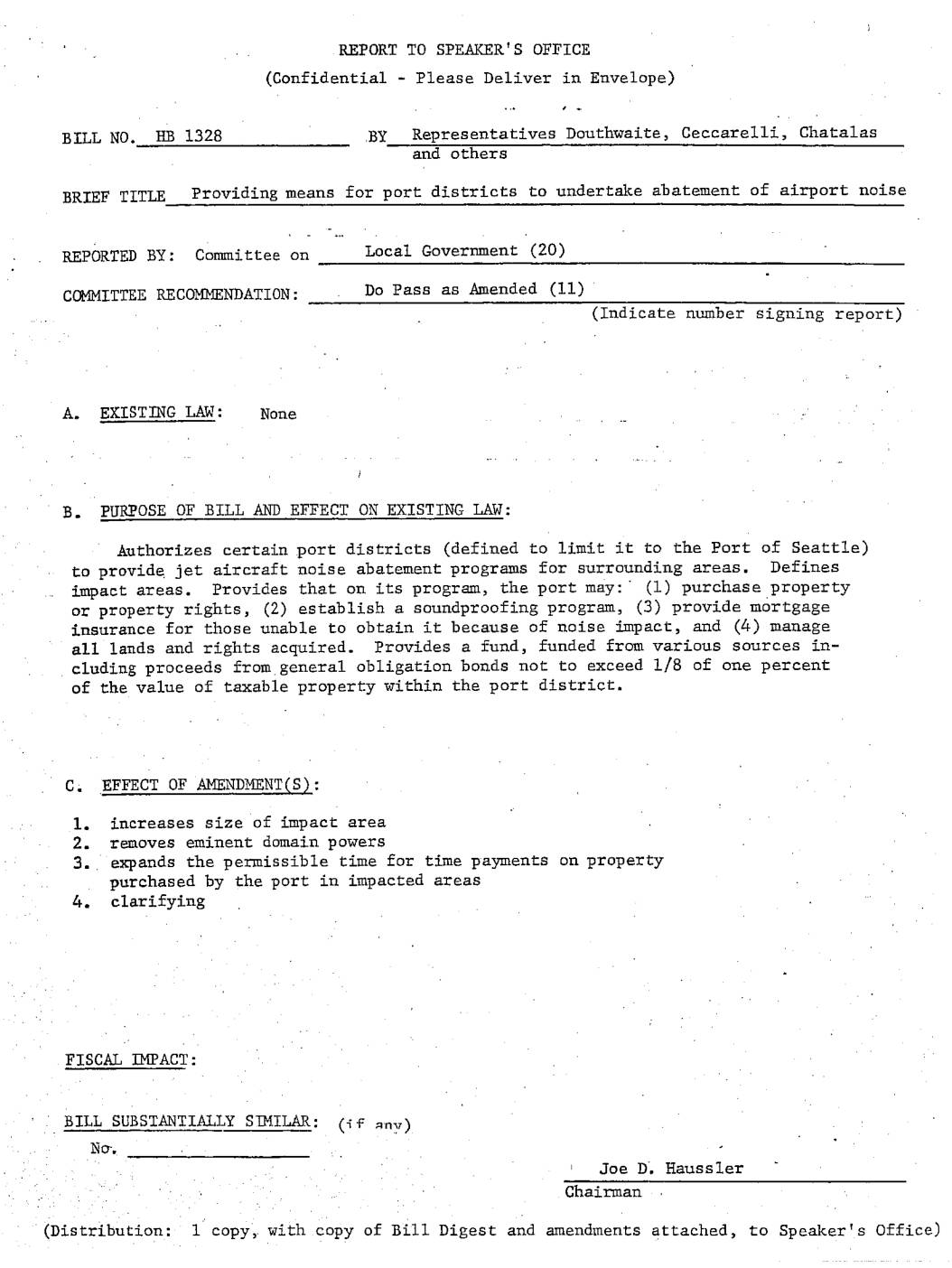
Report to Speaker’s Office: HB 1328 – Providing means for port districts to undertake abatement of airport noise
House Bill 1328 authorized the Port of Seattle to establish jet aircraft noise abatement programs for surrounding communities, allowing the port to purchase affected properties, fund soundproofing, and provide mortgage insurance for residents unable to obtain it due to noise impacts. The bill was amended by the Committee on Local Government to expand the defined impact area, remove eminent domain powers, and extend time limits for property payments. Funding for the program could come from general obligation bonds, capped at 1/8 of one percent of the total taxable property value within the port district. -
-
 2023-08-15
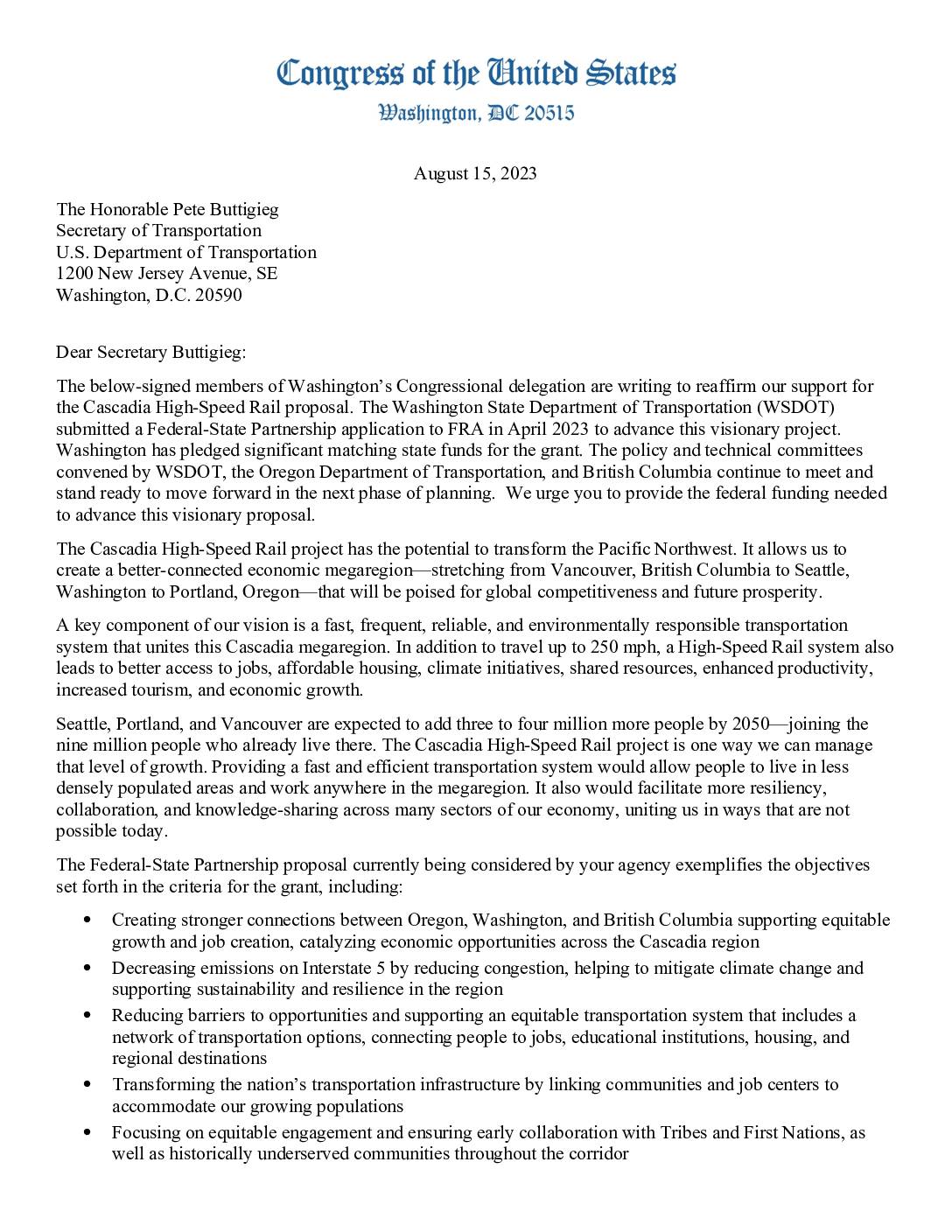
Washington State Congressional Delegation letter in support of Cascadia High Speed Rail proposal
A letter dated August 15, 2023, on U.S. Congress letterhead addressed to Secretary of Transportation Pete Buttigieg, in which members of Washington's Congressional delegation reaffirm support for the Cascadia High-Speed Rail proposal and urge federal funding for the project connecting Vancouver BC, Seattle, and Portland. -
 2023-06-15
Commercial Aviation Coordinating Commission Report to Legislative Transportation Committees: 2023 Final Recommendation
★ 32The Commercial Aviation Coordinating Commission (CACC) submitted its final report to the Washington State Legislature in June 2023, concluding that future commercial aviation capacity needs can only be met by identifying a new greenfield airport site, as no existing finalist location gained sufficient community support. The Commission was evenly divided on whether a new facility could be operational by 2040, with most members believing completion beyond 2050 is more realistic. The report and survey results were handed off to a follow-on work group established under ESHB 1791 to continue the site selection process. -
 2023-06-09
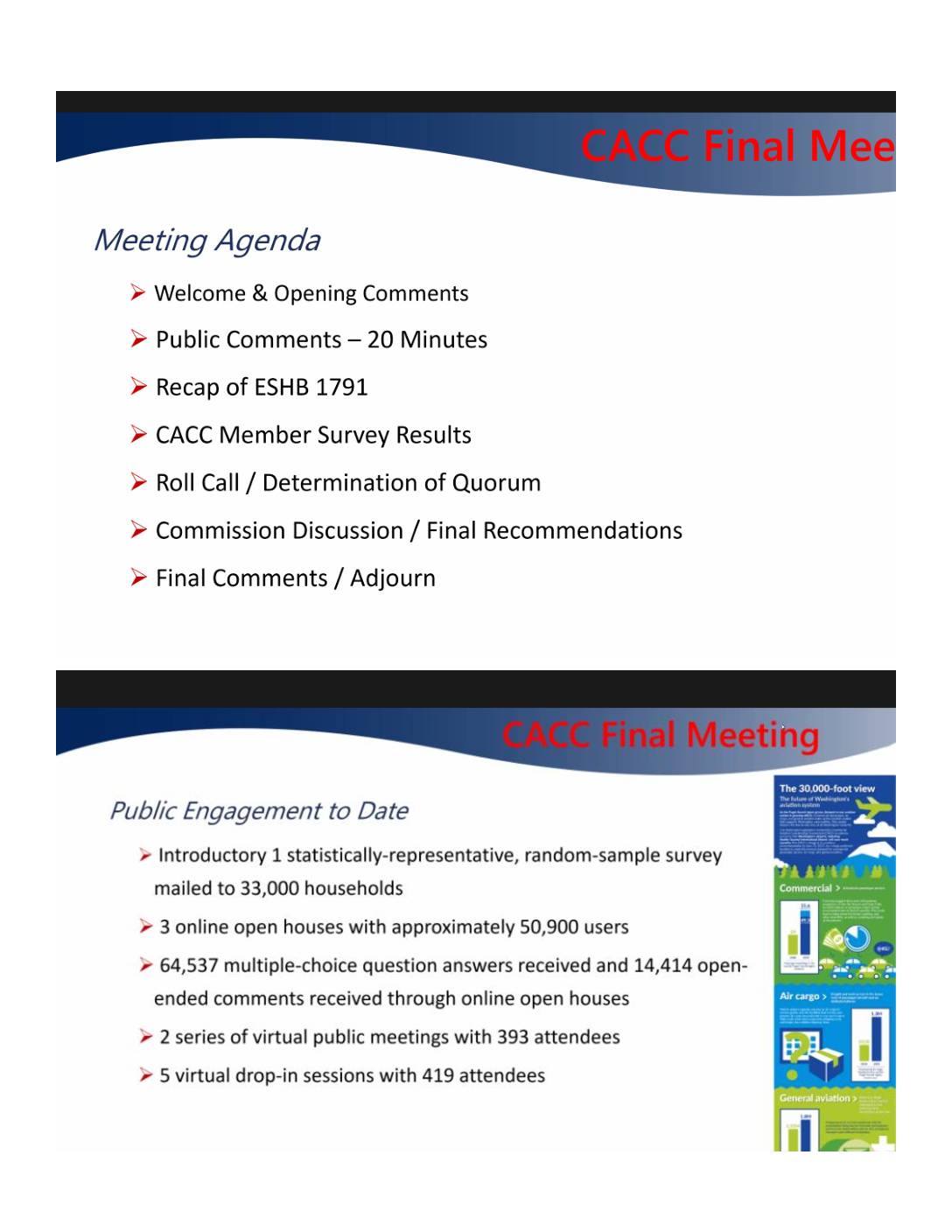
CACC Final Meeting: Commission Member Survey and ESHB 1791 Recap
This document presents the agenda and key materials from the final meeting of Washington State's Commercial Aviation Coordinating Commission (CACC), covering public engagement efforts, a recap of legislation ESHB 1791, and a commission member survey. The bill, signed by Governor Inslee, created a new Commercial Aviation Work Group (CAWG) to replace the CACC, though several sections were vetoed, including provisions for the CAWG task list, funding transfer, and immediate effect. A survey of commission members showed strong support (13 to 1) for the need for a new greenfield airport site to meet future commercial aviation capacity needs in the region. -
 2023-06-05
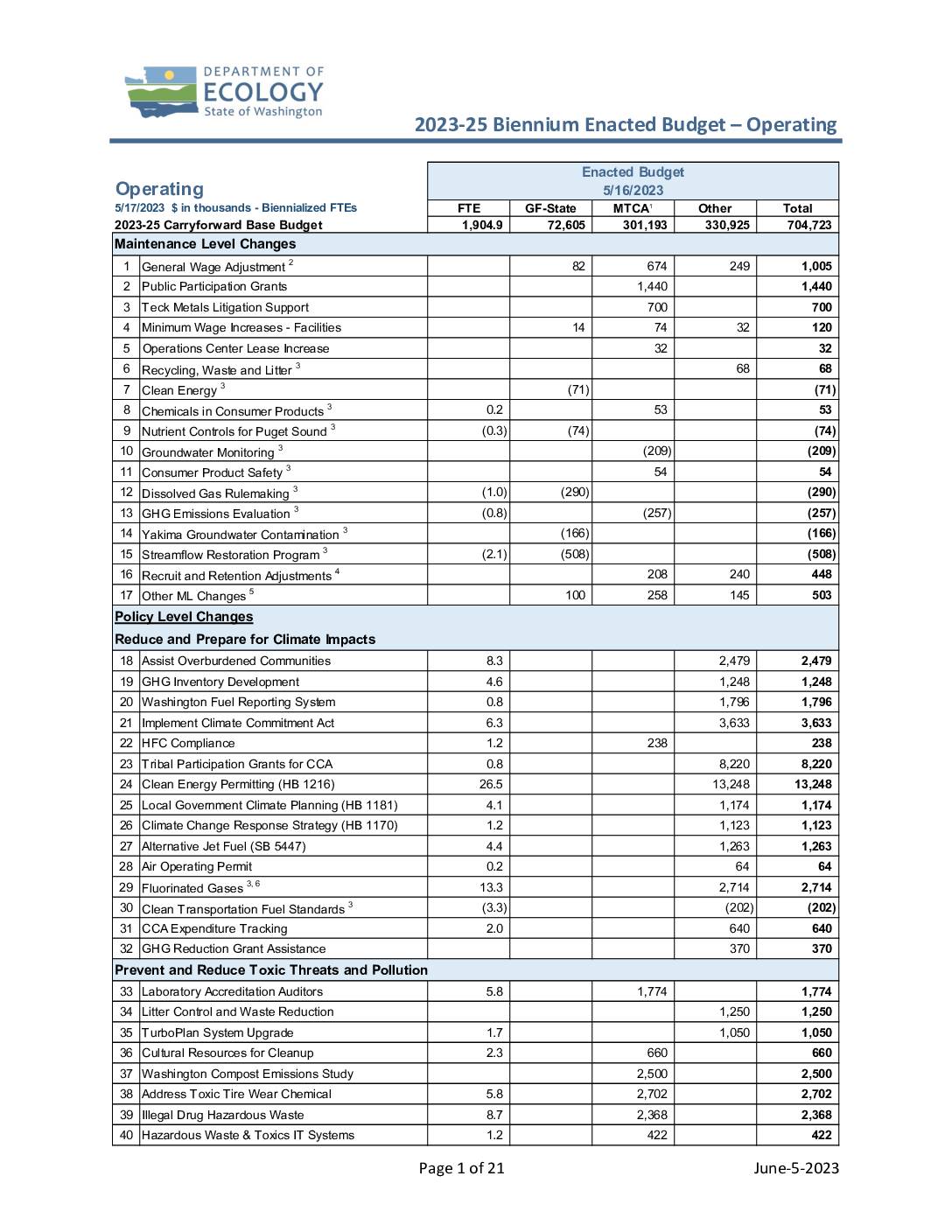
2023-25 Biennium Enacted Budget – Operating
This document outlines the Washington State Department of Ecology's 2023-25 Biennium Enacted Operating Budget, totaling approximately $862.6 million with 2,136.5 full-time employees. It details funding changes across priority areas including climate impact reduction, toxic threat prevention, and water protection, with notable investments in Clean Energy Permitting, Climate Commitment Act implementation, and water quality programs. The budget reflects a net increase of roughly $157.8 million over the carryforward base budget through a combination of maintenance level adjustments and new policy-level initiatives. -
 2023-05-16
Veto Letter for Engrossed Substitute House Bill 1791
Washington Governor Jay Inslee partially vetoed Engrossed Substitute House Bill 1791 on May 16, 2023, striking four sections while approving the rest of the bill, which creates a new State Commercial Aviation Work Group to study the need for additional airport capacity in Washington. The governor vetoed the section requiring simultaneous consideration of new airport sites alongside existing airport expansion, insisting the state should first fully explore increasing capacity at existing airports—excluding Sea-Tac—before pursuing a new airport. The vetoed sections also included a budget redirection of already-spent funds, a retroactive repeal of workgroup authority, and an emergency clause deemed unnecessary given the existing commission's June 2023 reporting timeline. -
2023-05-16
Veto Letter for Engrossed Substitute House Bill 1791
Washington Governor Jay Inslee partially vetoed Engrossed Substitute House Bill 1791 on May 16, 2023, striking four sections while approving the rest of the bill, which creates a new State Commercial Aviation Work Group to study the need for additional airport capacity in Washington. The governor vetoed the section requiring simultaneous consideration of new airport sites alongside existing airport expansion, insisting the state should first fully explore increasing capacity at existing airports—excluding Sea-Tac—before pursuing a new airport. The vetoed sections also included a budget redirection of already-spent funds, a retroactive repeal of workgroup authority, and an emergency clause deemed unnecessary given the existing commission's June 2023 reporting timeline. -
 2023-05-01
Puget Sound Regional Council Annual Report 2023
The Puget Sound Regional Council (PSRC) 2023 Annual Report highlights regional planning achievements including the adoption of a Regional Transportation Plan, a new Regional Housing Strategy, and Washington State's passage of House Bill 1110 to expand middle housing supply by an estimated 75,000 to 150,000 units over 20 years. The report also notes a $4.9 million grant secured for a Regional Safety Plan, progress on a Regional Equity Strategy, and efforts to support local comprehensive plan updates across the greater Puget Sound area. -
 2023-04-23
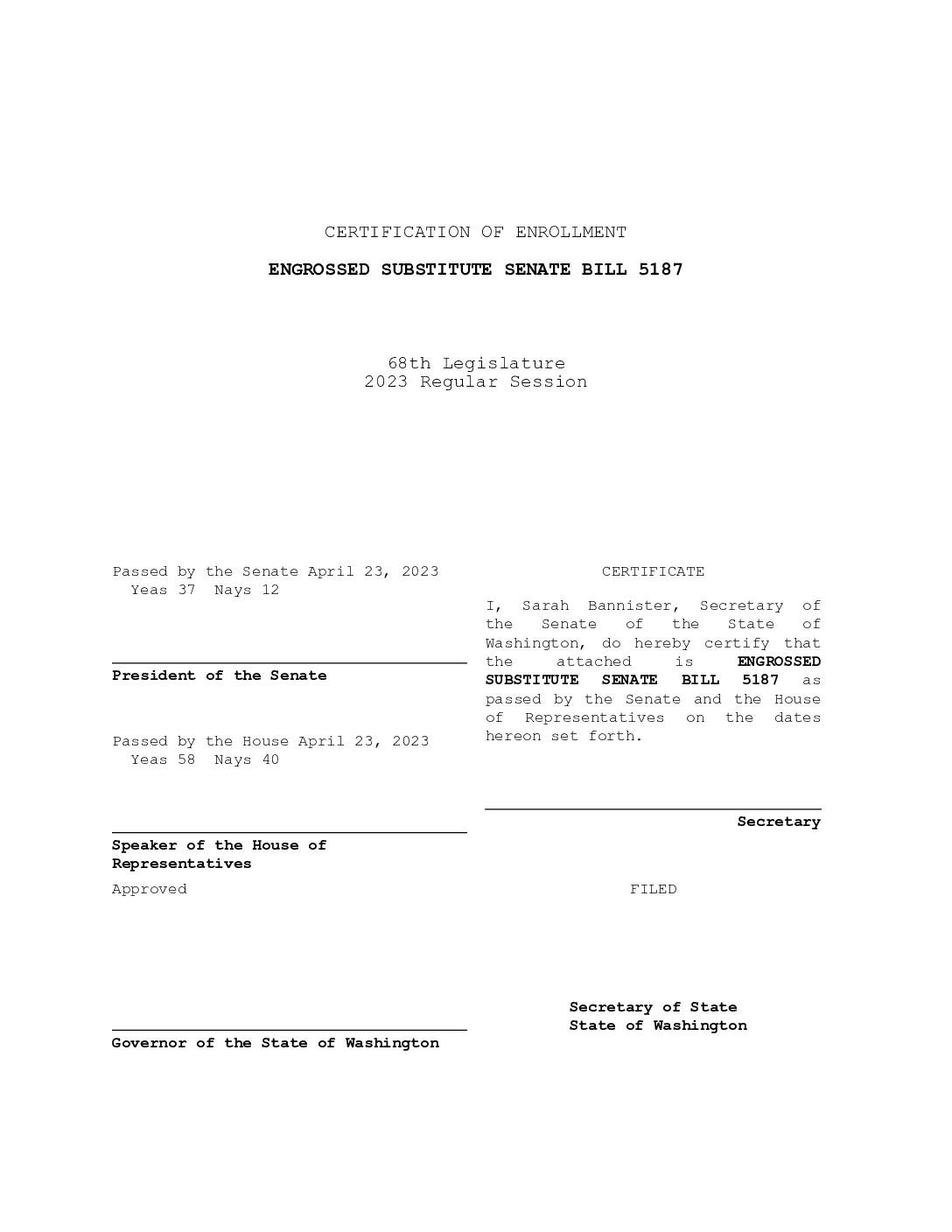
Engrossed Substitute Senate Bill 5187
Washington State Engrossed Substitute Senate Bill 5187, passed by both chambers of the legislature on April 23, 2023, is a broad fiscal appropriations act establishing the state budget for the 2023–2025 biennium (July 1, 2023 through June 30, 2025). The bill authorizes funding for salaries, wages, and operating expenses across numerous state agencies and offices, while also amending a wide range of existing state laws related to finance, health, education, and the environment. Note: this document pertains to general Washington State fiscal matters and does not appear to contain specific provisions related to Sea-Tac Airport noise policy.