TagWashington State Legislature(119)
-
 2021-01-01
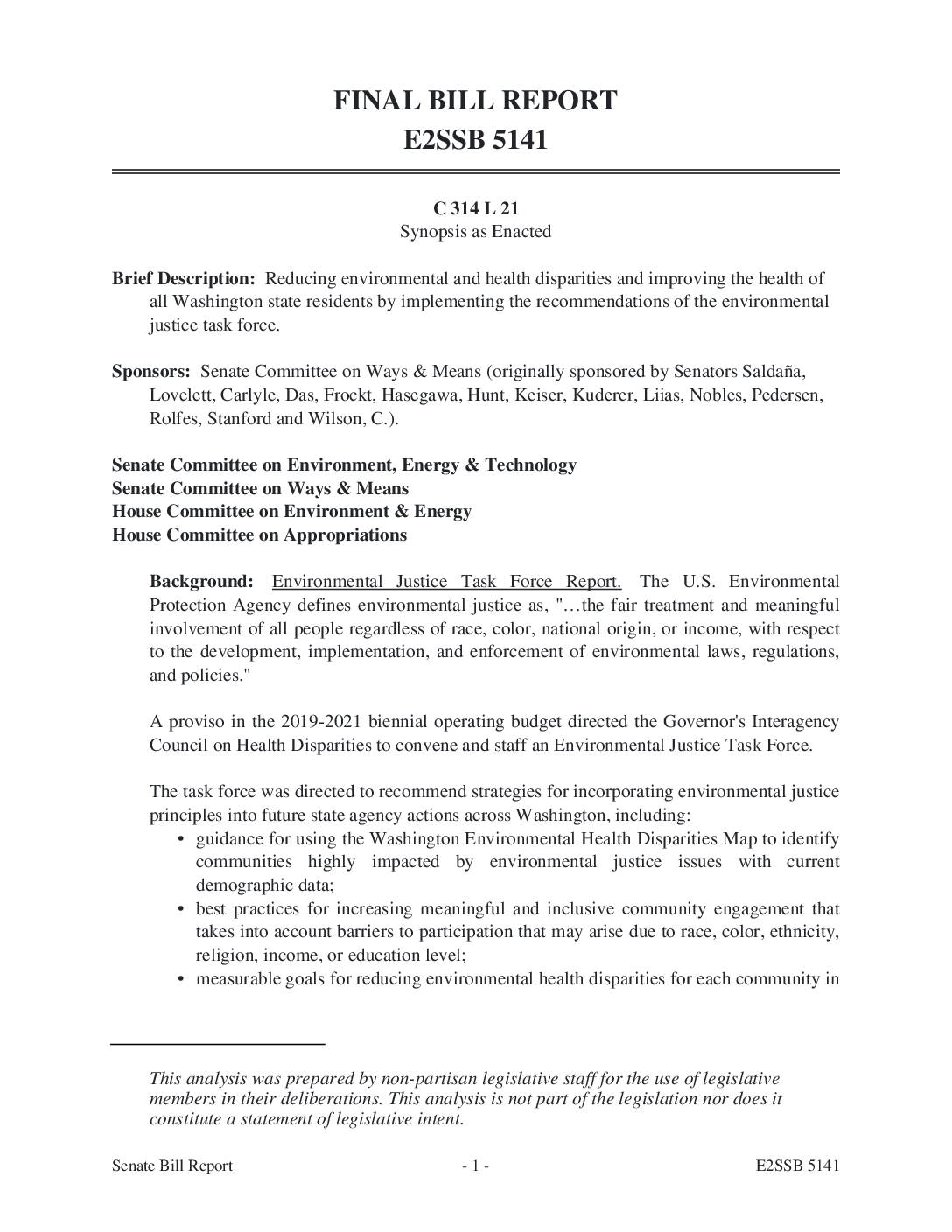
Final Bill Report: E2SSB 5141 — Washington Environmental Justice Act (HEAL Act)
Washington State's E2SSB 5141, enacted in 2021, requires key state agencies including Transportation and Ecology to incorporate environmental justice principles into their planning and decision-making processes, with a focus on protecting overburdened communities from disproportionate environmental and health harms. Agencies must develop community engagement plans by 2022, environmental justice implementation plans by 2023, and conduct formal environmental justice assessments for significant actions such as new rules, grants, and capital investments. Note: this legislation addresses statewide environmental justice policy broadly and does not specifically address Sea-Tac Airport noise issues. -
 2020-11-12
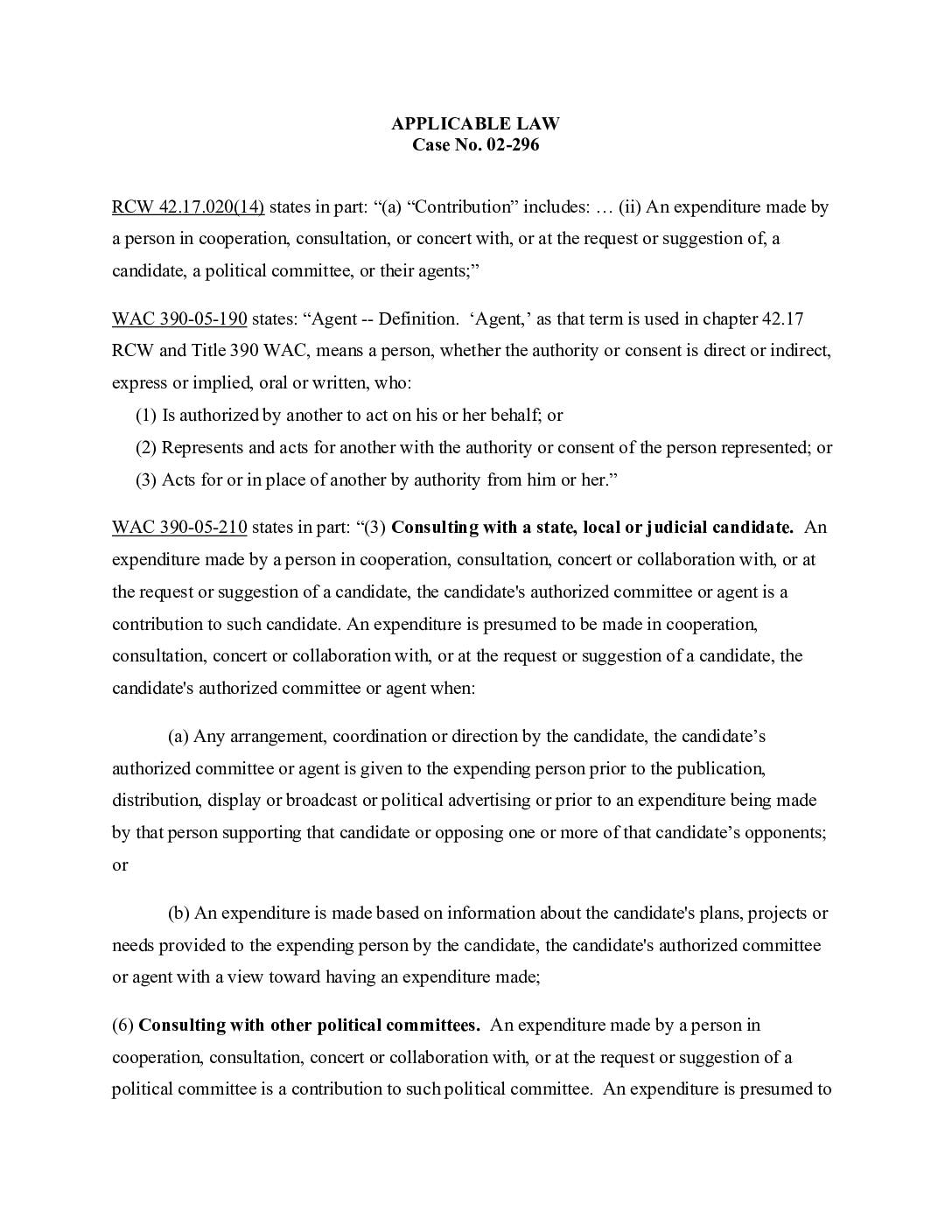
Applicable law, case no. 02-296
This document outlines Washington State campaign finance laws related to political contributions, coordination, and reporting requirements. It defines when an expenditure made by a third party counts as a campaign contribution — particularly when made in coordination with a candidate or political committee — and sets out registration and disclosure deadlines for political committees. These rules govern how campaigns and political organizations must track and report donations and spending. -
 2020-02-28
2020 Supplemental Operating Budget ESSB 6168 As Amended by the House – Agency Detail
This document presents the 2020 Supplemental Operating Budget (ESSB 6168) for Washington State, as amended by the House and published February 28, 2020 by the Office of Program Research. It provides a detailed breakdown of funding allocations and full-time equivalent staffing levels across state government sectors, including Legislative, Judicial, Human Services, Education, and Natural Resources, totaling over $102 billion in revised appropriations. The document covers base budget figures alongside supplemental adjustments for the 2019-21 biennium. -
 2020-02-25
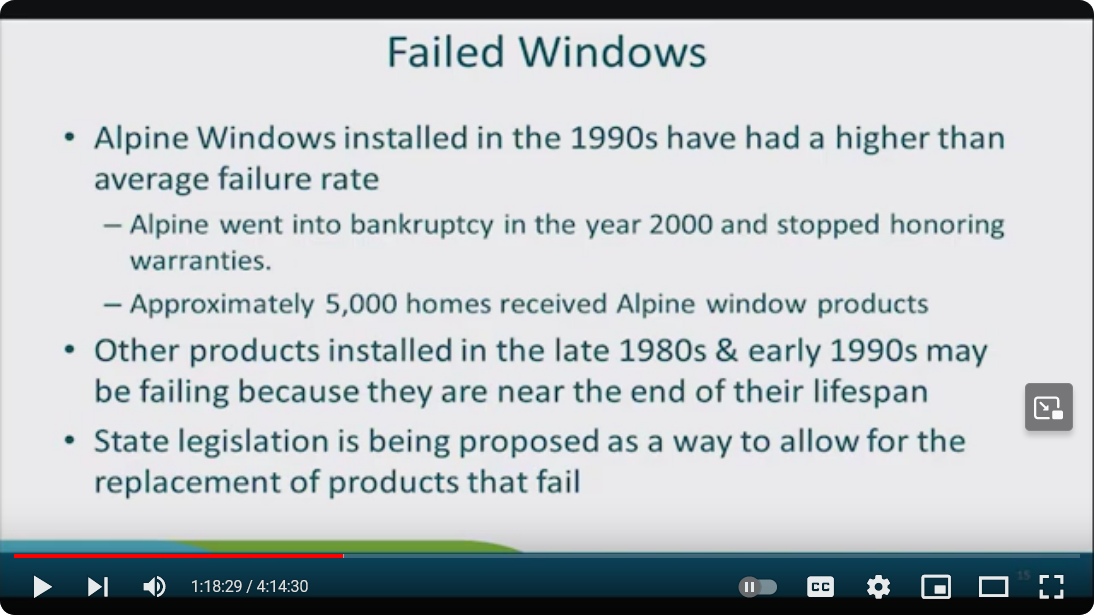
Failed windows
A presentation slide titled 'Failed Windows' states that Alpine Windows installed in the 1990s had a higher than average failure rate, that Alpine went bankrupt in 2000 and stopped honoring warranties, and that approximately 5,000 homes received Alpine window products. The slide also notes that other products from the late 1980s and early 1990s may be failing due to end-of-lifespan issues, and that state legislation is being proposed to allow replacement of failed products. -
 2020-01-28
Multiple agency fiscal note summary: Transportation policy goals (HB 2688)
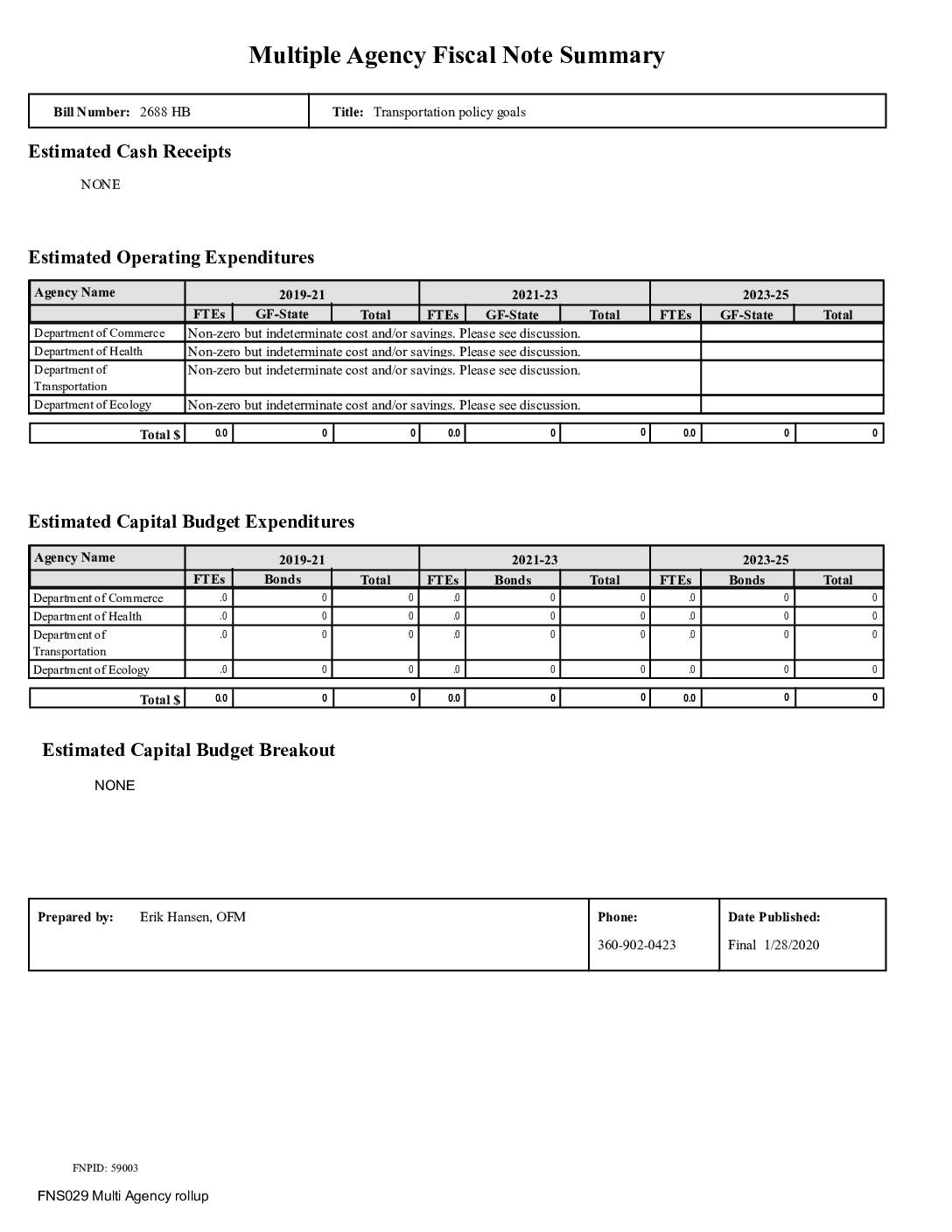
House Bill 2688 proposes changes to Washington State's transportation system policy goals, requiring the Department of Transportation (WSDOT) to evaluate transportation projects submitted to the legislature using updated policy criteria. Multiple state agencies — including the Departments of Commerce, Health, Ecology, and the Interagency Council on Health Disparities — would be required to participate in these project evaluations, along with representatives from vulnerable and highly impacted communities. The fiscal impact on participating agencies is estimated to be non-zero but indeterminate, with the Department of Commerce alone estimating costs of between $21,000 and $35,000 per year. -
 2020-01-22
HB 2688 bill analysis: Expanding transportation policy goals
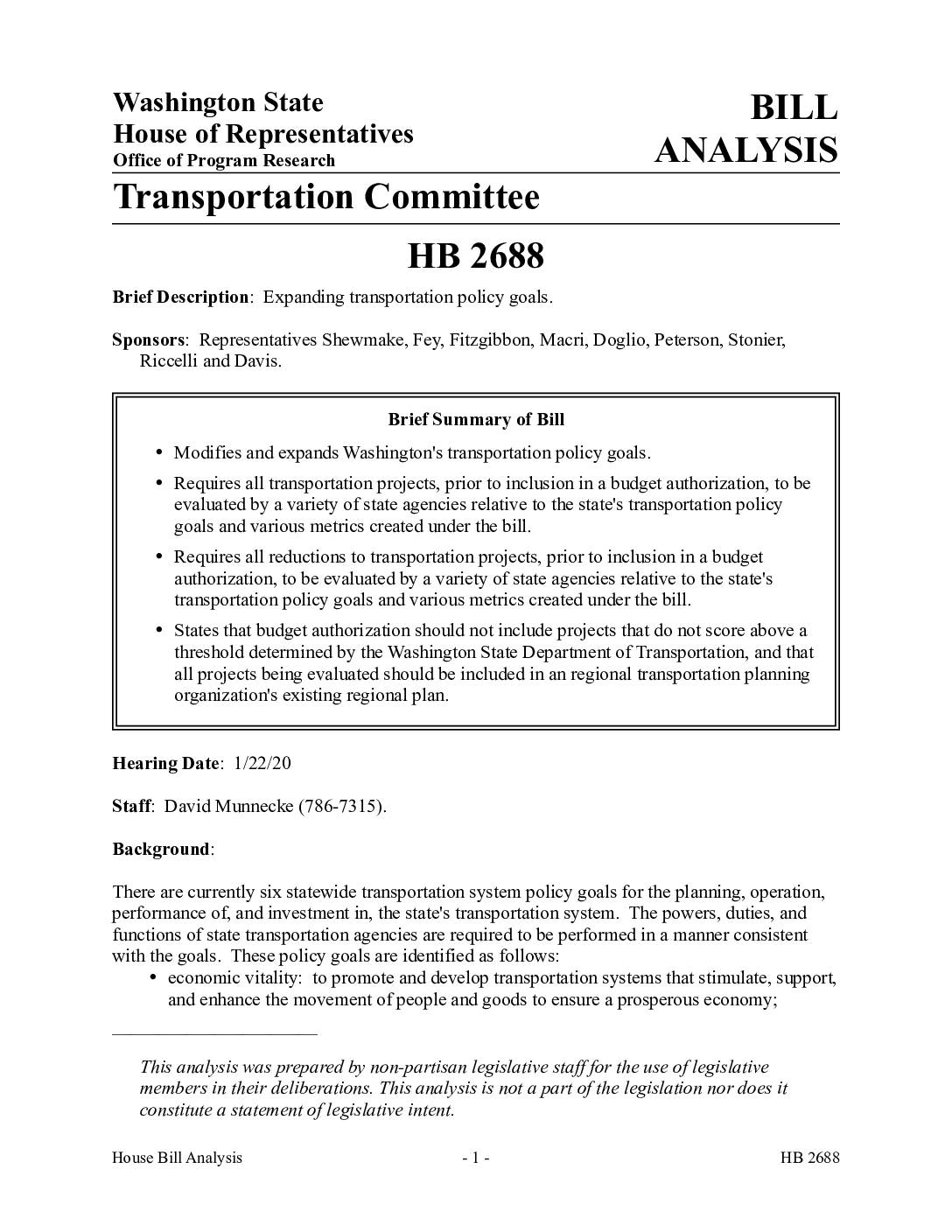
Washington State House Bill 2688 proposes expanding and modifying the state's transportation policy goals by adding new priorities such as accessibility, health and resilience, and equity and environmental justice, while removing existing goals like mobility and stewardship. The bill would require all transportation projects to be evaluated against these updated goals and specific metrics before receiving budget authorization, with projects failing to meet a minimum score threshold being excluded from funding. The evaluation process would involve multiple state agencies and must include public input from vulnerable and highly impacted communities. -
 2020-01-17
House Bill 2688: Relating to transportation policy goals
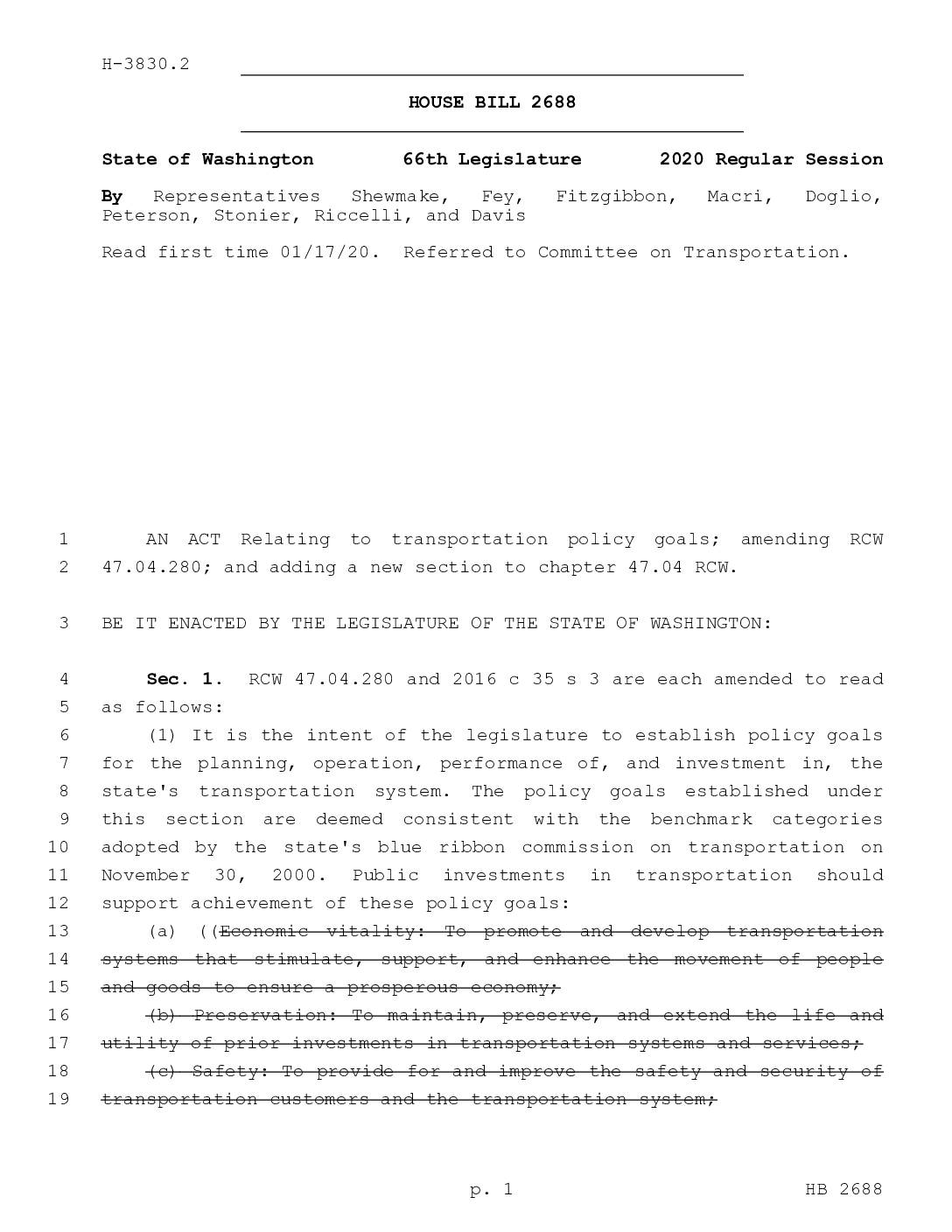
Washington House Bill 2688, introduced in the 2020 legislative session, proposes updating the state's transportation policy goals to prioritize accessibility, environmental justice, public health, and climate by replacing older goals focused primarily on economic vitality and mobility. The bill would require transportation projects to undergo a multi-agency evaluation—including input from vulnerable and impacted communities—before receiving budget authorization. Projects that do not meet a minimum score based on the new policy goals would generally be excluded from funding. -
 2020-01-01
Understanding the health effects of jet pollution around Sea-Tac Airport
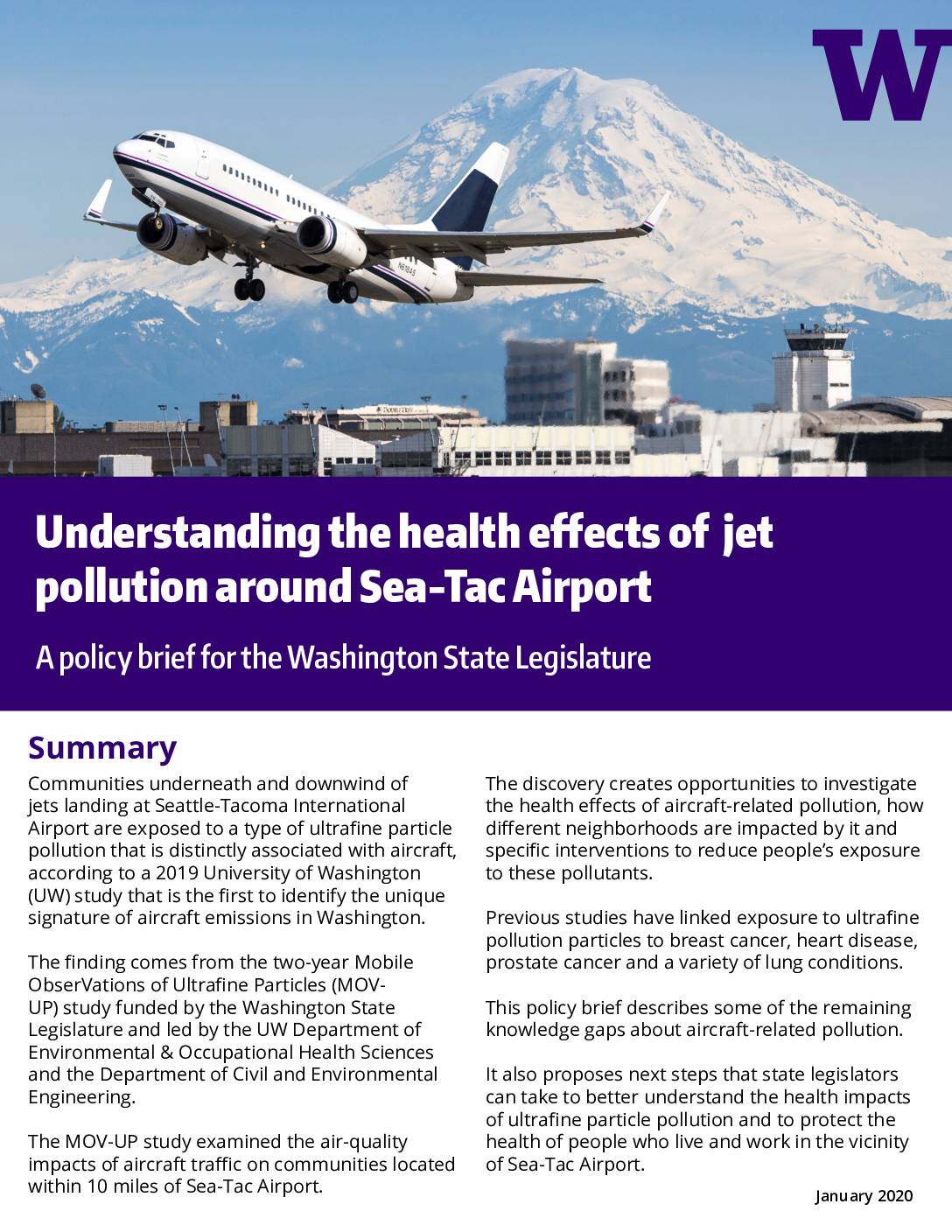
A 2019 University of Washington study found that communities within 10 miles of Seattle-Tacoma International Airport are exposed to ultrafine particle pollution uniquely linked to aircraft emissions, distinct from roadway traffic pollution. These microscopic particles — 700 times thinner than a human hair — are not currently regulated by federal or state air-quality standards, and prior research has associated them with breast cancer, heart disease, prostate cancer, and lung conditions. The policy brief calls on Washington State legislators to fund a follow-up two-year study to investigate the health impacts on nearby communities, which tend to be poorer and more racially diverse than King County as a whole. -
 2019-10-28
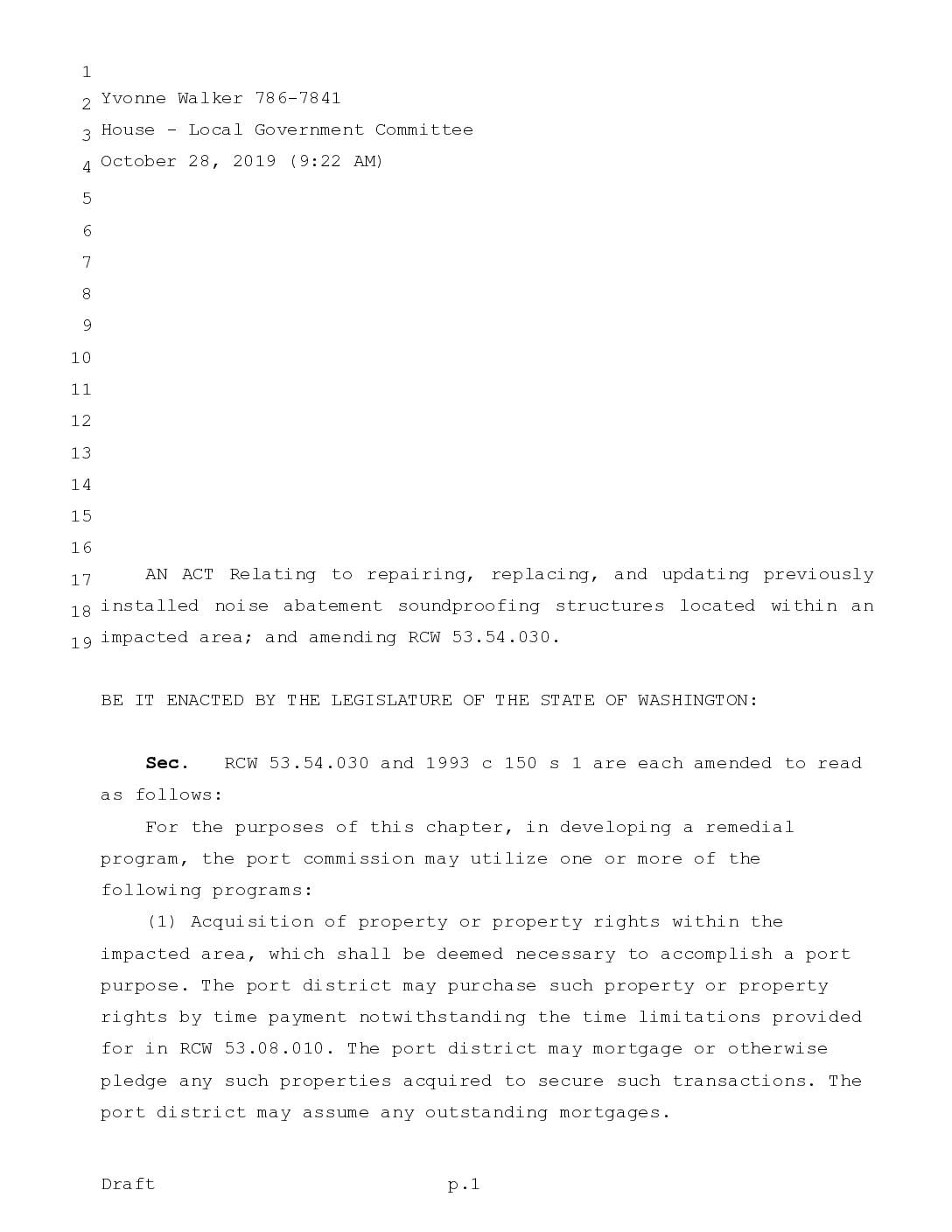
Draft Legislation: An Act Relating to Repairing, Replacing, and Updating Previously Installed Noise Abatement Soundproofing Structures Located Within an Impacted Area; Amending RCW 53.54.030
This 2019 Washington State draft legislation proposes amending RCW 53.54.030 to allow port districts to repair, replace, or upgrade previously installed noise abatement soundproofing structures in areas impacted by aircraft noise. Under existing law, individual properties generally cannot receive benefits from the same remedial program more than once, but this bill creates an exception for properties where soundproofing installations have deteriorated and need maintenance or improvement. The bill also preserves existing port commission tools such as property acquisition, transaction assistance, mortgage insurance, and land management programs for noise-impacted communities near airports like Sea-Tac. -
 2019-09-17
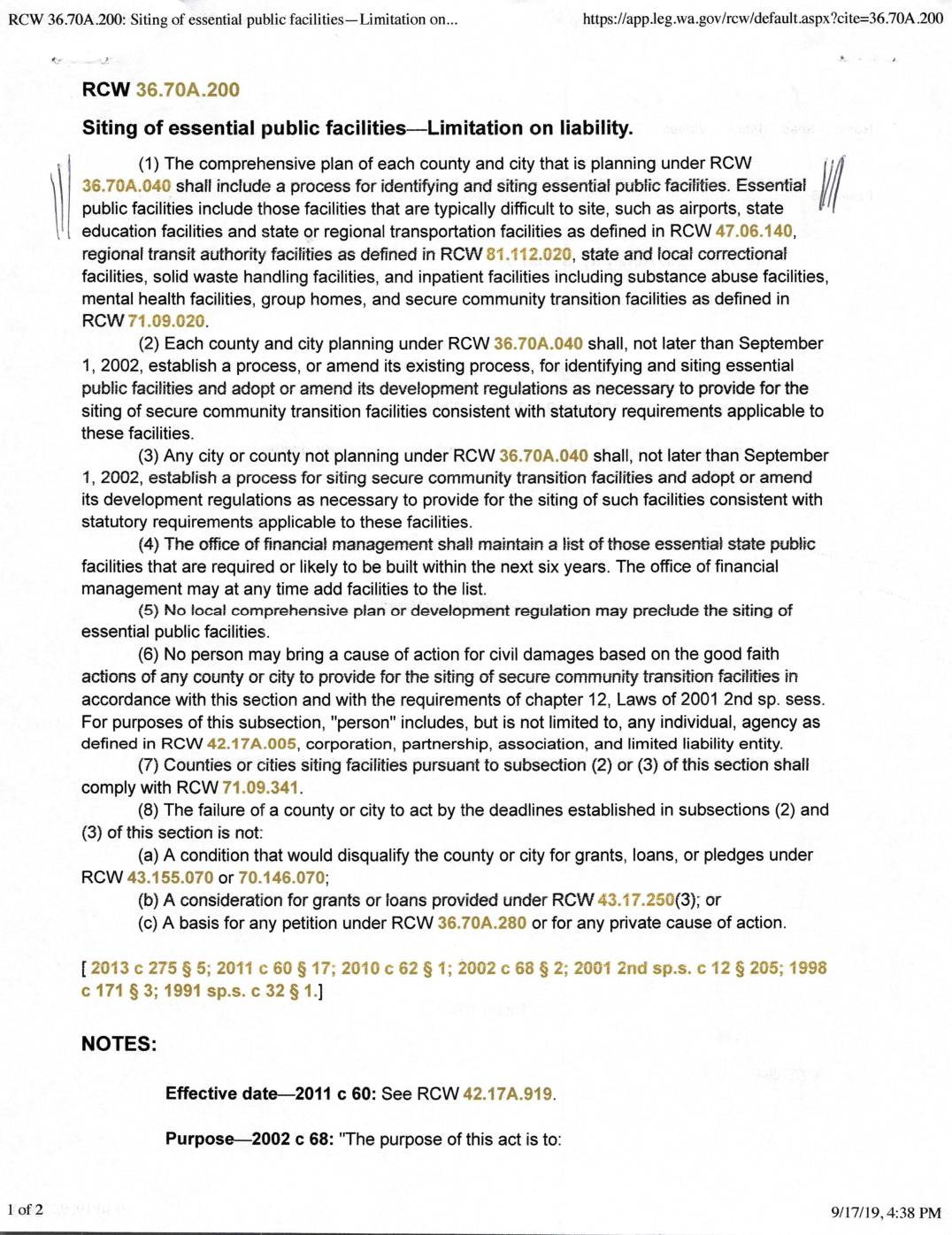
RCW 36.70A.200: Siting of essential public facilities—Limitation on liability
RCW 36.70A.200 requires counties and cities planning under Washington's Growth Management Act to include a process in their comprehensive plans for identifying and siting 'essential public facilities' — those typically difficult to site, such as airports, state education facilities, regional transportation facilities, correctional facilities, solid waste handling facilities, and inpatient care facilities. No local comprehensive plan or development regulation may outright prohibit the siting of these essential public facilities. The Office of Financial Management maintains a list of essential state public facilities likely to be built within the next six years.