I understand that you will never share my information with anyone, you will only use it to keep me updated on relevant events and that I may unsubscribe at any time.
The Puget Sound Clean Air Agency's Monitoring Team provides an October 2024 update on their ongoing ultrafine particle (UFP) monitoring program, explaining that UFPs are extremely tiny particles smaller than 0.1 microns that are not currently regulated under air quality standards. The presentation covers key concepts such as particle number concentration (PNC), monitoring instrumentation, and WHO good practice recommendations for UFP measurement. While not specific to noise policy, this monitoring effort is relevant to understanding air quality impacts near high-traffic areas such as airports.
Puget Sound Clean Air Agency (PSCAA) Monitoring Team October 2024 presentation on ongoing ultrafine particle (UFP) monitoring. Covers key acronyms and facts: UFP defined as particles less than 100 nm or 0.1 microns, particle number concentration (PNC), SMPS (Scanning Mobility Particle Size Spectrometer), and the fact that UFPs account for more than 80% of PNC. Notes UFPs are not a criteria pollutant under current air quality standards, with no reference methodology or SOP. References WHO 2021 good practice statement on UFP monitoring, including recommended PNC thresholds (low PNC < 1,000 particles/cm3 24-hour mean; high PNC > 10,000 particles/cm3 24-hour mean or 20,000 particles/cm3 1-hour). Includes size comparison of PM10, PM2.5, and ultrafine (0.1 µm) particles.
Title slide from a Monitoring Team presentation dated October 2024, titled 'Update on our ongoing ultrafine monitoring.' The slide features a red-toned banner image with silhouetted evergreen trees, consistent with environmental air quality monitoring reports relevant to airport-area pollution studies.
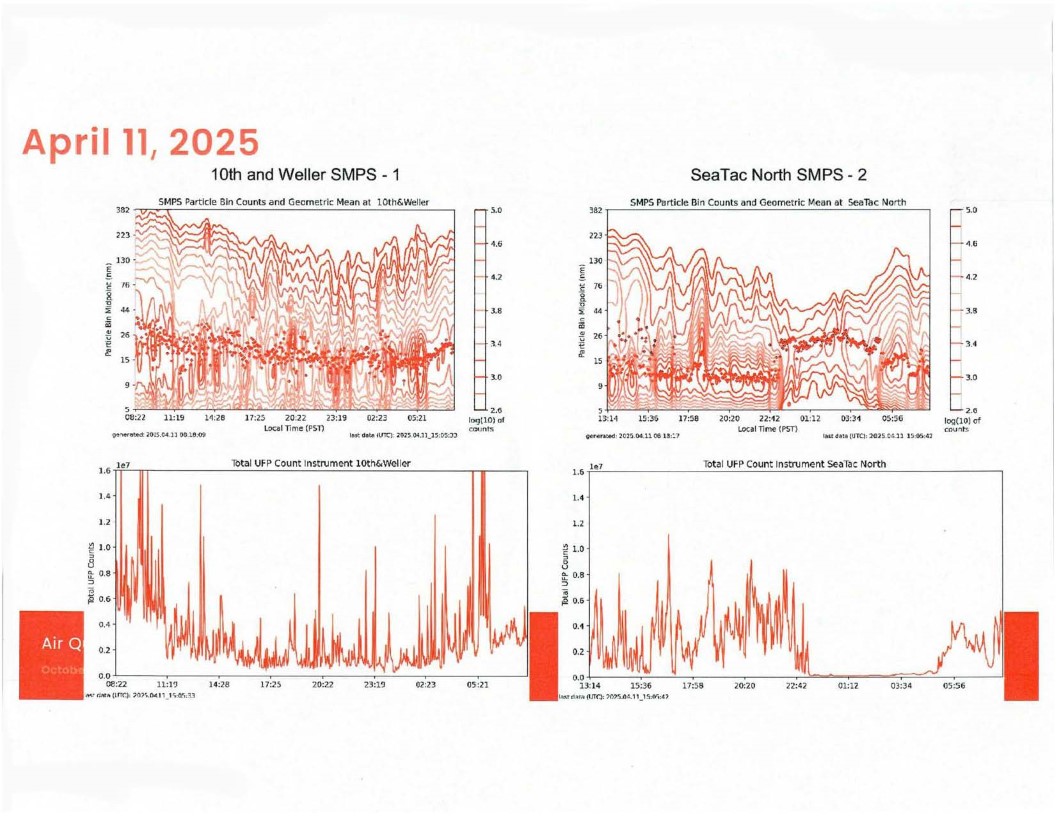
Air quality monitoring report dated April 11, 2025 showing SMPS (Scanning Mobility Particle Sizer) particle bin counts, geometric mean particle size distributions, and total ultrafine particle (UFP) counts for two monitoring stations: 10th and Weller (SMPS-1) and SeaTac North (SMPS-2). Data spans approximately 08:22 to 05:21 local PST time, with total UFP counts reaching peaks near 1.6×10^7 at both locations.
A presentation slide from the Puget Sound Clean Air Agency's Air Quality Programs – UFP (Ultrafine Particles) program, dated October 2024, listing research collaborations including the University of Washington MOV-UP study and the ASCENT study, with Olivia Hakan from UW working with ORCAA on rural measurements.
Slide from a Puget Sound Clean Air Agency 'Air Quality Programs – UFP' presentation (October 2024) showing a scatter plot of PM2.5 (µg/m³) versus Particle Number Concentration (PNC, particles/cm³) at roadside and urban background sites worldwide, based on De Jesus et al., 2019. The slide notes the relationship is not linear based on yearly averages, with cities including Toronto (YYZ), Helsinki (HEL), Barcelona (BCN), London (LON), Brisbane (BNE), Milan (MIL), Los Angeles (LA), Shanghai (SHA), and Nanjing (NKG) plotted.
A presentation slide from the Puget Sound Clean Air Agency's Air Quality Programs – UFP (Ultrafine Particle) program, dated October 2024, explaining the measurement theory for particles under 2.5 microns using a classifier, DMA (differential mobility analyzer), and CPC (condensation particle counter). The accompanying photo shows equipment installed at '10th and Weller,' with particle diameters ranging from 5–15 nm to 400–1000 nm.
A presentation slide from the Puget Sound Clean Air Agency's Air Quality Programs – UFP (Ultrafine Particles) program, dated October 2024, outlining next steps including relocating a 2nd SMPS instrument to the SeaTac site, analyzing data in partnership with the University of Washington, and making sampling protocols and findings accessible to the public. The slide includes a photograph of monitoring equipment and the agency's CAA logo.
A presentation slide from the Puget Sound Clean Air Agency's Air Quality Programs – UFP (Ultrafine Particles) unit, dated October 2024, describing an ongoing instrument collocation study begun September 24, 2024, to assess precision and repeatability using sampling rates of 1, 2.5, and 5 minutes. The accompanying photo shows monitoring instrumentation installed at the '10th and Weller' site.
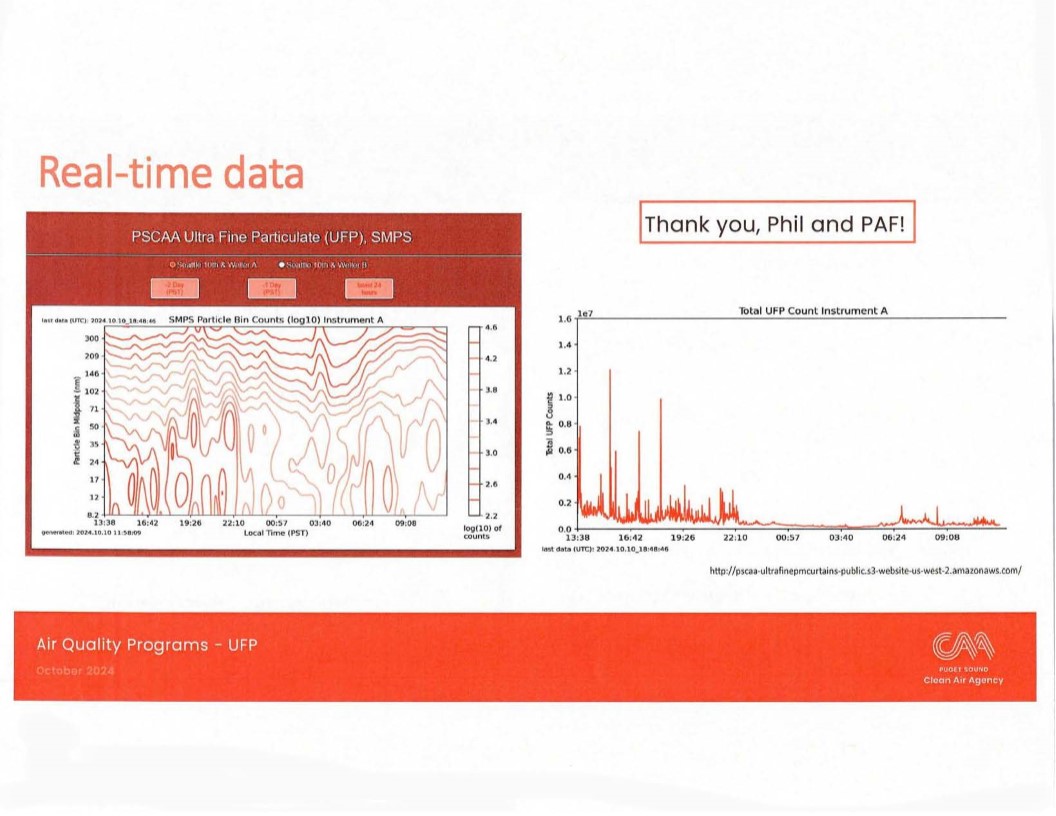
A presentation slide from the Puget Sound Clean Air Agency (PSCAA) Air Quality Programs – UFP, dated October 2024, displaying real-time Ultra Fine Particulate (UFP) SMPS data from Seattle 10th & Weller monitoring stations. The slide includes a contour plot of SMPS Particle Bin Counts and a time-series graph of Total UFP Count Instrument A, with data timestamped 2024-10-10, and a acknowledgment reading 'Thank you, Phil and PAF!'
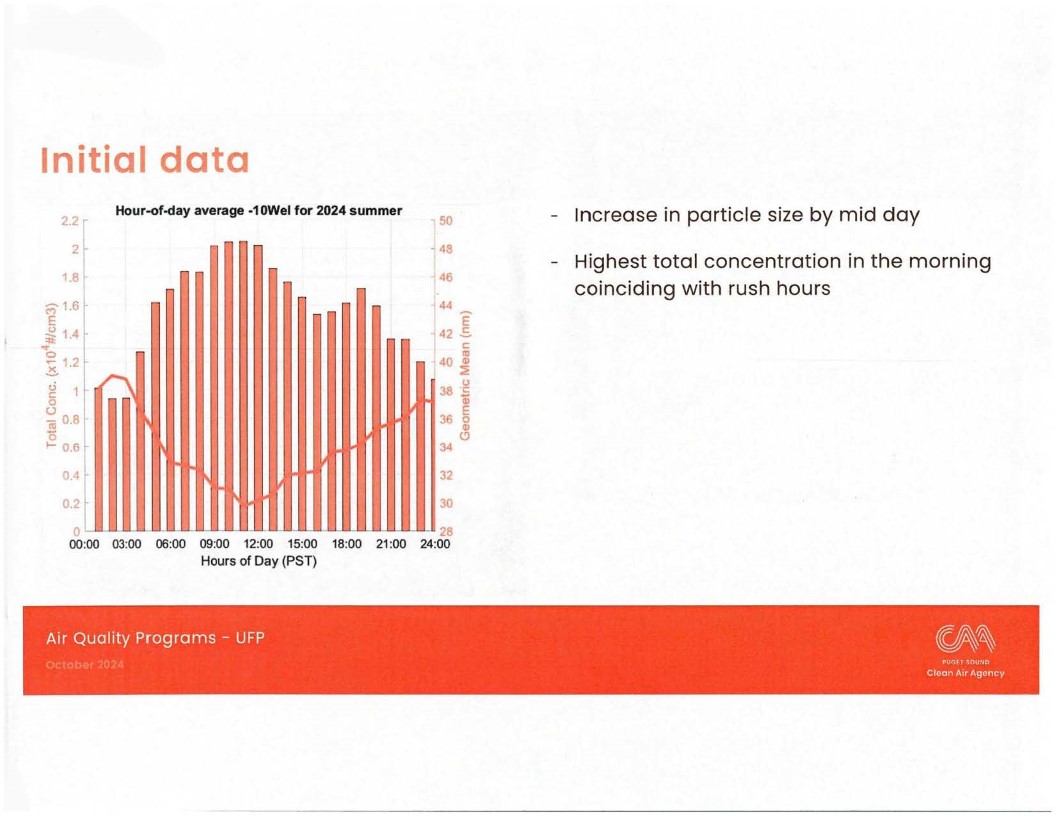
A presentation slide from the Puget Sound Clean Air Agency's Air Quality Programs – UFP (Ultrafine Particles) program, dated October 2024, showing a bar and line chart of hour-of-day average particle concentration and geometric mean size (-10Wel sensor) for summer 2024. Key findings noted are an increase in particle size by midday and highest total particle concentration in the morning coinciding with rush hours.
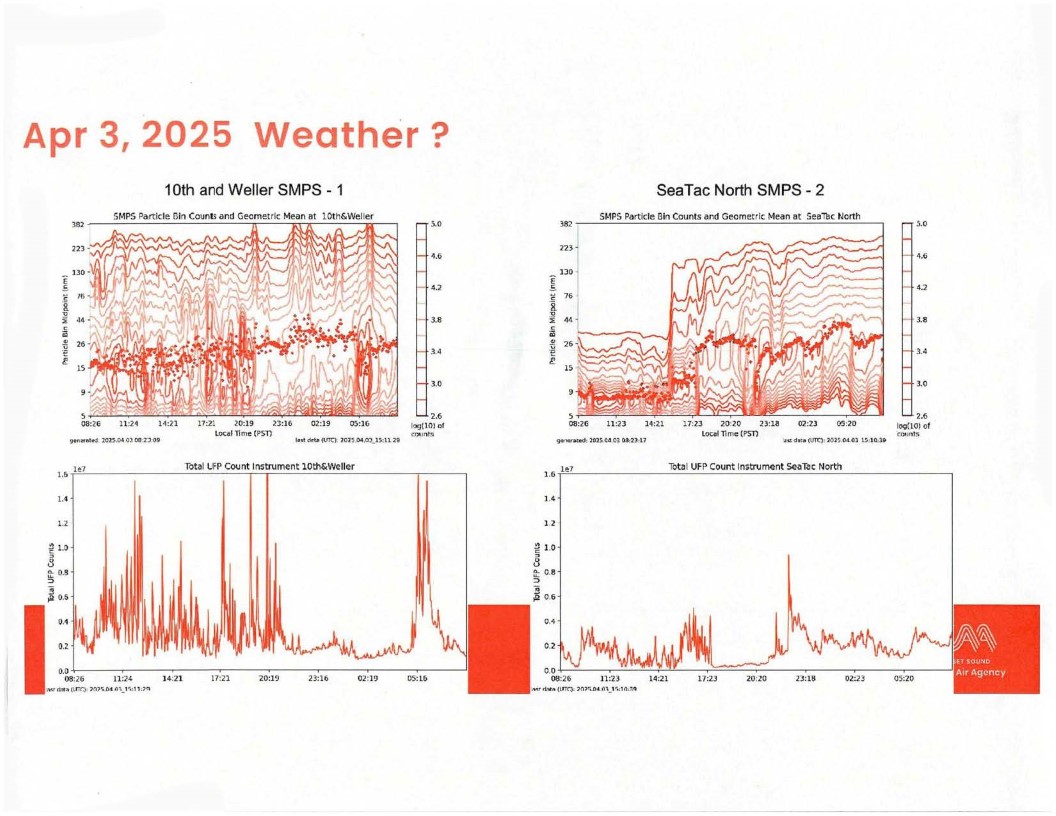
Puget Sound Clean Air Agency data slides dated April 3, 2025, showing SMPS particle bin counts and total ultrafine particle (UFP) counts at two monitoring stations: 10th and Weller (Seattle) and SeaTac North. The charts display particle size distributions and UFP count spikes over a roughly 24-hour period, labeled with the question 'Apr 3, 2025 Weather?' suggesting weather context is being examined in relation to UFP levels.
An EPA-sourced infographic published by Nature (nature.com/articles/s12276-020-0405-1) illustrating the relative sizes of ultrafine particles (UFPs at 0.1 µm), fine particles (PM2.5 at <2.5 µm), and coarse particles (PM10 at <10 µm) compared to human hair (50–70 µm) and fine beach sand (90 µm). The graphic shows that for equal total mass, a single 10 µm coarse particle equals 64 fine particles or 1,000,000 ultrafine particles.
Title slide from a presentation by the Monitoring Team dated October 2024, titled 'Update on our ongoing ultrafine monitoring.' The slide features a red banner header with silhouetted conifer trees, consistent with environmental monitoring reporting likely related to airport or aviation emissions impact studies.
A presentation slide from the Puget Sound Clean Air Agency's Air Quality Programs – UFP (Ultrafine Particles) program, dated October 2024, showing two weeks of air quality monitoring data collected at Seattle's 10th & Weller location in August. The slide displays size distribution (log scale), total UFP counts, PM2.5 concentrations, and wind speed/direction data, noting that particle counts correlate with black carbon but not strongly with PM2.5, and are sensitive to weather patterns.
A slide from the Puget Sound Clean Air Agency's Air Quality Programs – UFP (Ultrafine Particles) presentation, dated October 2024, showing aerial maps of two air quality monitoring sites: 10th & Weller and Sunset Park. The slide is unrelated to Sea-Tac Airport noise policy and instead documents urban air quality monitoring locations in the Seattle area.
A presentation slide from the Puget Sound Clean Air Agency's Air Quality Programs – UFP division, dated October 2024, detailing ultrafine particle (UFP) monitoring funded by a Washington State legislative proviso ($370k for two sites: near-road at 10th and Weller and North SeaTac). The slide notes guidance from the ASCENT network and University of Washington, and additional UFP work via the TREE trailer; a photo shows the instrument installation at 10th and Weller.
A presentation slide from the Puget Sound Clean Air Agency's Air Quality Programs – UFP series (October 2024) summarizing health impacts of ultrafine particles (UFPs), including their ability to penetrate deep into the respiratory system, reach the circulatory system and organs, and potentially affect the brain via the olfactory nerve. The slide notes that while UFPs have potential for harm, their role in specific illnesses and epidemiology is not yet well understood.
A presentation slide from the Puget Sound Clean Air Agency's Air Quality Programs – UFP series (October 2024) listing sources of ultrafine particles, including road traffic, shipping, aviation, biomass burning, industrial emissions, and residential heating. The slide notes that primary UFPs from traffic decrease drastically after rush hours with fast dilution rates dropping concentrations within tens of meters from the source.
A slide from Puget Sound Clean Air Agency's Air Quality Programs – UFP presentation (October 2024) illustrating how small ultrafine particles (UFPs) are relative to human hair and fine beach sand, and showing that particles of equal total mass at 0.1 µm (ultrafine) number 1,000,000 compared to just 1 coarse particle at 10 µm. Source data attributed to EPA and a Nature article (doi referenced).
A presentation slide from the Puget Sound Clean Air Agency (October 2024) titled 'Couple acronyms & facts to start,' defining key terms including Ultrafine Particles (UFP), Particle Number Concentration (PNC), and Scanning Mobility Particle Sizer (SMPS), and noting that UFPs are not regulated criteria pollutants. An inset box references WHO 2021 good practice statements on UFP monitoring.
Air quality monitoring data from November 14, 2024, showing SMPS (Scanning Mobility Particle Sizer) particle bin counts (log10) and total ultrafine particle (UFP) counts for two co-located instruments at the 10th and Weller monitoring site, used to assess measurement precision. The charts span approximately 14:51 PST on Nov 13 through 09:11 PST on Nov 14, 2024, and appear to be produced by an organization whose partial logo (likely Air Quality or similar agency) is visible in the lower corners.
Two-panel scientific chart from the Puget Sound Clean Air Agency's Air Quality Programs – UFP (Ultrafine Particle) monitoring report, dated October 2024, showing particle size distribution (dN/dlogDp in #x10⁴/cm³ vs. diameter in nm) and a time-series for Thursday, July 18, 2024, tracking total particle concentration and black carbon (ug/m3) throughout the day in Pacific Standard Time.
We use cookies to provide basic functionality. We also provide access to search engines in order to provide site analytics. We do not sell or share your data.