• The toxic killers in our air too small to see

    Current pollution meters don’t count the very smallest pollutants – nanoparticles. Recent research suggests these tiny toxic substances could be a major cause of illness and death. By Tim Smedley 15th November 2019 A After years of headlines about air pollution, we’ve been misled on a few things about the world’s biggest environmental health problem.
  • 2019-01-23

    Mobile ObserVations of Ultrafine Particles (MOV-UP) advisory

    The MOV-UP (Mobile ObserVations of Ultrafine Particles) study, presented at the Highline Forum in January 2019, was commissioned under a Washington State proviso to investigate air quality impacts from Sea-Tac Airport traffic. Researchers from the University of Washington measured ultrafine particle (UFP) concentrations in communities surrounding the airport, aiming to distinguish aircraft-related pollution from other sources. A final study report was due to local governments and the community by December 1, 2019.
  • 2016-12-27

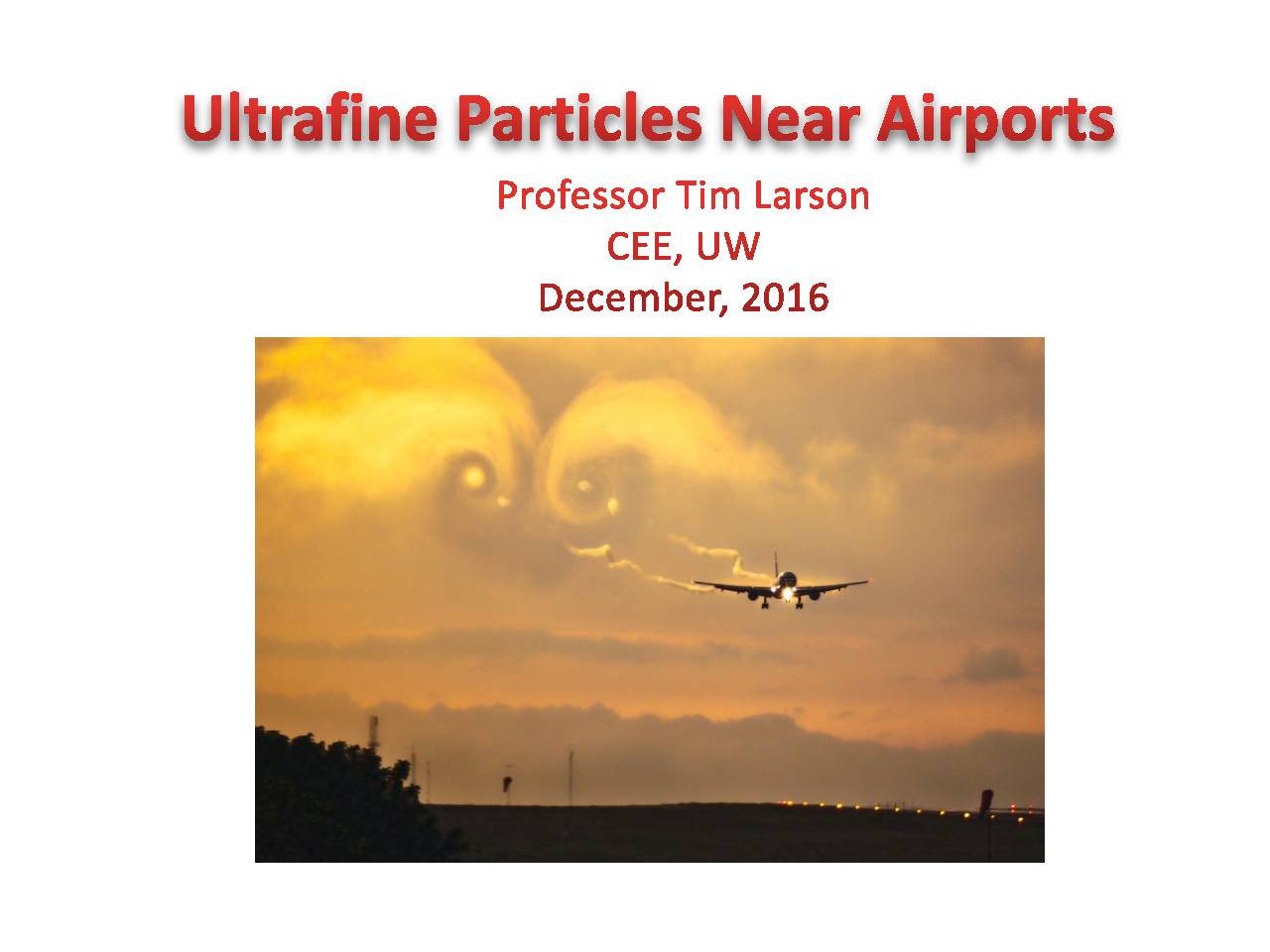
    Ultrafine Particles Near Airports

    Presentation by Professor Timothy Larson, University of Washington Department of Civil and Environmental Engineering (CEE/UWDEOHS), on ultrafine particles (UFPs) near airports, delivered December 2016. Covers UFP characteristics, size ranges (sub-100nm), and comparison to diesel smoke, combustion products, tobacco smoke, carbon black, and other particulates. Collaborative research with USC researchers Scott Fruin and Neelakshi Hudda, and
  • 2016-12-27

    Ultrafine Particles Near Airports

    This December 2016 presentation by University of Washington Professor Tim Larson examines ultrafine particles (UFPs) — tiny airborne particles smaller than 0.1 micrometers — found near airports, including sources such as jet engine exhaust and other combustion products. The research, conducted in collaboration with USC scientists, investigates the concentration and spread of these microscopic particles in communities surrounding airports. The findings are relevant to ongoing discussions about air quality and public health impacts near facilities like Sea-Tac Airport.
  • 2016-12-01

    Ultrafine Particles Near Airports

    This December 2016 presentation by University of Washington Professor Tim Larson examines ultrafine particles (UFPs) — tiny airborne particles smaller than 0.1 micrometers — found near airports, with a focus on emissions from aircraft and other combustion sources. Conducted in collaboration with researchers from UW and USC, the study explores how these microscopic particles, which are far smaller than diesel smoke or tobacco smoke particles, may pose environmental and health concerns for communities near airports like Sea-Tac. The research provides scientific context for understanding air quality impacts associated with airport operations.
  • 2016-12-01

    Ultrafine Particles Near Airports

    Presentation by Professor Tim Larson (CEE, University of Washington) on ultrafine particles (UFPs) near airports, delivered December 2016. Covers what UFPs are, their size range (sub-100nm), and sources including diesel smoke, combustion products, tobacco smoke, and aviation emissions. Collaborative research between UW (DEOHS) and USC researchers Scott Fruin and Neelakshi Hudda. References ACI EUROPE UFP
  • 2013-08-24

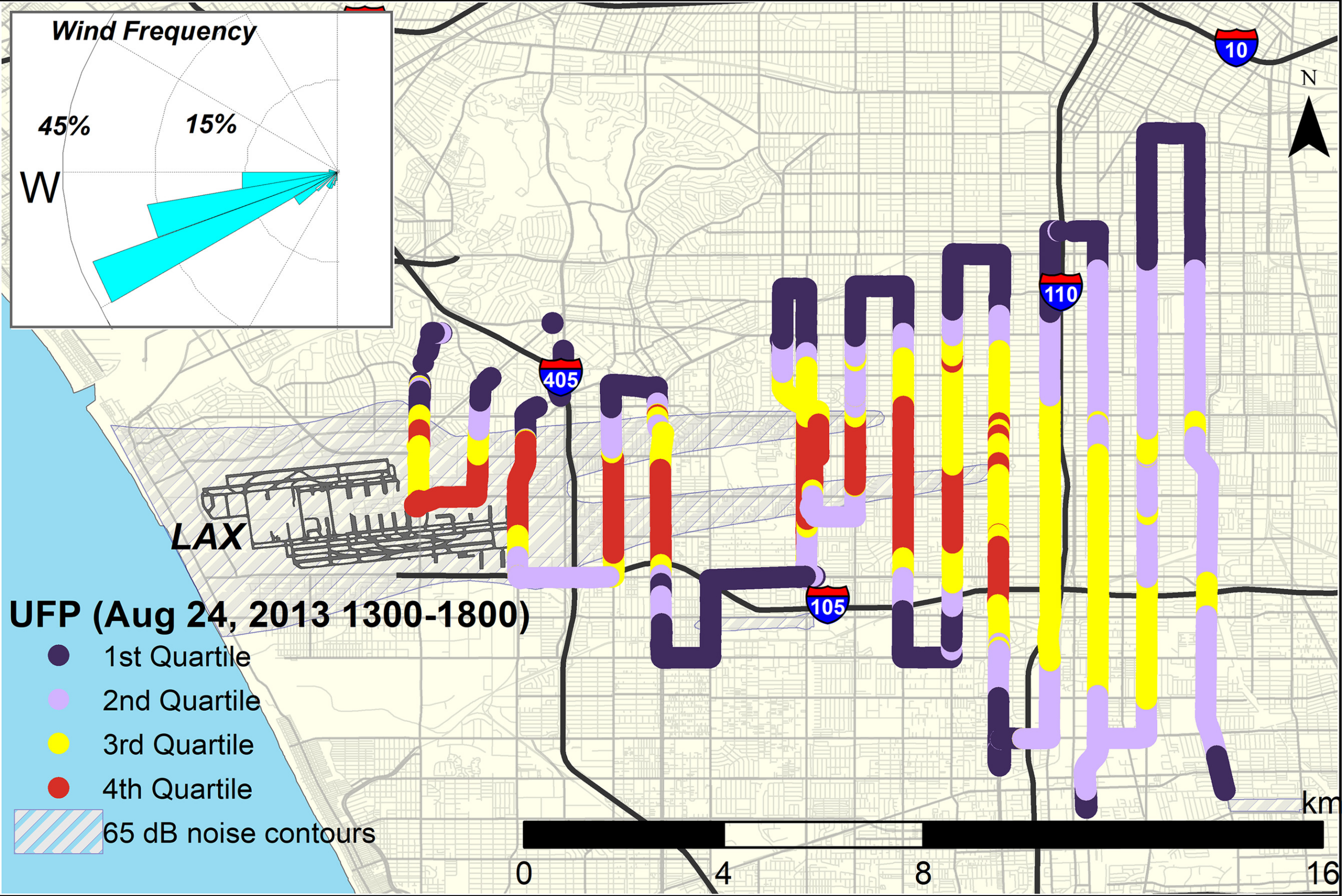
    LAX ultrafine particle (UFP) concentrations map, August 2013

    This map displays ultrafine particle (UFP) concentrations measured by quartile along driving routes near Los Angeles International Airport (LAX) on August 24, 2013, between 1300–1800 hours. The map includes a wind rose showing predominant westerly winds, 65 dB noise contours from LAX flight paths, and nearby freeways I-405, I-110, and I-105.