TagPort Of Seattle(2405)
-
 1998-11-01
EXH AR022233: Stormwater Pollution Prevention Plan — STIA
This Stormwater Pollution Prevention Plan (SWPPP), prepared by the Port of Seattle for Seattle-Tacoma International Airport in November 1998 (with revisions through December 2001), outlines strategies and best management practices (BMPs) to prevent pollutants from contaminating stormwater runoff at Sea-Tac Airport. The plan covers a range of potential pollution sources including aircraft servicing, deicing operations, spills, construction sites, and vehicle maintenance, and describes the airport's drainage systems and inspection requirements under its NPDES permit. It serves as a regulatory compliance document ensuring that airport operations minimize their impact on local water quality. -
 1998-11-01
EXH 427: Annual Stormwater Monitoring Report STIA Jun 1 1997–Jun 30 1998
This November 1998 report presents the Annual Stormwater Monitoring Report for Seattle-Tacoma International Airport, covering the period from June 1, 1997 through June 30, 1998, prepared by the Port of Seattle. It documents stormwater sampling results from various airport subbasins, including measurements of pollutants such as metals, oils, grease, fecal coliforms, and deicing chemicals. The report also evaluates the performance of Best Management Practices (BMPs) implemented across the airport to manage and reduce stormwater contamination. -
 1998-10-27
EXH AR024767: Water Quality Talking Points — Copper, Third Runway 401 Certification
A 1998 fax from Parametrix, Inc. to the Port of Seattle discusses water quality concerns related to copper in stormwater runoff at Seattle-Tacoma International Airport. The document outlines that while standard Best Management Practices (BMPs) can remove most metals from stormwater, copper remains a persistent challenge due to its widespread presence from sources like automobile brakes and rooftops. It raises questions about compliance requirements, the cost of installing sand or compost filters (potentially up to $100 million), and how the Port and Washington State Department of Ecology can reach a workable agreement on stormwater discharge standards. -
 1998-10-02
Declaration of Lawrence Corvari Supporting Plaintiff’s Petition for a Writ of Review
In October 1998, Lawrence Corvari, Co-President of Citizens Against Seatac Expansion (CASE), filed a declaration in King County Superior Court supporting a petition for a writ of review against the Port of Seattle. The declaration states that CASE directed its attorneys to appeal the Port's SEPA Determination of Non-Significance (DNS) related to the Auburn Mitigation Project, arguing that the Port's failure to comply with environmental review requirements harmed both the organization's members and the Miller Creek Basin environment. -
 1998-09-28
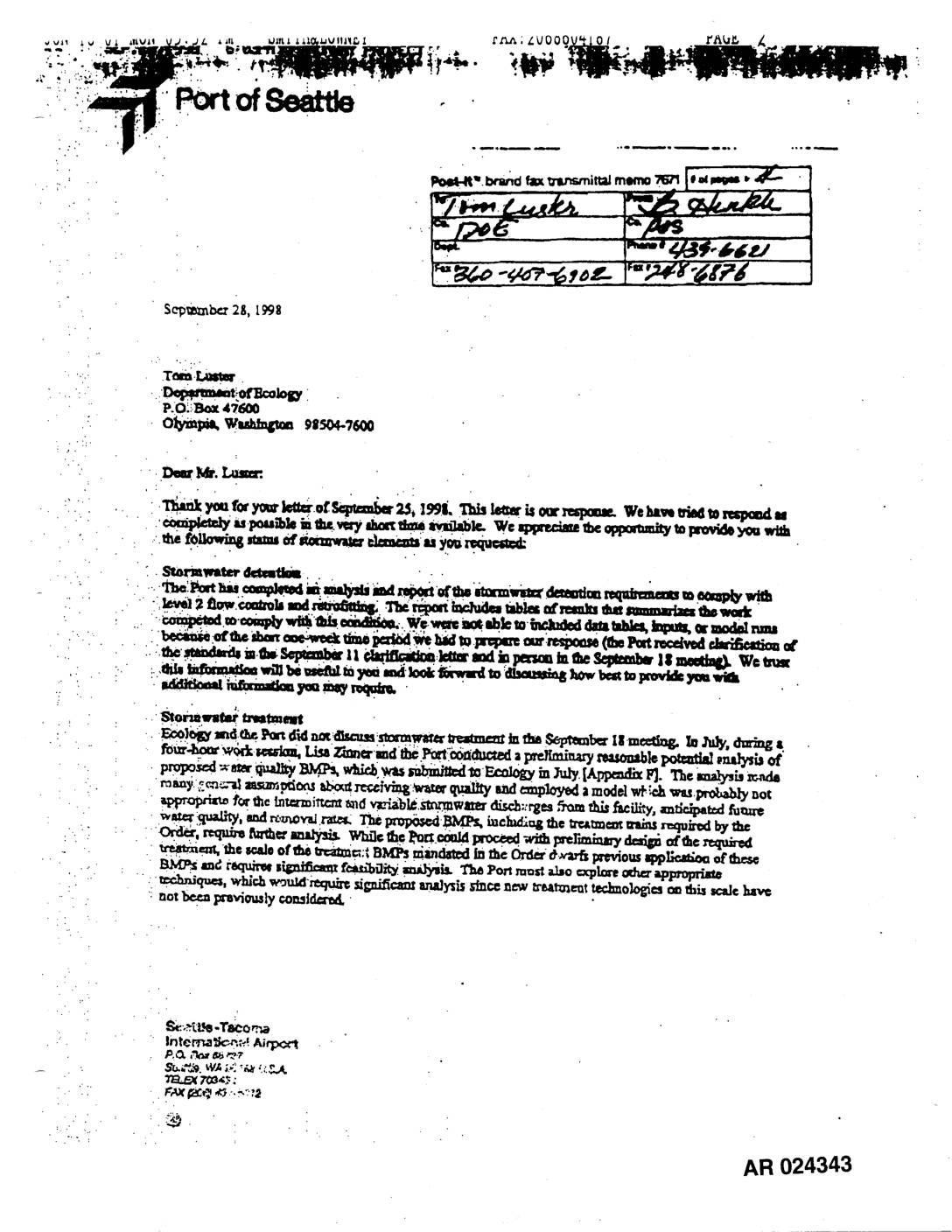
EXH AR024343: Letter to Ecology — Stormwater Detention, Treatment, Copper, First Flush, Wetland Delineation, Water Rights
In a September 28, 1998 letter from the Port of Seattle to the Washington Department of Ecology, the Port provides a status update on stormwater management efforts at Seattle-Tacoma International Airport, covering detention, treatment, copper loading, and first flush analysis. The letter outlines proposed delivery dates for required reports and explains the complexity of treating stormwater runoff, including challenges related to mandatory FAA-regulated de-icing and anti-icing chemicals used on runways. It also addresses the status of ongoing wetland delineations and water rights reviews connected to the airport's planned third runway construction. -
 1998-09-02
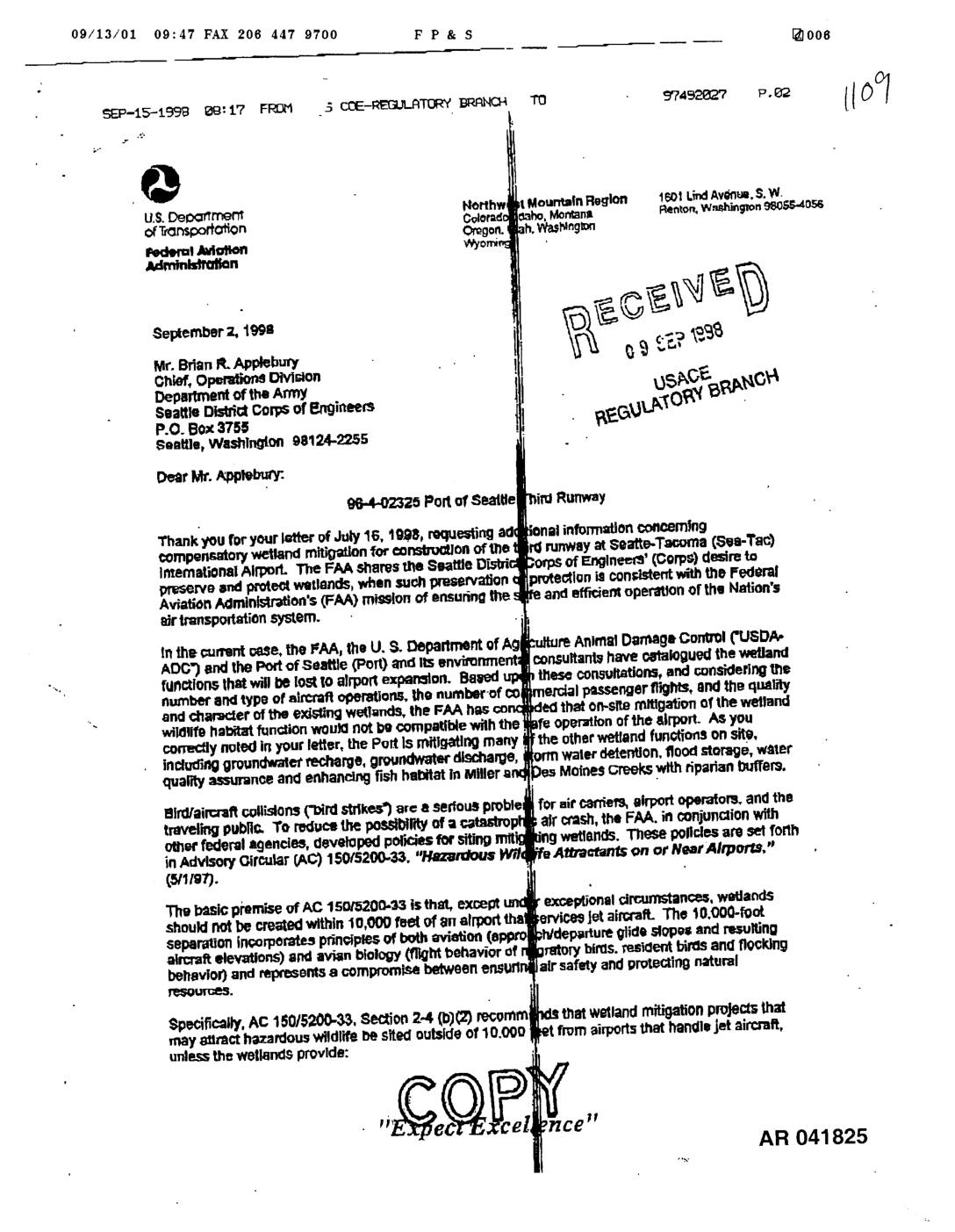
EXH AR041825: FAA Letter to U.S. Army Corps of Engineers Regarding Port Of Seattle Third Runway Wetland Mitigation
FAA Northwest Mountain Region letter dated September 2, 1998, from FAA to Brian R. Applebury, Chief Operations Division, Seattle District Corps of Engineers, regarding permit application 96-4-02325 for Port Of Seattle Third Runway at Seattle-Tacoma International Airport. Letter addresses compensatory wetland mitigation, bird/aircraft strike hazard, Advisory Circular AC 150/5200-33 ‘Hazardous Wildlife Attractants on or Near -
 1998-08-19
EXH AR041760: Miller Creek Enhancement Program — Seattle-Tacoma International Airport Master Plan Update Improvements
Draft report prepared by Parametrix, Inc. for Port of Seattle regarding the Miller Creek Enhancement Program associated with Seattle-Tacoma International Airport Master Plan Update Improvements. Document AR 041760 covers Miller Creek relocation and enhancement, floodplain compensation, floodplain enhancement, Lora Lake buffer enhancement, and Miller Creek riparian buffer enhancement. Includes ecological assessment of Miller Creek (fish -
 1998-08-18
EXH AR041715: Revised Off-Site Wetland Mitigation Plan, Seattle-Tacoma International Airport Master Plan Update Improvements
Draft Revised Off-Site Wetland Mitigation Plan prepared by Parametrix, Inc. for Port Of Seattle regarding Seattle-Tacoma International Airport Master Plan Update Improvements, dated August 18, 1998 (project number 55-2912-01(03)). Document covers rationale for off-site habitat mitigation, mitigation site selection, revised project wetland impacts as of July 14, 1998, and revised mitigation plan design objectives. Includes -
 1998-08-18
EXH AR041729: Des Moines Creek Flow Augmentation Plan — STIA Master Plan Update Improvements
Draft Des Moines Creek Flow Augmentation Plan prepared by Parametrix, Inc. for Port Of Seattle, dated August 18, 1998, AR 041729. Document covers proposed design for flow augmentation of Des Moines Creek using existing wells, well upgrades, conveyance system, and stream discharge at Seattle-Tacoma International Airport (Sea-Tac Airport) Master Plan Update Improvements. Includes operational criteria, -
 1998-08-13
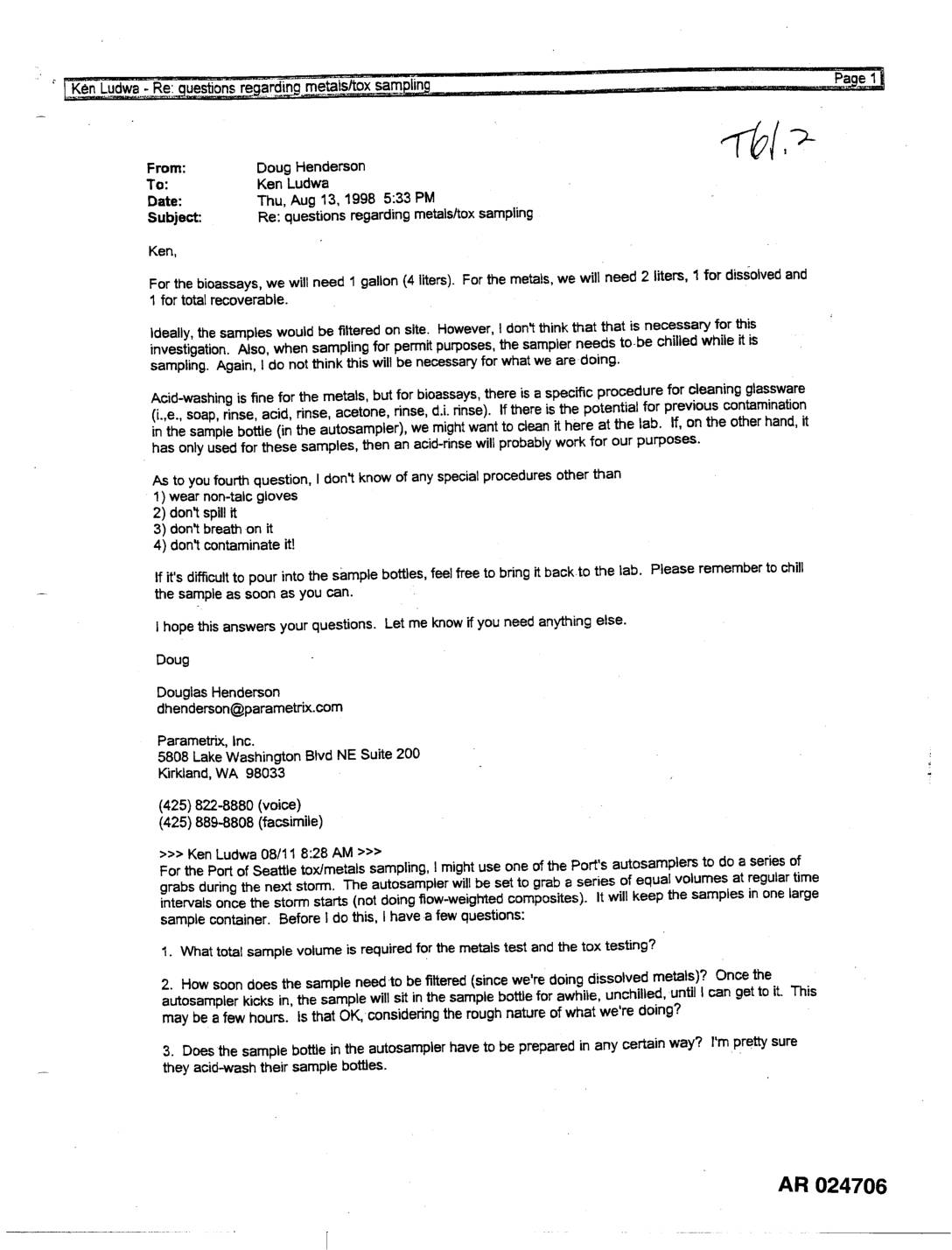
EXH AR024706: Email Correspondence Metals/Tox Sampling Procedures Storm Water Study
This August 1998 email exchange between Ken Ludwa and Doug Henderson of Parametrix, Inc. discusses technical procedures for collecting stormwater samples at the Port of Seattle for metals and toxicity testing. Ludwa asks about required sample volumes, filtration timing, bottle preparation, and transfer procedures when using an autosampler during a storm event. Henderson advises that bioassays require 1 gallon and metals testing requires 2 liters, and provides guidance on sample chilling, glassware cleaning, and handling precautions.