Skip to content
  • STNI
  • Statistics
    • Ops and Passengers
      • King County International Airport (Boeing Field) Annual Operations
    • Financials
    • Aviation fuel uplift in the State of Washington 2018 – 2025
      • Aviation Fuel Tax Revenue in the State of Washington 1983-2025
      • Aviation Fuel Uplift at Sea-Tac Airport
    • Air Quality Monitoring
    • Flight Tracking
      • Flow and Flight Tracks
      • Five Year Comparison
      • Busiest Hours and Days
    • SEL Noise Reports & Graphs
      • About The Permanent Noise Monitors
      • Minutes of Quiet by Noise Monitor
      • Noise Events mapped
      • Noise Events (SEL)
    • Runways
    • Employees
    • Real Estate
      • Port Properties and Trees mapped
    • Parking
  • Events
  • Protest
    • Regular Events
    • Legislation 2026
    • Complain about a particular flight
    • Advocacy Organizations
    • Media Outlets
    • People
    • The Port of Seattle
      • Commission Meetings
      • Public Records Requests
      • StART
      • Highline Forum
    • Contact Your Electeds
  • Resources
    • FAQs
      • FAA Occurrences/Accidents/Indents
    • The SAMP
      • SAMP Public Comment Template
        • Two versions of Appendix K: NEPA/SEPA 2018 vs 2023
      • SAMP NTP: 31 projects by the numbers
      • SEPA Draft EIS (2026)
      • SAMP Record of Decision/FONSI (2025)
      • SAMP Draft EA (October 2024)
      • 2018 Scoping
    • Port Packages
      • Port Package Property Costs
      • Port Packages mapped
      • The Port Package Explainer
      • So you want a (first-time) Port Package? Start here
      • Port Package Looker Upper
      • How do I determine if I have a Port Package or Avigation Easement?
      • Progress on Port Package Update legislation
      • Having a Port Package Problem?
      • Port Package Site Visit Follow-Up
    • Document Library
    • Explainers
      • The Airport Law Cheat Sheet
      • The Grant Explainer
    • External Articles
    • History
      • Timeline
      • The Sea-Tac Communities Plan
        • Sea-Tac Communities Plan – Planning Maps
      • PSRC Third Runway Decision Process
    • Studies
    • Videos
  • Stories
  • Mission
  • Subscribe
  • Contact
Scroll down to content

Get InformedStay Informedx

I understand that you will never share my information with anyone, you will only use it to keep me updated on relevant events and that I may unsubscribe at any time.

STNI

STNISea-Tac Noise.Info

  • Solve for Sea-Tac. Solve for every airport.
  • Since 2016, working to obtain justice for everyone living under the flight path.
  • Less Noise. Cleaner Air. Better Public Health. Compensation.
  • Everything you think you know about the airport is wrong.

TagPort Of Seattle(2405)

Advanced Search Options

  • Dates
  • Media
    • External Articles
    • Images
    • PDFs
    • Video
    • Audio
  • Order By
  • 1999-03-16

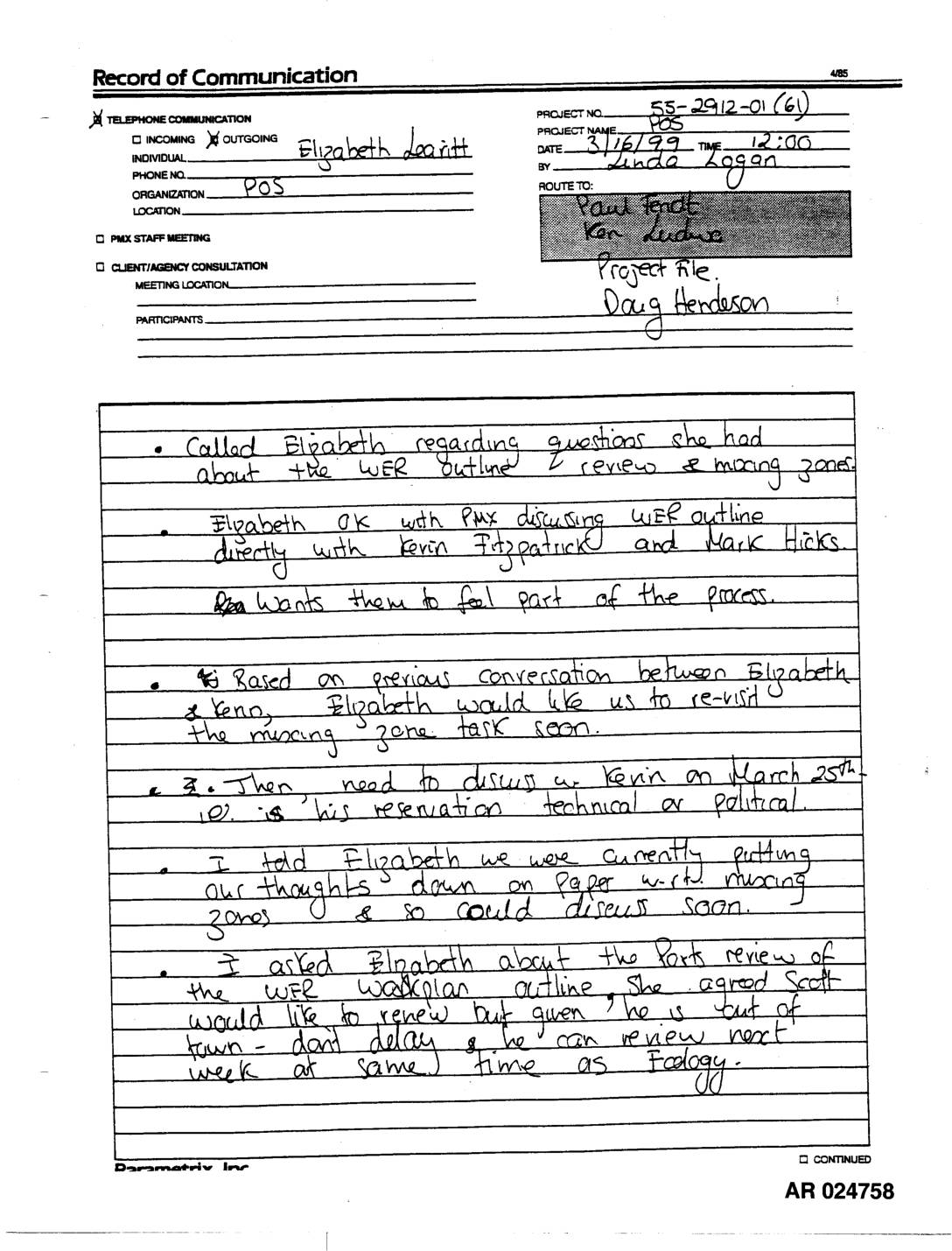
    EXH AR024758: Record of Communication — WER Outline, Mixing Zones, Port Review

    A March 16, 1999 outgoing phone call was made to Elizabeth Leavitt of POS regarding her questions about the WER (Work Element Review) outline, review process, and mixing zones. Elizabeth was advised she could discuss the WER outline directly with Kevin Fitzpatrick and Mark Hicks, and that the team was preparing written thoughts on mixing zones for further discussion. The call also addressed scheduling a Port review of the WER workplan outline, with a suggestion to coordinate the review alongside a Fooogy (likely Ecology) meeting the following week.
    TagsACC, Elizabeth Leavitt, PCHB, Pollution Control Hearings Board, Port Of Seattle, Third RunwayFolderBox 10
  • 1999-03-11

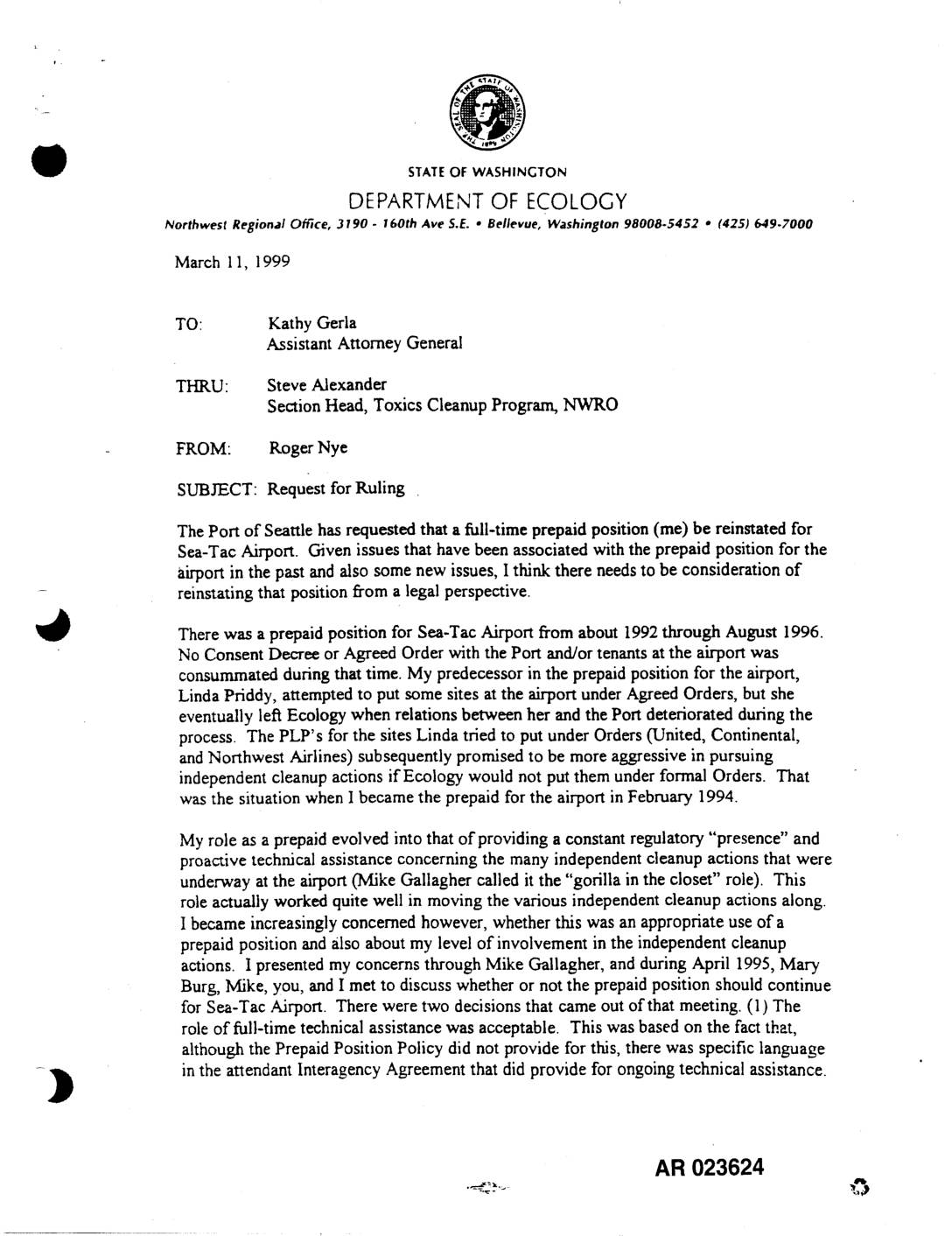
    EXH AR023624: Roger Nye to Kathy Gerla — Ruling Request, Reinstatement Prepaid Position STIA

    A 1999 memo from Washington State Department of Ecology staff member Roger Nye to Assistant Attorney General Kathy Gerla raises legal questions about reinstating a full-time 'prepaid' regulatory position at Sea-Tac Airport, funded by the Port of Seattle. The memo outlines the history of the position from 1992–1996, noting it was cancelled due to the lack of a signed Agreed Order, and describes public concerns that the arrangement gave the Port undue influence over Ecology. Key issues flagged include whether the prepaid role can legally extend beyond the scope of an Agreed Order, whether a new Interagency Agreement is needed, and whether reinstatement would require a public comment period likely to draw strong opposition.
    TagsACC, Ecology, PCHB, Pollution Control Hearings Board, Port Of Seattle, Sea-Tac Airport, Third RunwayFolderBox 10
  • 1999-02-23

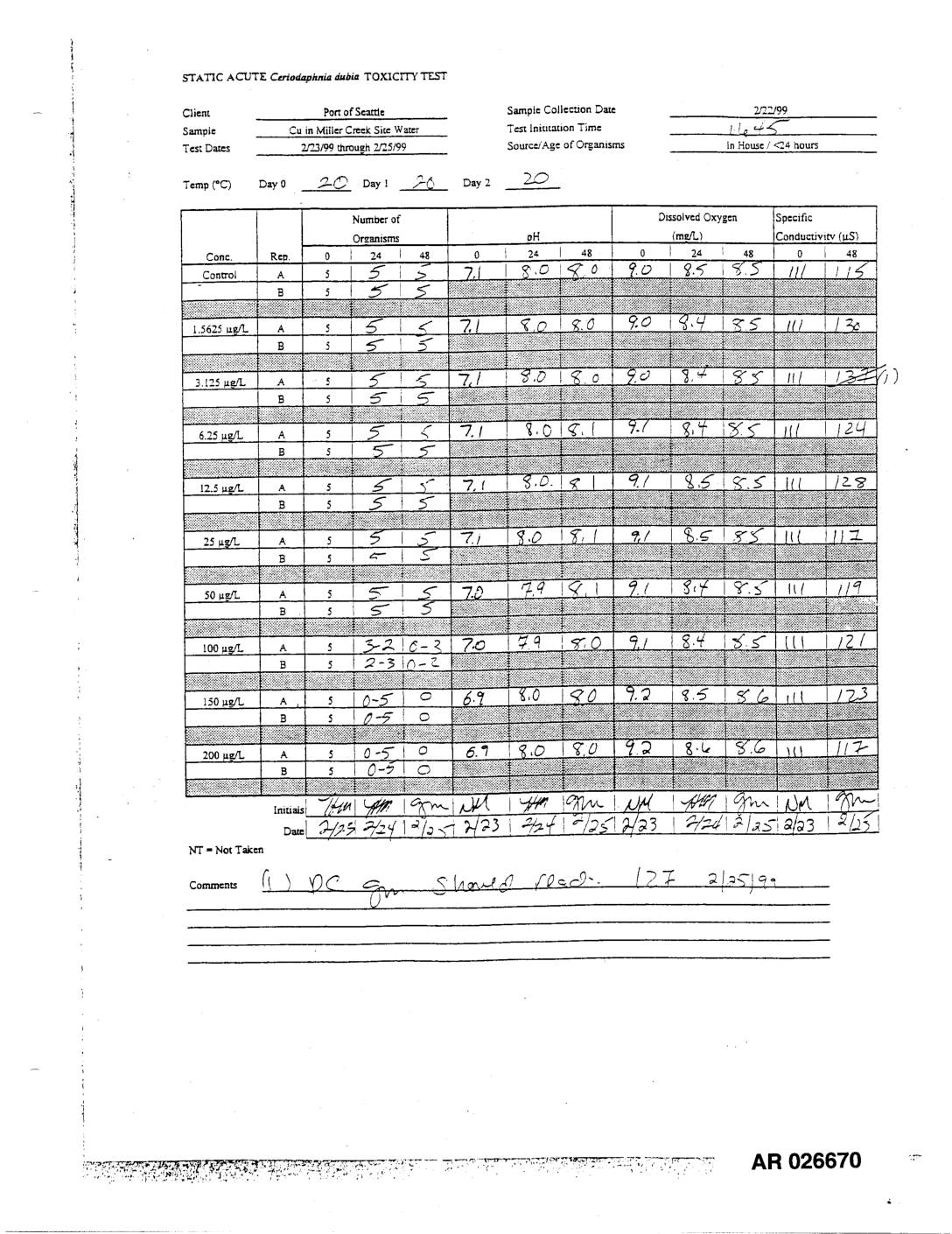
    EXH AR026670: Static Acute Ceriodaphnia dubia Toxicity Test — Cu, Miller Creek Site Water, Feb 1999

    This document presents results from a 48-hour acute toxicity test conducted in February 1999 for the Port of Seattle, exposing water fleas (Ceriodaphnia dubia) to copper-contaminated water collected from Miller Creek. The test found that all organisms survived at concentrations up to 50 micrograms per liter, while complete mortality occurred at concentrations of 100 micrograms per liter and above. Water quality parameters including pH, dissolved oxygen, and specific conductivity were monitored throughout the test period.
    TagsACC, Environment, Miller Creek, PCHB, Pollution Control Hearings Board, Port Of Seattle, Third Runway, Water QualityFolderBox 10
  • 1999-02-01

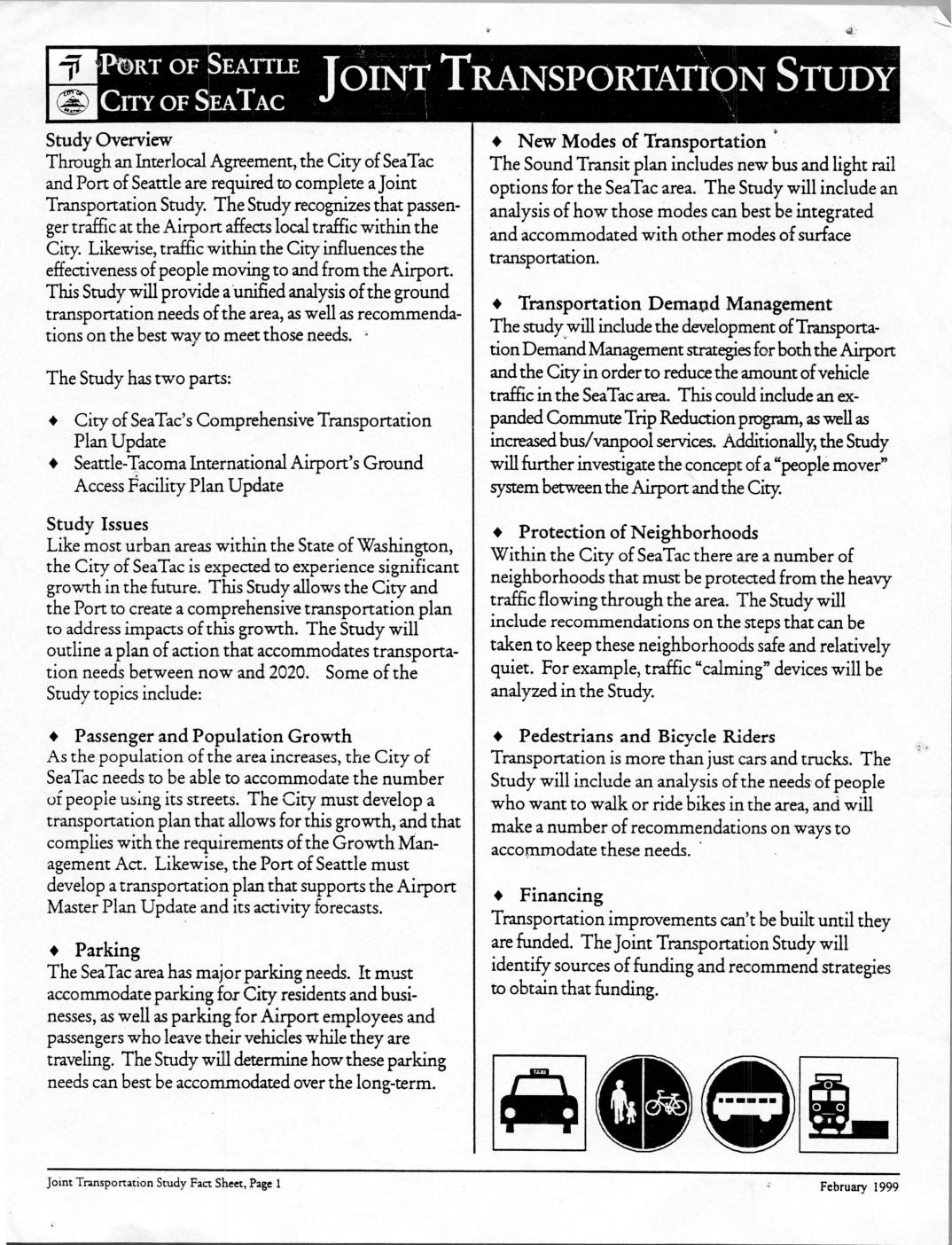
    Port Of Seattle and City of SeaTac joint transportation study fact sheet

    A February 1999 fact sheet outlining the Joint Transportation Study jointly undertaken by the City of SeaTac and the Port of Seattle under an Interlocal Agreement. The study aims to address ground transportation needs through 2020, covering topics such as population and passenger growth, parking, new transit modes including light rail, neighborhood protection, and pedestrian and bicycle access. It also examines Transportation Demand Management strategies to reduce vehicle traffic around Seattle-Tacoma International Airport.
    TagsCity Of SeaTac, Port Of SeattleFolderSeaTacStudy TopicsTransportation
  • 1999-02-01

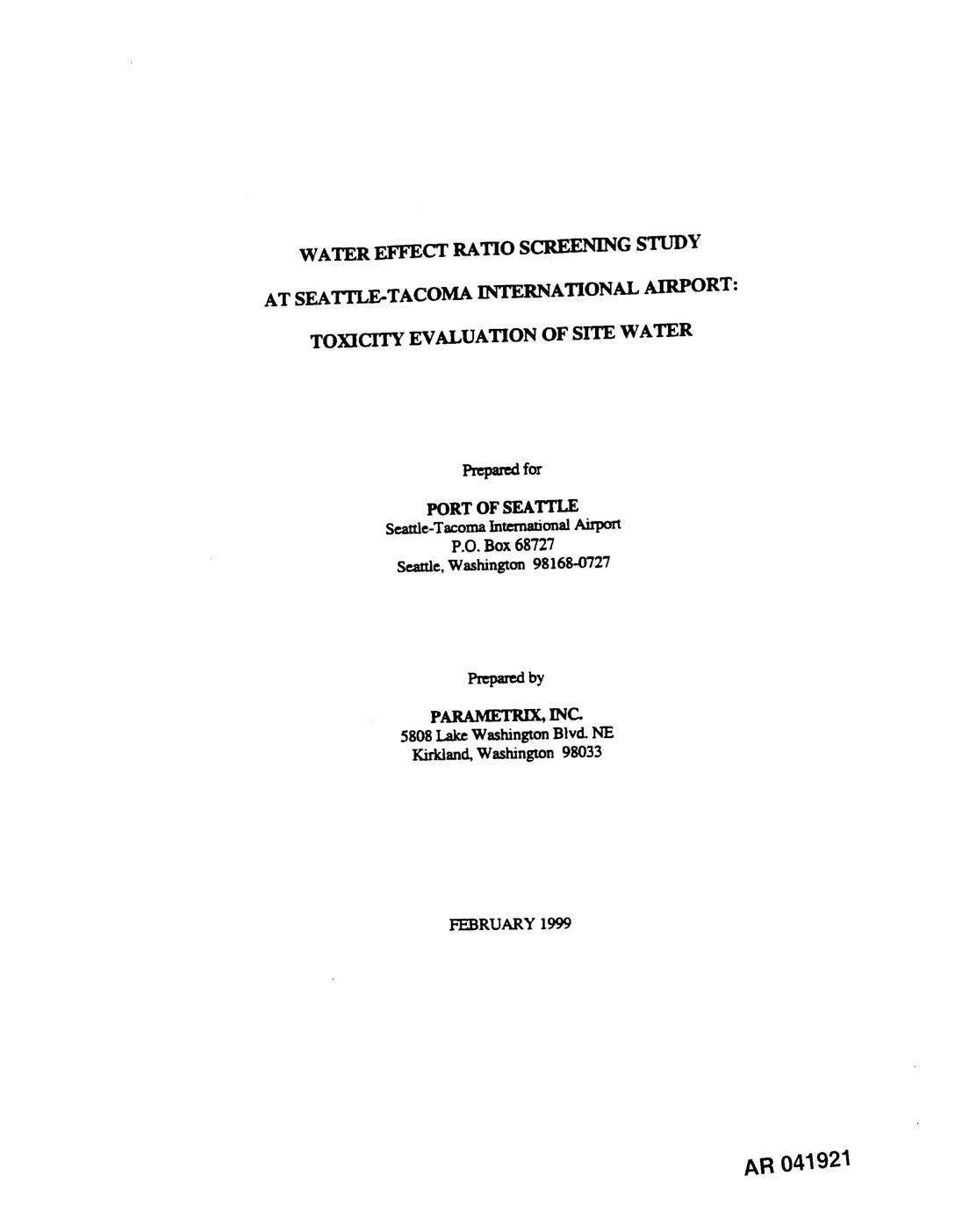
    EXH AR041921: Water Effect Ratio Screening Study at Seattle-Tacoma International Airport: Toxicity Evaluation of Site Water

    Draft report (AR 041921) prepared by Parametrix, Inc. for Port Of Seattle, STIA, summarizing procedures and results of acute screening-level Ceriodaphnia dubia bioassays conducted on site water from Seattle-Tacoma International Airport in January 1999. Samples collected January 14, 1999 during a storm event at eight locations including Miller Creek Upstream of Lake Reba, Miller Creek
    TagsACC, Des Moines Creek, Miller Creek, Pollution Control Hearings Board, Port Of Seattle, Sea-Tac Airport, Water QualityFolderBox 17
  • 1999-01-14

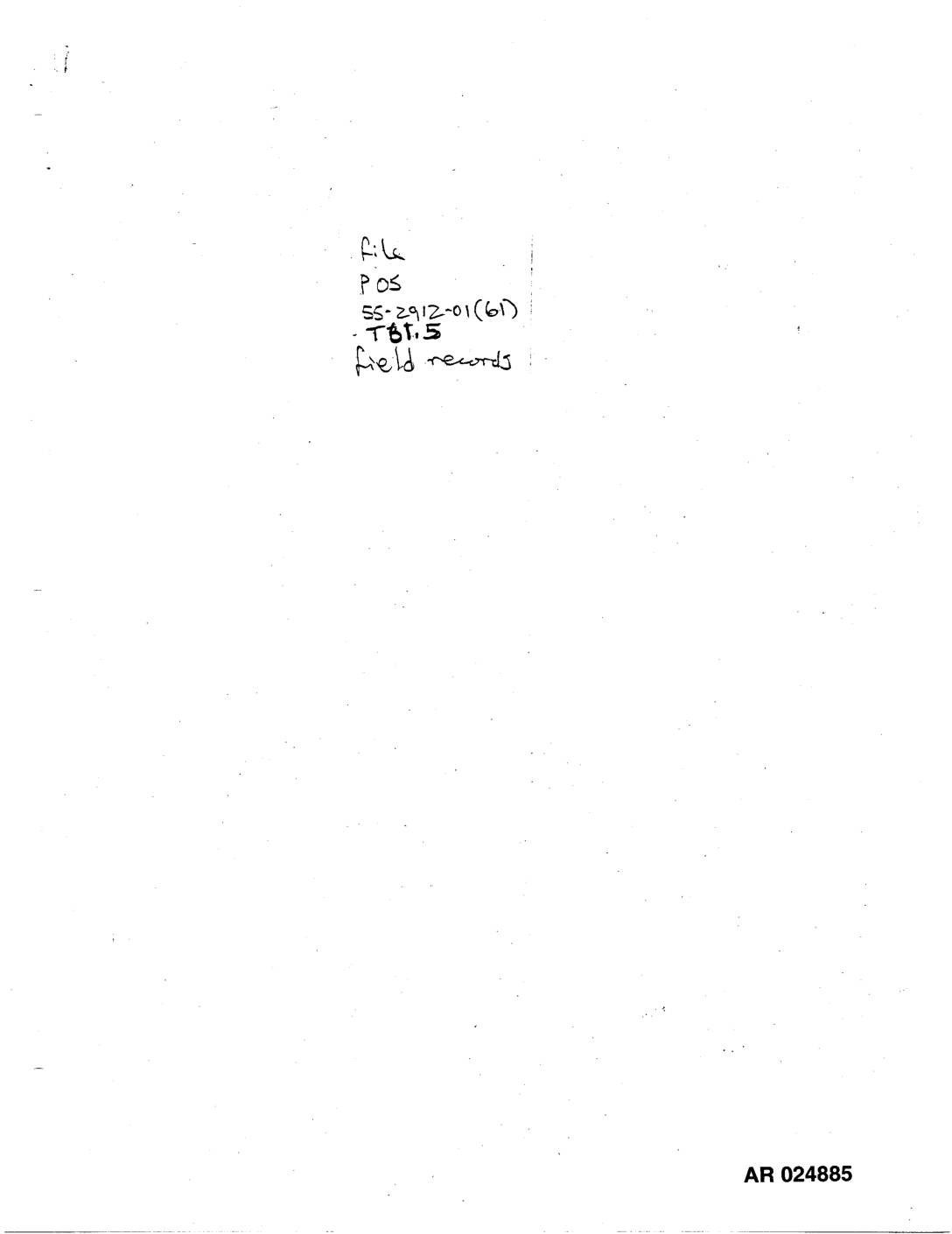
    EXH AR024885: Water Quality Datalog 55-2912-01(61) Miller DS Field Measurements & Flow Weighting Calc, Jan 14 1999

    These are field records from a water quality sampling event conducted on January 14, 1999, at the Miller DS site near McD NC, documenting storm water measurements taken from a culvert. Samplers recorded water levels, flow rates, pH, temperature, and dissolved oxygen at 12 intervals throughout the morning. A flow-weighting calculation worksheet was used to determine subsample volumes, with a total storm flow of 122,400 units recorded from a 4x4.3 pipe.
    TagsACC, PCHB, Pollution Control Hearings Board, Port Of Seattle, Stormwater, Third Runway, Water QualityFolderBox 10
  • 1999-01-08

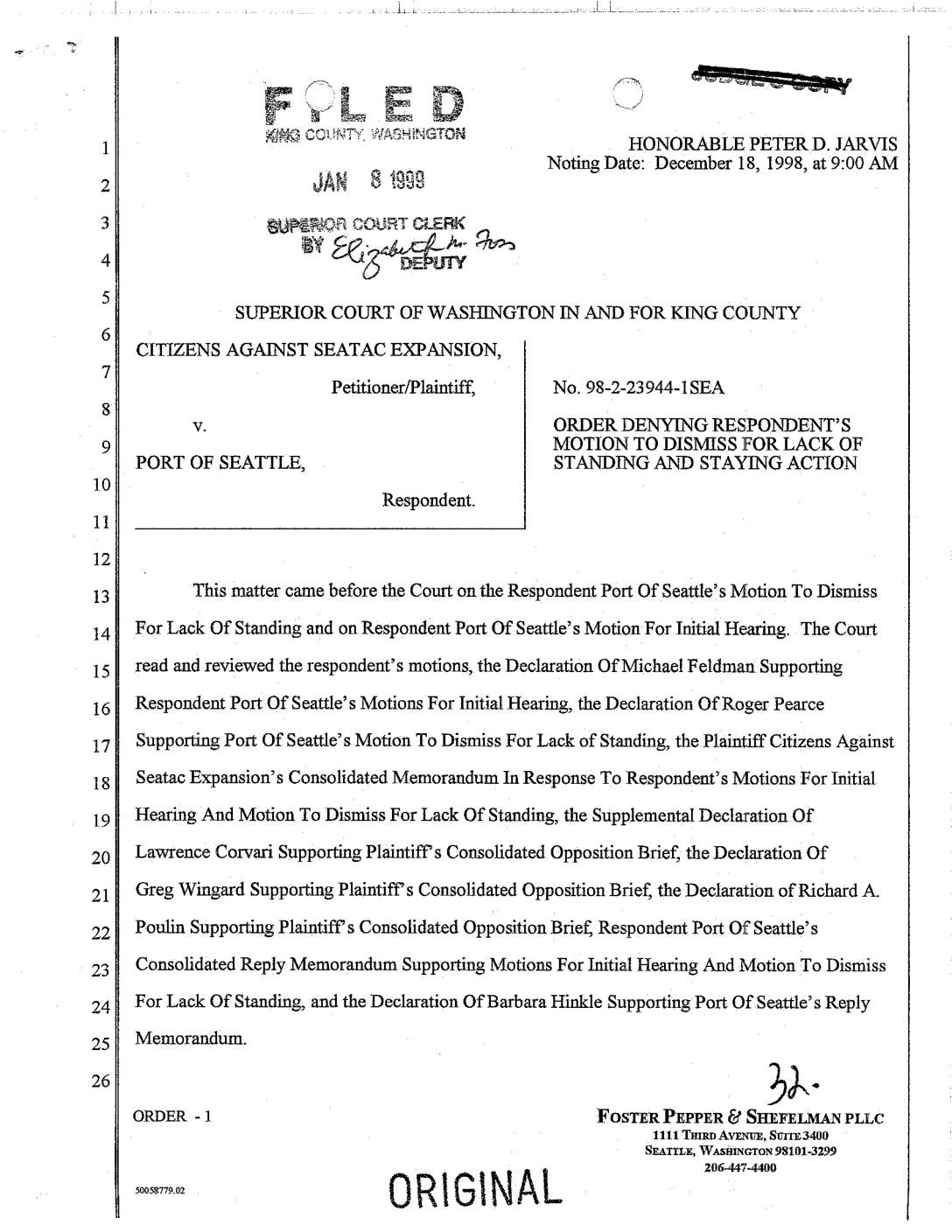
    Order Denying Respondent Port Of Seattle’s Motion to Dismiss for Lack of Standing and Staying Action

    In January 1999, the King County Superior Court denied the Port of Seattle's motion to dismiss a lawsuit brought by Citizens Against SeaTac Expansion, ruling that a potential injury from wetland filling near the airport could not be ruled out. The case centered on the Port's plan to fill wetlands in Auburn as part of its Master Plan Update, which included construction of a proposed third air carrier runway at Seattle-Tacoma International Airport. The court stayed all further proceedings until the U.S. Army Corps of Engineers issued a final decision on the Port's wetland-filling permit under Section 404 of the Clean Water Act.
    TagsAuburn Wetland, CASE, Clean Water Act, Port Of Seattle, Third RunwayFolderCASE #98-2-23944-1 SEA
  • 1999-01-06

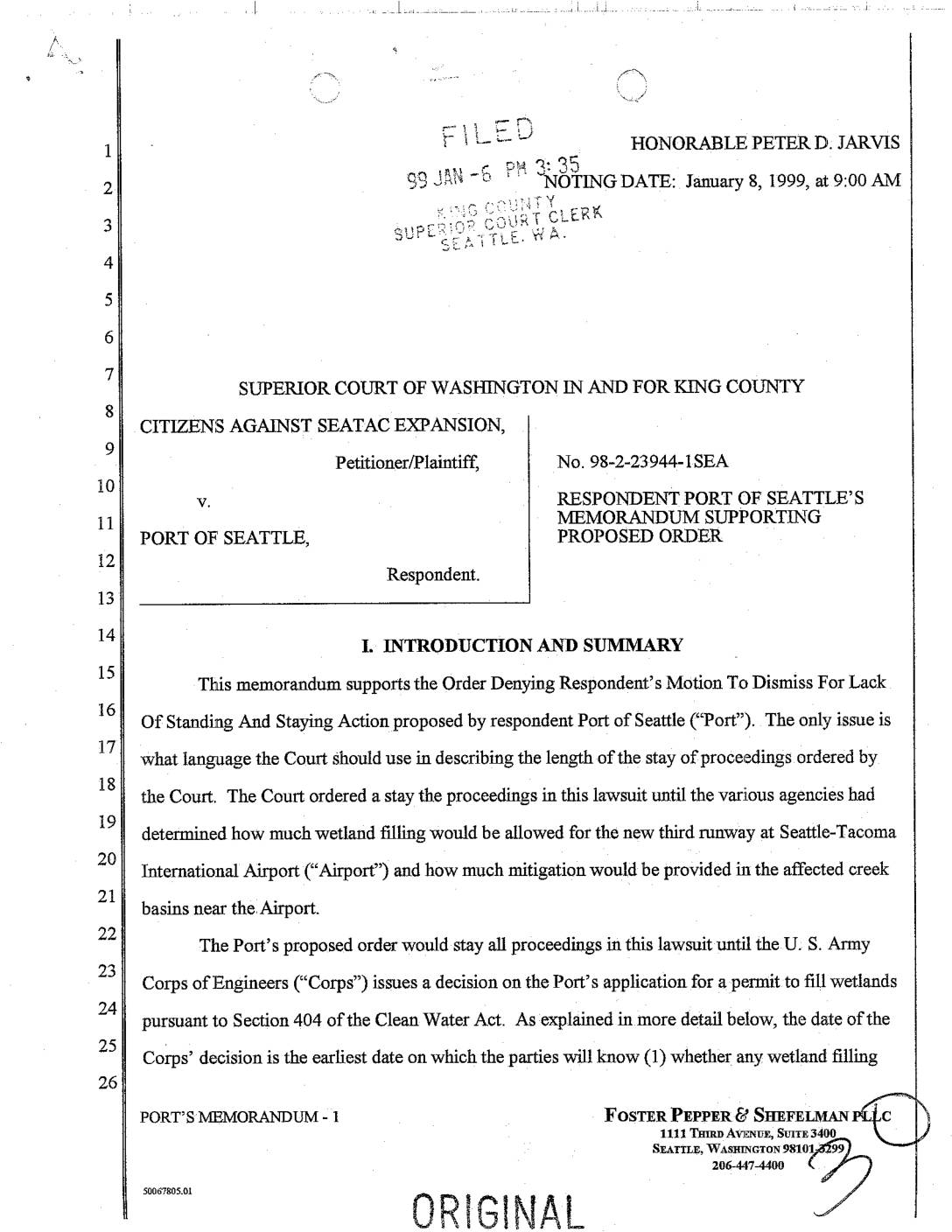
    Port Of Seattle’s Memorandum Supporting Proposed Order: CASE v. Port Of Seattle (No. 98-2-23944-1 SEA)

    In January 1999, the Port of Seattle filed a legal memorandum in King County Superior Court supporting a proposed order to stay (pause) a lawsuit brought by Citizens Against SeaTac Expansion (CASE) regarding the expansion of Seattle-Tacoma International Airport. The central dispute concerned the construction of a proposed third runway and the filling of nearby wetlands, with the Port arguing that court proceedings should be paused until the U.S. Army Corps of Engineers issued a final decision on the Port's wetland-fill permit under Section 404 of the Clean Water Act. The two parties disagreed on the exact language defining how long the stay should last, with the Port seeking a clear end date tied to the Corps' permit decision and CASE proposing broader conditions related to Port environmental decisions.
    TagsArmy Corp of Engineers, CASE, Clean Water Act, Port Of Seattle, Third RunwayFolderCASE #98-2-23944-1 SEA
  • 1999-01-01

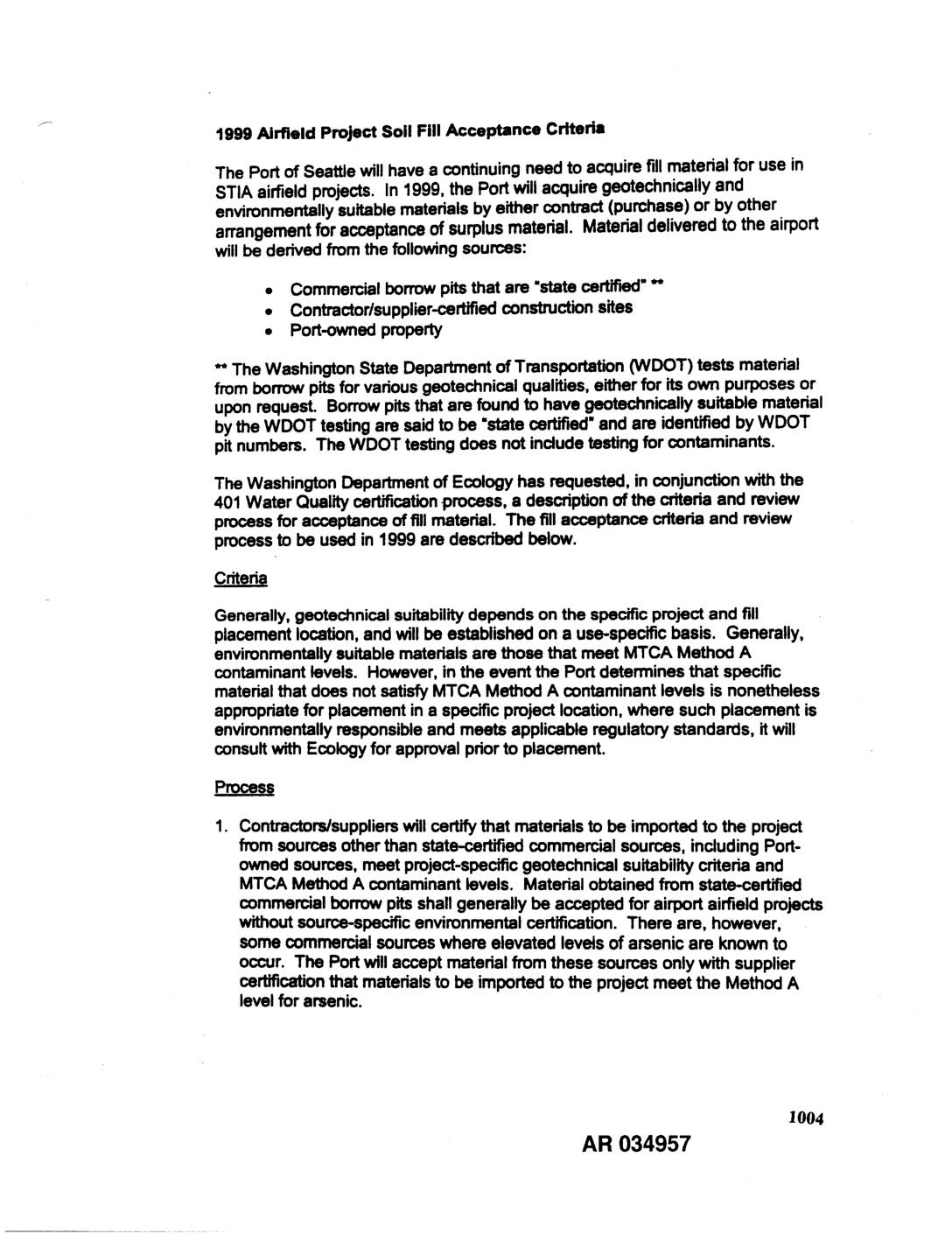
    EXH AR034957: 1999 Airfield Project Soil Fill Acceptance Criteria

    Port Of Seattle 1999 Airfield Project Soil Fill Acceptance Criteria for STIA airfield projects, describing criteria and review process for acceptance of fill material requested by Washington Department of Ecology in conjunction with 401 Water Quality certification. Covers geotechnical and environmental suitability standards including MTCA Method A contaminant levels, arsenic, TPH and metals analyses. Details
    TagsACC, Ecology, Fill Dirt, MTCA, Pollution Control Hearings Board, Port Of Seattle, Water QualityFolderBox 14
  • 1999-01-01

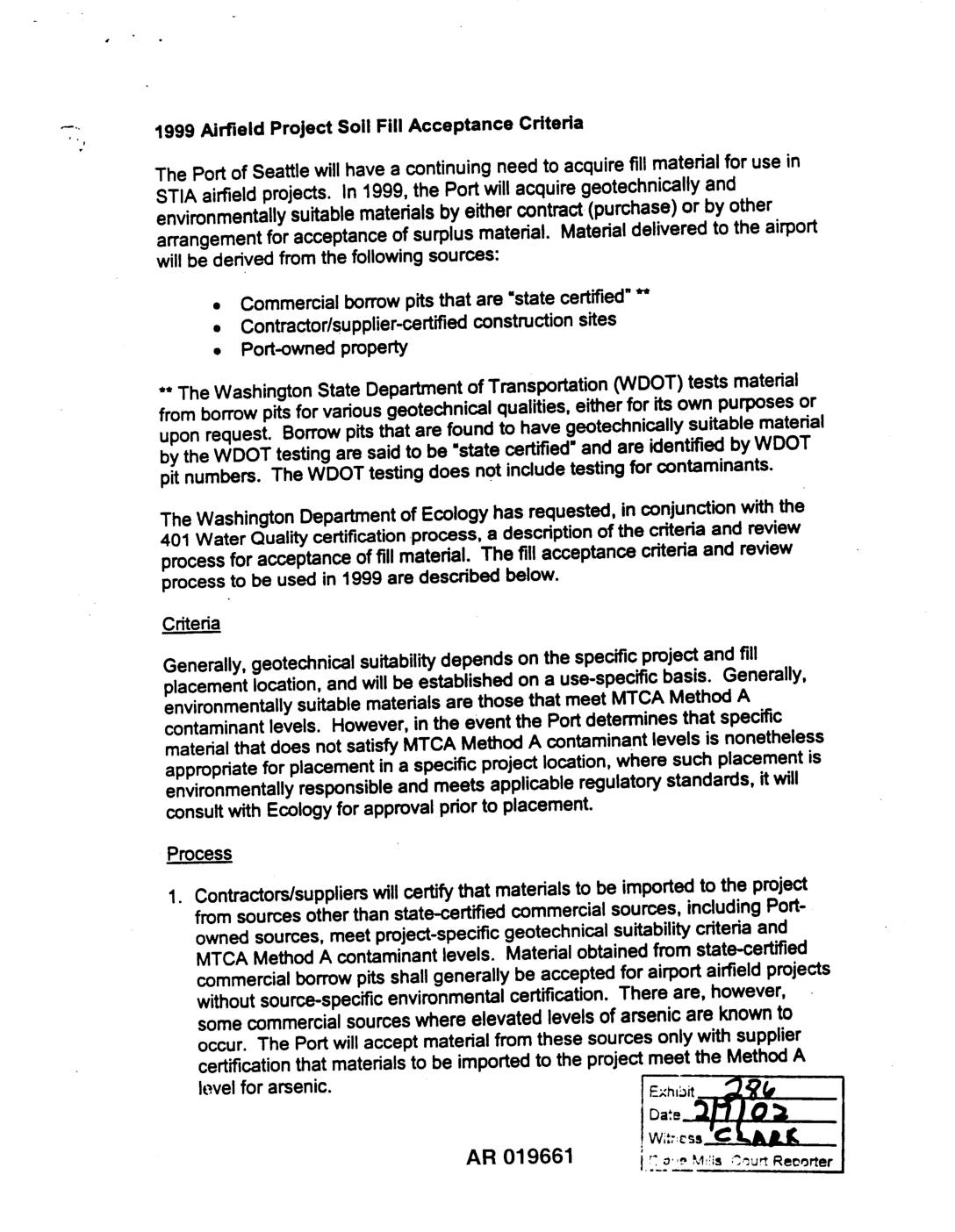
    EXH 286: 1999 Airfield Project Soil Fill Acceptance Criteria

    This 1999 Port of Seattle document outlines the criteria and review process for accepting soil fill material used in Sea-Tac International Airport (STIA) airfield construction projects. Fill material must come from approved sources—such as state-certified commercial borrow pits, contractor-certified construction sites, or Port-owned property—and generally must meet Washington State MTCA Method A environmental contamination standards. Contractors and suppliers are required to certify the quality of their materials, and independent soil technicians monitor all deliveries to ensure only safe, suitable fill is placed on airport grounds.
    TagsACC, Ecology, Fill Dirt, MTCA, Pollution Control Hearings Board, Port Of Seattle, Third RunwayFolderBox 09

Posts pagination

Page 1 … Page 208 Page 209 Page 210 Page 211 Page 212 … Page 241
Sidebar On/Off

Upcoming Events

  • Port of Seattle Regular Commission Meeting September 22, 2026
    Add to CalendarMTuesday Sep 22: 12:00pm
    17801 International Blvd, Seattle, WA 98158
    2026 09 22 rm packet pdf

    Order of Business 10:30 a.m. 1. Call to Order 2. Executive Session – if necessary, pursuant to RCW 42.30.110 (executive sessions are not open to the public) 12:00 p.m. – Public Session Reconvene or Call to Order and Pledge of Allegiance 3. Approval of the Agenda 4. Special Orders of the Day 4a. Presentation of

    [...]
  • Highline Forum Agenda – September 23, 2026
    Add to CalendarMWednesday Sep 23, 2:30pm - 4:30pm
    City of Des Moines, Police Services Building,
    Highline forum agenda final 23sept2026 pdf

    Highline Forum Agenda Theme: Part 150 Update and PortJobs Overview 2:30pm – Convene Meeting/Introductions Port Co-Chair, Commissioner Mohamed 2:35pm – Public Comments Audience The meeting will be held in person and virtually. Those wishing to provide public comment may: 1) Deliver public comment via email; 2) Deliver public comment via Microsoft Teams; or 3) Deliver

    [...]

[See all...]


Help study childhood asthma. Get free HEPA filter!

read more...

Issues

Sea-Tac Airport is currently undergoing the largest and longest expansion in its history, collectively known as the Sustainable Airport Master Plan (SAMP). Some of it you can already hear, but you’re probably not aware of what it all means. Here’s what you need to know.
read more...

Read This!

As the source for federal transportation grants, the Puget Sound Regional Council was charged with developing a system to meet the growing need for commercial aviation. When the search for a second airport failed, they authorized the Port of Seattle to build the Third Runway, with a mandate to develop a noise abatement and mitigation program. In their effort to stop the Third Runway, the ACC argued over every detail of the Port's efforts--including property buyouts and sound insulation. The dispute was meant to be settled by a three member Expert Arbitration Panel. This is their final report. It finds 2-1, that the Port's program was insufficient in several respects. Despite that, funding for the Third Runway was approved by the PSRC, and the 'Port Package' program, proceeded largely unchanged. Expert Arbitration Panel's final decision finding that the Port of Seattle had not shown sufficient reduction in real on-the-ground noise impacts to satisfy noise reduction conditions required for approval of a third runway at Sea-Tac International Airport. The majority decision concluded the Port's noise abatement programs were insufficient despite being impressive in scope.
continue...

  • Sea-Tac Noise.Info
  • Connect with STNI

    • Subscribe
    • Port Package Problem?
    • Donate
    • Podcast
    • Socials
      • Facebook
      • X (Twitter)
      • Bluesky
      • Instagram

    "Airport Observation Deck Scene" — , 2023

  • Learn

    • Frequently Asked Questions
    • Explainers
    • Youtube
    • Research Requests
    • Make a complaint
  • Goals

    Fulfill the promises of 1976:
    • Compensation
    • Reduced noise
    • Improved air quality
    • Environmental remediation
Login/Register
©2026•Data Privacy

Message

We use cookies to provide basic functionality. We also provide access to search engines in order to provide site analytics. We do not sell or share your data.
V V