TagNoise(262)
-
 2017-06-02
Letters to the editor: Federal Way residents on airplane noise and quality of life
Residents of Federal Way, Washington wrote letters to their local mirror newspaper in June 2017 expressing frustration over increasing airplane noise from Sea-Tac Airport, citing quadrupled noise and emission impacts, the need to wear earplugs indoors and outdoors, and calling for a second regional airport at Everett's Payne Field. Former Federal Way City Council member Linda Kochmar, drawing on her decade of experience with the Airport Communities Coalition, urged South Sound mayors to pressure the state legislature and congressional delegation to act. The letters were written in response to a columnist who had minimized residents' concerns, and collectively call for greater media and government attention to the environmental and quality-of-life impacts of the FAA's 2017 Long Range Plan for expanded flight operations. -
 2017-06-01
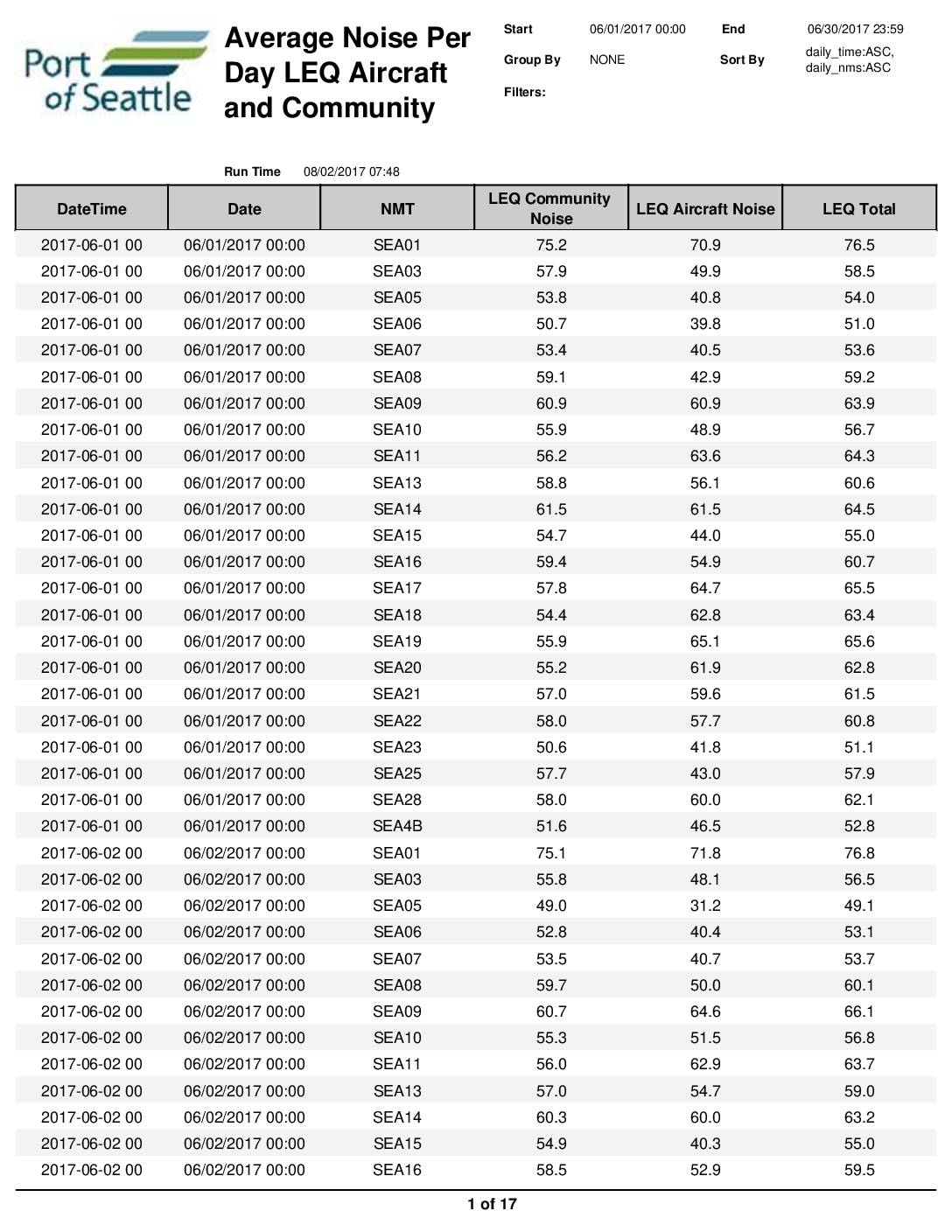
Average Noise Per Day LEQ Aircraft and Community — June 2017
This report from the Port of Seattle presents daily average noise levels recorded at Sea-Tac Airport monitoring stations (NMTs) throughout June 2017. It breaks down sound levels in decibels (dB LEQ) into three categories: community noise, aircraft noise, and a combined total, measured at more than 20 locations surrounding the airport. The data shows that aircraft noise levels frequently exceeded community noise levels at many monitoring sites, with some stations recording combined totals above 65 dB on multiple days. -
2017-04-14
Burien fought the FAA over airplane noise and won, so far
Residents teamed up with the City of Burien to fight the FAA over airplane noise and won, at least so far. Neighbors noticed an increase in airplane noise last summer and say the FAA started diverting jet propeller planes from Sea-Tac to the west over Burien, when take-off was to the north. Residents complained about -
 2017-03-01
Laguardia airport title 14 code of federal regulations (cfr) part 150 final noise exposure map report
Final Noise Exposure Map Report for LaGuardia Airport prepared under Title 14 CFR Part 150 by Environmental Science Associates and other consulting firms for the Port Authority of New York & New Jersey. This report addresses federal requirements for airport noise compatibility planning. -
2016-03-17
Aviation roundtable members argue over structure at meeting – QNS
By Madina Toure Posted on March 17, 2016 By Madina Toure (clarifying the history of the roundtable structure) The highly anticipated New York Community Aviation Roundtable meeting was marked by tension last week as people spent nearly three hours debating everything from the roundtable’s structure to individuals directly affected by airplane noise. The March 10 -
 2016-01-30
FAA NextGen and the 2012 to 2015 ‘Optimization of Metroplex Airspace’
This 2016 report by Palo Alto resident Mark Shull examines how the FAA's NextGen 'Optimization of Airspace and Procedures in the Metroplex' (OAPM) program, implemented between 2012 and 2015, led to dramatically increased aircraft noise over residential communities by redesigning flight paths to be lower, straighter, and more concentrated. The author argues that while the program was publicly marketed as improving efficiency, reducing fuel use, and lowering environmental impact, its primary purpose was increasing airport capacity by reducing separation between aircraft and simplifying flight corridors. The report traces the legislative, regulatory, and industry decisions that shaped the program, concluding that communities were left worse off and that genuine air traffic modernization will be harder to achieve going forward. -
 2015-05-01
Residential Sorting and Environmental Externalities: the Case of Non-linearities and Stigma in Aviation Noise Values
Academic journal article by Sotirios Thanos, Abigail L. Bristow, and Mark R. Wardman, published in the Journal of Regional Science (May 2015), examining residential sorting in response to aviation noise exposure in a housing market. Uses Spatiotemporal Hedonic Pricing (HP) and Stated Choice (SC) methods to quantify nonlinear noise depreciation ranging from 0.40 to 2.38 -
2015-05-01
Residential Sorting and Environmental Externalities: the Case of Non-linearities and Stigma in Aviation Noise Values
Academic journal article by Sotirios Thanos, Abigail L. Bristow, and Mark R. Wardman, published in the Journal of Regional Science (May 2015), examining residential sorting in response to aviation noise exposure in a housing market. Uses Spatiotemporal Hedonic Pricing (HP) and Stated Choice (SC) methods to quantify nonlinear noise depreciation ranging from 0.40 to 2.38 -
 2015-04-09
Two heads of airport roundtable elected for LGA, JFK – QNS
Two heads of airport roundtable elected for LGA, JFK By Tom Momberg Posted on April 9, 2015 By Tom Momberg Members of the newly formed New York Airport Community Roundtable Committees for LaGuardia and John F. Kennedy International Airports met Tuesday night to install their leadership. The roundtable last adjourned in November without achieving any -
 2015-02-11
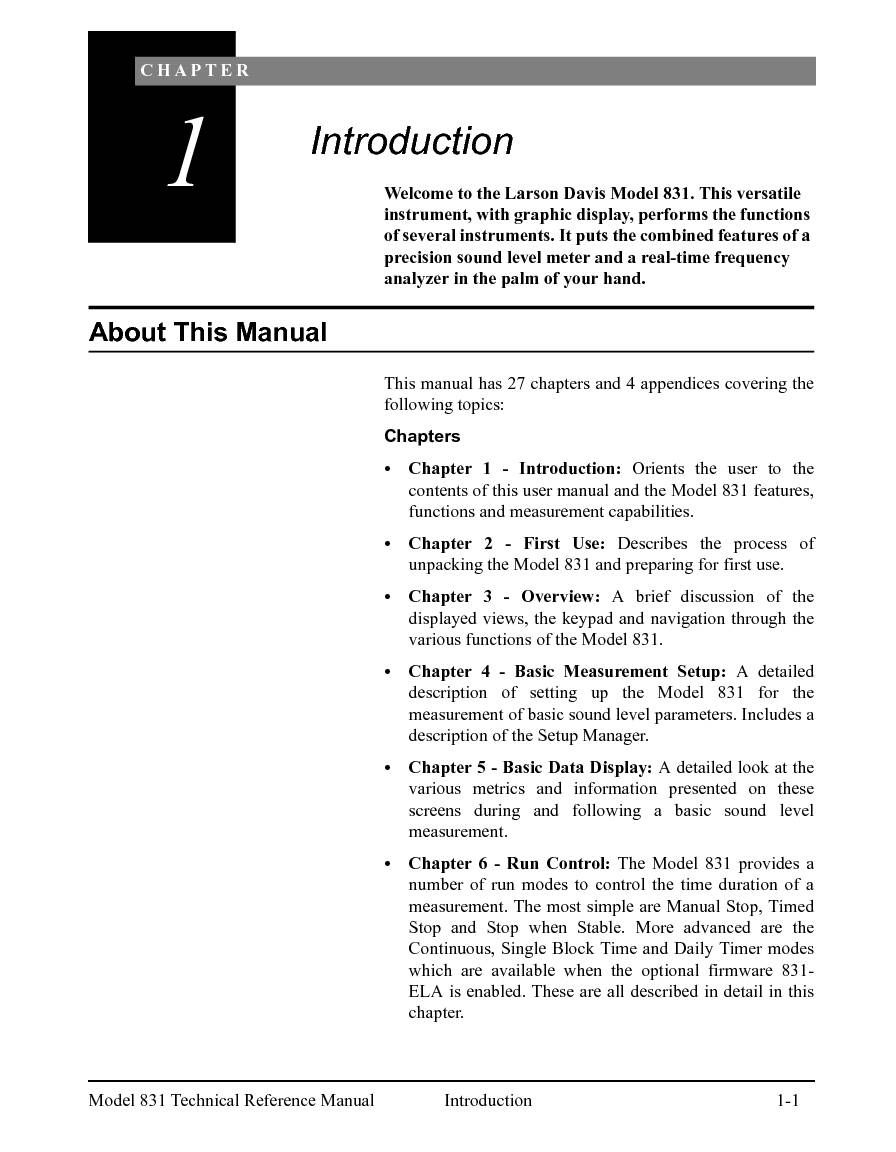
Model 831 technical reference manual introduction
The Larson Davis Model 831 Technical Reference Manual provides comprehensive guidance for operating a handheld precision sound level meter and real-time frequency analyzer. The manual covers 27 chapters and 4 appendices addressing topics such as measurement setup, noise dose and exposure monitoring, time history logging, calibration, and data storage. It serves as a complete reference for professionals conducting acoustic measurements, including those relevant to environmental noise monitoring near airports.