TagFAA(687)
-
 2025-12-15
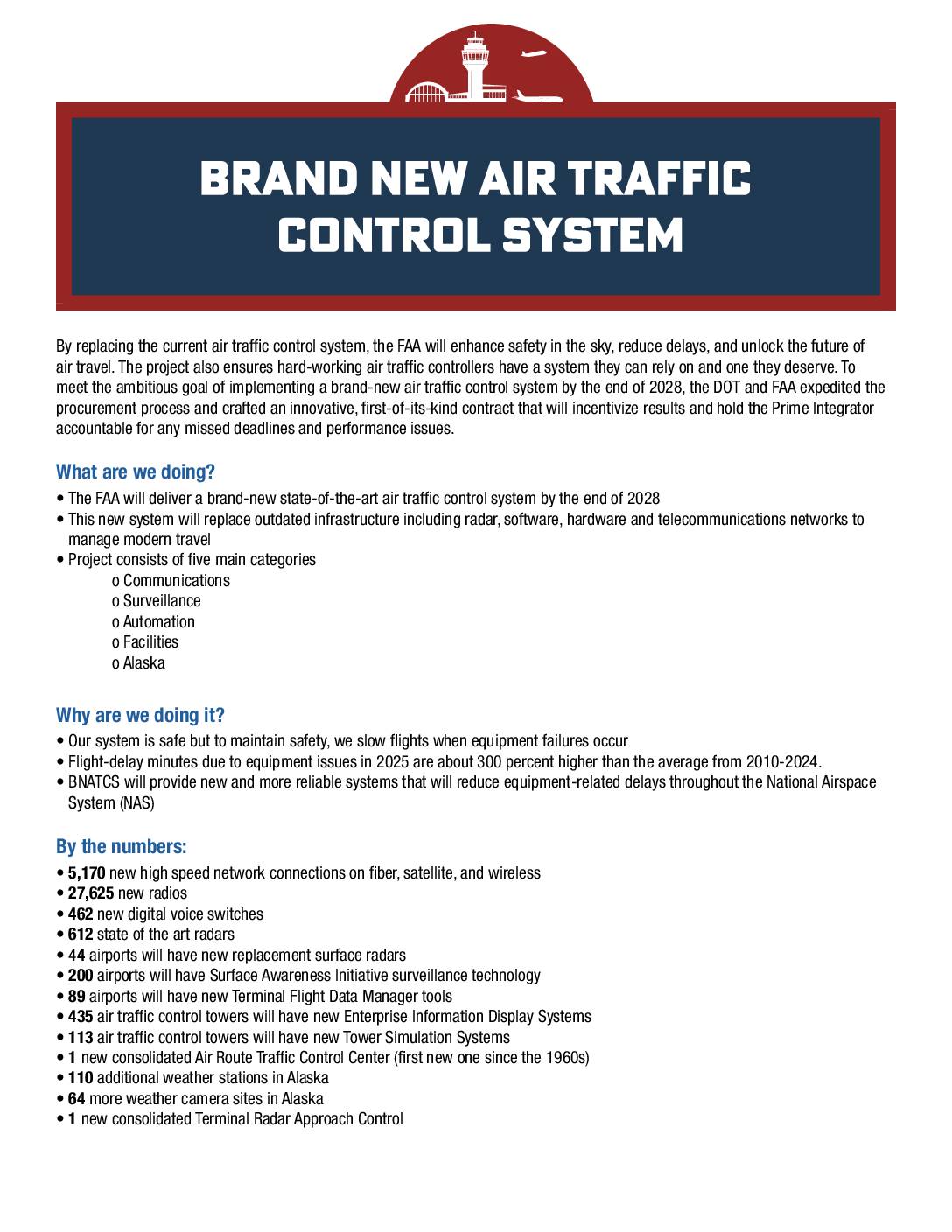
Brand New Air Traffic Control System Fact Sheet
The FAA is replacing the entire U.S. air traffic control system by the end of 2028, upgrading outdated radar, software, hardware, and telecommunications networks to improve safety and reduce flight delays. The project, known as BNATCS, is funded by a $12.5 billion congressional investment with an additional $20 billion still needed, and is being managed by a single prime integrator, Peraton, under a performance-based contract. Key upgrades include thousands of new radios, hundreds of new radars, and expanded weather monitoring infrastructure, with telecommunications identified as the top priority. -
 2025-12-12
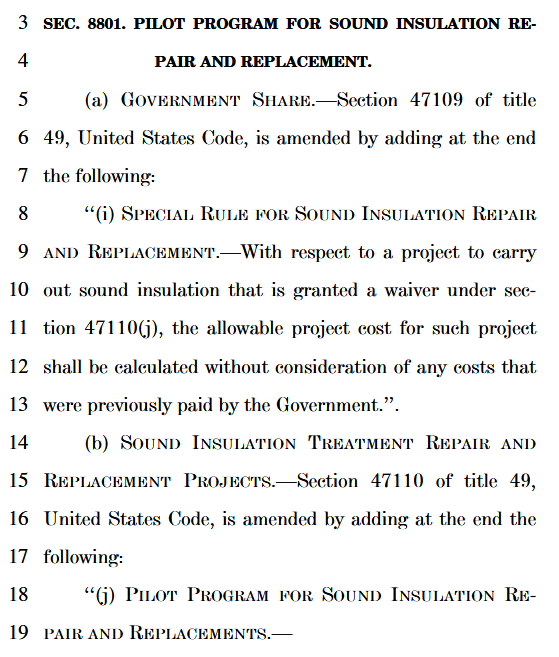
NDAA Section 8801 Pilot Program for Sound Insulation Repair and Replacement
Legislative text from SEC. 8801 establishing a Pilot Program for Sound Insulation Repair and Replacement, amending Title 49 of the United States Code (Sections 47109 and 47110). The provision adds a special rule excluding previously government-paid costs from allowable project cost calculations for sound insulation projects granted waivers under Section 47110(j). -
2025-12-12
Pilot program for sound insulation repair and replacement passes in Defense bill
Smith/Murray provide funding. And so many loopholes. The House of Representatives has passed its mandated National Defense Authorization Act for Fiscal Year 2026. Near the end of the bill is Section 8801, language previously put forward by Congressman Adam Smith WA-9 to allow the FAA to provide grant funding for updates to existing sound insulation -
 2025-12-12
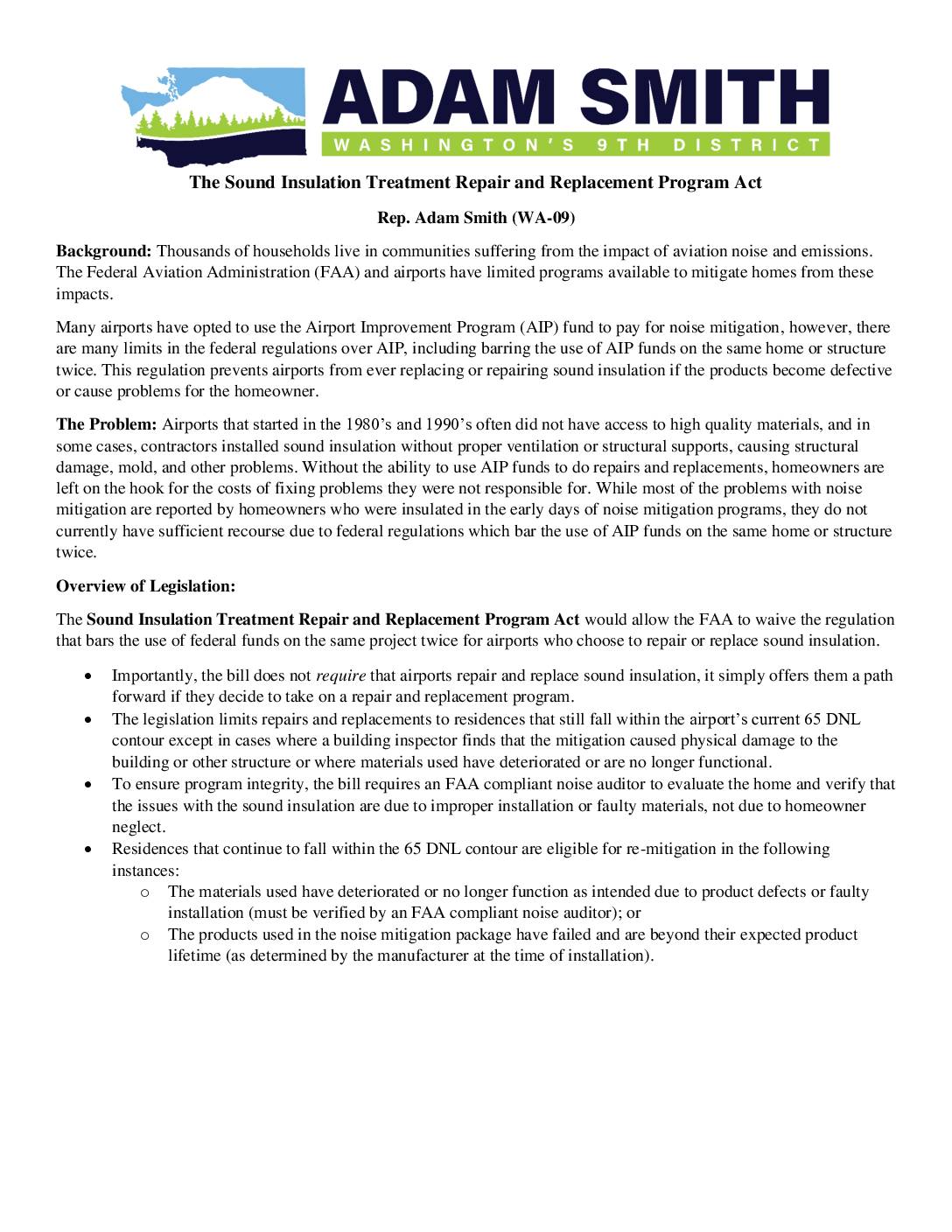
The Sound Insulation Treatment Repair and Replacement Program Act
The Sound Insulation Treatment Repair and Replacement Program Act, introduced by Rep. Adam Smith (WA-09), would allow the FAA to waive a rule that currently prevents federal Airport Improvement Program (AIP) funds from being used more than once on the same home. The bill addresses problems caused by poor-quality materials and faulty installations from early noise mitigation programs in the 1980s and 1990s, which left some homeowners dealing with mold, structural damage, and non-functioning insulation at their own expense. Airports would not be required to participate, but those that choose to could repair or replace defective sound insulation in homes still within the 65 DNL noise contour, provided an FAA-compliant noise auditor verifies the issues stem from improper installation or faulty materials rather than homeowner neglect. -
 2025-12-09
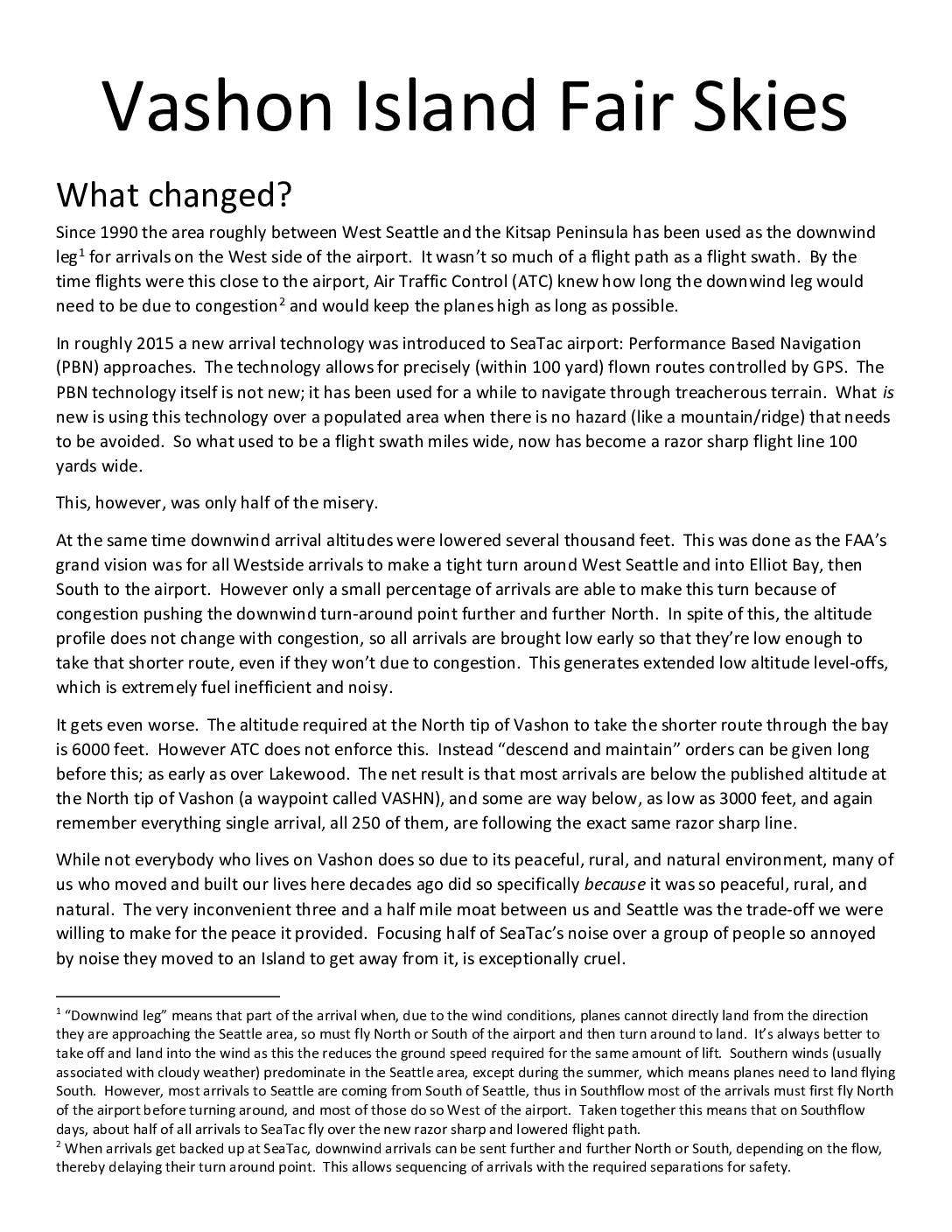
Vashon Island Fair Skies – What changed?
A document explaining changes to aircraft arrival patterns at SeaTac airport around 2015, including the introduction of Performance Based Navigation (PBN) technology and lowered flight altitudes. The changes concentrated flight paths over Vashon Island in a narrow corridor, causing increased noise pollution for residents who chose to live there for its peaceful environment. -
 2025-12-01
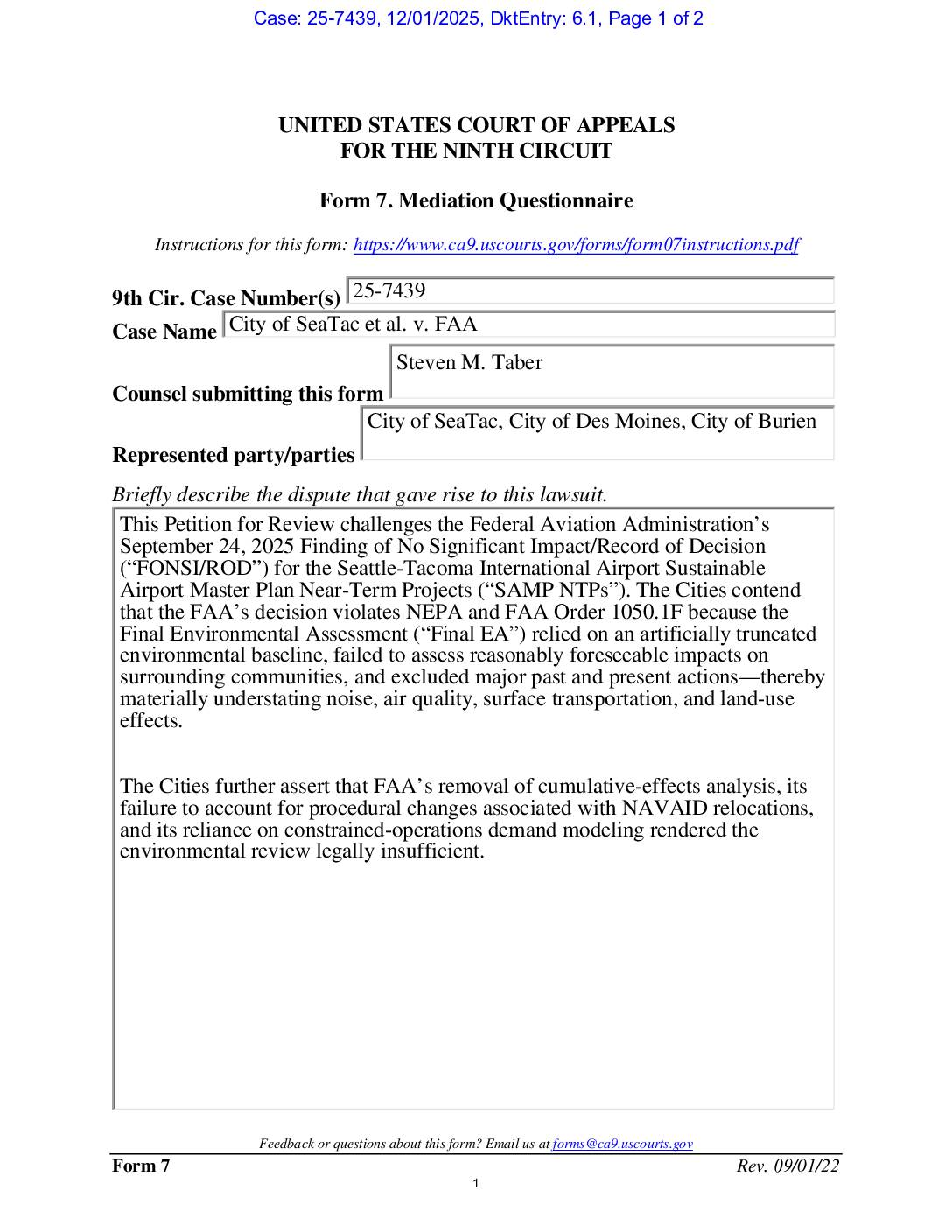
Case 25-7439 Docket Ninth Circuit Court of Appeals
Three cities near Seattle-Tacoma International Airport — SeaTac, Des Moines, and Burien — are challenging a September 2025 FAA decision that declared a major airport expansion plan would have no significant environmental impact. The cities argue the FAA's environmental review was legally flawed because it used an artificially narrow baseline, ignored cumulative effects, and underestimated impacts on noise, air quality, and traffic in surrounding communities. The case is being heard in the Ninth Circuit Court of Appeals alongside a related challenge brought by Vashon Island Fair Skies, with the FAA seeking to consolidate both cases. -
 2025-11-25
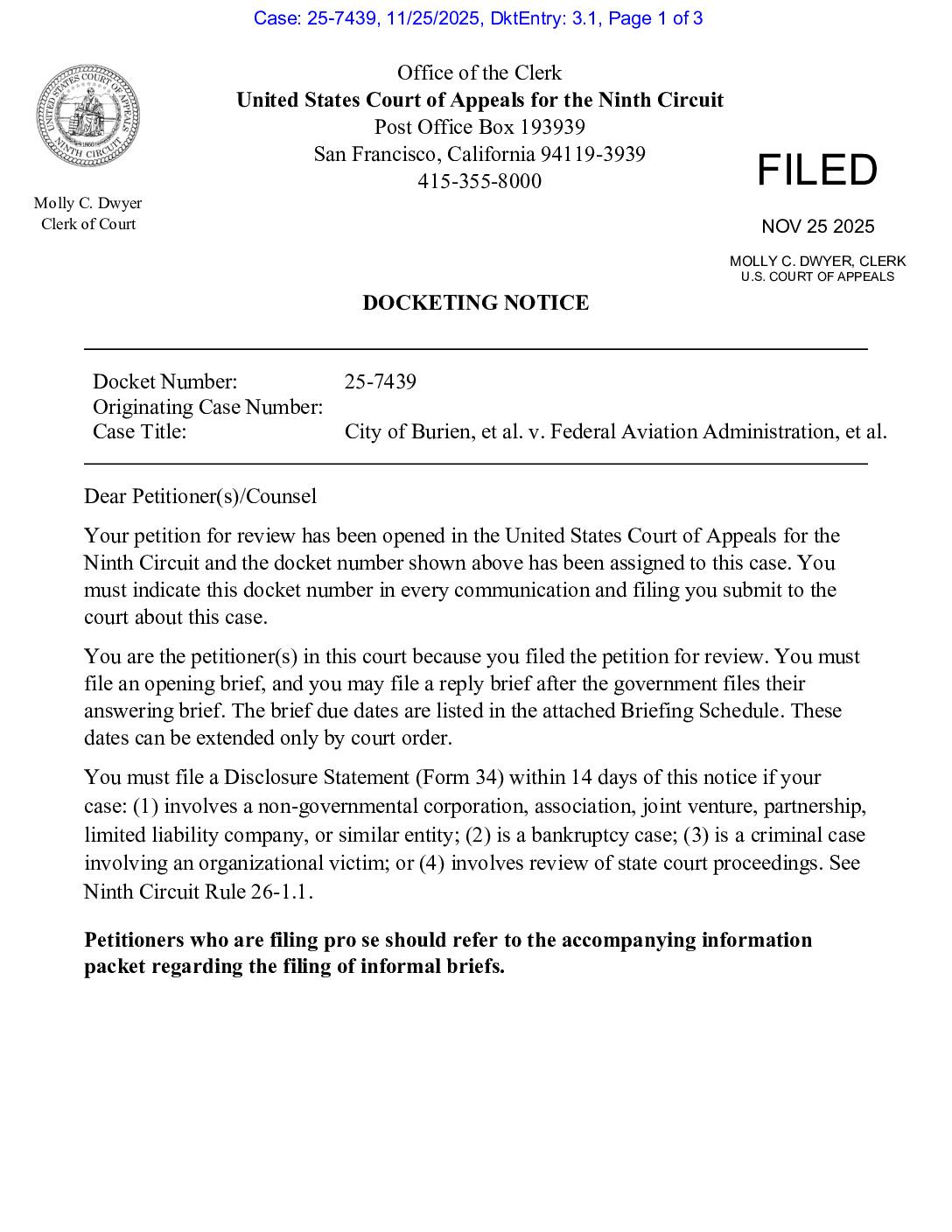
Docketing Notice and Briefing Schedule: City of Burien, et al. v. Federal Aviation Administration, et al., Case No. 25-7439
The U.S. Court of Appeals for the Ninth Circuit has opened a case (No. 25-7439) in which the cities of Burien, Des Moines, and SeaTac are jointly challenging the Federal Aviation Administration and U.S. Department of Transportation over airport-related policy. The petitioning cities must submit mediation questionnaires by December 1, 2025, and file their opening briefs by February 13, 2026, with federal respondents' answering briefs due March 16, 2026. Failure by the cities to meet the opening-brief deadline could result in dismissal of the case. -
 2025-11-24
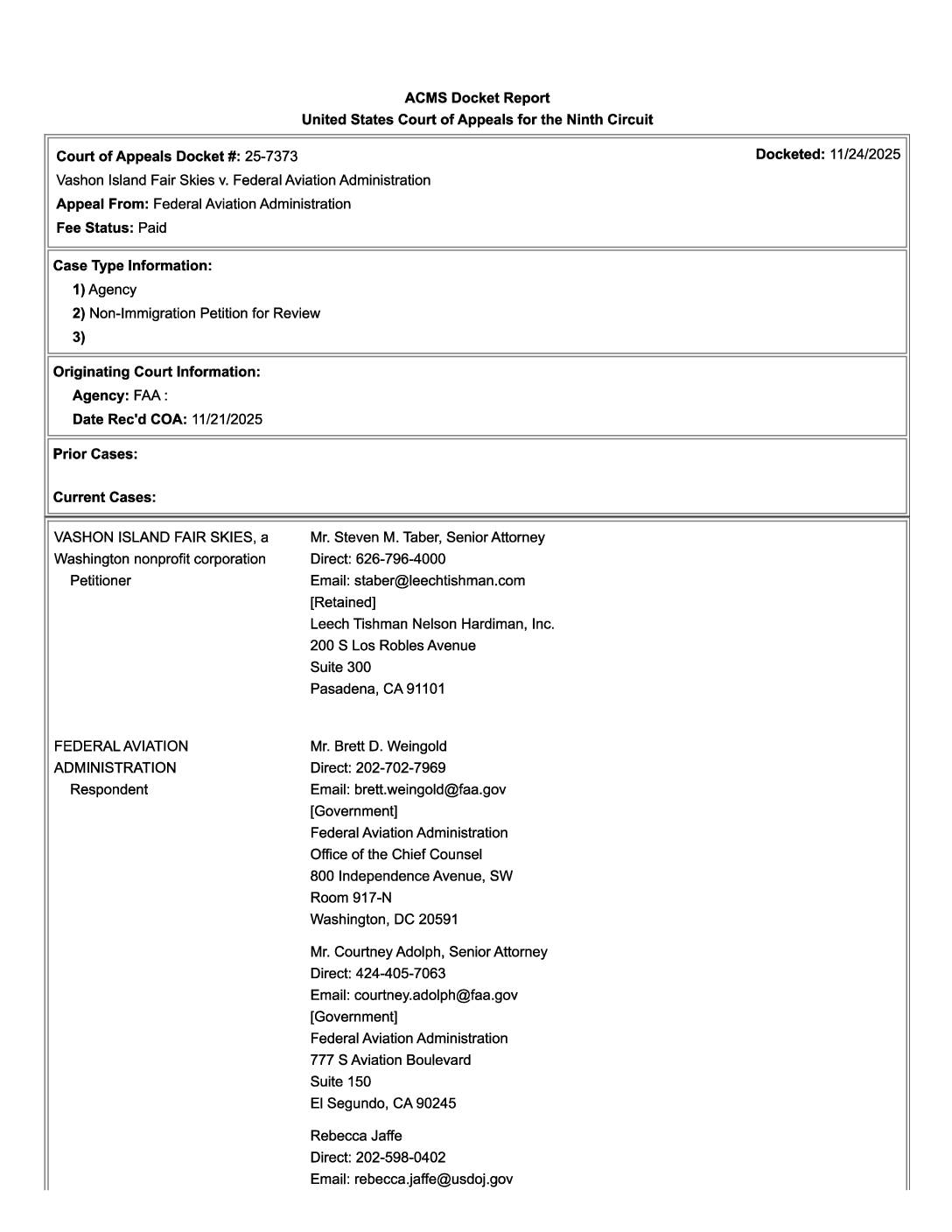
Docket Report: Vashon Island Fair Skies v. Federal Aviation Administration, Case No. 25-7373
Vashon Island Fair Skies, a Washington nonprofit corporation, has filed a petition for review against the Federal Aviation Administration in the U.S. Court of Appeals for the Ninth Circuit (Case No. 25-7373), docketed on November 24, 2025. The case challenges an FAA decision and is represented on the petitioner's side by attorney Steven M. Taber of Leech Tishman Nelson Hardiman, with the FAA and U.S. Department of Justice defending the agency's position. This case likely relates to aircraft noise or airspace management issues affecting Vashon Island, located near Seattle-Tacoma International Airport. -
 2025-11-24
25-7439 Petition for Review of Agency Order – City of Burien, City of Des Moines, and City of SeaTac v. FAA
Three Washington cities near Seattle-Tacoma International Airport — Burien, Des Moines, and SeaTac — filed a legal challenge on November 24, 2025, asking a federal appeals court to review the FAA's September 2025 decision approving near-term construction and expansion projects under the airport's Sustainable Airport Master Plan. The cities argue the FAA's environmental finding, known as a FONSI/ROD, should be scrutinized by the Ninth Circuit Court of Appeals, which has jurisdiction because the cities are located within that circuit. The petition was filed on the last allowable day of the 60-day filing window, as the original deadline fell on a Sunday. -
 2025-11-24
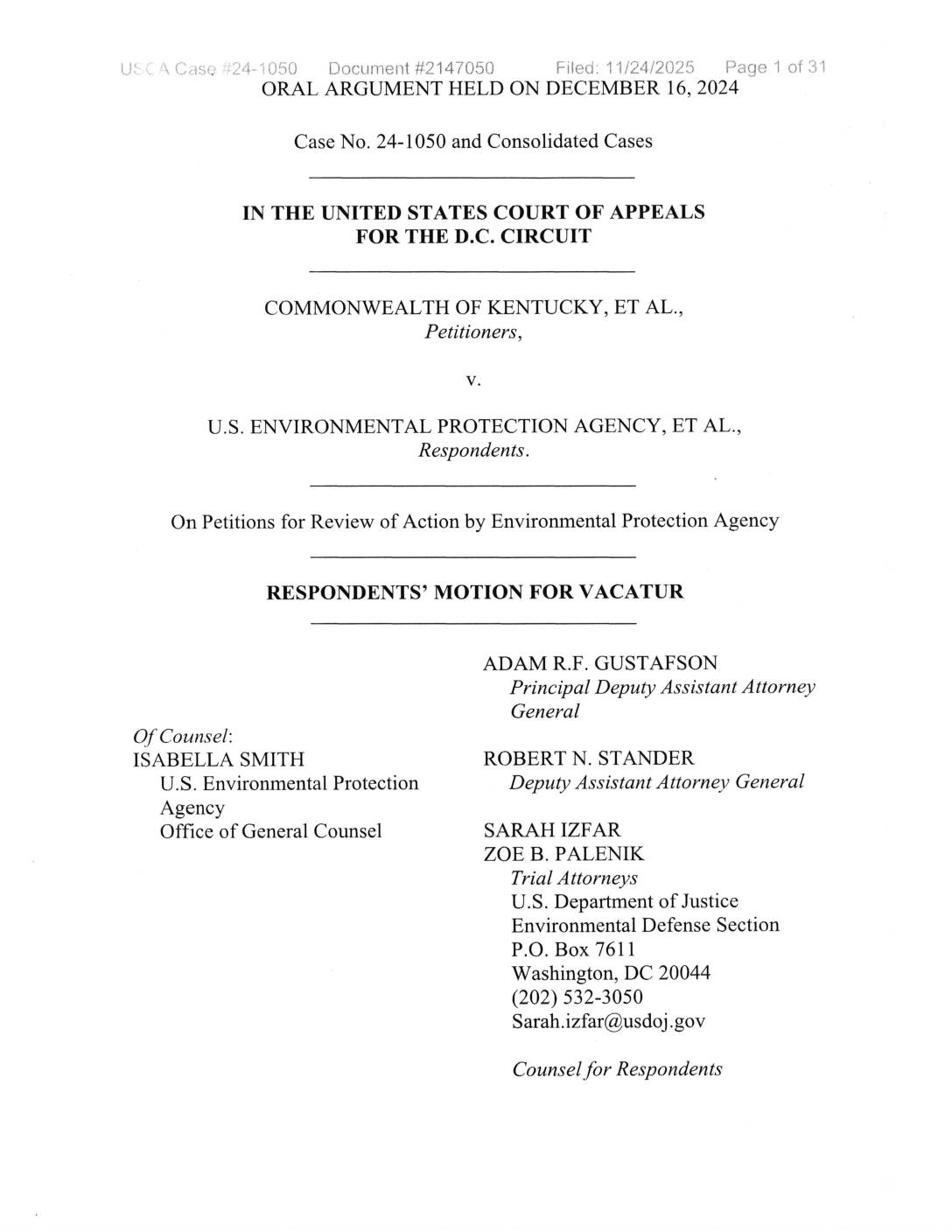
Respondents’ motion for vacatur
This is a legal filing in the U.S. Court of Appeals for the D.C. Circuit in which the U.S. Environmental Protection Agency asks the court to vacate its own previously issued air quality standard, arguing that EPA lacked the statutory authority to revise the standard without completing a full review process. The case centers on National Ambient Air Quality Standards (NAAQS) under the Clean Air Act, not airport noise policy. This document does not contain information relevant to Sea-Tac Airport noise policy.