TagFAA(687)
-
 2025-11-21
Request for Waiver of Conflict of Interest
Law firm Leech Tishman Nelson Hardiman, Inc. sent this November 2025 letter to the cities of Burien, Des Moines, and SeaTac, Washington, along with Vashon Island Fair Skies, Inc., requesting their consent to be represented together in legal challenges against the FAA's environmental approval of near-term construction projects at Seattle-Tacoma International Airport. The firm explains that while a potential conflict of interest exists in representing multiple clients simultaneously, all parties currently share a common goal of contesting the FAA's Finding of No Significant Impact related to increased aviation noise. The letter outlines the conditions of the joint representation, including fee-sharing arrangements, attorney-client privilege limitations, and procedures the firm will follow if the clients' interests diverge. -
 2025-11-21
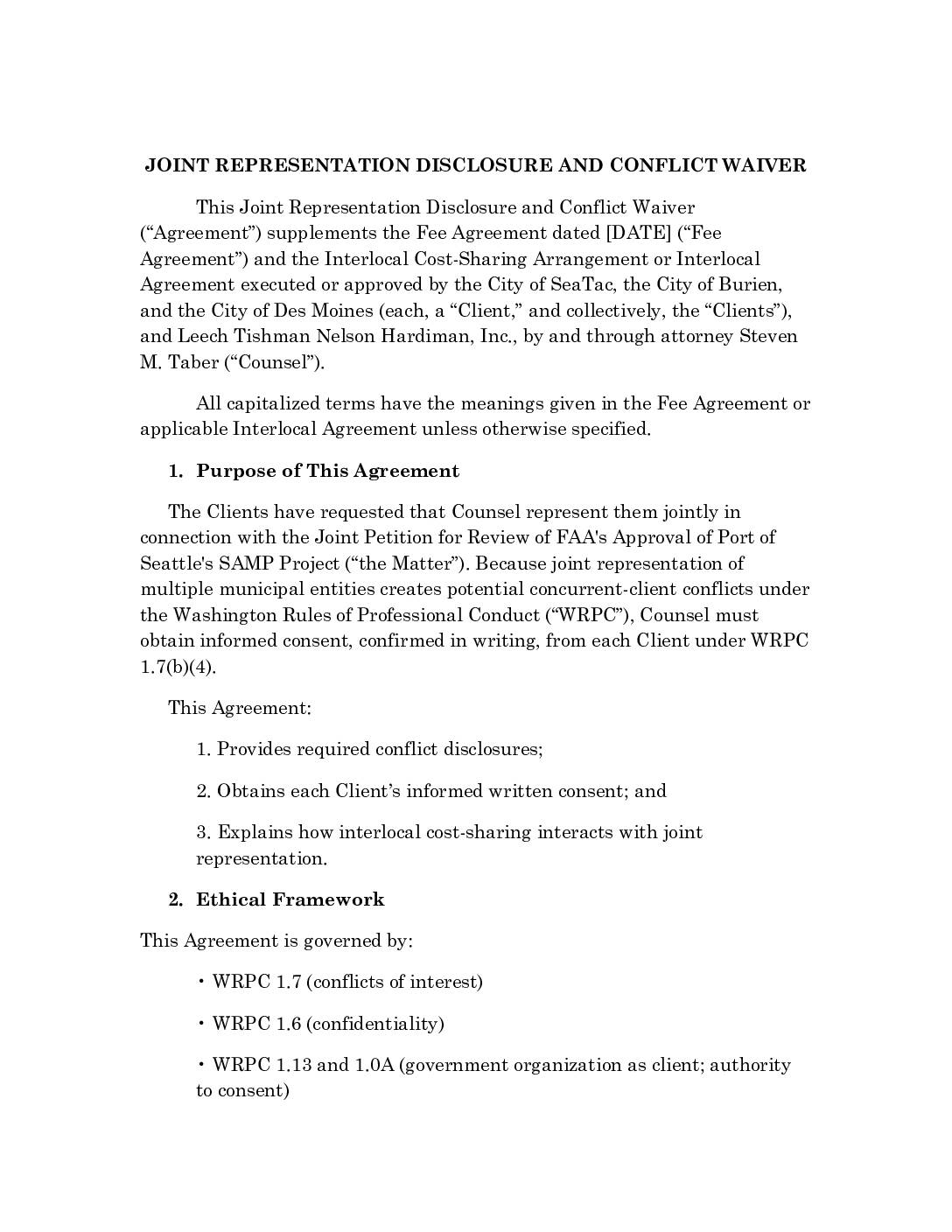
Joint Representation Disclosure and Conflict Waiver
This agreement establishes the terms under which attorney Steven M. Taber of Leech Tishman Nelson Hardiman, Inc. will jointly represent the cities of SeaTac, Burien, and Des Moines in a legal challenge to the FAA's approval of the Port of Seattle's SAMP airport expansion project. It discloses potential conflicts of interest that can arise when multiple municipalities share one lawyer, and requires each city to formally consent to the arrangement in writing. The document also explains how the three cities will share legal costs under an interlocal agreement, and outlines steps that must be taken if conflicts between the cities emerge during the litigation. -
 2025-11-21
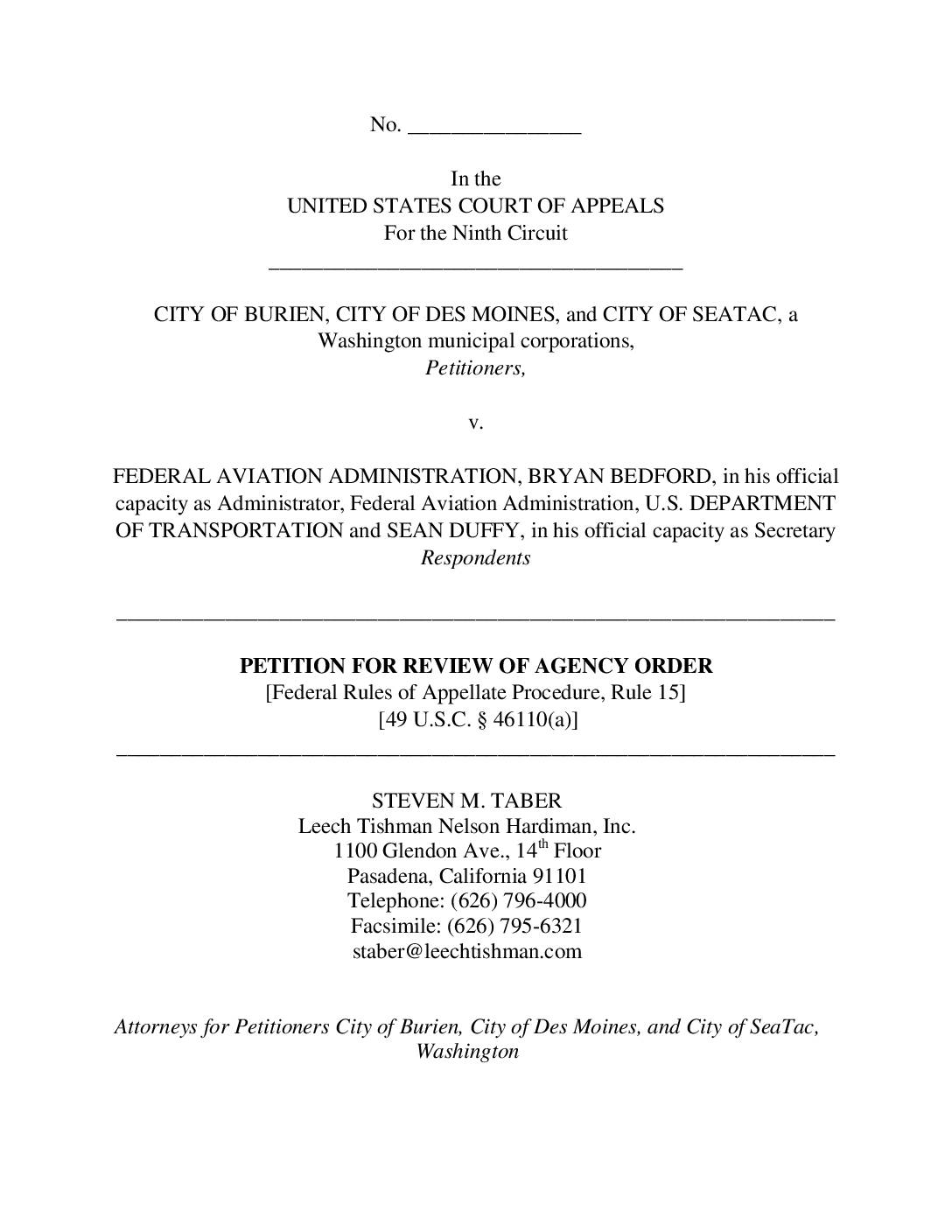
Petition for Review of Agency Order
Three Washington cities — Burien, Des Moines, and SeaTac — have filed a legal challenge in the Ninth Circuit Court of Appeals against the Federal Aviation Administration's September 2025 decision approving near-term expansion projects at Seattle-Tacoma International Airport. The petition contests the FAA's Finding of Significant Impact/Record of Decision related to the airport's Sustainable Airport Master Plan, which the cities argue warrants judicial review. The filing, submitted November 21, 2025, was made within the 60-day statutory deadline under federal aviation law. -
 2025-11-21
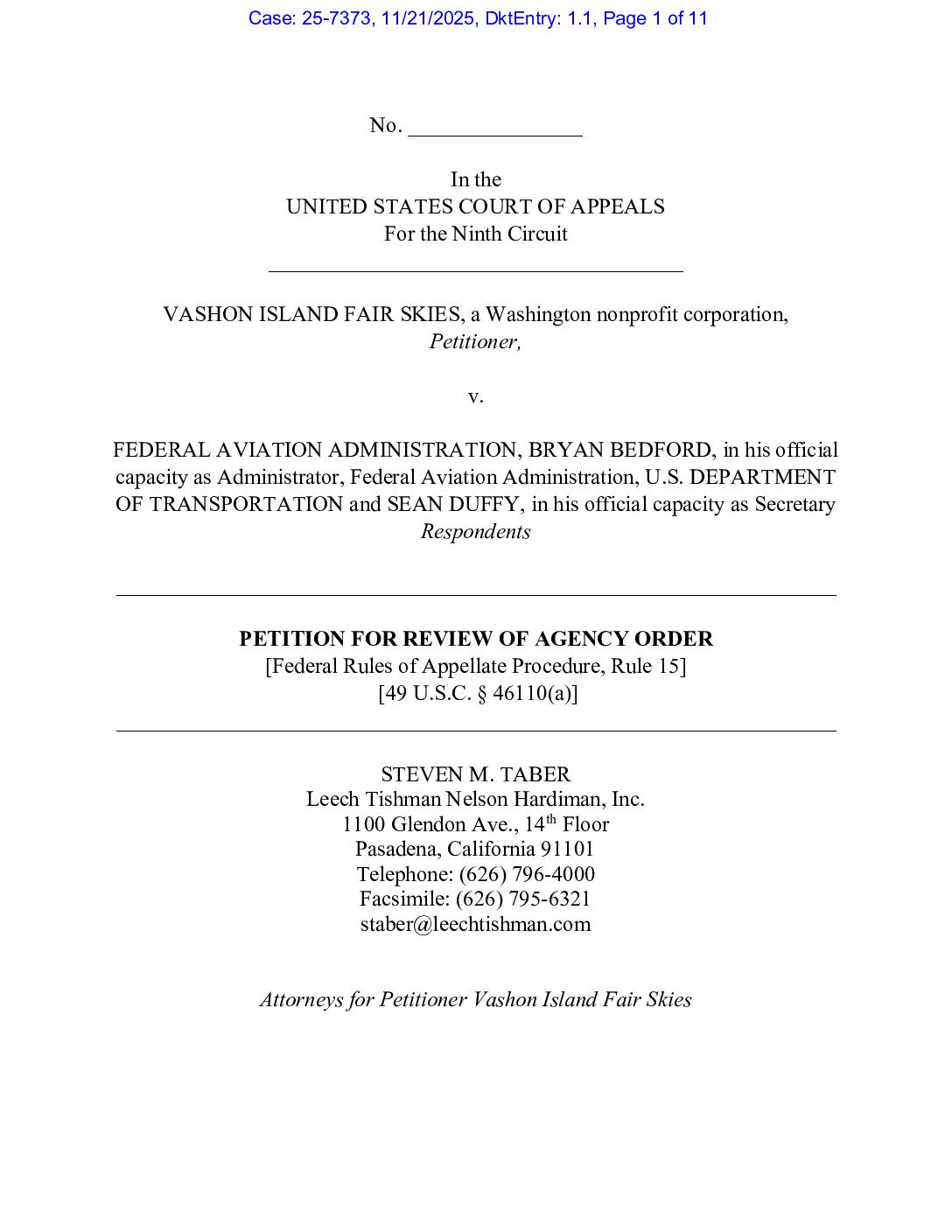
Petition for Review of Agency Order: Vashon Island Fair Skies v. Federal Aviation Administration
Vashon Island Fair Skies (VIFS), a Washington nonprofit representing residents affected by aircraft noise, has filed a petition in the Ninth Circuit Court of Appeals challenging a September 2025 FAA decision approving near-term expansion projects at Seattle-Tacoma International Airport. The group argues that the FAA's environmental review failed to adequately address the significant noise impacts on Vashon and Maury Islands resulting from concentrated, low-altitude flight paths introduced under the FAA's NextGen navigation program. VIFS has been actively opposing these flight path changes since 2018, when new Performance-Based Navigation procedures began routing more aircraft directly over the islands at lower altitudes. -
2025-11-21
Petition for Review of Agency Order
Three Washington cities — Burien, Des Moines, and SeaTac — have filed a legal challenge in the Ninth Circuit Court of Appeals against the Federal Aviation Administration's September 2025 decision approving near-term expansion projects at Seattle-Tacoma International Airport. The petition contests the FAA's Finding of Significant Impact/Record of Decision related to the airport's Sustainable Airport Master Plan, which the cities argue warrants judicial review. The filing, submitted November 21, 2025, was made within the 60-day statutory deadline under federal aviation law. -
2025-11-21
Request for Waiver of Conflict of Interest
Law firm Leech Tishman Nelson Hardiman, Inc. sent this November 2025 letter to the cities of Burien, Des Moines, and SeaTac, Washington, along with Vashon Island Fair Skies, Inc., requesting their consent to be represented together in legal challenges against the FAA's environmental approval of near-term construction projects at Seattle-Tacoma International Airport. The firm explains that while a potential conflict of interest exists in representing multiple clients simultaneously, all parties currently share a common goal of contesting the FAA's Finding of No Significant Impact related to increased aviation noise. The letter outlines the conditions of the joint representation, including fee-sharing arrangements, attorney-client privilege limitations, and procedures the firm will follow if the clients' interests diverge. -
2025-11-15
Sea-Tac Airport Part 150 Study Virtual Public Workshop Transcript
Hello and welcome to the virtual public workshop for the Part 150 study for Seattle-Tacoma International Airport. We appreciate you attending this workshop today and your participation and input is a key component of this study. This series of workshops is a continuation of the in-person workshops that were held starting on September 30th. Today -
 2025-11-14
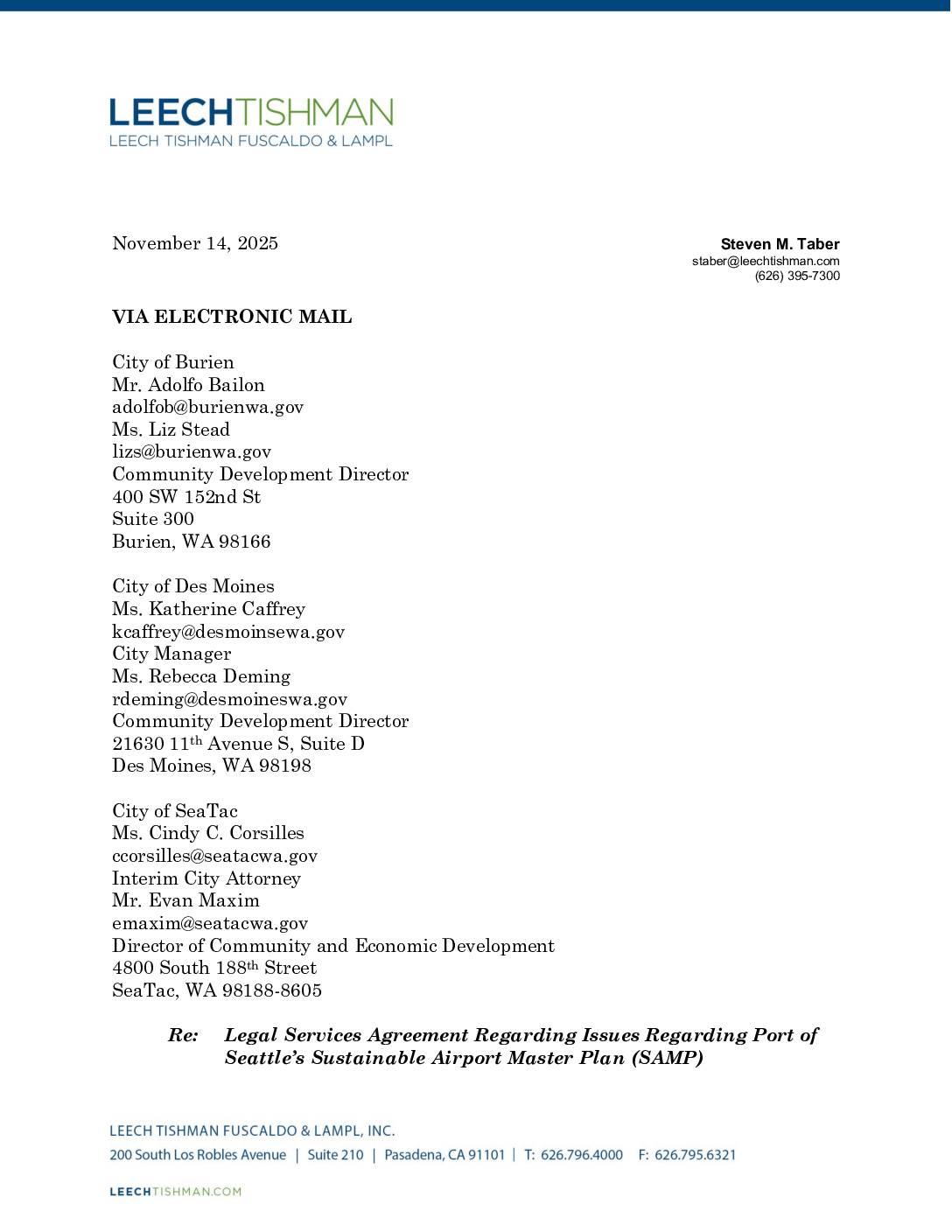
Legal Services Agreement Regarding Issues Regarding Port Of Seattle’s Sustainable Airport Master Plan (SAMP)
The cities of Burien, Des Moines, and SeaTac have jointly hired the law firm Leech Tishman Fuscaldo & Lampl to challenge the Federal Aviation Administration's approval of the Port of Seattle's Sustainable Airport Master Plan (SAMP). The firm will file a Petition for Review in the U.S. Court of Appeals for the Ninth Circuit, naming the FAA as the respondent. Under the agreement, SeaTac will receive and pay all legal invoices on behalf of the three cities, with legal fees starting with a $10,000 retainer and billed at $540 per hour for the lead attorney. -
 2025-11-14
NEPA Determination, Simple Categorical Exclusion for the Industrial Wastewater Treatment Plan Expansion Project at Seattle-Tacoma International Airport
The FAA has determined that Seattle-Tacoma International Airport's proposed expansion of its Industrial Wastewater Treatment Plant (IWTP) qualifies for a Simple Categorical Exclusion under the National Environmental Policy Act, meaning the project is not expected to have a significant impact on the environment. The project includes upgrades to the existing treatment plant infrastructure, construction of an aerated gravel bed, and updates to the adjacent Lagoon 3 site. This determination, issued November 14, 2025, clears the way for the required Airport Layout Plan update without the need for further environmental review. -
2025-11-14
NEPA Determination, Simple Categorical Exclusion for the Industrial Wastewater Treatment Plan Expansion Project at Seattle-Tacoma International Airport
The FAA has determined that Seattle-Tacoma International Airport's proposed expansion of its Industrial Wastewater Treatment Plant (IWTP) qualifies for a Simple Categorical Exclusion under the National Environmental Policy Act, meaning the project is not expected to have a significant impact on the environment. The project includes upgrades to the existing treatment plant infrastructure, construction of an aerated gravel bed, and updates to the adjacent Lagoon 3 site. This determination, issued November 14, 2025, clears the way for the required Airport Layout Plan update without the need for further environmental review.