TagFAA(687)
-
 1992-11-20
Airport planning: Seattle-Tacoma International Airport, State of Washington
In a November 1992 letter to the FAA's Northwest Mountain Region manager, the President of the Regional Commission on Airport Affairs urges the federal government to defer funding and detailed planning for a proposed third runway at Seattle-Tacoma International Airport (Sea-Tac). The letter argues that the Puget Sound Regional Council's ongoing regional airport system planning process must be allowed to fully evaluate all alternatives before any single project receives federal financial commitment. The author warns that proceeding prematurely with site-specific plans and an Environmental Impact Statement risks wasting federal money if the regional plan ultimately selects an alternative other than a third runway at Sea-Tac. -
1992-06-12
Flight Patterns – FAA’s ‘Four Post’ traffic plan for planes is illogical, insulting
June 12, 1992 Publication: THE SEATTLE TIMES Page: A9 Word Count: 354 The Ninth Circuit in San Francisco recently voted that since the noise level was not above 65 decibels (recently raised from 55 decibels) the Federal Aviation Administration did not have to be subject to any environmental impact requirements. Therefore, the FAA’s brilliant “four post” plan remains -
Seattle Community Council Federation v. FAA 961 F.2d 929
961 F.2d 829 SEATTLE COMMUNITY COUNCIL FEDERATION, a Washington nonprofit corporation, Petitioner, v. FEDERAL AVIATION ADMINISTRATION; Samuel Skinner, Respondents. No. 90-70253. United States Court of Appeals, Ninth Circuit. Argued and Submitted Jan. 8, 1991. Decided April 9, 1992. Peter J. Eglick and Henryk J. Hiller, Seattle, Washington, for petitioner. Peter R. Steenland, Jr., and J. -
 1992-04-09
Seattle Community Council Federation v. F.A.A., 961 F.2d 829 (9th Cir. 1992)
In 1992, the Ninth Circuit Court of Appeals upheld the FAA's decision to change flight patterns for turbine-powered aircraft at Seattle-Tacoma International Airport without preparing a full Environmental Impact Statement. The FAA had issued a Finding of No Significant Impact based on a computer noise model using the 65 decibel day-night sound level as the threshold for significant noise impact, which the court found to be a reasonable approach. The Seattle Community Council Federation had challenged the decision, arguing that the FAA failed to adequately assess the noise effects on surrounding communities. -
 1992-03-06
Letter from James D. Chalupník to Richard Aramburu Regarding Sea-Tac Aircraft Noise Study 2: Ldн Metric and Integrated Noise Model
In this 1992 letter, acoustics expert James D. Chalupník explains to attorney Richard Aramburu how aircraft noise near Seattle's Sea-Tac Airport is measured and rated, focusing on the appropriateness of the Ldn metric and the data used in the FAA's Integrated Noise Model (INM). He outlines the key physical properties of noise—intensity, frequency distribution, and fluctuation over time—and describes how various weighting schemes, particularly the A-weighting (dBA) scale, are used to approximate human perception of loudness and annoyance. The letter also notes the limitations of simpler metrics and introduces more sophisticated rating methods such as Stevens' Loudness Level and Perceived Noise Level for evaluating aircraft noise. -
 1992-02-01
Des Moines Creek water quality study
A 1992 water quality study of Des Moines Creek, prepared by Parametrix, Inc. for the FAA and Port of Seattle, assessed the health of the creek during storm runoff events. The creek, which originates near Sea-Tac International Airport and flows to Puget Sound, had its aquatic ecosystem severely damaged by jet fuel spills in 1985 and 1986. The study sampled seven locations along the creek and three tributaries to identify water quality problems and determine whether stormwater pollution from airport operations was causing toxic conditions. -
 1992-01-01
EXH AR037747: Flight Plan Project Draft Final Report and Technical Appendices (Including Draft Programmatic Environmental Impact Statement)
AR037747. Draft Final Report of the Puget Sound Air Transportation Committee’s Flight Plan Project, January 1992, sponsored by the Puget Sound Regional Council and Port Of Seattle with FAA grants. Study findings and draft recommendations for long-term air carrier system needs of the Puget Sound Region, including a Draft Programmatic Environmental Impact Statement. Committee chaired -
 1991-03-31
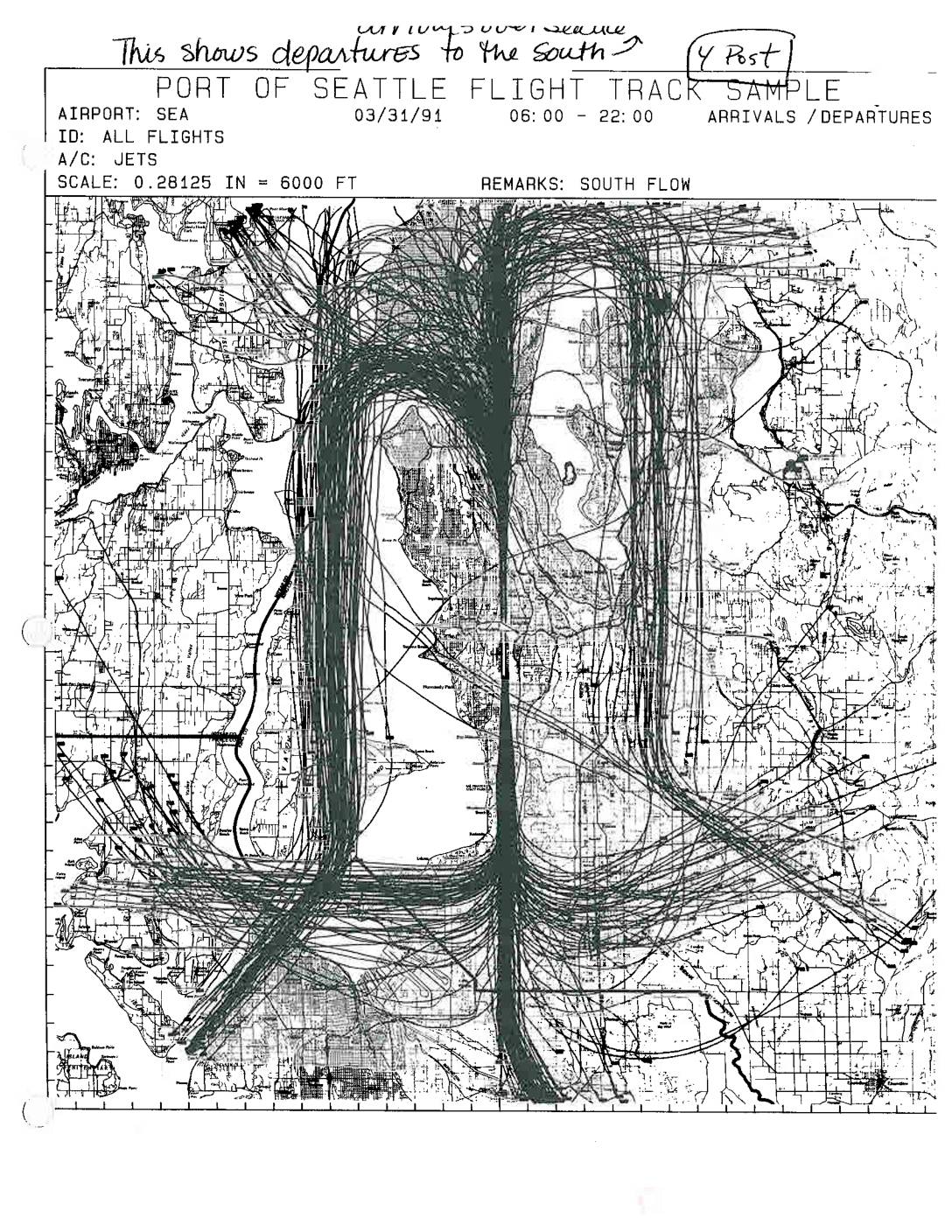
Port Of Seattle Flight Track Sample: South Flow Arrivals/Departures — Pre- and Post-Four Post Plan Comparison Maps
These two Port of Seattle Flight Track Sample maps compare jet aircraft arrival and departure patterns at Seattle-Tacoma International Airport (SEA) under south flow conditions, one from March 22, 1989 (pre-4 Post) and one from March 31, 1991 (4 Post). Both charts plot all jet flight tracks between approximately 4:30–24:00 and 6:00–22:00 respectively, showing how flight paths over the Seattle region shifted between the two periods. The maps are annotated to highlight southbound departures and arrivals over Seattle, serving as visual evidence for noise impact analysis related to airport runway and procedure policy changes. -
 1990-04-02
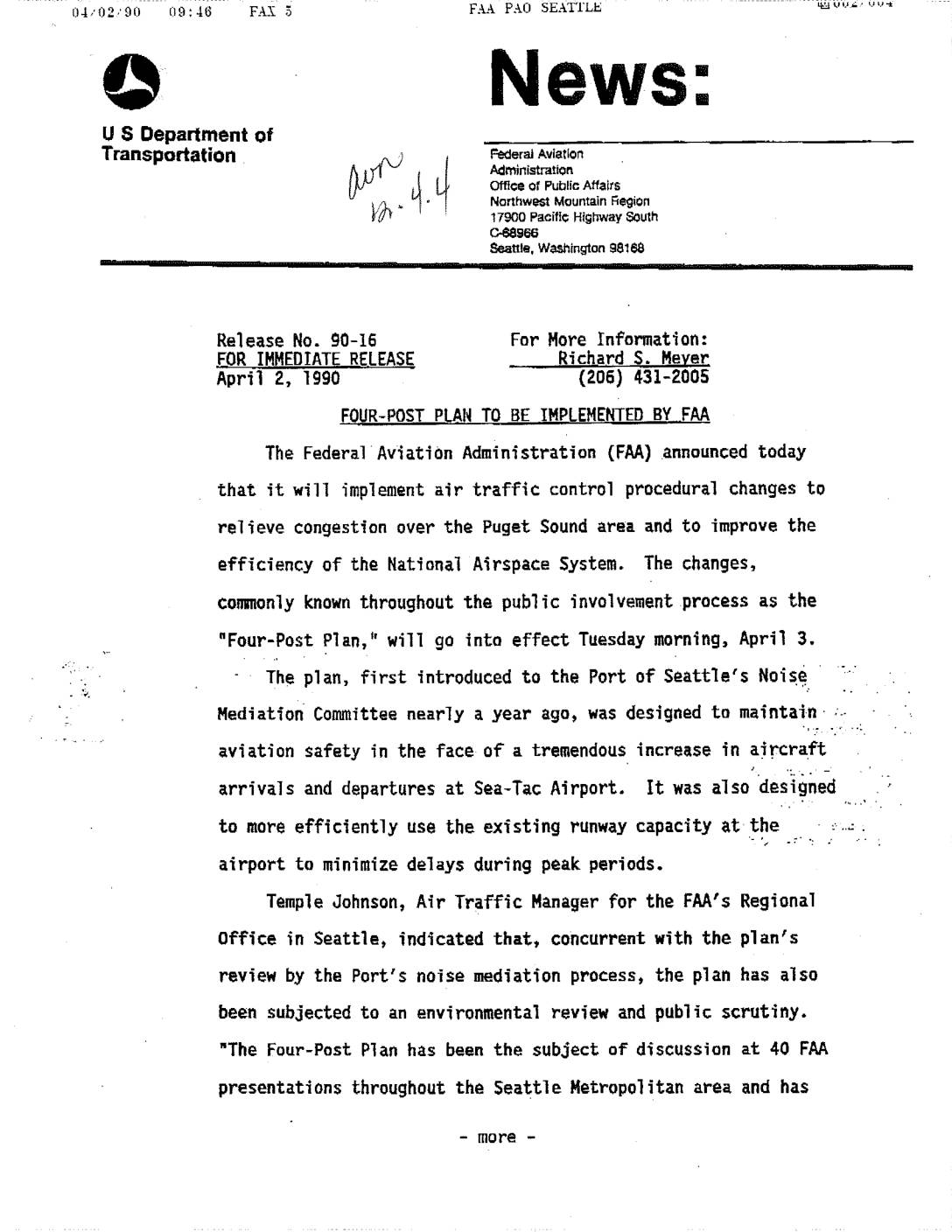
Four-Post Plan to Be Implemented by FAA
On April 2, 1990, the FAA announced it would implement the 'Four-Post Plan,' a set of air traffic control procedural changes at Seattle-Tacoma International Airport designed to reduce congestion, improve efficiency, and address worsening arrival delays. The plan, developed after nearly a year of public meetings, environmental review, and computer simulation of 13 alternatives, was determined to produce no significant noise impact on surrounding communities. The FAA cited a 30,000 increase in annual landings and takeoffs since 1988 and the failure of mediation talks to produce an agreed-upon flight path solution as key reasons for moving forward with the changes. -
 1990-03-31
Final Package of Mediated Noise Abatement Actions for Seattle-Tacoma International Airport, Agreed to by the Mediation Committee, March 31, 1990
This 1990 document outlines a comprehensive package of noise abatement actions for Seattle-Tacoma International Airport, agreed upon by a Mediation Committee on March 31, 1990. It covers measures such as nighttime flight restrictions, soundproofing programs for nearby homes and public buildings, improved flight corridors, and a new noise management monitoring system. According to the technical consultant involved, full implementation of these agreements could reduce noise levels by approximately 50% for communities surrounding the airport.