TagFAA(687)
-
 1996-10-01
Memorandum of Agreement: Air Quality Monitoring Program Activities Relating to the Seattle-Tacoma International Airport Vicinity
This 1996 Memorandum of Agreement establishes a 24-month air quality monitoring program near Seattle-Tacoma International Airport, involving the Port of Seattle, FAA, EPA, Washington State Department of Ecology, and the Puget Sound Air Pollution Control Agency. The program, funded at $195,000, focuses on measuring carbon monoxide, nitrogen oxides, and aircraft fuel particle residue to establish baseline air quality data and evaluate potential pollution impacts from planned airport expansion projects. The Port agreed not to proceed with expansion elements projected to cause carbon monoxide standard violations until monitoring is complete and, if necessary, mitigation measures are identified. -
 1996-09-19
Memorandum of Agreement: Air Quality Monitoring Program Activities Relating to the Seattle-Tacoma International Airport Vicinity
A 1996 Memorandum of Agreement between the Port of Seattle, FAA, EPA, Washington State Department of Ecology, and the Puget Sound Air Pollution Control Agency established a 24-month air quality monitoring program near Seattle-Tacoma International Airport. The $195,000 program was designed to measure carbon monoxide, nitrogen oxides, and aircraft fuel particle residue in order to establish baseline pollution data and assess the accuracy of earlier 'worst case' air quality models from the airport's Final Environmental Impact Statement. The Port agreed not to proceed with Master Plan expansion projects projected to cause CO standard exceedances until monitoring was complete and, if necessary, appropriate mitigation measures were identified. -
 1996-03-27
Appendix E: Comments Concerning the Final Environmental Impact Statement — Sea-Tac Airport Master Plan Update
Appendix E contains public comments submitted in response to the Final Environmental Impact Statement (FEIS) for the Seattle-Tacoma International Airport Master Plan Update. Commenters include the Highline Water District, the Washington State Department of Ecology, the U.S. Public Health Service, and the Washington State Department of Natural Resources, raising concerns about groundwater contamination, the handling of aircraft de-icing glycols, storm water runoff, and surface mining permit requirements for borrow sites on Port of Seattle property. The agencies generally called for stronger mitigation measures and clearer answers to environmental questions before approving the proposed airport expansion. -
 1996-03-18
Testimony of Dr. Stephen Hockaday before the Subcommittee on Aviation of the House of Representatives Committee on Transportation and Infrastructure
In 1996 congressional testimony, Dr. Stephen Hockaday argued against building a costly third runway at Seattle-Tacoma International Airport, contending that the Port of Seattle greatly overstated the frequency of poor weather conditions that would require it. He presented evidence that true instrument flight conditions occur less than 8% of the year—not the 44% the Port claimed—and that existing navigation technologies like Localizer Directional Aid approaches could address capacity needs at far lower cost. Hockaday warned that spending half a billion dollars on a runway used only 15% of the time would divert resources from better long-term regional aviation solutions. -
 1996-02-01
Final Environmental Impact Statement for proposed Master Plan Update development actions at Seattle-Tacoma International Airport, Volume 7 of 7, Appendix T
This 1996 Final Environmental Impact Statement (EIS), prepared by the FAA and Port of Seattle, evaluates the environmental effects of proposed expansion plans at Seattle-Tacoma International Airport, including construction of a third parallel runway, terminal upgrades, and parking improvements planned through 2020. The document addresses key community concerns such as aircraft noise, air quality, surface traffic, and impacts on wetlands and floodplains. It includes transcripts and written comments from two public hearings held in June 1995, attended by community members and agencies who raised significant concerns about noise, health, and environmental impacts. -
 1996-02-01
EXH AR038744: Final Environmental Impact Statement for Proposed Master Plan Update Development Actions at Seattle-Tacoma International Airport, Volume 1 of 7
Final Environmental Impact Statement (EIS) prepared jointly by the Federal Aviation Administration (FAA) Northwest Mountain Region and the Port of Seattle for the Seattle-Tacoma International Airport (Sea-Tac) Master Plan Update, dated February 1996, AR038744. Covers proposed development actions 1996-2020 including a new third parallel runway (Runway 16X/34X) up to 8,500 feet long separated 2,500 feet -
 1996-01-01
Box 1321: Airport Litigation Documents — Expert Arbitration Panel Audio Tapes, Transcripts, and Cassettes, 1993–1996
This archival box (Historical Box No. 1321) contains airport litigation documents from 1993–1996, including Expert Arbitration Panel audio tapes, meeting transcripts, and diskettes related to proceedings involving Treece, Shirley & Brodie. It also holds records on the FAA Grant MSA Phase II, the MSA Consultant Selection Process, Regional Airport System Plan applications for federal assistance, and materials related to the Four Post Task Force and North/Adjacent planning. The box is held on long-term loan at the WA State Archives. -
1996-01-01
Box 1321: Airport Litigation Documents — Expert Arbitration Panel Audio Tapes, Transcripts, and Cassettes, 1993–1996
This is an Archives and Storage record (CID 10996, Box No. 01289, Historical Box No. 1321) from the Administration Office, prepared by Angie Daniels, covering 1993–1996. Contents include Expert Arbitration Panel audio tapes, meeting transcripts, cassette tapes of proceedings, FAA Grant MSA Phase II materials, Regional Airport System Plan federal assistance applications, Puget Sound Regional Council Four Post Plan documents, and related correspondence pertaining to Sea-Tac Airport litigation and system management. -
 1995-12-04
Seattle 4-Post Decision and Order
This 1995 FAA Decision and Order addresses longstanding air traffic congestion and inefficiency problems at Seattle-Tacoma International Airport (Sea-Tac), stemming from outdated flight route procedures established in the 1970s. The document explains that existing arrival and departure routes caused safety concerns, reduced airport capacity, and increased controller workload, particularly when runway directions changed multiple times daily. It also notes that the so-called 'noise abatement' procedures from 1974 were not based on any coherent noise reduction plan, but were largely the result of moving flight paths away from communities that had complained. -
 1995-07-01
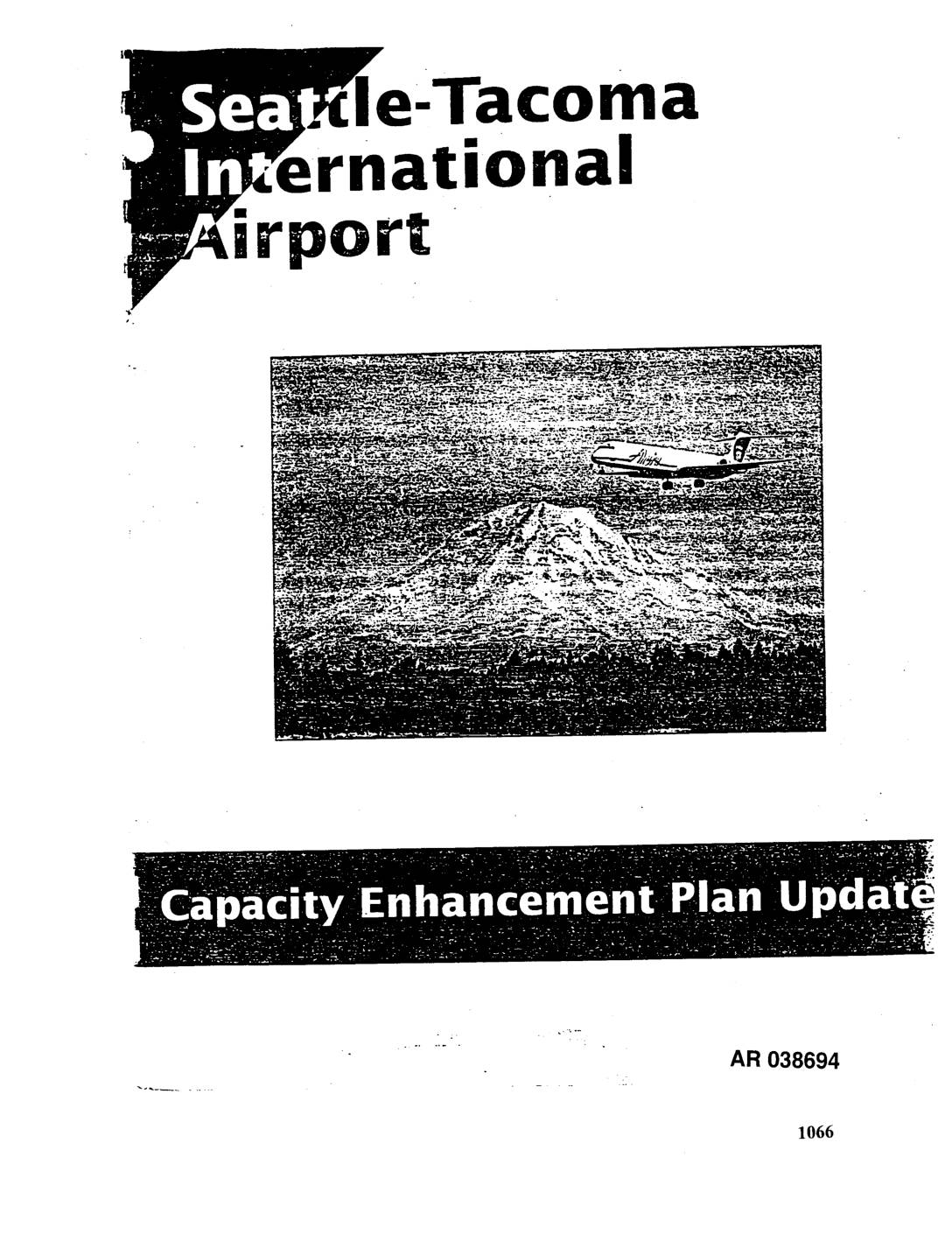
EXH AR038694: STIA Capacity Enhancement Plan Update
Seattle-Tacoma International Airport (STIA) Capacity Enhancement Plan Update, July 1995, AR 038694. Prepared jointly by the U.S. Department of Transportation, Federal Aviation Administration (FAA), Port Of Seattle, and airlines and general aviation community serving Sea-Tac Airport. Document covers airport capacity planning and enhancement initiatives.