TagEPA(118)
-
 1998-02-01
EXH AR041523: Washington State Department of Ecology Water Quality Program — Whole Effluent Toxicity (WET) Program Evaluation
Whole Effluent Toxicity (WET) Program Evaluation prepared by Randall Marshall, WET Coordinator, Washington State Department of Ecology Water Quality Program, February 1998 (Publication #98-03). Evaluates implementation of Washington State’s WET regulation adopted October 1993, covering WET test review, effluent toxicity data, the state’s WET rule (WAC), EPA WET policy, SETAC Pellston Workshop (September 1995), EPA -
 1997-06-01
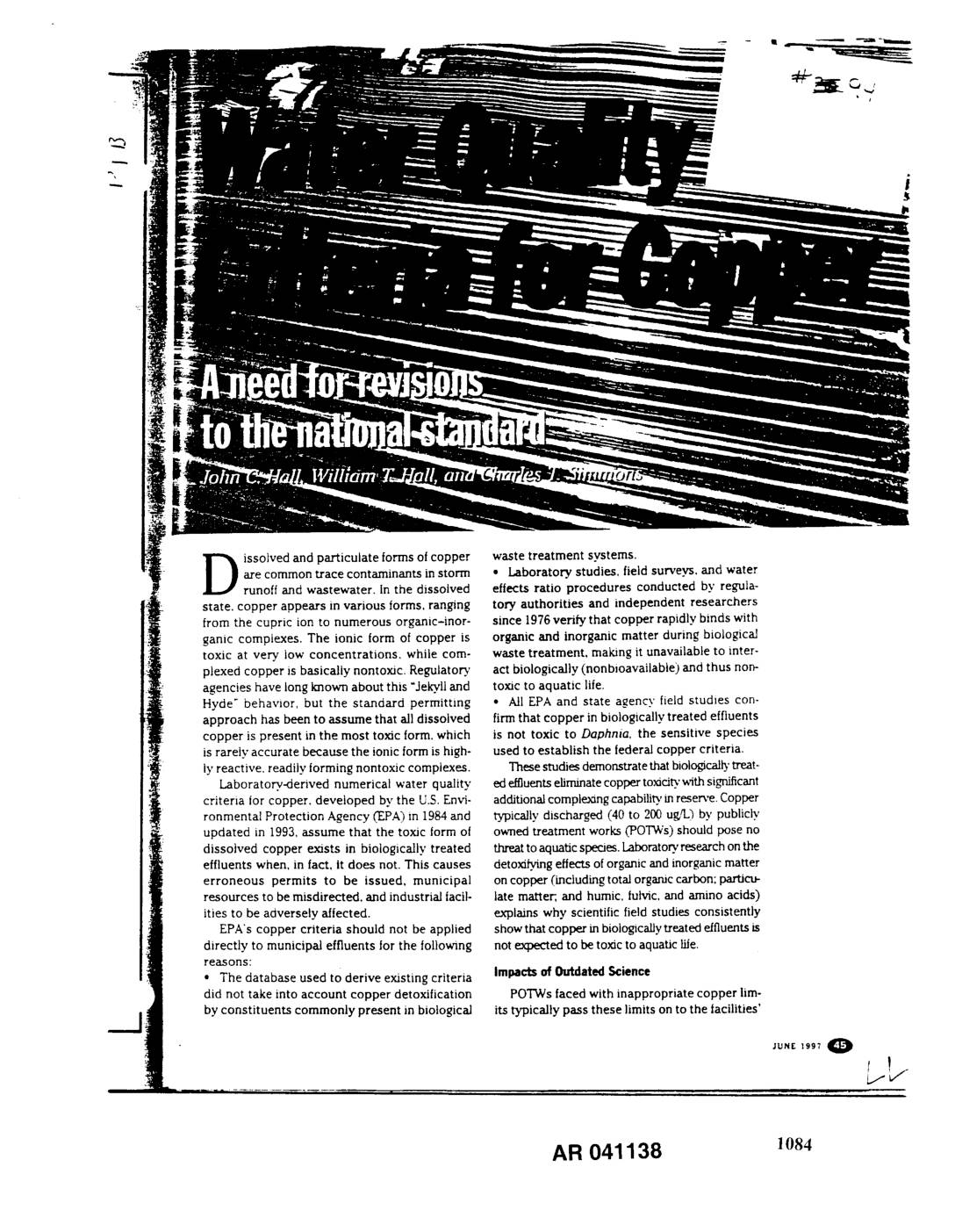
EXH AR041138: Water Quality Criteria for Copper — A Need for Revisions to the National Standard
Article by John C. Hall, William T. Hall, and Charles J. Simmons published in Water Environment & Technology (June 1997) arguing that EPA’s 1984 and 1993 copper water quality criteria should not be applied directly to municipal effluents (POTWs) because dissolved copper in biologically treated effluents is complexed with organic and inorganic matter and is -
 1996-10-01
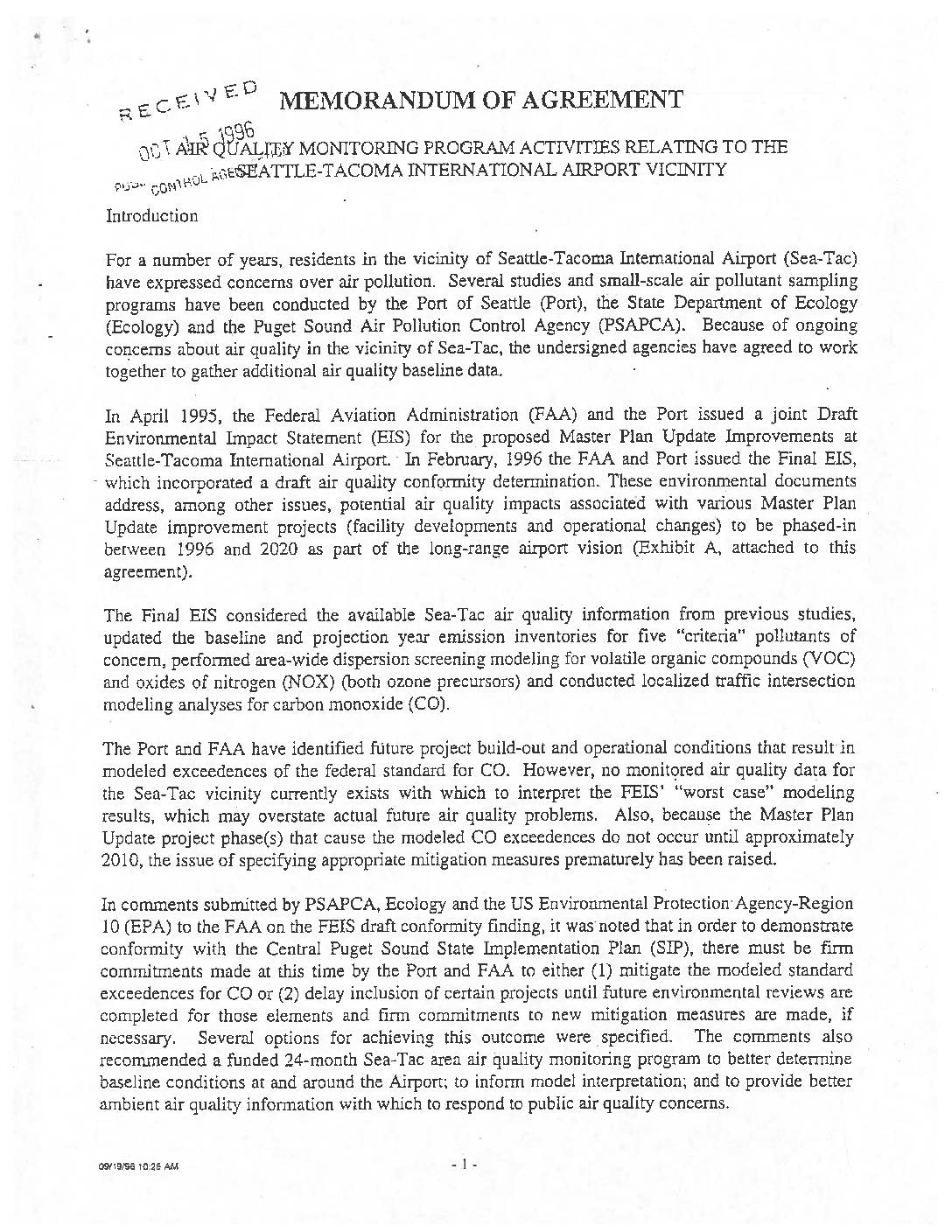
Memorandum of Agreement: Air Quality Monitoring Program Activities Relating to the Seattle-Tacoma International Airport Vicinity
This 1996 Memorandum of Agreement establishes a 24-month air quality monitoring program near Seattle-Tacoma International Airport, involving the Port of Seattle, FAA, EPA, Washington State Department of Ecology, and the Puget Sound Air Pollution Control Agency. The program, funded at $195,000, focuses on measuring carbon monoxide, nitrogen oxides, and aircraft fuel particle residue to establish baseline air quality data and evaluate potential pollution impacts from planned airport expansion projects. The Port agreed not to proceed with expansion elements projected to cause carbon monoxide standard violations until monitoring is complete and, if necessary, mitigation measures are identified. -
 1996-07-01
EXH AR033736: Soil Screening Guidance: User’s Guide, Second Edition
EPA Soil Screening Guidance: User’s Guide, Second Edition (Publication 9355.4-23, EPA/540/R-96/018), published July 1996 by the U.S. Environmental Protection Agency Office of Emergency and Remedial Response (OERR), Office of Solid Waste and Emergency Response. This Superfund guidance document provides soil screening levels (SSLs) and methodologies for evaluating contaminated soil at Superfund sites, including statistical approaches -
 1996-06-06
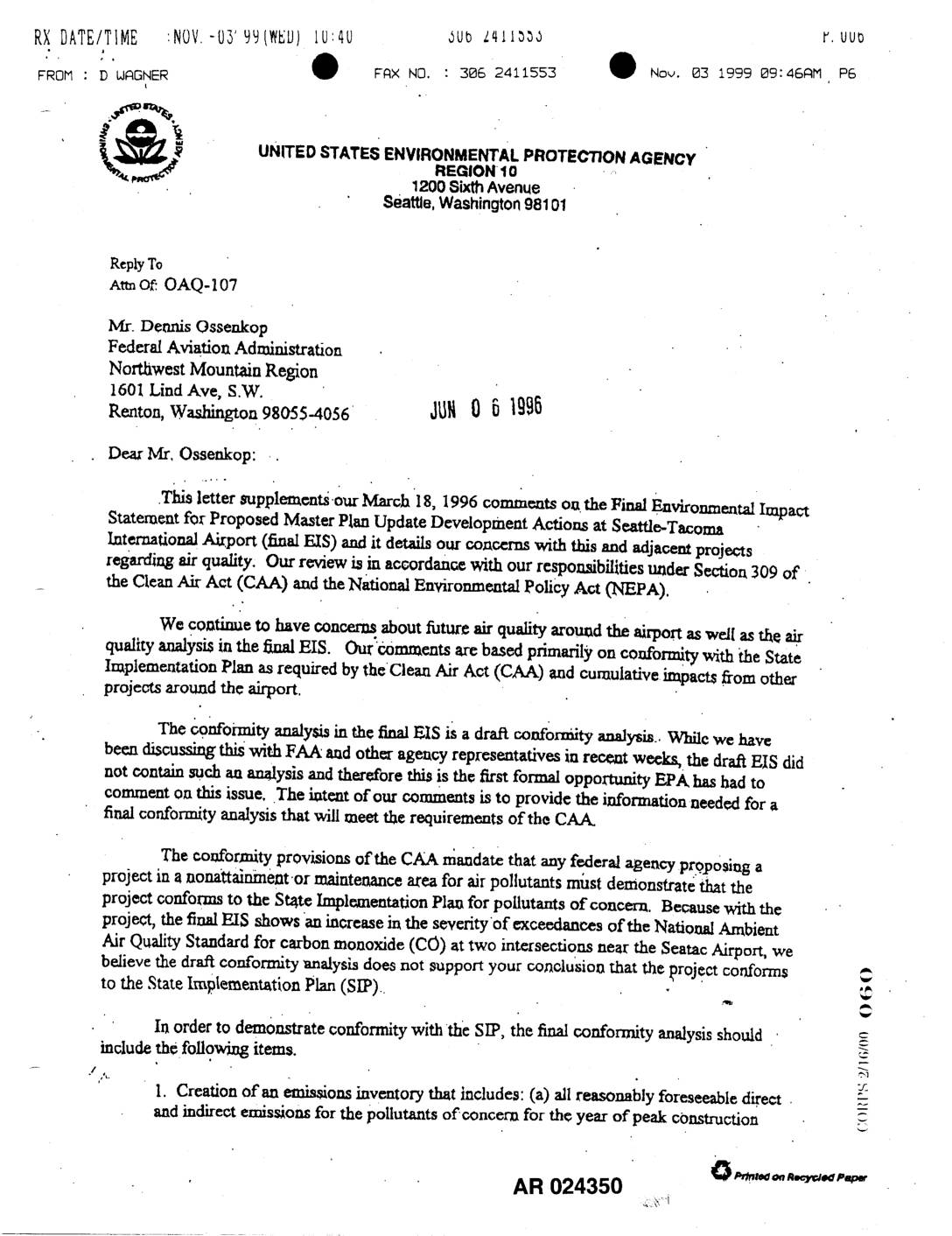
EXH AR024350: EPA Region 10 Letter to FAA Air Quality Conformity Analysis STIA Master Plan Update EIS
In a 1996 letter to the Federal Aviation Administration, the U.S. Environmental Protection Agency (EPA) Region 10 raised concerns about air quality impacts from the proposed Master Plan expansion at Seattle-Tacoma International Airport, noting that the project was projected to worsen carbon monoxide levels at nearby intersections in violation of federal air quality standards. The EPA called for a comprehensive emissions inventory, a comparison of air quality with and without the project, and enforceable mitigation measures, while also highlighting inconsistencies in air quality modeling across multiple related development projects in the airport area. The agency urged the FAA and Port of Seattle to coordinate data sharing with regional authorities and establish a long-term air quality monitoring program to address cumulative impacts from surrounding projects. -
 1996-04-01
EXH AR033734: Soil Screening Guidance: User’s Guide
EPA Superfund publication 9355.4-23 (April 1996), ‘Soil Screening Guidance: User’s Guide,’ issued by the United States Environmental Protection Agency Office of Solid Waste and Emergency Response, Washington DC 20460. Exhibit AR033734. Includes Table C-4 presenting metal Kd values (L/kg) as a function of pH for metals including arsenic (Ag), barium (Ba), beryllium (Be), cadmium (Cd), -
 1995-01-01
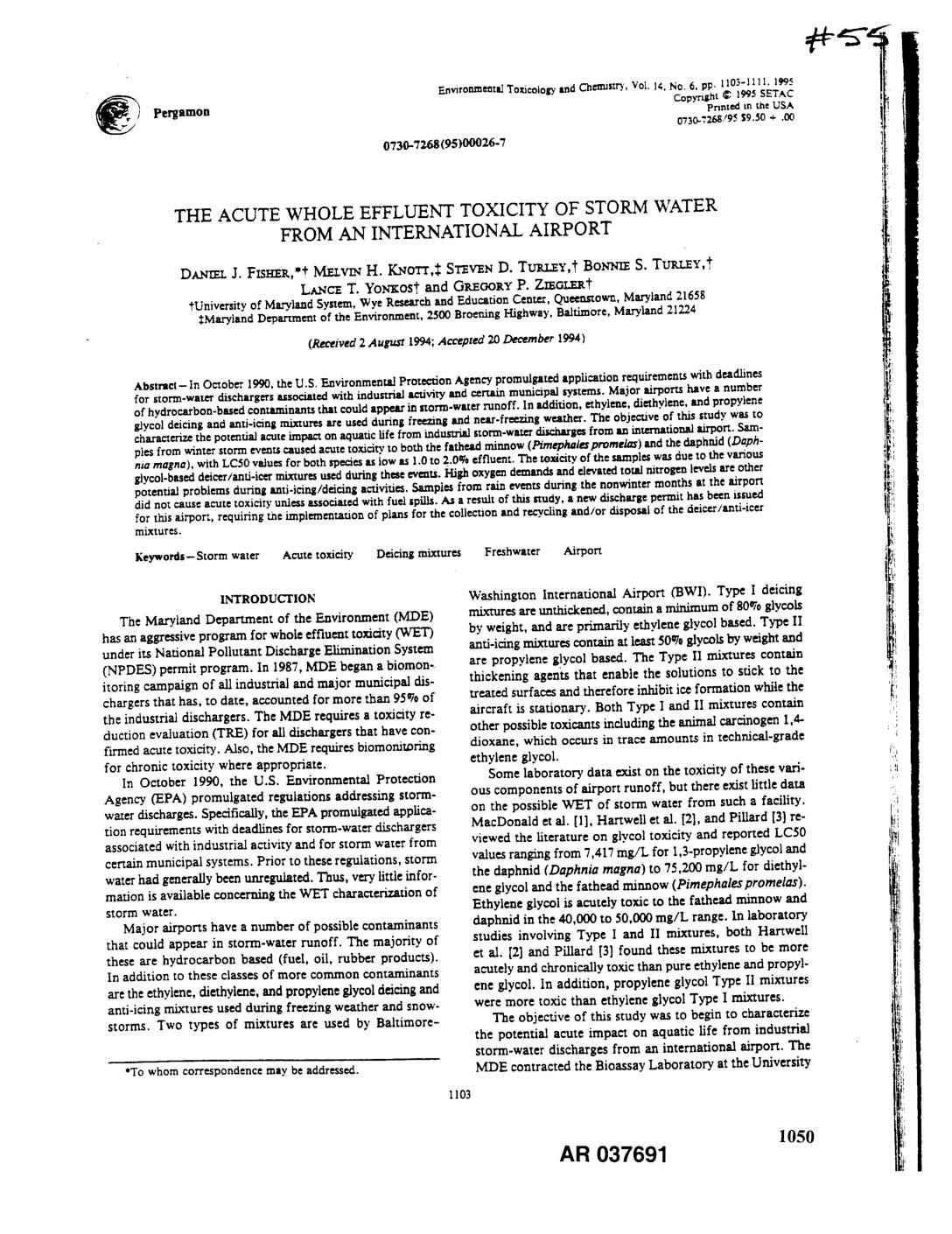
EXH AR037691: The Acute Whole Effluent Toxicity of Storm Water from an International Airport
Academic journal article published in Environmental Toxicology and Chemistry (Vol. 14, No. 6, 1995) by Fisher, Knott, Turley, Turley, Yonkos, and Ziegler from the University of Maryland and Maryland Department of the Environment. Study characterizes acute whole effluent toxicity (WET) of storm water from Baltimore-Washington International Airport (BWI) on fathead minnow (Pimephales promelas) and daphnid -
 1994-08-01
EXH AR037430: EPA Water Quality Standards Handbook: Second Edition — Appendix L, Interim Guidance on Determination and Use of Water-Effect Ratios for Metals
EPA Water Quality Standards Handbook, Second Edition (EPA-823-B-94-005a), August 1994, published by the EPA Office of Water (4305). Includes Appendix L: Interim Guidance on Determination and Use of Water-Effect Ratios for Metals, and a February 22, 1994 memorandum (EPA-823-B-94-001) from Tudor T. Davies, Director, Office of Science and Technology, to Water Management Division Directors Regions -
 1994-03-01
EXH AR028121: Guidelines for Developing Freshwater Wetlands Mitigation Plans and Proposals
Guidelines for developing freshwater wetlands mitigation plans and proposals, published March 1994 as Ecology Publication #94-29. Jointly produced by Washington State Department of Ecology, Washington State Department of Fish and Wildlife, U.S. Army Corps of Engineers, U.S. Environmental Protection Agency, and U.S. Fish and Wildlife Service. Covers restoration, creation, and enhancement of freshwater wetlands as -
 1994-02-11
Executive Order #12898 Federal Actions To Address Environmental Justice in Minority Populations and Low-Income Populations
Executive Order 12898, signed by President Clinton in February 1994, directs all federal agencies to identify and address disproportionately high and adverse environmental and health impacts on minority and low-income populations. It establishes an Interagency Working Group on Environmental Justice, led by the EPA, to coordinate agency strategies, data collection, and research. Each federal agency was required to develop and finalize an environmental justice strategy within 12 months, ensuring that federal programs do not discriminate based on race, color, or national origin.