TagEPA(100)
-
 1994-08-01
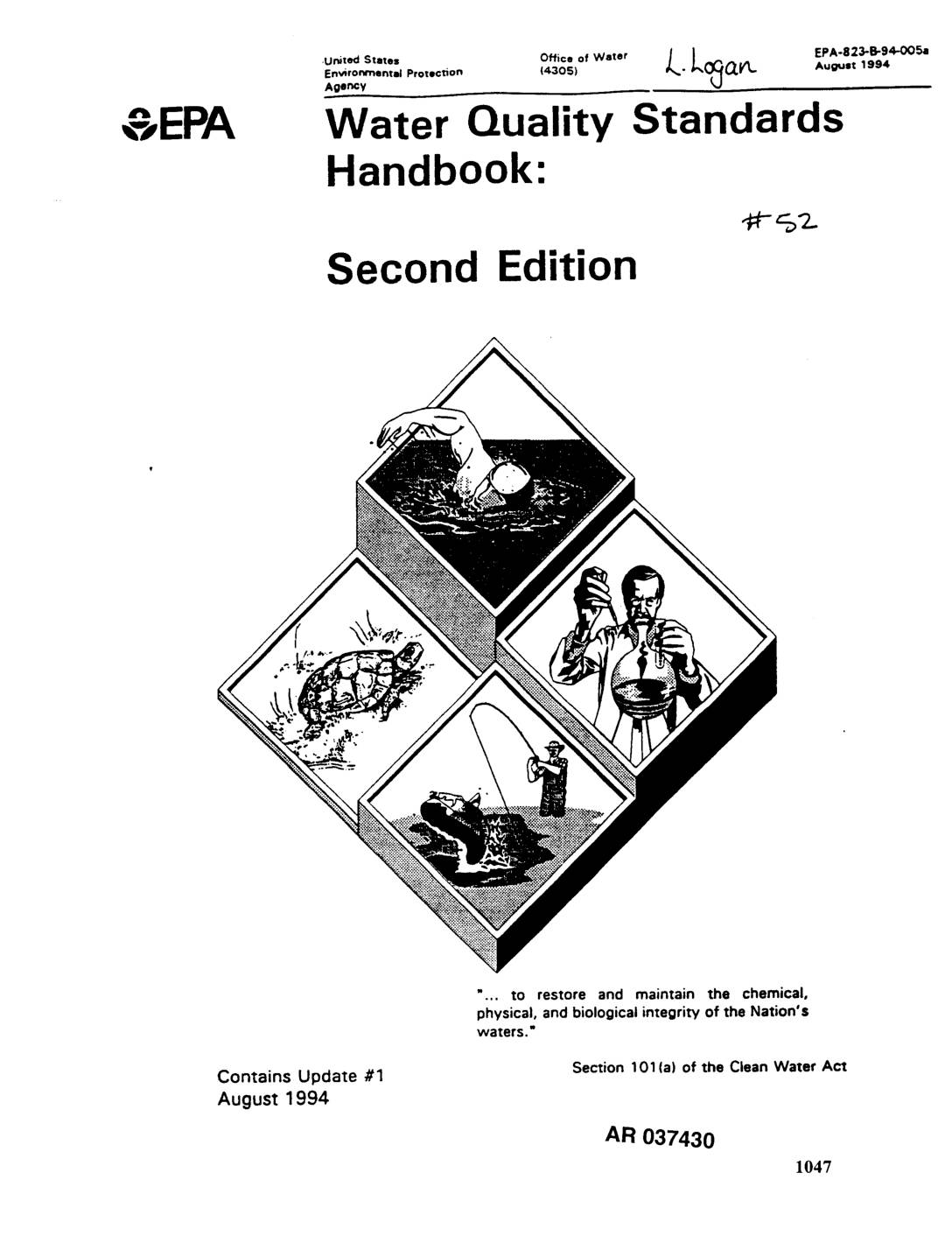
EXH AR037430: EPA Water Quality Standards Handbook: Second Edition — Appendix L, Interim Guidance on Determination and Use of Water-Effect Ratios for Metals
EPA Water Quality Standards Handbook, Second Edition (EPA-823-B-94-005a), August 1994, published by the EPA Office of Water (4305). Includes Appendix L: Interim Guidance on Determination and Use of Water-Effect Ratios for Metals, and a February 22, 1994 memorandum (EPA-823-B-94-001) from Tudor T. Davies, Director, Office of Science and Technology, to Water Management Division Directors Regions -
 1994-03-01
EXH AR028121: Guidelines for Developing Freshwater Wetlands Mitigation Plans and Proposals
Guidelines for developing freshwater wetlands mitigation plans and proposals, published March 1994 as Ecology Publication #94-29. Jointly produced by Washington State Department of Ecology, Washington State Department of Fish and Wildlife, U.S. Army Corps of Engineers, U.S. Environmental Protection Agency, and U.S. Fish and Wildlife Service. Covers restoration, creation, and enhancement of freshwater wetlands as -
 1994-02-11
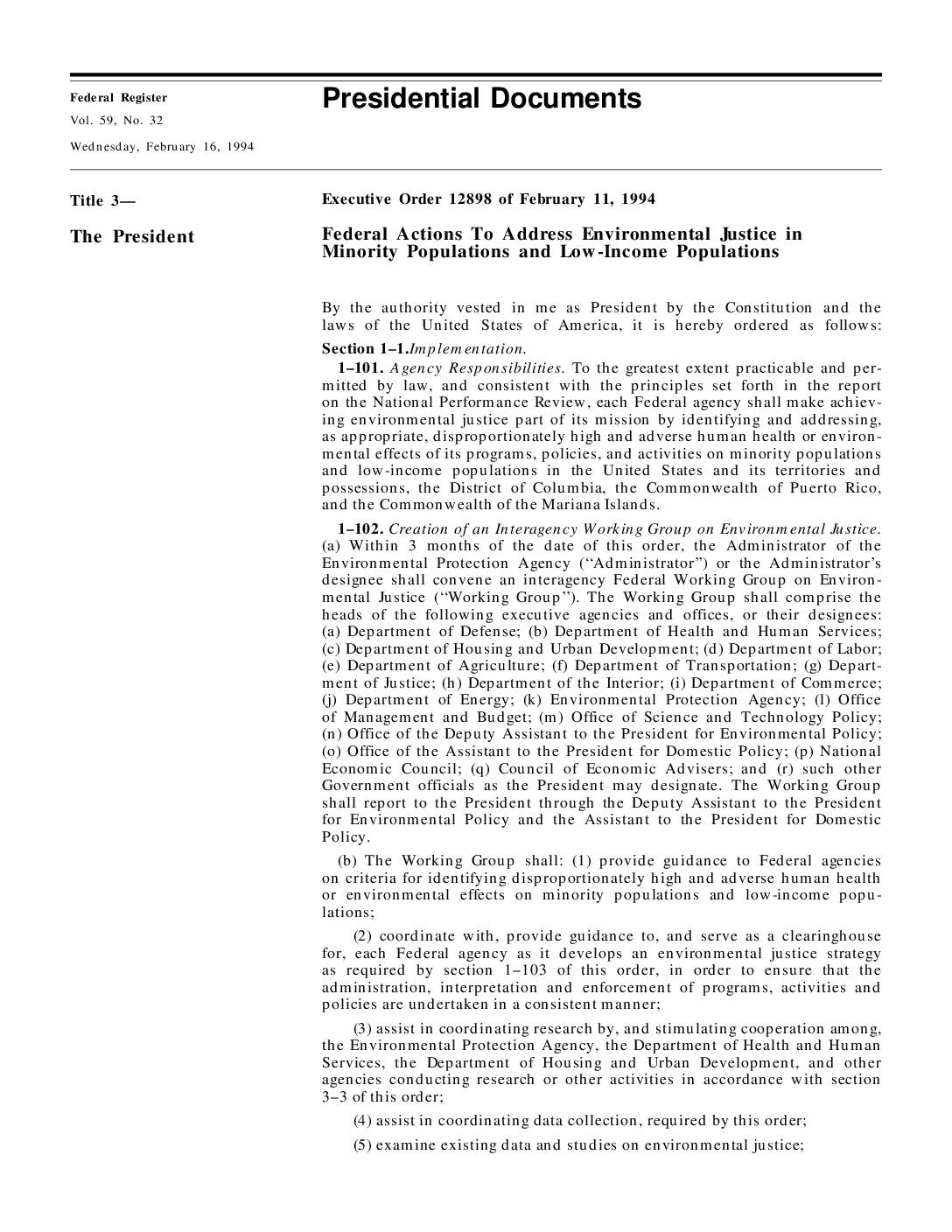
Executive Order #12898 Federal Actions To Address Environmental Justice in Minority Populations and Low-Income Populations
Executive Order 12898, signed by President Clinton in February 1994, directs all federal agencies to identify and address disproportionately high and adverse environmental and health impacts on minority and low-income populations. It establishes an Interagency Working Group on Environmental Justice, led by the EPA, to coordinate agency strategies, data collection, and research. Each federal agency was required to develop and finalize an environmental justice strategy within 12 months, ensuring that federal programs do not discriminate based on race, color, or national origin. -
 1993-04-01
Estimation and Evaluation of Cancer Risks Attributed to Air Pollution in Southwest Chicago: Final Summary Report
Final Summary Report submitted to U.S. EPA Region 5 Air and Radiation Division by ViGYAN Inc., April 1993, estimating and evaluating cancer risks attributed to air pollution in southwest Chicago. The report assesses cancer risk from air pollutants in the southwest Chicago area, prepared under EPA contract for regional air quality and public health assessment. -
 1990-03-16
Day Night Average Sound Level (DNL): The Descriptor of Choice for Airport Noise Assessment
This 1990 FAA document explains why the Day Night Average Sound Level (DNL) was chosen as the standard metric for measuring airport noise. DNL averages noise exposure over a full 24-hour period, applying a penalty for nighttime flights, and has been adopted by multiple federal agencies—including the EPA, DOT, HUD, and DOD—as the most reliable way to assess how aircraft noise affects surrounding communities. The FAA formally incorporated DNL into federal regulation through FAR Part 150, Airport Noise Compatibility Planning, in 1981. -
 1984-10-01
EXH AR037232: Guidelines for Deriving Numerical Aquatic Site-Specific Water Quality Criteria by Modifying National Criteria
EPA-600/3-84-099, published October 1984 by the U.S. EPA Environmental Research Laboratory, Duluth, Minnesota. Authored by Anthony R. Carlson, William A. Brungs, Gary A. Chapman, and David J. Hansen from EPA Environmental Research Laboratories in Duluth MN, Narragansett RI, Corvallis OR, and Gulf Breeze FL. Provides protocols for deriving numerical aquatic site-specific water quality criteria by -
 1984-01-01
EXH AR037276: Ambient Water Quality Criteria for Copper – 1984
EPA document EPA 440/5-84-031 establishing ambient water quality criteria for copper, published by the U.S. Environmental Protection Agency Office of Water Regulations and Standards, Washington D.C., pursuant to Section 304(a)(1) of the Clean Water Act of 1977 (P.L. 95-217). Authored by Robert W. Andrew (freshwater) and John H. Gentile (saltwater) at Environmental Research Laboratories in -
 1973-07-27
Public health and welfare criteria for noise
This 1973 U.S. Environmental Protection Agency document establishes scientific criteria for understanding how noise affects public health and welfare, including hearing damage, annoyance, communication interference, and property value loss. Prepared by EPA's Office of Noise Abatement and Control under the Noise Control Act of 1972, it describes cause-and-effect relationships between noise exposure and human health impacts. The criteria laid out in this document were intended to serve as a foundation for developing future noise standards and regulations, though the document itself does not constitute a standard or regulation. -
U.S. Maps Airport‐Noise Curb; Pilots and Industry Assail Plan
WASHINGTON, June 21 —Sweeping recommendations designed to quiet the din of jet aircraft at airports around the country were made public to day by an Environmental Protection Agency study group. The proposals were quickly as sailed in statements by pilots and airport and airline executives as potentially unworkable and, in some cases, unsafe. The recommendations -
1970-12-31
42 USC Chapter 85, Subchapter II, Part B: Aircraft Emission Standards
★42 USC CHAPTER 85, SUBCHAPTER II, Part B: Aircraft Emission Standards Current 2024 Main Ed. (1/6/2025) [Titles 1 through 41] 2018 Ed. and Supplement V (1/3/2024) 2018 Ed. and Supplement IV (1/5/2023) 2018 Ed. and Supplement III (1/3/2022) 2018 Ed. and Supplement II (1/13/2021) 2018 Ed. and Supplement I (1/24/2020) 2018 Main Ed. (1/14/2019) 2012