TagSea-Tac Airport(1855)
-
 2023-06-07
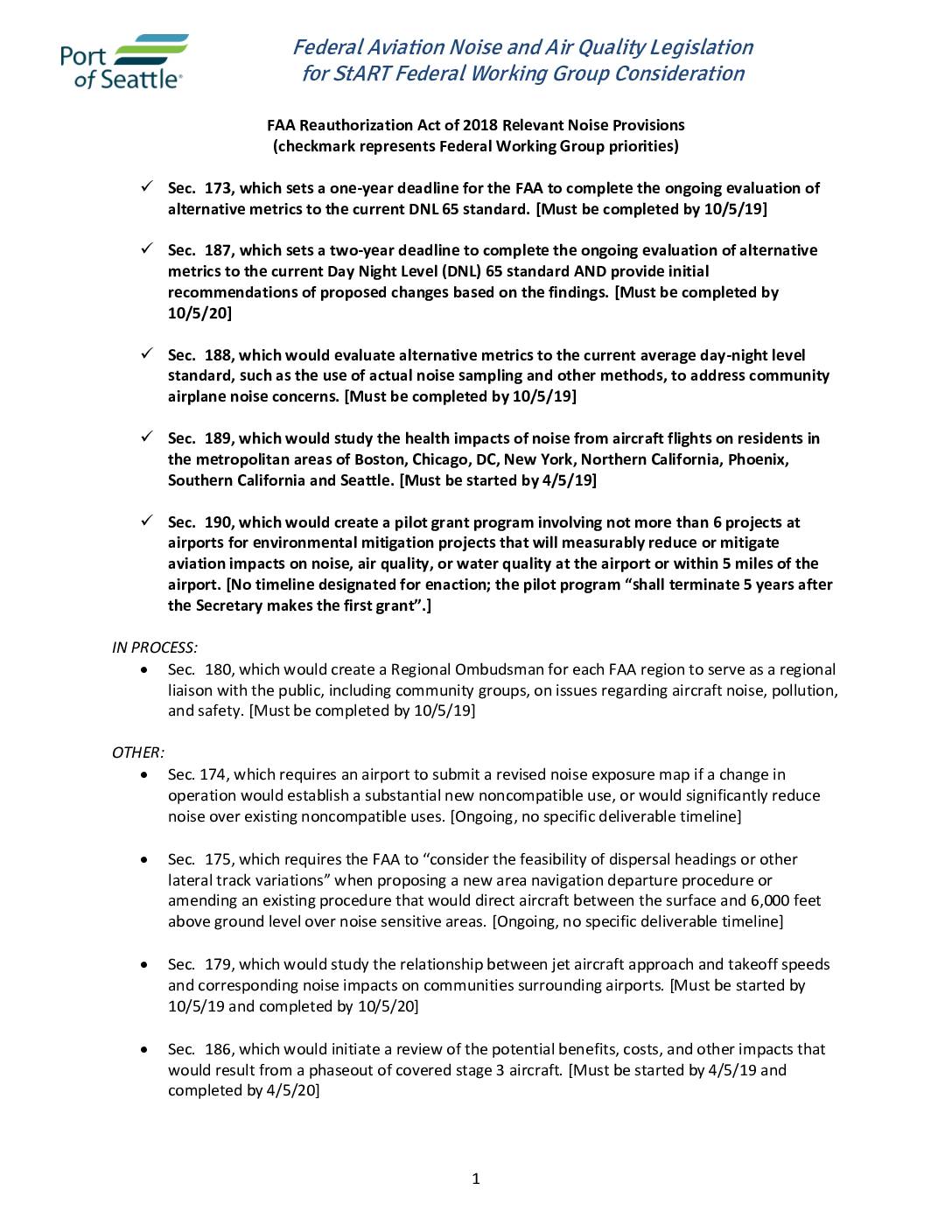
Federal aviation noise and air quality legislation for StART Federal Working Group consideration
This Port of Seattle document outlines key federal aviation noise and air quality legislation relevant to the StART (Sea-Tac Airport Roundtable) Federal Working Group, including provisions from the FAA Reauthorization Act of 2018 and proposed 2019 legislation. It highlights priority items such as evaluating alternatives to the DNL 65 noise standard, studying health impacts of aircraft noise in major metro areas including Seattle, and creating environmental mitigation grant programs for airports. Additional considerations include secondary noise insulation, increased funding for federal noise programs, and greater flexibility for local communities to address aviation impacts. -
 2023-06-07
Sea-Tac Stakeholder Advisory Round Table annual report
The Sea-Tac Stakeholder Advisory Round Table (StART) is a forum created by the Port of Seattle to strengthen relationships between Sea-Tac Airport and six neighboring communities, working cooperatively to identify issues and possible solutions. Development of StART began in mid-2017, with each city appointing two community members and one city employee to participate, alongside the Airport's Managing Director as chair. Airlines Alaska and Delta, as well as Lynden, also serve as members of the round table. -
 2023-06-07
Final Engineering Report: SEA IWTP Expansion
This final engineering report, prepared by Gresham Smith for the Port of Seattle, details the planned expansion of the Industrial Wastewater Treatment Plant (IWTP) at Seattle-Tacoma International Airport. Dated June 7, 2023, the report was developed in compliance with Washington Administrative Code 173-240-130 to satisfy permit requirements under Waste Discharge Permit #7810-05. It outlines technical plans for upgrading the airport's wastewater treatment infrastructure to meet current regulatory standards. -
2023-06-07
Final Engineering Report: SEA IWTP Expansion
This final engineering report, prepared by Gresham Smith for the Port of Seattle, details the planned expansion of the Industrial Wastewater Treatment Plant (IWTP) at Seattle-Tacoma International Airport. Dated June 7, 2023, the report was developed in compliance with Washington Administrative Code 173-240-130 to satisfy permit requirements under Waste Discharge Permit #7810-05. It outlines technical plans for upgrading the airport's wastewater treatment infrastructure to meet current regulatory standards. -
 2023-05-26
When Sea-Tac Airport disappeared for six months
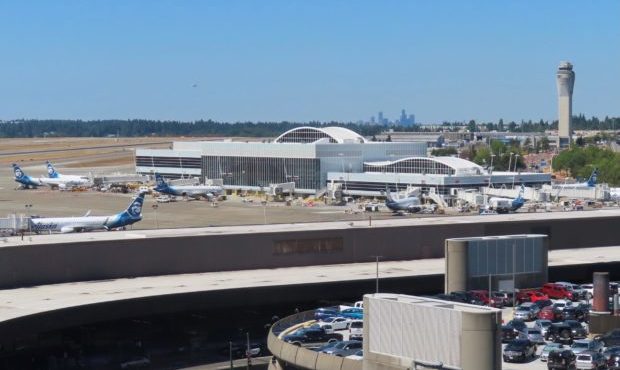
Seattle-Tacoma International Airport was renamed Henry M. Jackson International Airport in tribute to the late senator for six months in the early 1980s. (Feliks Banel/KIRO Radio) BY FELIKS BANEL Local historian The history of the word “Sea-Tac” (or “Seatac,” or “SeaTac”) as an abbreviation for “Seattle-Tacoma” can feel a little murky sometimes. As far as anybody -
 2023-05-24
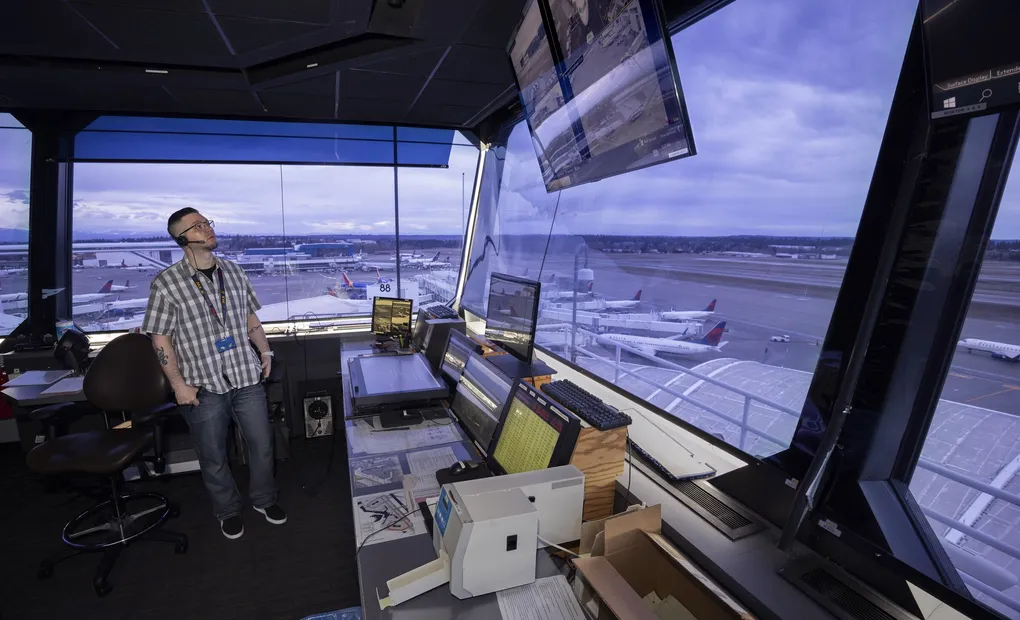
Airport Control Tower Interior
A person wearing a badge/lanyard stands in an airport control tower cab surrounded by multiple monitors and radar displays. Delta Air Lines aircraft are visible at gates on the ramp below, consistent with Sea-Tac Airport's terminal configuration. -
 2023-05-20
Free Shuttle Bus Service at Airport
A large 'Free Shuttle Bus / Passenger Load Unload Only / Shuttle' sign stands at what appears to be Sea-Tac Airport, with a Pan American World Airways terminal building visible in the background. A van marked 'Free Parking Lot Shuttle / Lot Shuttle' is parked beneath the sign, with airport personnel and vintage automobiles visible in the scene. -
Meet a few of the 23,329 people who keep Sea-Tac Airport humming 24/7
By Erik Lacitis Seattle Times staff reporter IF YOU’RE AN ADULT in Western Washington, there’s a 50/50 chance that you flew out of Seattle-Tacoma International Airport in 2022. The specific statistic for this region is 2.4 million adults, or 54%, according to the market research firm Nielsen Scarborough. So, yes: Sea-Tac is a very familiar -
Sea-Tac’s parking garage is huge, pricey and almost always mostly full
1 of 2 | The Sea-Tac parking garage, with 13,000 spaces, is the world’s second-largest parking lot, according to the online geography site WorldAtlas.com. Number 1 honors go to the West Edmonton Mall in Alberta, Canada, with 20,000 spaces…. (Port of Seattle, 1968) By Erik Lacitis Seattle Times staff reporter Editor’s note: Pacific NW magazine’s -
 2023-05-07
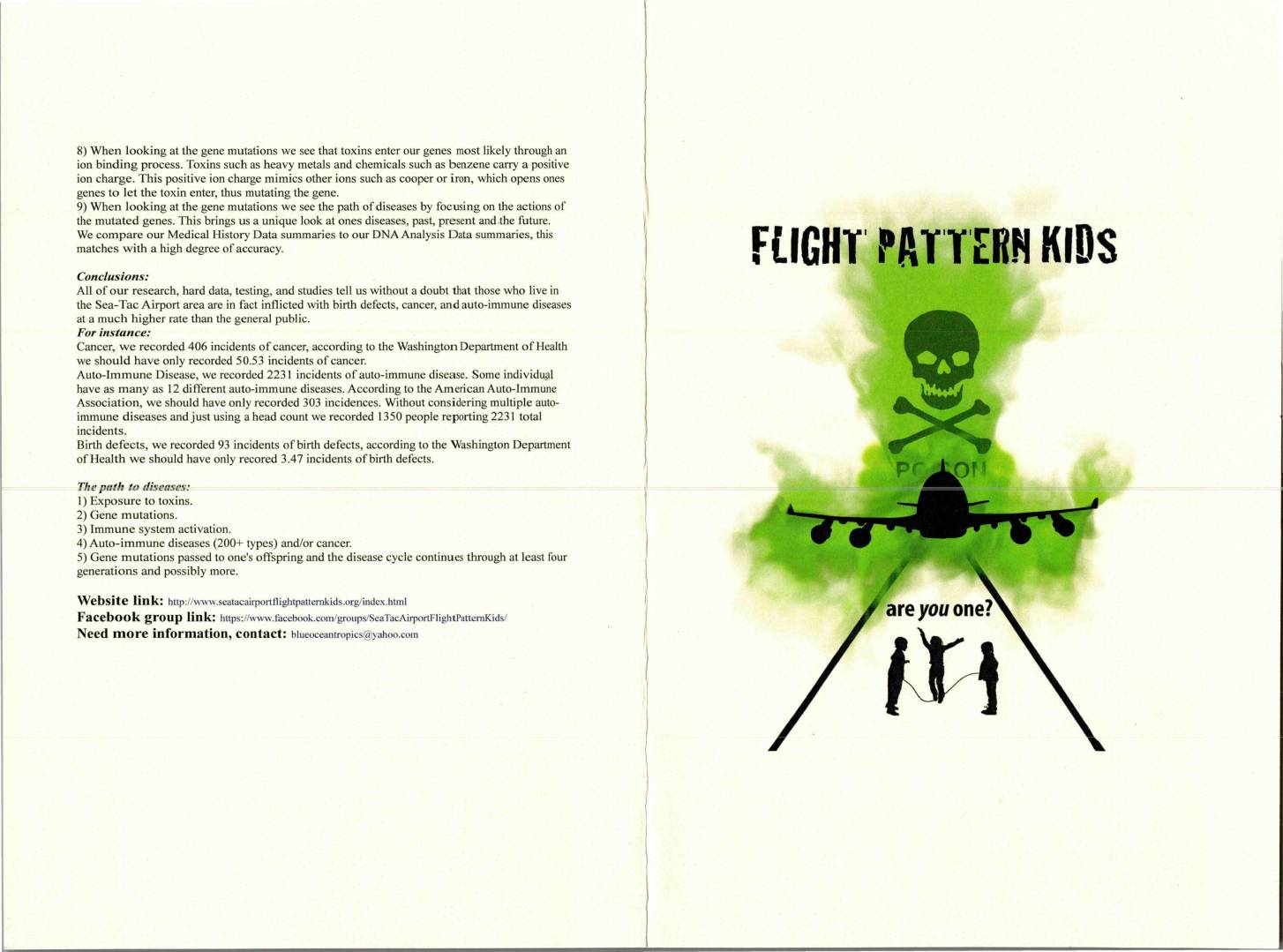
Flight Pattern Kids: Sea-Tac Airport Environmental Health Research Flyer
The 'Flight Pattern Kids' group, a non-profit based near Seattle-Tacoma International Airport, claims that residents living within a 3-mile radius of the airport experience significantly elevated rates of cancer, birth defects, and auto-immune diseases compared to the general population. Their self-reported study of 330+ families suggests these health issues stem from toxic environmental exposure linked to airport operations, which they argue causes gene mutations passed across generations. The group is calling for further environmental testing of air, water, and soil in the surrounding area.