TagPort Of Seattle(2400)
-
 1978-06-21
Project Manual 4A: Noise Monitoring System, Port Of Seattle at Sea-Tac International Airport, 1978
This 1978 Project Manual outlines the specifications for a Noise Monitoring System at Seattle-Tacoma International Airport, issued by the Port of Seattle Commission. The document covers bidding requirements, contract conditions, and detailed technical specifications for installing remote monitoring stations, communications channels, and a central processing system to track aircraft noise levels around the airport. It was prepared under the direction of Chief Engineer Vernon L. Ljungren and includes provisions for system warranty and ongoing maintenance services. -
 1978-03-23
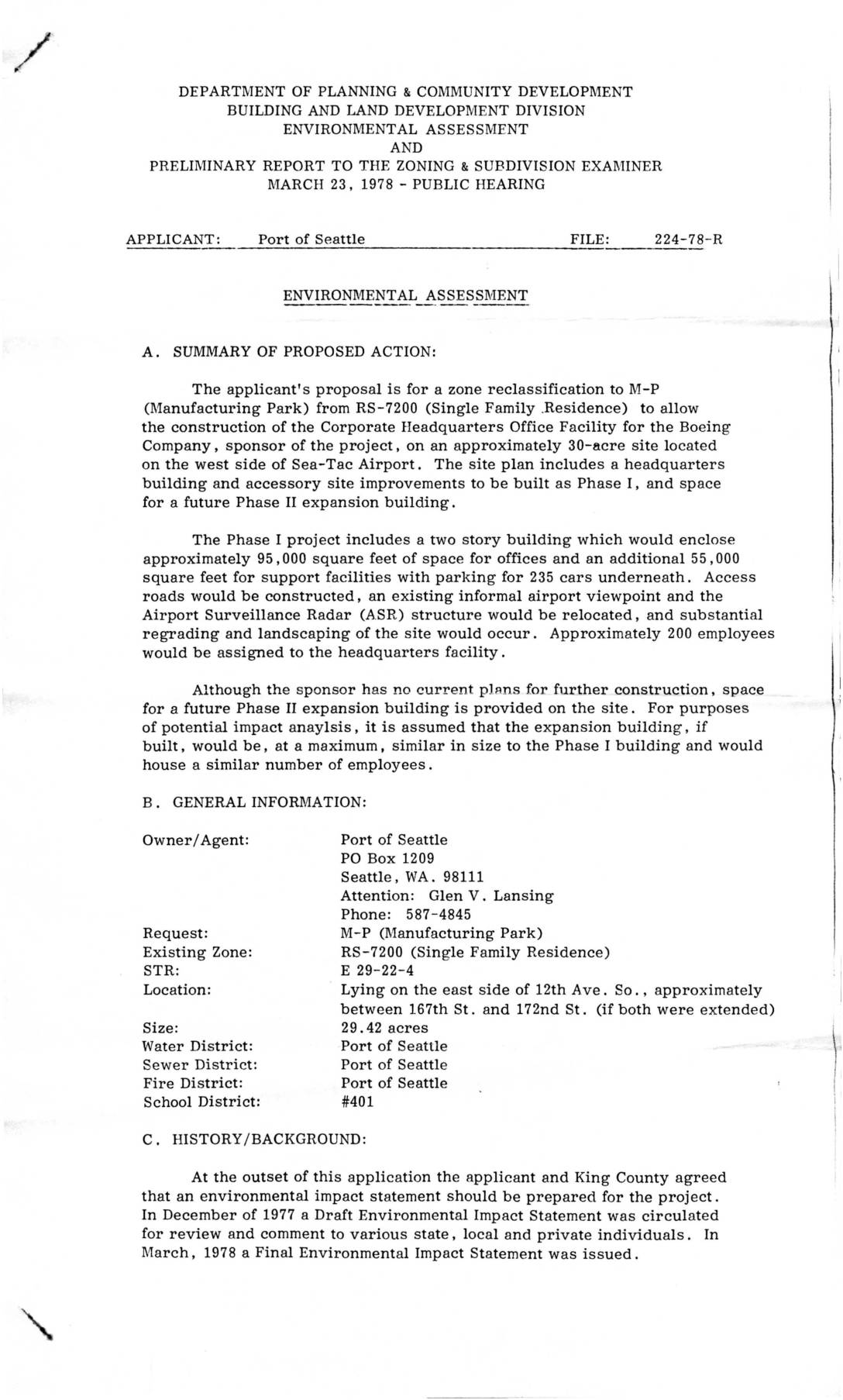
File 224-78-R: Environmental Assessment and Preliminary Report to the Zoning & Subdivision Examiner — Boeing Corporate Headquarters, Sea-Tac Airport West Side
In 1978, the Port of Seattle applied to rezone a 29-acre parcel on the west side of Seattle-Tacoma International Airport from single-family residential to Manufacturing Park (M-P) to allow Boeing to build its Corporate Headquarters Office Facility. The proposed Phase I development included a two-story, 150,000-square-foot building with underground parking for 235 cars and roughly 200 employees, along with road construction, radar relocation, and site landscaping. The application required an Environmental Impact Statement and raised land-use compatibility questions given that surrounding community plans had designated much of the site as open space or parkland. -
 1978-03-15
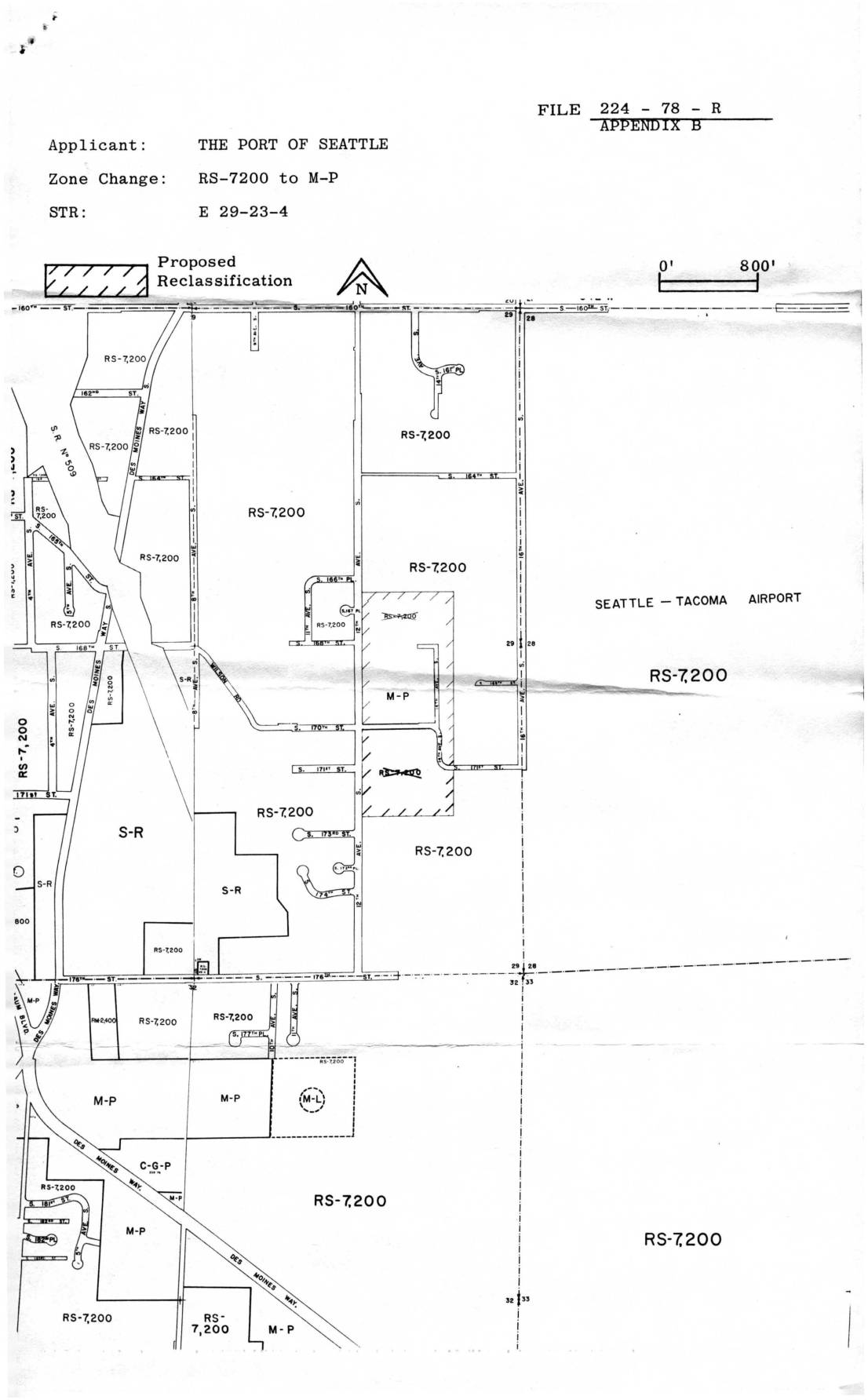
File 224-78-R Appendix B: Port Of Seattle Zone Change Map, RS-7200 to M-P, STR E 29-23-4
This 1978 King County Building & Land Development document relates to a zoning reclassification application (File 224-78-R) filed by the Port of Seattle, proposing to change land near Seattle-Tacoma Airport from residential (RS-7,200) to manufacturing-park (M-P) zoning. The accompanying map shows the affected parcels in section E 29-23-4, located adjacent to Sea-Tac Airport, where multiple residential zones were targeted for conversion. A notice was mailed to area resident Virginia Dana at 2648 South 142nd Street, Seattle, in March 1978. -
 1978-03-09
Final Environmental Impact Statement for the Proposed Boeing Company Corporate Headquarters Facility
This March 1978 Final Environmental Impact Statement, prepared jointly by King County and the Port of Seattle, evaluates the proposed construction of a Boeing Company Corporate Headquarters Facility on the western boundary of Sea-Tac International Airport. The project required zoning reclassification, community plan amendments, and various permits for a site located east of 12th Avenue South between South 166th Place and South 173rd Street. The document was prepared under the Washington State Environmental Policy Act (SEPA) and related county regulations. -
 1978-01-01
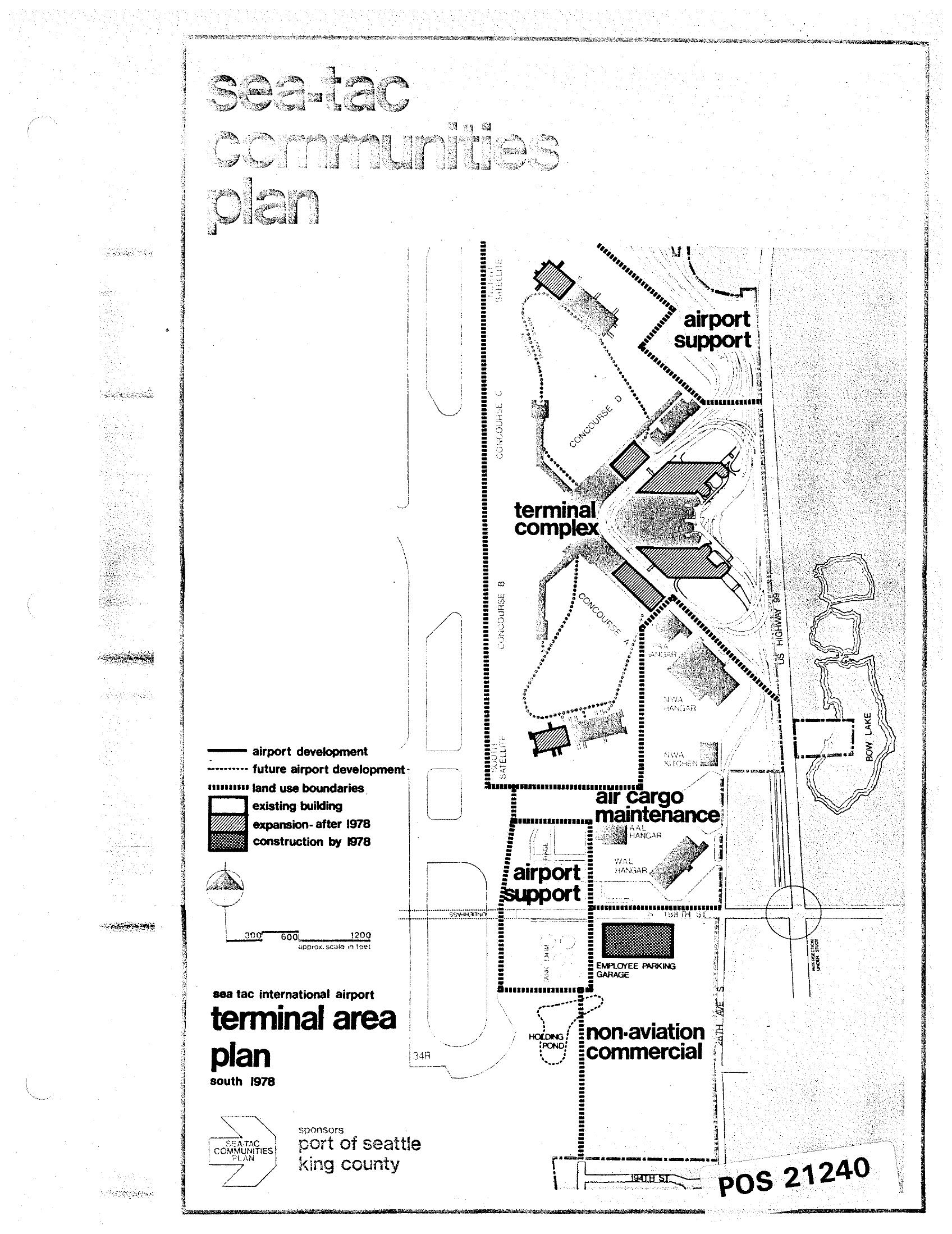
Sea-Tac International Airport Terminal Area Plan — Land-Use Map from the Sea-Tac Communities Plan (1978)
A land-use map from the Sea-Tac Communities Plan showing the Sea-Tac International Airport terminal area as of south 1978, sponsored by the Port of Seattle and King County. The map identifies zones including the terminal complex, airport support, air cargo maintenance, and non-aviation commercial areas, with a legend distinguishing existing buildings, expansions after 1978, and construction by 1978. Document reference number POS 21240. -
 1977-09-27
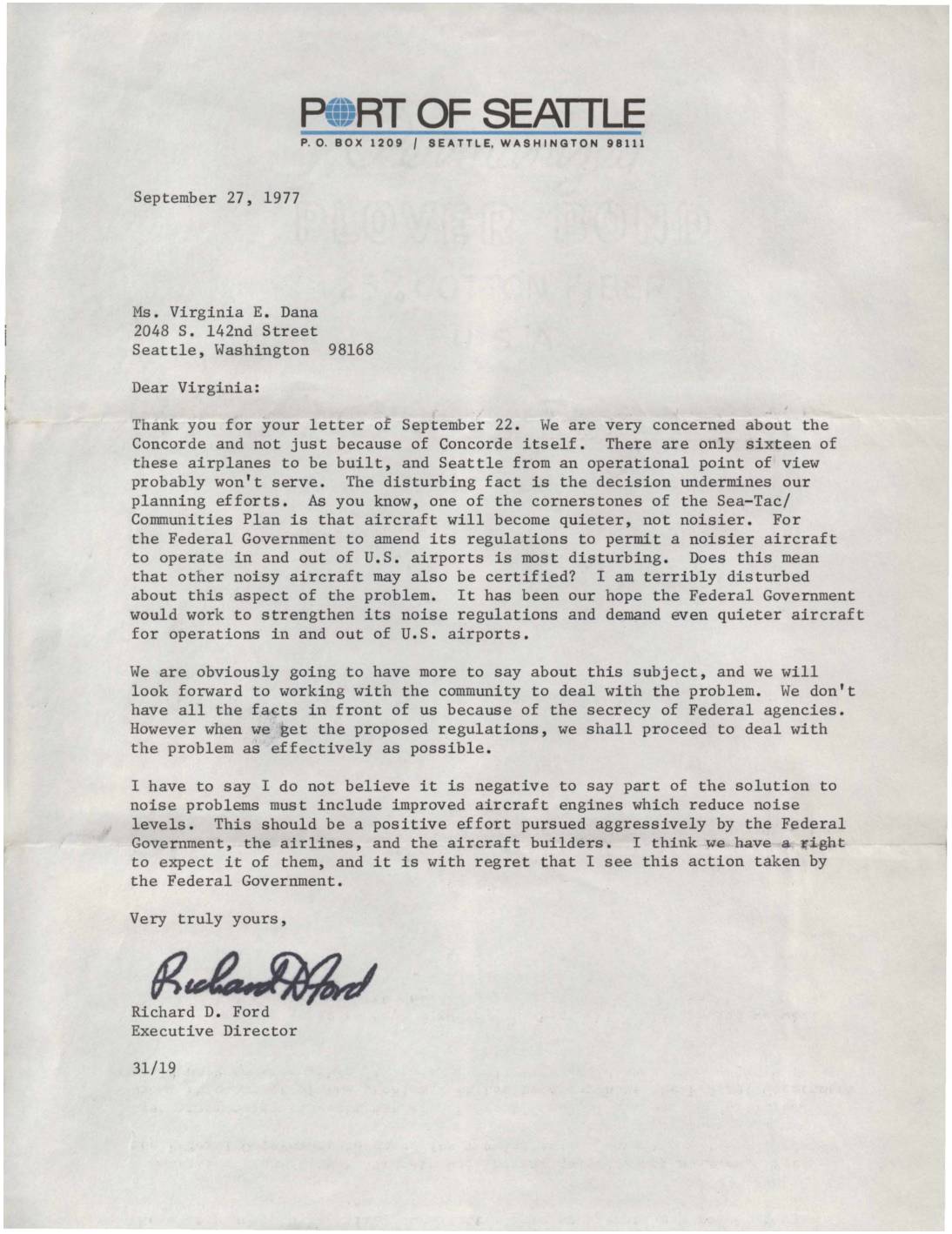
Letter from Port of Seattle Executive Director Richard D. Ford regarding Concorde aircraft noise concerns
In this September 1977 letter, Port of Seattle Executive Director Richard D. Ford responds to a community member's concerns about the Concorde supersonic jet, expressing alarm that the Federal Government amended its noise regulations to allow a noisier aircraft to operate at U.S. airports. Ford warns this decision undermines the Sea-Tac/Communities Plan, which was built on the expectation that aircraft would become progressively quieter over time. He calls on the federal government, airlines, and aircraft manufacturers to aggressively pursue quieter engine technology as a necessary solution to airport noise problems. -
 1977-08-11
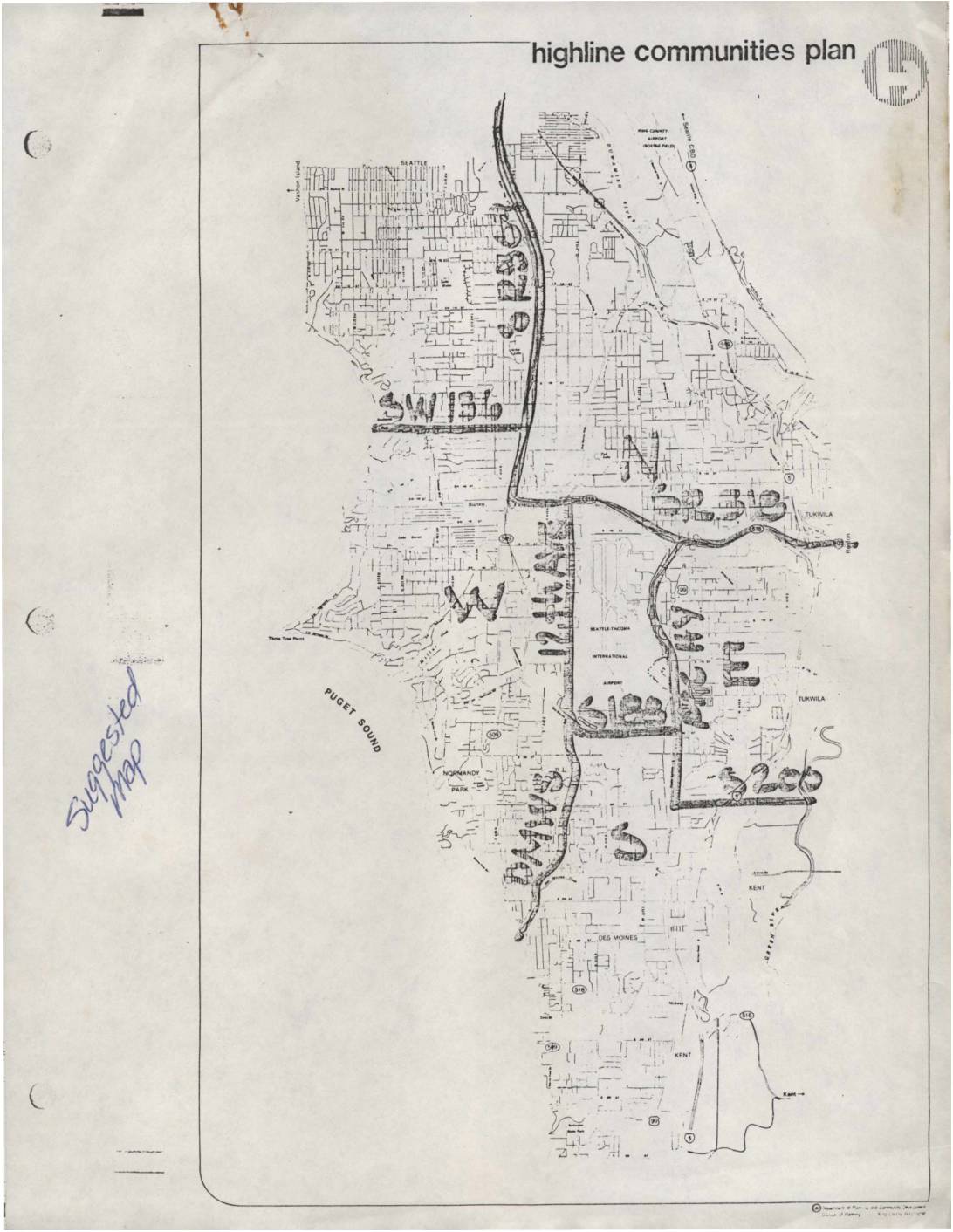
Highline Communities Plan: Policy Advisory Committee Meeting Minutes, August 11, 1977
These documents are from the Highline Communities Plan, a King County planning effort covering neighborhoods surrounding Seattle-Tacoma International Airport. The materials include community boundary maps dividing the Highline area into North, West, East, and South zones with approximate 1980 population figures, and minutes from a Policy Advisory Committee meeting held August 11, 1977. The meeting, attended by representatives from the Port of Seattle, FAA, Boeing, King County, and community groups, addressed Boeing's proposed office facility on the west side of Sea-Tac Airport, including discussions on site design, landscaping, parking, and a public viewpoint park. -
 1977-05-26
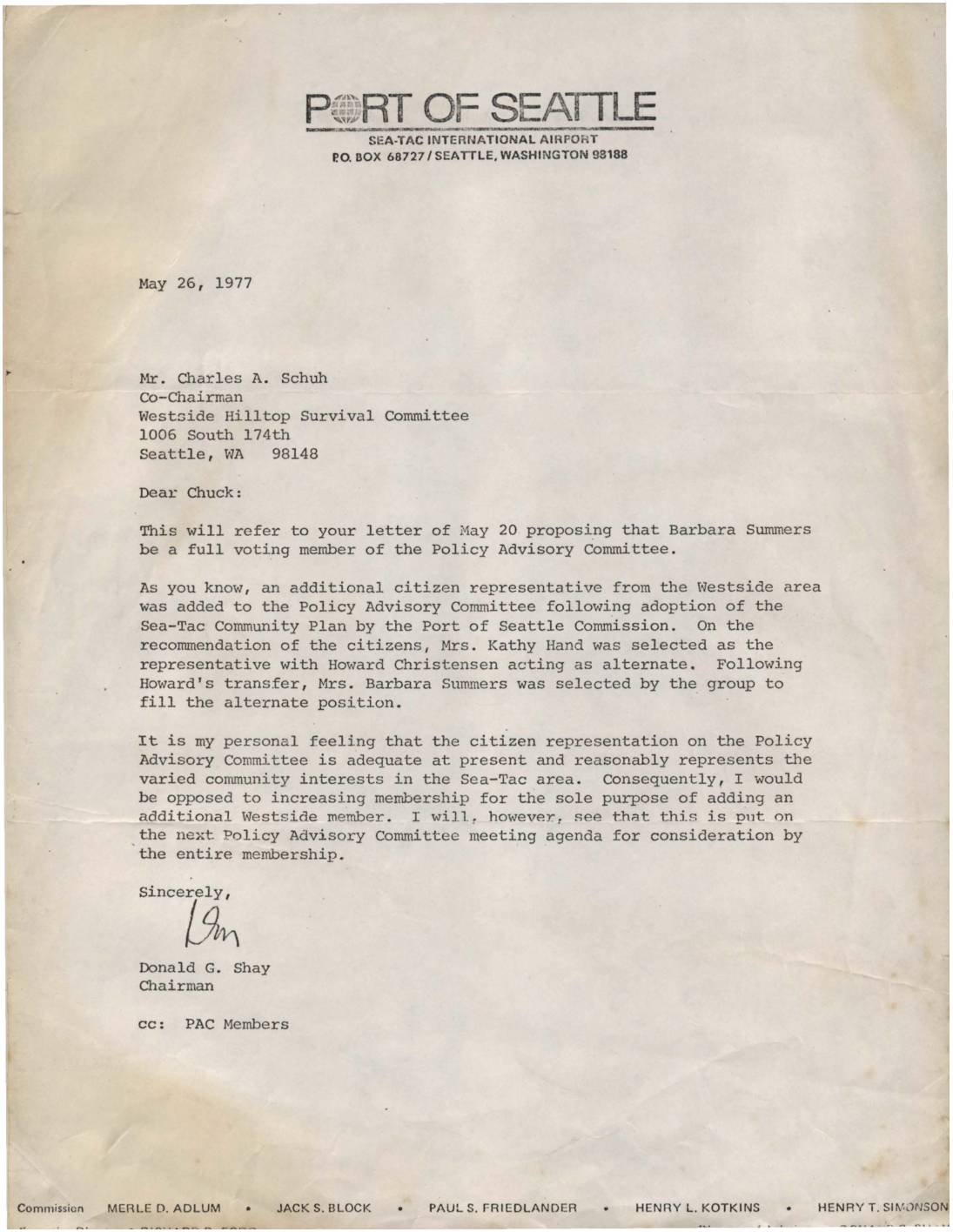
Letter to Charles Schuh regarding Barbara Summers and Policy Advisory Committee membership
In this May 26, 1977 letter, Port of Seattle Chairman Donald G. Shay responds to a request from the Westside Hilltop Survival Committee to make Barbara Summers a full voting member of the Policy Advisory Committee (PAC). Shay explains that Summers currently serves as an alternate representative for the Westside area and expresses his personal opposition to expanding PAC membership solely to add another Westside representative. He agrees, however, to place the matter on the next PAC meeting agenda for consideration by the full membership. -
 1977-05-12
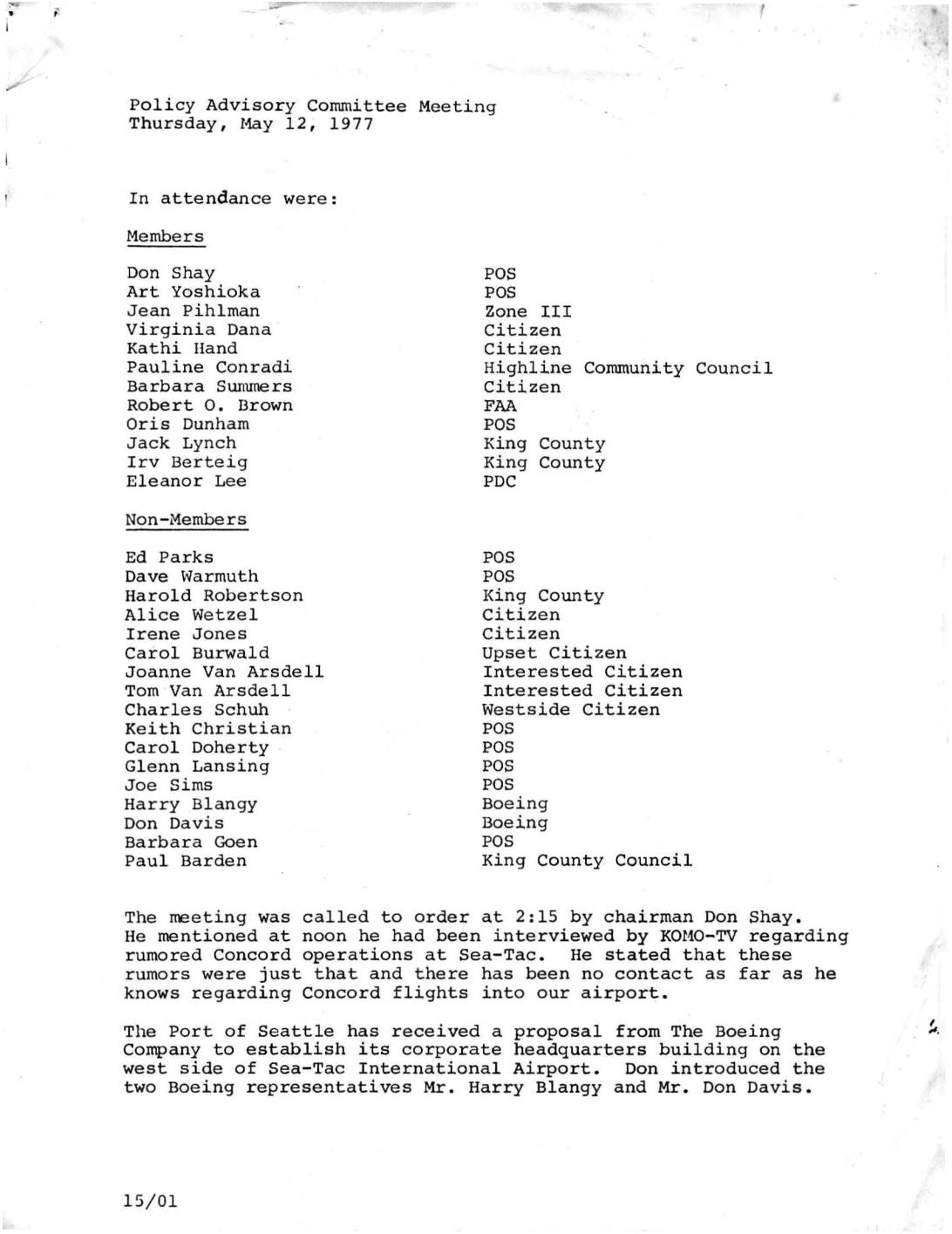
Policy Advisory Committee Meeting Minutes: Boeing Corporate Headquarters Proposal at Sea-Tac Airport
Minutes from a May 12, 1977 Policy Advisory Committee meeting at Sea-Tac International Airport, covering Boeing's preliminary proposal to build its corporate headquarters on approximately 12 acres on the airport's west side. The proposal required an amendment to the Sea-Tac/Communities Plan and raised community concerns about traffic, parking, landscaping, and the potential relocation of a planned viewpoint park. Port of Seattle officials emphasized that any development would need extensive buffering, no westerly road access, and maximum community participation in the decision-making process. -
 1977-03-31
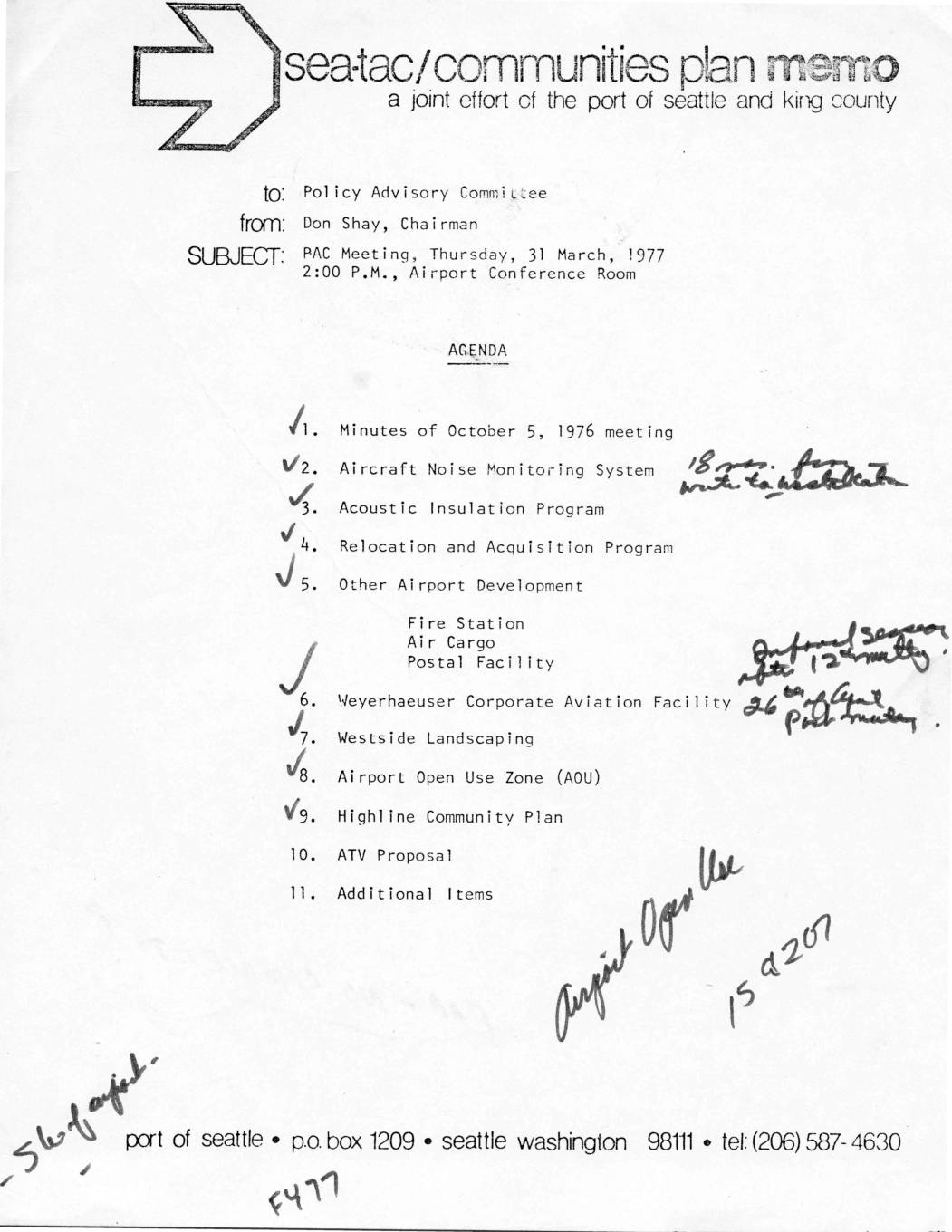
PAC meeting agenda, 31 March 1977
This is a 1977 agenda memo from Don Shay, Chairman, calling a Policy Advisory Committee (PAC) meeting at Sea-Tac Airport on March 31, 1977. The meeting covered key airport development and community impact topics, including an Aircraft Noise Monitoring System, Acoustic Insulation Program, Relocation and Acquisition Program, and various facility developments such as a Fire Station, Air Cargo, and Postal Facility. Additional agenda items included the Weyerhaeuser Corporate Aviation Facility, Westside Landscaping, the Airport Open Use Zone, the Highline Community Plan, and an ATV Proposal, reflecting the joint planning efforts of the Port of Seattle and King County.